Social media is free…but I’m not

free

It’s been one of those days… so I’m going to allow myself just a wee bit of time before I snap out of it.  I’m going to vent. It started this morning when I heard back from a prospective client who liked the 5 page social media strategy overview document but…

The “but” was they wanted more specific details on what I was going to do. I told them that I would give them the specifics in time. but that I thought that it was important that they understand the how and the why before we got into the how to and the what for. I did this because we’re talking about a client that knows virtually nothing about social media.

If I would have given them the latter, 2 things would have happened. 1)  It would have been so over their head that they would have not understood and probably bailed and or 2) Believe it or not, they could take the document and either try and implement it themselves, or use it as a blueprint with another company and leverage their new found knowledge. You might not think that happens, but it does, as well as some other things  Why?

The ease of entry into social media is less than zero. I can sign up for a majority of social networks in less than a minute. I can create social profiles in less time. So the assumption with a lot of companies and people is, “What is so hard about being social”? or creating a Facebook page, or a Twitter profile?and you know what? They are right. It’s easy.

Boom.

The thinking is really as simple as the majority of social interfaces that you see. Just create a profile and now you’re part of the social media revolution. You don’t need a consultant or a company to tell you how to do this. It’s easy. Plus there’s all of these killer blogs and sites with free information on social media, all these free tools, you can just figure all of it out on your own.

Sure. You can figure it out until it falls flat and you have one comment on your blog post. You have 19 registered members in your community, or you have 5,000 followers and you’re  following 5,000 but you have 111 tweets and zero conversations. Or maybe that Facebook page of yours has 56 fans but is doing nothing else. Or the YouTube video you made, has driven approximately 24 views.  When stuff is free, you get what you paid for.

There are some seriously smart people in this space. I value what they do and say and we value what we do and say, and we value what we create. But we also are working for a living. As much as we would like to give it away, we can’t. As it stands, the majority of people in this space, give away a lot. In fact, the amount of time that a lot of the social media marketing people that I know, give away, is extreme.  In terms of amounts of their time and resources-there is not a more giving  bunch. That’s the essence of social media.

But… at the end of the day, bills have to be paid and you’re going to have to take that leap of faith.

I’m done venting.

Share this Post

How are you driving people to your social media presence?

cattle

What are you planning to do to drive people to your social media presence? And do you have the money to do it? I read this question this morning and thought, boom, dude you nailed it. It was a post in Clickz by Sean Carton. Though he didn’t really answer it.

So lets talk about that. What are your plans? You have gotten the gig, but now you are tasked with driving traffic to all of the social media properties that you have set up for the client.

Quick question though. Is that really a function of social media managers? To drive traffic? Or is that a pure marketing function? A search function? Something you pay for? Something you outsource?

I digress. So what are you going to do get these communities/social media personas jammin?

I think first and foremost, as Jason Falls has so aptly put it,

To be effective in social media, whether as a marketer or just an ordinary participant, you must, first and foremost, communicate well.

Ok so you have that down, you can communicate with the best of them, now what?

Well if we’re to look at social media as a messaging and communications type of activity, wouldn’t that responsibility ultimately sit on the shoulders of PR? Should PR pros be responsible for driving traffic to social media networks?

Or is it something a marketing department should do? Does a community manager do that?

Wait, I’m blurring the message here. Let’s go back.

What are you going to do to drive traffic? I don’t care if you’re in marketing, PR, or IT, you have been tasked with making this social media thing work, so wutcha got? And don’t go telling me we need to define our objectives and align them with our strategies. We get that. Yea I know numbers don’t truly define success but they certainly are going to determine a lot of things going forward. So pick your poison.

  • We have blogs-what’s your plan to drive readers?
  • You’ve created a Facebook fan page or group page, how many friends are you going to get and then what will you do with them?
  • You’ve create a social network on Ning now what?
  • What is your plan to grow your Ning group or your community?
  • You’ve got that Twitter profile rolling, what’s your goal? Do numbers even mean anything anymore? How many conversations are you looking for?
  • Now that you have that podcast where are you going to find that audience? What is going to compel them to tune in every week?
  • Wikis are a cool collaborative tool if people know about them and feel compelled to contribute. So why should they do anything with yours? Out of some benevolent stroke of contributing for contribution’s sake?
  • Is a big budget going to make it easier for you to create these communities? You know once your PPC campaign ends, your traffic might leave to..
  • What if you do suck at communicating? Then what?
  • Who should be responsible for the success or failure?

What I keep coming back to, is that with each bullet point, it still helps to define the purpose of why you are doing it in the first place. Here’s the problem though. There are a lot of hours involved in any of these activities, and if any company or person is going to work on these, then we or you need to see something on the back end that is justifiable. Is that ROI? Could be. Is it return on engagement? Well…

Try selling the story that because of social media, you had one killer conversation or engagement per blog post. Or you have 30 really awesome friends on that Facebook fan page. Or you helped 1 customer out who found you through Twitter…

I’m not sure those type of numbers can justify the time suck and investment of resources.

So I ask you again, what is your plan of action for driving traffic to your social sites and communities.

How to strike the balance between your blog and Twitter

seesaw

Do you feel like Twitter is stealing the oomph from your blog? That you don’t blog as much as you used to? Yea me too. A lot of good topics get thrown under the 140 character bus in the form of epiphany like sound bites. So what do you do about it? How are you striking the balance between the 2? Are you on a schedule? Do you tweet at certain times?

How do you decide when to save that mind blowing tweet for a full blown blog post?

I used to blog every day, and now? 3 times a week. However there are days that I might write 3 blog posts in one day. Is that you? Here’s what might work for you. Because though I may be only blogging 3 times a week, I’m getting my source material from Twitter.

So though Twitter might be stealing some of my thunder, it is also creating the lightning for my blog posts.

Use Twitter as your source and inspiration for topics.

The real trick though, as has just been pointed out to me by@newjerseyliz, is how do you manage to read tweets, respond to tweets, read blog posts and respond to blog posts and write your own blog posts? And do it consistently. That’s why my Twitter network has evolved into my own personal RSS filter of what I should read. Maybe yours should too? Tell me what’s working for you.

Share this Post

Twitter Town Hall Takes Center Stage

tweettownhall

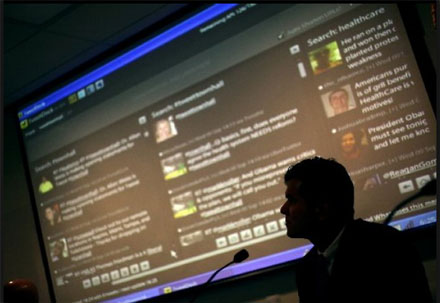
Twitter Town Hall,  a concept slowly starting to make sense, came roaring into the spotlight last night. At the epicenter of people who are most concerned about health care reform (senior citizens living in Florida) it became a little bit more magnified.

Last night, at the Naples Daily News headquarters, I had the pleasure to help manage with Cyndee Woolley, the “back channel” for a discussion on Health Care. However the difference was that this back channel was in the forefront.

Why? Because we took questions not only from the SRO crowd of almost 300, but also from the folks watching the stream live on their computers and participating via Twitter. Hyper local took on a whole new meaning.

You want to see Web 2.0 in action across multiple generations? We had it last night. Streaming video, Twitter, Facebook and 3 party applications all played out before the common people who wanted to hear and wanted to be heard.

Interestingly enough this was essentially the brainchild of one of Florida’s state representatives, Matt Hudson, who truly “gets” the power of social media. And because of social media, the event was organized very quickly, was very well attended, and it achieved it’s goal of informing as many people possible in as many ways as possible.

Here is NBC’s take on last night’s Twitter Town Hall

Here is the Local Fox affiliates take

Town Hall meetings might never be the same.

Social Media Conundrum #13…The tools

tools

Practical, useful, functional, sensible…

Those are all synonyms of a word that best fits social media. I’ll let you in on that word at the end of this.

I think sometimes we like to have things that look pretty, but don’t really perform that well, and yet we have tendency to accept it. We shrug our shoulders and we incorporate the time suck and the inconvenience into our daily routine.  I’m sure we can all think of products or services in social media that we bought or downloaded that had a lot of slick features, but at the end of the day, just didn’t work. But we stayed with it. Why? Because we were told it was the thing to do or have.

At the end of the day, we just needed it to do X instead of A through X. Even though K throught X doesn’t even work anyway without an upgrade.

Initially, we suffer for beauty, until we learn that practicality can go a long way in  online marketing and social media success.

Social media tools and sites are, at their core, about creating and enhancing the way we communicate with friends and strangers. The essence isn’t so much about how I say it and where I say it, as it is about what I say and to whom. It’s usefulness is only useful if you’re using it. We use the tools of social media to enhance and simplify and extend our communication and marketing efforts to customers, clients and friends and relatives. It’s a utility, and we use it as such. Whether we know it or not.

What’s my point?

Practical, useful, functional, and sensible can go a long way in social media. They also can a long way in enhancing the relationships with your customers and your clients. They don’t and you don’t for that matter, need the snake oil, the spam and the bullshit pitch. They need a social media solution or tool that is practical, useful, functional and makes sense for their employees, their company and their customers. So give it to them. and give it to yourself. Use what works.

The word?

Its Utilitarian.

Social media is utilitarian.

Do you agree?

Context is a 4 letter word…

Actually it’s a seven letter word… but maybe the context was lost in the title.  Simply put. We need more context in social media conversations. Specifically in Twitter but certainly not immune to all other social networks, context can elude us quite easily.  Either we abuse it, we don’t use it, we misuse it, or we lose it. Alot!

context

Just as the earth revolves around the sun and rotates on it’s access, context continues to toss, turn and tumble around the foundations of conversations. Word has it that the phone works pretty well at restoring context. TBD. What do you think?

Share this Post

14 social media and marketing podcasts worth listening to.

mic

You know what I love about podcasts? They are archivable, searchable and hands free. Which means that I can listen and learn while I’m doing other things. In the social media and tech space, I think its critical from a business standpoint to continue to grow and learn and stay ahead of the curve.

With that being said here are 14 social media , marketing, and new media podcasts that do just that-allow  me/you to learn. Coming from some of the true leaders of thought and innovation, these should help you achieve what you need most in this industry. Knowledge.

1) Quick-n-Dirty-Brought to you by Jennifer Leggio (@mediaphyter) and Aaron Strout (@aaronstrout) they talk about social networks and social media case studies, and talk with social media thought leaders- as well, they bring their certain style and panache to each podcast. Smart.

2) User Friendly Thinking interviews subject matter experts and industry thought-leaders on topics related to web design, content management, Internet marketing and social media. The show is hosted by CEO John Munsell and marketing director Paul Chaney from Bizzuka.

3) Diva Marketing Talks What can I say about Toby Bloomberg that hasn’t already been said? Add a great podcast to the mix and just be a sponge and learn about social media marketing.

4) Dishy Mix You want content? You want variety? This site and Susan Bratton brings it to you.

5) FIR is a twice weekly podcast covering new media, technology and PR,
provided by Neville Hobson and Shel Holtz, this podcast is very current and will always keep you in the new media loop.

6) Marketing Over Coffee Wait long enough and  John Wall and Chris Penn are likely to talk about anything, however they do focus pretty heavily on the tech, digital media space. Great variety here though.

7) Managing the Gray All around good guy, C.C. Chapman uses his podcast to help business professionals and individuals stay up to date on what is happening in the world of social media.

8. Marketing Voices I’ve been a big fan of marketing voices and Jennifer Jones for awhile now. Jennifer interviews leading marketers and business executives who are changing, or trying to change the marketing landscape.

9) Twist Image Mitch Joel is pretty dialed in. Don’t think so? Look who he has on and look at the topics he chooses to tackle. Plus his sight is bangin.

10) Jaffe Juice One of my faves, each week marketing dude and extremely tongue in cheek provacateur Joseph Jaffe discusses the world of new marketing, media and PR.

11) The Marketing Edge,  is one of the longest running marketing and PR podcasts. Be sure to check out the great summary posts by host Albert Maruggi

12) Find and Convert Wait till you see the list of topics and guests that Bernie Borges has on. Great topics and great content are a winning combination.

13) School of Social media Focused on Web2.0 marketing strategies, the show is produced by Ken English, the BlogTalkRadioGuy, and the Niche Prof, aka Dr. Ron Capps, for the School of Social Marketing and the Social Radio Network.

14) Connected World David Jacobs provides Connected World Radio, produced every Tues and Fri,  featuring a quick thought about an aspect of social or new media.

Have I missed some that might be a great addition to this list?

Share this Post

Social Media Conundrum #62 False assumptions.

thinker

I was in a meeting yesterday with a highly respected group of people running a very notable local organization. It was a follow up meeting to a social media marketing pitch made by a business associate from another company. I was enlisted as the wingman. In a sense, I was the muscle, or the validator, or better yet, the street cred. The initial meeting with this group could not have gone any better. The plan(s) and the views offered in that first meeting were warmly embraced. There was a caveat though. They wanted more. They wanted specific details on how to roll it out. Fair enough. All positive signs.

Then I relaxed and let me friend down.

I assumed she had it under control; when I should have helped her to dig deep and develop a detailed more specific and actionable social media marketing plan. I didn’t.

Our meeting was pushed back, which pushed it further out of my collective conscience. Out of sight, out of mind, right?

I should have had her back. I was her wingman right? No excuse on my part. I should have really looked at the follow up document that she had crafted, and picked holes in it, but I didn’t. I should have thought about and anticipated the “push back” from the group, but I didn’t.

And they pushed back. As nicely as they could. But they pushed. They essentially came back with saying, “There’s not enough here”. And then they talked about ROI…and how they wanted to see it. And we, me? her? Didn’t map back precisely enough on what we were going to measure and how it was going to be measured. I assumed we’d get there, after they had said yes…

Could I have jumped all over their ROI concern? You betcha. And clearly here was my chance to pounce. and I didn’t. Because in a sense it was right there for the taking. I just assumed…

The bottom line is I barely uttered a word. Part of me wanted to and I sort of said something, but it was barely audible. I needed to be her calming voice in the storm of measurable ROI. I wasn’t. Subconsciously, I didn’t want to dominate her show, but I also didn’t want to engage in a lengthy discussion in the conference room at that time over the merits of social media measurement. Or maybe that is the place and time to have that discussion?

No it isn’t. It would take too long. And, in a sense, they were right. It will be the case of every single encounter that one has when trying to pitch and trying to win social media marketing contracts.

What are you going to do? How are you going to measure it? and what will be the results?

Assume nothing.

Share this Post

Opportunity Cost of Twitter

cash

I can pick up the phone and make a cold call and talk to someone who I might be able to get business from; or I can create a Twitter account and follow people who I might be able to get business out of.

The next best thing that a person can engage in is referred to as the opportunity cost of doing the best thing (more desirable) and ignoring the next best thing to be done.

So which is the best thing? Which is more effective?

Opportunity cost is a key concept in economics because it implies the choice between desirable, yet mutually exclusive results. Which is desirable? Making a cold call or reaching out via Twitter to someone you might get business from? Which is a more effective use of your time? Are the results mutually exclusive? Maybe. But not immediate.

The notion of opportunity cost plays a crucial part in ensuring that scarce resources are used efficiently. If I have 2 phones and 2 computers with 2 Twitter accounts-which will be more efficient in the long run? Or the short run for that matter.

You see, opportunity costs are not restricted to monetary or financial costs:  it can be the real cost of  lost output or lost time. Twitter can be quite  inefficient when it comes to working it into the prospecting flow of your work day and treating it like you would your outbound marketing. You have to know how to use it correctly. It compliments, but it doesn’t replace.

Try selling that to an SMB