Discontinuous change in social media marketing and marketing for 2009

In 2009 you have a choice  you can either do what you did in 2008 or you can look at 2009 as a chance to get it right. Everything is upside down, including the way we used to market to consumers and the way consumers used to listen to marketers.

If you’re relying on the way you “used to do things” then stop. If you think you have a robust social media marketing presence, because you have a lot of “friends” and “followers” then stop. Seth Godin likes to quote that this is the “imitation of turbulent activity” .You are in the echo chamber and your clients (if you have any) aren’t in there and chances are they not listening to you anyway. But you wouldn’t know that because of your personal social media involvement-and the fact you might have your self important blinders on.

You’re “moving for the sake of motion” as my friend Jason Breed over at Neighborhood America would say. And that will get you nowhere. We need you to change. You need to change and  you need to adapt now to even newer rules of marketing  that are evolving before our very eyes. Realize the current situation for what it is.

Your goal for social media marketing and marketing in 2009

Today I talked to 1 clients, 2 prospects, 1 partner and 1 colleague. All very distinct and different conversations about marketing, social media and the client customer relationship. None of these individuals know each other and yet in so many words, all 5 of us agreed on the same exact thing.  Here it is.

The way you market to your clients, the way we market to clients is not the same as it was 1 year ago and 6 months ago. Now you might be thinking, “I know that”.   But do you really?  Do you  really know that these are different and challenging times? Lay off’s every day. Numbers down with all companies of all shapes and sizes across the board, and you might be pitching the same way you did 6 months ago? Forget 2008.

You need to take more time now with the client, the customer and the prospect, than you have ever done before. You need to understand their pain and their challenges before you can even think to market with them. Notice I said with, and not to. And you’re going to try and get the client to utilize social media marketing? Ha! Put yourself in their shoes. They don’t know social media, and in fact what they really care about  is getting warm bodies thinking about their service or product.

So the question is, what are you going to do about it? What is your plan? 2009 is almost here. You have to have a plan that is going to separate you from the echo. Be different.

diff

Where are your customers?

Are you where they are?

I was reading an old post by Drew McLellan in which he basically asks the same thing. He says, “Where do your customers gather?  What are you doing to make sure you’re there too?”

Good point.  Might make sense on Twitter too. If you’re a marketer and your hangin with other marketers, then you might not run into many clients or customers or leads. That’s not actually your fault, it’s the nature of the way we follow and are followed. But maybe it might make sense to find people in a certain vertical and follow them? I’ll give you an example.

When I was in college, I sold concert t-shirts. It paid well, I loved music, and it was a helluva gig. There were a couple of challenges though. First, they were bootlegs, and second, I wasn’t the only one selling them. So whenever there was a big stadium show for example, every t-shirt seller from here to BFE was out selling them. Too much competition. In fact, there was so much competition that we would all end up clustering by the same places hoping to make a sale and ultimately end up talking to each other and selling/yelling at customers. Oh and third?  Some of the shirts were of lesser quality and limited sizes and yet, some of the sellers would sell at a lower price that ultimately disturbed the economic balance of the business. Sound familiar?

bootleg

However the shirt sellers that hustled, broke off from the rest, and found quieter pockets of customers that were tailgating for instance, had a much better chance of talking with the customer and also having an exclusive captive audience, thus resulting in not just one sale, but perhaps selling 4-6 shirts at a premium price.

I know it’s a stretch for an analogy but the point is that now more than ever, your strategy needs to be more focused, refined, flexible and targeted. Instead of yelling and selling, go find the quiet bunch of tailgaters chillin and grillin and ready to buy. But don’t wait for them.

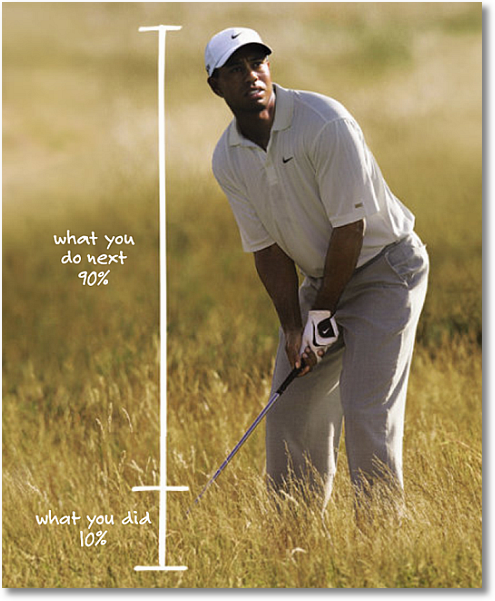
Lets Focus

 tiger-woods-focus-on-what-to-do-next-accenture1

When thinking of writing another blog post, it’s often about social media, or marketing, or web 2.0. All really big topics, and all with champions and thought leaders in each. But chances are if you come here to my blog, you’re looking for something. I want to give it to you. But today what I’m going to give you is some advice. It’s advice I need to heed but don’t from time to time.

It goes something like this.

How many blogs are in your feed reader? Mine? Somewhere between 150 and 200. I would love to read them every day but I don’t. Maybe I should focus on about 10 per day and rotate them from time to time? Want some suggestions?  Instead of the obvious, here are some with some variety in the content like Valeria Maltoni, Mark Story, Peter Kim, Toby Bloomberg, B.L. Ochman, Paul McEnany and Beth Harte

How many social networking sites or groups do you participate in? Me? At least a half a dozen, maybe more. How many can I actively participate in? That’s a good question. Maybe 3, maybe 6 and not much more. I’d rather be really active in 3 instead of marginal in 6-10. How bout just Linkedin, Flickr, Facebook, Twitter, and your blog? 2 of those are somewhat passive so you could manage them all fairly effectively.

How often do you read email? Me? Too often to really even narrow down. But it least 2-3 times per hour. I’m not sure what I’m hoping to get, but surely it can wait an hour or 2 before I respond. I believe Tim Ferris says read it twice a day?

How often do you use Twitter? What actions during your day revolve around the usage and participation of Twitter? Me? I have Tweetdeck running from the moment I step in my office. Not sure if that is wise. Does Mr. Tweet enhance or hinder this?

I think you see where I’m going, but let’s continue.

What amount of your day is spent reading about what is going on in our country right now? I admit that my day revolves around what is happening on a local level (Naples, Florida) a national level, an economic level, and globally. Does it consume me?  No, but It concerns me, so I read a lot. Should I reduce that amount like I should email?

What am I doing about IT? and what can I do about IT? What can you do about IT?

You see the challenge here is that we have a tremendous amount of tool sets and new web sites at hand right now, from social media tools to web 2.0 tools, and we can use them to improve what we do. We can also use aspects of them to improve our companies, our clients and our prospects, but we need to focus on which tools will work best for whom. We need to focus on doing what we do better. We need to refine it. Hone our skills, if you will. We need to better manage our time, our focus and our ability to cut through the clutter of filling up our day with a lot of social media bullshit apps and web 2.0  alpha and beta sites. Focus on what you know and do it better. I know I’m going to try. I need to. We need to. I don’t have a choice and neither do you.

Sports and Social Media

We talk a lot about the fabric that is sports and how it is weaved throughout the daily routine of our lives. Whether we like it or not, we all have some type of passing interest in sports and our communities. Either on a local, regional, national, or international level. Face it, if sports didn’t mean anything it wouldn’t be a section of the newspaper. It wouldn’t have it’s own segment on the local nightly news and it wouldn’t dominate our attention every  four years, or every sunday in the fall.

But how has social media changed the landscape of how we view or participate in sports? Here are some sites and examples that have already or seem to be elevating how we use social media with sports.

Ballhype is a social news site that’s sole focus is on sports, but it uses sports content/news as an entry point to encourage more interaction amongst its users.

Sports-focused social media company Citizen Sports recently acquired a few social media application developers: Sportacular, Sport Interactiva, and FantasyBook.  Citizen Sports launched its first fantasy football app on Facebook in July, and the acquisitions of Sport Interactiva and FantasyBook add new fantasy sports content to the roster, as well as securing  Citizen Sports a coveted spot in mobile, as Sportacular has a leading sports application of the same name for the iPhone.

Yardbarker breaks down traditional barriers, allowing fans and athletes to debate sports, read and write articles, and watch videos. It also features thousands of sports websites and blogs,

Pat Coyle runs a site called sports marketing 2.o that is related to all things web 2.0 and sports. Pat is obviously understand the effect that social media is having on sports, as he also created the NING group, Sports Marketing 2.0

The Sports Business Journal recently mentioned the 5 people that you need to know in social media-

Open Sports Led by Mike Levy, the founder of CBS SportsLine.com this site is a comprehensive platform of products and services that brings together breaking sports news, social media tools, user generated content, fantasy sports games and multimedia applications.

Want to see a professional athlete who has leveraged his blog to a degree that journalists and fans use it for his latest sound bite? Look no further than the baseball player Curt Schilling

Then we have XOS technologies a leading technology partner for maximizing the value of content, commerce and services for sports organizations and fans.Whether it’s a coach assessing recruiting content, a video coordinator creating game-video highlights, a team streaming a press conference online or a fan engaging in interactive content.

Jason Peck uses his blog as a platform for sports, business and social media. In fact, Jason provides a great resource in his 50 sports social networking sites, which is a must bookmark blog post. Along the lines of citizen journalism in sports, look no further than Deadspin.

Mashable, the great provider of all things social media list related chimes in with it’s own 20 sports social networks, though it is a year old.

MVP Spot is an online community that provides amateur athletes the ability to showcase their talents to the world.

And SportMates is a global sports social network founded by a group of passionate sports fans who have created and managed some of the largest sports communities on the Internet over the last eight years. They have created an environment where fans and athletes from all cultures and geographical locations can share their passion for sports with likeminded fans.

The point of this post was really to show you that sports is permeating every thing at every level, related to sports. From fan blog sites, to communities devoted to teams and activities, to Facebook groups devoted to teams and athletes, to teams reaching out by creating social networks devoted to their most ardent of fans. and to  professional athletes themselves blogging.

Sports and social media are at the cross roads of fan participation like we have not seen at any other point in time sports. Look for it to continue to escalate with even more user generated content and platforms created to showcase that content. With that being said, look for the voice of the fan to become more and more prominent in the industry of sports.


What has been your “Ah-Ha” moment for 2008?

ah-ha

As we fall forward and 2009 approaches, I was reading a blog post in which the reader talked about her Ah-Ha moment in twitter and I started thinking about what was my “Ah-Ha” moment for 2008. Was it a connection? Was it one of those seminal moments with a client? A conversation? A conference? An e-mail? A tweet? A blog post that took the conversation to another level?

I’m curious as to what it might have been for you.

Given that 2008 might have been lean for some on certain levels, I’m sure you can still point to some thing or some moment in 2008 that might have either helped make the light bulb above your head brighter or just enriched you on a level that you never thought possible. What was it?

I’ve had many moments that were game changers this year but the one that stands out is the effect that Twitter has had on me professionally. In short, not only has it allowed me to connect with my peers but it has connected me to information and resources quicker than if I would have done the search myself. It has kept me dialed in to what matters in my industry and from a networking standpoint, there is no comparison. So to the 500 or so people that I follow, I want to thank you for providing me with my “Ah-Ha” moment in 2008.

Talk with them…

I’m learning as much as you right now. If you are a marketer or an advertiser then you need to be talking with your customers and not at them. We have been talking about that for a while now.  IDC just came out with a report that says that advertisers are failing miserably at communicating with social net users. Why? Because they are used to pushing shoving? their info and their product down people’s throats. According to IDC:

There are four major reasons why consumers use SNS: to connect and communicate; in response to peer-pressure; for entertainment; and for work-related purposes. Advertising does not factor into consumer motivations.

Ouch. So essentially advertisers still don’t get it. Keep reading, it gets better. IDC continues,

One of the potential benefits of SNS that the advertising industry has discussed is whether peoples’ connections (i.e., whom a user knows or is linked to) could be used for advertising. For instance, publishers could show a car manufacturer’s ads to a user’s contacts because that user’s online behavior has indicated that she is interested in a particular brand of cars. Anecdotally, there has been some indication that this “social advertising” might be more effective than behavioral targeting. However, that idea is stillborn. Of all U.S. Internet users, only 3% would allow publishers to use contact information for advertising. For instance, publishers could show a car manufacturer’s ads to a user’s contacts because that user’s online behavior has indicated that she is interested in a particular brand of cars.

If you have been reading some of the thought leaders in the social media marketing space like a Jason Falls, like a Beth Harte or Amber Naslund or Valeria Maltoni or Paul Chaney– they have stressed the importance of brand champions and community influencers who can shape the decisions and actions of the group or community or social net-naturally.

IDC’s report says that “One of the potential benefits of Social networks is that the advertising industry has discussed is whether peoples’ connections (i.e., whom a user knows or is linked to) could be used for advertising.”

I’m not sure what to think. Should I admonish IDC for putting out a report in which this comes as to no surprise to a lot of us? Or should advertisers be ashamed for not listening to some of the people I mentioned above who so obviously “Get it”? and have been saying what was put out in the report for a long time? A LONG TIME. IDC and advertisers could have saved a lot of grief, time and money just by listening to what is being written and talked about every day online in blogs and on Twitter.

Advertisers need to start listening to the thought leaders in the social media space to start with.

Sensitive marketing. 11 simple questions for marketers

pain

I’ve been thinking a lot about this lately, but…

  1. Do marketers have any idea of of the level of pain and frustration and fear that envelopes the people that they are currently marketing to?
  2. How are they or you addressing it?
  3. What are they or you doing to change yours or their tactics? You cannot market the same way you did in the good times.
  4. Are you even asking the hard questions?
  5. Are you meeting your clients and prospects halfway?
  6. Is what you are marketing and selling, solving problems in any economy?
  7. Are they problems that are different now because of the current state of the economy? YES.
  8. So how are you adapting?
  9. Are you changing the way you market to them?
  10. Are you touting social media and social media marketing? You have a case. But
  11. How well are you wrapping that case and your argument around today’s problems?

Marketing in a poor economy is no doubt what we are faced with right now which means that you have to be sensitive not only to the challenges that you are going to face, but also of the people that you are talking to on a daily basis. Some might say that the timing is right for social media marketing to be the panacea for what is ailing a lot of companies right now, but that remains to be seen. In the meantime what might be needed is a brand of sensitive marketing.

You Think About It.

We need social media mentors not evangelists

mentor

Be a mentor.  this thought occurred to me while watching  a vid on Todd Adrilik’s blog titled, The dumbest generation, don’t trust anyone under 30. While it was a compelling piece about how anyone under 30 might be more inclined to be lazy and check on their social networks and do nothing else- I would like to think that there is a tremendous opportunity not only for them to lead us even further into the digital age but also for us, as digital marketers, to do the same. Lead them, and show them now, how to do it right.

You see, at some point all of that digital knowledge you have, those social media experiences in your head, needs to be transferred to others. Just telling people about how great it is, is one thing, but showing them, and taking people under your wing to guide and mentor, and to teach and explain, is something completely different and much more valuable.

Ok, so for those of us in the social media bubble, we get it. Now go out and instead of telling people how great social media is, show them how great it can be.

Put your social media mentor hat on and make an even bigger difference.

Should a small business owner care about Social media?

Every day I can either get my bad news from the nightly news, the internet, print publications or the radio. In fact, my new job or position is a direct result of what is happening globally, nationally and locally. We all know of all the massive lay-offs and closings, but what of the trickle down to the small business owners?  How can they keep it going?  What tools could they use?  What tactics can they employ? Is social media a viable option? Should they be using it, trying it?

Jennifer Leggio a few weeks ago, had written about a recent survey that showed that 55 percent of 120 surveyed small business owners believe that online social networking — such as Twitter, LinkedIn and Facebook — can be beneficial to their businesses.

Only 55% believed it could benefit? So the other 45% think it won’t? Let me ask you, who do you think will succeed?

Ok lets try this: I go up to the SMB and I give you 2 doors. Behind door number one is every possible tool you could want that might drive traffic to your business or your site. Behind door number two, are only the tools that have worked in the past. Which would you choose?

My question to the small business owner? Why wouldn’t you try everything right now? Including social media? What is your reason for not trying it? The Risk?

deal_l