When the social media relationship ends…

The_Way_We_Were

In my previous post about nurturing relationships, I was skewered a bit for not really pinning down the how’s and why’s as much as I was alluding to going out and just doing it. Ok, I get that. perhaps another post is in order in which I suggest specific tools on how to nurture a relationship via social networking. But in the meantime, I wanted to tell you a quick and true story about what happens when the relationship goes bad in social networks.

It goes like this

About 4 years ago I had created an online community to support the sales and marketing efforts of a CPG. Why did I create it? Initially I thought it just made sense to put up a KB with some bells and whistles, but it quickly became evident that something larger was needed just because of the amount of emails and feedback we were getting. I’d like to claim it was some great epiphany but no, it just made sense.  So the community was born. 5000 members strong.

Mistakes are made

I decided to manage it. You’ll be pleased to know that I was not transparent and I hid behind a cleverly stupid name. Mistake #1.

Mistake #2, though we had created a rules and regulations, TOS, policies page, I did not adhere to enforcing them. I would capitulate time and time again in my efforts to make everyone happy. Lesson #1/Mistake #2, You cannot possibly make everyone happy as a community manager.

As I kept my distance from the community and only appeared on an as needed basis, my stature took on the persona of something that resembled the all powerful and mighty Oz. I would come in periodically, settle a dispute swiftly, siding with the person who I didn’t want to piss off and away I would go. Further alienating people as I went. Mistake #3 Not abiding by the TOS, having little or no affinity to the members of the community, and essentially being completely out of touch with the nuances of the community.

To alleviate this headache, I appointed 3 moderators to buffer the criticism. The problem was I gave them too much power and they instituted their own brand of vigilante justice. Mistake #4 I was now playing favorites and siding with the moderators who may not have had the best interests of the community at hand, since they were not being paid and were merely the “appointed” brand champions of the community.

Mistake #5 Instead of reasoning and understanding and trying to empathize with the passionate members of the community, I would throw down the swift hand of justice. I would warn members and then subsequently kick them out. Some got second and third chances, others did not.

When the social network relationship goes really bad.

Instance #1 The person I kicked out, did a blog post on how he would like to kick my ass and kill me. Now this person did have some issues but instead of me trying to reason with this person, who was by the way, a brand champion- I kicked them out. This person was a very very popular member of the group and  once gone, weakened the core group of passionate users and brand champions. Mistake #6 I didn’t realize how important this person was until they were gone.

Instance #2 Another brand champion was just a bit too busy on the site. Always emailing me, IM’ing me with suggestions, how to’s, criticism, you name it. I took it all in stride but he was always seeing how far he could push things in regards to what he would do for the sake of the group and to his page within the site. I found myself always having to check his page, his comments, his posts, and his avatar to see if he was behaving. I was also periodically geting complaints about him from other members, as well as the mods. Which then meant that I had to talk to him  and tell him to chill. It was getting old.

I had warned him on numerous occasions and he would comply and behave for a bit, but not for long. The last straw was him dropping some code on some of his pages which locked down the site for quite some time. That was it. He had to go. So I kicked him out.

From bad to worse

Did he go quietly? No.In short order he did the following: He found every social site that I was a part of and did everything in his power to make my life miserable. He either trashed me, the site, or the product. When he wasn’t doing that, he was creating multiple and I mean multiple personas, and coming back into the community, and proceeding to again, trash me, the product, the company and anything else he could think of to disrupt the site. It was a community nightmare to the nth degree.

So what did I do? I tried to follow behind him and clean the mess up, but that proved virtually impossible. So I did the only thing I could do. I reached out to him and brought back into the community, back into the fold. Why? Because it was easier to “manage him” within the community rather than outside of it. It was a very unpopular decision. Mistake #7 The best move turned out to be the worst moved followed by an even worse move.

By now, most people had had enough and to be honest, at this point, things were starting to die down. The brand champions were moving on, the passion was waning, and there was nothing really happening at the corporate level-that was keeping people involved and engaged in the community.

Lessons learned

So yes, in a sense, the moderators and the administrators certainly didn’t help things. Nor did we learn from our mistakes or adapt from them. But on a larger level, the community life-cycle, the people that made the community thrive, and the site as a whole, were diminishing, either by my actions or just the natural progression of things. Could it have been prevented? Hard to say. The easy answer is yes, but how long would that have prolonged the shelf life? Relationships begin and end and begin again, all the time. In some cases it just wasn’t meant to be and in others it is. In this one, there are valuable lessons everywhere, you just have to know how to look,  and not necessarily where.

My point is this. All of our social relationships right now are thriving in one way or another but for how long? The natural progression of things dictates that most of them will flame out. At that point what is left? What do we have for the effort? Your takeaway?  Understand the value of purpose before the relationship begins in earnest knowing that there is the distinct possibility that the relationship will end.

Share this Post

How to nurture conversations in social media

In social media, social networking and in this web 2.0 world, there is one thing that is and must remain consistent. That is the art of conversation. In order for it to “work”. Conversations have to ensue, they have to abound, and they have to be maintained. Beyond “just” having a conversation, there has to be a beginning, a middle and an end. Or a purpose, right? What social media has really done has created the means to have conversations in ways that 10 years ago we could only imagine. But beyond the means, you now know so much more about the person you are now having a conversation with. And if you don’t know that much about that person, you now have the ability to find out, rather quickly too.

There’s the old school version of communicating

rotaryphone

And there’s the new school.

social-media-icons

But neither works if you don’t adopt the mode of give and take or… serve, receive, and volley..

Sorta like…

pong

In social media, you can serve and hit against the backboard all you want, but you will never get anything out of that except becoming adept at repetition. In other words, you can create social network profiles on all of the hot social networks, and you can write really great blog posts, but if you don’t take the time to go out and share you, your personality and your content with people that have similar interests and tastes, it will die on the vine. Learn how to share your content. Social Poster is a great place to start, but beyond that you need to decide where you and your interests fit in.

Here’s the best example I can think of.

When you first go into Facebook it’s just one big funnel. But eventually most of you find your way, your groups, your peeps, or your tribes. But once you do, joining doesn’t guarantee anything.

Here’s another example.

Penn Station in New York to the outsider can seem incredibly confusing. But really, it’s pretty efficient. What it does is that it funnels and routes people from the suburbs into the city and back again. Like Facebook, each person from their distinct city, town, and neighborhood at the beginning and end of the day can find their way out of town and back home and vice-versa again at Penn station. With a little research, some directions, some effort, and some help, someone can walk off the street and get to the neighborhood, town, suburb or city that they need to get to in the surrounding New York/New Jersey area.

penn

With a little research, some directions, some effort, and some help…you can get where you need or want to go.


Share this Post

The difference between Facebook and Twitter

I just read a blog post about Twitter Surpassing Facebook as the top link in E-mail marketing campaigns and that got me wondering why. But if you think about it, it makes perfect sense. If I’m a marketer or large company and I know that my intrusive and possibly NOT opt-in, much less  double opt-in email is not being read; and I want the recipient to grab something-what is easier? What social link might they click on?

Twitter

snack

Or Facebook?

thanksgivingmeal

Both ultimately satisfy and both are going to give the reader of the email the info they are hoping for. Information about you and your company. But the difference is Twitter is a snapshot about culture, beliefs, thoughts and opinions. While Facebook is a movie. Facebook is what happens after we have talked on the phone and have decided to meet.

For the  email marketer, you have only a certain amount of time to get the attention of your prospect. What can they hit quicker? Twitter or Facebook? What will give them the quickest return? Will it give you a higher conversion rate? Hard to say. But at least it gives you the chance to pitch one more time. And hopefully your Twit stream is a bit more robust and useful than what some marketers seem to think Twitter is best used for. Take more time to develop out a solid Twitter presence. Don’t ignore Facebook but understand the difference between the two as marketing vehicles.

Share this Post

10 Blended Social Media Marketing Strategies A Company Might Want To Consider

prism

We have been talking a lot lately about… talking. When we should be doing a lot more… doing. So the thought for this post, interestingly enough, bubbled up from a client request, that I should supply a document that mapped out the ways that you can blend social media into your marketing mix. So what I’ve done is supplied the tool or the platform, how I used it, what was the time suck and what were the results. Hopefully this will shed a little light on what the heck we’re doing and why we talk about it so much. Keep in mind one thing though- I do not get into the number of hours I put into meetings, documents, strategy docs, client objectives, client objections, proposals, pitches, the number of clients I pitched, the number of proposals rejected, the number of times I’ve been told that it doesn’t work, the number of times there is no response and the number of times I’ve educated the client and then have had them put into action on their own, what I have told them they need to do and why they should use us…So this is also for them. If you’re going to do it, at least do it with some knowledge of what you’re doing!

1)      Twitter. You’ve heard of Twitter but why use it? Twitter helps you monitor conversations about anything that might be relevant to you and your company. You don’t even have to actively participate to monitor it.

Time suck rating: Depending on how much you want to monitor and participate. Give it a rating of 5/10

Use case: Created structured conversations around hashtag to create community, market under the radar, build credibility and lead source. Monitor clients,products,industry,city,state,region. Ex: hashtagsocialmedia.com

2)      Search is not going away soon. Universal search is looming larger and larger by the day. Universal search blends listings from news, video, images, local and book search engines as well as social media elements compiled from Twitter, LinkedIn, Flickr, and YouTube. By understanding the value of Search and it how it plays into the overall strategy of your company and it’s goals and objectives, the better you will understand the importance of having more than just a “cup of coffee” type of presence with each of the above listed elements and sites. There is such a direct correlation between search and everything that people do on a day to day basis that to underestimate or devalue it is a grave mistake.

Time suck rating: Extensive. 9/10

Use case: Created reputation management program built on all elements of search using Flickr micro-websites, robust white hat SEO tactics and product specific blog sites. Results were reduction in negative websites and mentions. Increase in traffic and visibility.

3)      Social Bookmarking– In recent years, social bookmarking has become more sophisticated, somewhat diminished and yet no less important. Important to what? Social bookmarking adds a great deal of efficiency to your searches-That’s right, SEARCH, for useful information on the web. That information will be about you and your company. Not only are resources easier to find, but your company is easier to find as well. This means additional promotional opportunities for you and your brand by being able to better target people who will be interested in what your company is about. Example sites of Social bookmarking are Digg and StumbleUpon and Delcio.us

Time suck rating: Not bad 3/10

Use case: Created corporate profiles on the top social bookmarking sites, seeded each site every day with a new blog post or link revolving around relevant product, service, company, or industry. Resulting in hundreds of links, tags and bookmarks relating back to corporate and product. Results were seen in less than 6 months in the SERPS.

4)      YouTube-Video is permeating our lives. It had been for awhile, but we just didn’t call it video, we called it TV or we called it,”the movies”. Today we call it online video. You don’t have to look farther than YouTube, and Hulu to see the value of it. But did you know how much video is tied into search? That’s right we’re back to search again. As another channel to push out content you’ve created, which search engines love, to tag that content, which search engines devour, and to find ways for others to take your content and embed it on their sites perhaps, means that video is a perfect vehicle to take your message further than any other content that you might have, short of a widget. What does it require? A $30 webcam and some creativity.  The payoff? The chance that your content can go viral. Example: Musician hoping to get a million views in one year of his music video appeal to United airlines about his damaged guitar-gets 4.5 million in less than a month.

Time suck rating: Pretty easy 4.5/10

Use case: Created and embedded Youtube videos on client site and blog with relevant  tags and keywords resulting in continuous and steady traffic every day to blog site. Blog site links back to product site resulting in sales growth of 11% directly attributable to video.

5)      Flickr– We all have cameras embedded in our phones now right? Digital cameras are dirt cheap and you have products, employees, conferences, meetings and content just waiting to be tagged and… searched upon. Understand this, “every digitized element that you have in house, now has the potential to be searched upon”!. What makes that point more important and relevant, is that there are now more social sites than ever before to accommodate and house those elements. For what it’s worth, and or until the top SE’s change their algorithm, there is a very strong tie between search and social networks. Which means that your Flickr photos and their associated tags, will show up in image searches as well in some standard searches. What does this mean to you? A chance to push out more content about you and your company…Again.  Requirements? Your ability to understand the upload function of social sites and how to manipulate and tag your pics.

Time suck rating: Nominal 5/10

Use Case: Created  Flickr product accounts for CPG’s with relevant tags and keywords all pointing back to product/e-commerce page as well as to customer forum; and additionally corp. blog site. Results were direct and indirect traffic, as well as image sharing requests with requisite track backs to product and growth in the SERP’s.

6) Facebook– Facebook cannot be ignored. Does this mean that it becomes the primary focus of your organization? Not necessarily. But Facebook fan pages are a great way to market to people that are not registered with Facebook. Which means that fan pages are indexable. i.e. show up in search! The difference between fan pages and group pages are that with fan pages they are, for the most part, better for a long-term engagement with your fans, brand champions, and customers because the barrier for entry is low and the ability to push out information is real time and quick and easy to manage. Group pages are generally better for attracting quick attention but can be tough to sustain, though group members have the potential to become recruiters of the group site and can take it viral quick.. The requirements? Some type of comfort level of the tools, bells, whistles and apps available for the administrators; as well as and this important to note: The Privacy settings. FYI read them and understand them.

Time suck rating: Above average 6.5/10

Use case: Created fan page and group page sites for CPG, and Twitter site, which resulted in ongoing growing list of targeted brand champions, evangelists and new customers, as well as placeholder for announcements, offers and polling and 2-way messaging.

7)      LinkedIn– Personally speaking, not only should each person within yours or any organization have a Linkedin profile, but even from a professional standpoint as well. What can you do with Linkedin? You can, in short order, join thousands of groups and associations, ask and answer questions associated with you and what your company does, create your own group or organization, find people and groups that do what you and your company do, and link to them and research the people or company that you are getting ready to hire or work with. If they are not on Linkedin. It is now an immediate red flag. The requirements: A little time to set up.

Time suck rating: Below average 3/10

Use case: Created interactive Q and A series resulting in  corporate branding exposure, development of database of contacts, companies and potential partners. Also created Linkedin group resulting in over 300+ contacts.

8)      Blogs– Don’t think their importance is diminishing just because of the advent of micro-blogs. They are still very relevant, very link friendly and can be integral to the success of some organizations. As well, they are not just place holders for the written word. They can now hold video, audio, podcasts, images, widgets and more.

Time suck rating: Blogging can be somewhat time intensive if the intent is to create another relevant, visible, and valuable vehicle for your message: 7/10

Use case: Created multiple corporate blogs to create 2 way conversation between customers and company, push down negative press and improve a tarnished corporate image as well as criticism stemming from negative public sentiment. Also created CPG blog to support product launches, latest consumer information as well as provide tips, links and resources to consumers and tire kickers.

9)      Microsite development– Developing small relevant websites that revolve around your products, your company and your keywords is a great way to drive links, push out content and otherwise add to the search results for your product or company. They don’t need to be robust. They can be text heavy, link heavy or even video heavy, but creating content laden sites is a way to not only you’re your main site, but also as a way to amplify your message. If you are adept at HTML or if you prefer to use a CMS to fire up your micro-sites, either way is effective.

Time suck rating: Fairly laborious on the front end 7/10

Use case: Able to create multiple micro-sites for multiple clients resulting in positive search results, reputation management success and increased product and customer awareness as well as positive SERP results.

Note: Short of coining a new phrase I decided to call this blurb “macroblogging.” Twitter is called microblogging and the next step up would be these next 2 sites. Tumblr and Posterous. These 2 platforms are redefining what it means to blog. What these 2 sites/platforms are providing is a more, if that is possible, streamlined way to push out content to the masses in lieu of using a traditional blogging platform like wordpress or typepad. The upside? You guess it, search. They are simple to fire up and easy to Market, share and build. I have not yet used them extensively to provide a use case.

10) Community development- A number of years ago I started an online community to support a very popular consumer product at the time. To me it just made sense from a communication standpoint. It also made sense because we had a built in sounding board for new product releases, customer support and polls. Not only was the community an immediate success, it gave us insight into our typical customer’s mindset. We were able to test and float ideas before we took products to market. For the people of the community, all who were very passionate about the product, it gave them a place to hang out and bond. I’m not saying all products have that potential but there are numerous ways to create online communities around your brand champions and evangelists and customer service initiatives. They can be done via Facebook groups, Ning, Groupsite, Google groups and half a dozen template based sites.

Time suck rating: Can get labor intensive 8.5/10

Use case: Built, managed and recruited online community to support CPG. At its peak, it had 5,000 members contributing hundreds of posts and comments per day.

So as you can see from this list, these are only 10 scenarios of what has worked for me. There are other smaller examples that I have employed with a minor degree of marketing and branding success from podcasting, creating a nationally recognized personal blog, co-authoring a book, creating successful email campaigns, and personally building close to a 100 web sites. But let me reiterate This is what has worked and works for me when working with clients. I am comfortable with these 10 activities and their associated tools.  I know there are more, and I’m learning more as I go, but I thought I should share what has worked for me so that others might learn as well. If you want to specifically explain how to do it, let me know and we’ll go from there!

Share this Post

Why your Twitter pitches just got easier…

newtwit

Finally. Now you can wow your prospects and clients with conversations about you, your peers, your product, your company, your industry, and your competition right at the beginning of your pitch. Finally, people will not be spooked by the ambiguity of the “old” Twitter home page. The barrier to kick the tires has just been lowered.

Share this Post

What do consumers want from social media?

choices

I was reading a post titled, Marketers Like Twitter More Than Consumers Do

This excerpt caught my eye:

The firm says that about 45% of marketers polled felt Twitter will grow exponentially, while two thirds of consumers said they didn’t have an opinion, and only 12% of the latter said it is something young people and the media will use. Eight percent of consumers said Twitter is already a digital has-been.


Consumers can’t dismiss something before they have even learned about it right? And yet it strikes me that perhaps we as marketers and thinkers have not done enough in explaining what Twitter is. Or perhaps Twitter has done a poor job in articulating what Twitter is and can do?

A step in the right direction was the recent release of Twitter 101 for business, but before we can prime a business on the benefits of what social media and or Twitter can do for them, perhaps we should take even less time and just ask what they want. In other words, instead of starting by explaining what social media is..we take the business challenge at hand, and see if we can mold a social media solution to that business challenge. If there is not a fit, and in some instances, that just might be the case…we move on.

But beyond that, the last statement in the above mentioned post struck a nerve with me and it was a comment by Harris Interactive and it was this:

“It is the advertisers and marketers who should play the lead role in promoting consumer education if they truly want to move Twitter beyond infancy and into its tween years.”

So I ask you this. Are we giving consumers what they want? Do they know what they want? Or are we giving them what we think they want?

Social Media Thought #74: It’s not speed dating.

I was designing a quick-n-dirty logo for a group that I’m part of in Naples, Florida called  Coffee and Social Media and while I was messing around with some content, A typo has resonated with me. The typo was this:

Social Media is REALationship driven…

So instead of this first:

married

Let’s start with this:

2talking

Take the time to develop the relationships with your clients, your customers, your prospects and your peers.

Share this Post

When the tweet doesn’t live up to the hype

play_risk

What do you, what can you do? You click on a compelling tweet with a link and it brings you to a lame blog post or just bad content. You took the link bait. What do you do? You read it and you say to yourself this is bullshit. It has a lot to do with credibility going forward doesn’t it? You feel like a sucker.

Trust? Your trust of who sent the link is diminished. Your skepticism for any subsequent posts is raised and the likelihood of ever going back to that blog and or to even follow that Tweeter is in jeopardy. So is this you? Are you the offender? If it is, here is one piece of advice. We’re not that stupid.

Don’t play us.


Share this Post

Twitter 101 is good but…

This week Twitter released Twitter 101-Best Practices for Businesses on Twitter and while it is a great site/primer on the how and whys of twitter- we’re still missing a fundamental component that escapes most first time users.

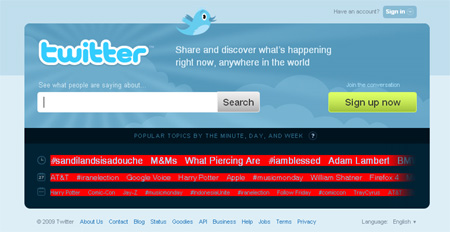
This is the entry page to Twitter

twitUI

The link for Twitter 101 is buried in the footer. A lot of people work on this premise: Ready, Fire, Aim. And this UI, now going on 3+ years needs to be retired. Now granted the notion could be, “we may complicate matters by displaying the Twitter 101 link prominently”..thus losing people who inherently sign up and register on anything that smells of  a social network. But let’s be honest, the only sight I know of where less is more is…

google_logo2It’s time for Twitter to grow up, you’re not the cool little startup anymore. I know you’re having scalability issues and you’re the darling of mainstream media. All good problems to have but…You do want to make money at some point, right? Well it starts with a first impression. So although Twitter 101 is a step in the right direction, it’s not a landing page.

Share this Post

Hey marketers, what can one person do?

I have conversations every day about brand champions, leaders within communities, word of mouth marketing and  how some things can go viral. During yesterday’s Hashtagsocialmedia chat with host Rachel Happe, someone used this video as an example of a Flash Mob within a community. Watch this video. It is a perfect example of  how a) one person can make a difference and b) how viral things can quickly become.

Share this Post