18 reasons a social media snake oil salesman might want out

Last week I wrote a post that got a tremendous amount of love from the folks over at social media today and rightly so, it was all the reasons why I love social media.

But what if you were sick of it? What if you were a snake oil salesman trying to cash in on the social media phenomenon and you were starting to realize that this social media stuff sucked? What might be your reasons for getting out and jumping into real estate short sales or something?

Your excuses, er reasons might look something like this:

1) You didn’t realize how much work it took

2) You realized that people aren’t into your “get 200 Twitter followers” for $19 a month program

3) Your social media certification classes didn’t really take off like you thought

4) Stealing other peoples content was hard work

5) Spamming hashtags wasn’t driving any business

6) No one is calling you or responding to your sign up landing page with exclusive offers and social media tips

7) People were not sharing your viral videos that you stole created

8. Strategy? What strategy?

9) The trusting client is pissed because the Twitter account you created for them with the 30 tweets, 30 followers, and the 5000 people you’re following, hasn’t really amounted to anything

10) There was too much to learn

11) You’re tired of RT’ing others on your 6 month old Twitter account

12) You never figured out what that Facebook vanity URL thing was

13) Case studies? On what?

14) Social media is dead anyways

15) You hate creating content and no one was coming to the blog

16) Social Media ROI isn’t important

17) It doesn’t work

18) When someone asked you about Gowalla and Foursquare you looked at them like this…

Share this Post

This week’s #Socialmedia Tweetchat Topic: Social and the New Model For Market Segmentation #sm48

So you know by now that we attempt to shake things up a bit and challenge people to think differently about topics and their impact on business.  Our topic this week is no exception and with the skills of our moderator, we are going to test those limits.  This week’s discussion is around market segmentation and how social can change how we approach it.

Market segmentation is more than what markers do with homogeneous products before deciding which actress to use in the commercial to best reach a desired consumer group.  Market segmentation is defined by Wikipedia as:

“A market segment is a sub-set of a market made up of people or organizations sharing one or more characteristics that cause them to demand similar product and/or services based on qualities of those products such as price or function.”

This is a good start as a definition, however this does not even begin to scratch the surface.  How do we take this to the next level?  To explore ways by which to re-imagine consumer grouping, we must get past the traditional segmenting like demographics, geography, income, even behavioral.  For many marketers, they look at data models that break out behavioral with layers of demo and geographics mashed in.  This modeling then determines a budgeted ad spend for a period in time like 3 or 6 months where the messaging is developed, pricing assigned and commercial created.  The problem is that by the time the ads hit, the data models have shifted and the intended groups have moved on.  Now with peer reviews and endless product content the real-time web is heavily influencing consumer preferences  that continue to change with increased velocity.

Savvy marketers have been using insights for more than just marketing also.  Savvy marketers use segmentation for product development, pricing, marketing channel, and even customer retention.  Using the last example, customer retention, the segmenting considers factors like profitability, strategic fit, product version and longevity.  Can you service your customers differently with better targeting for profitability or would you be more proactive with customers who were ripe for renewal or upgrades?  Now consider going beyond your internal gates and imagine the results if you combined internal factors along with external or social listening capabilities.  Maybe that customer who is really loud socially is a drain on your profitability.

So what this means is that the social web is having a profound affect on preferences, therefore insights that are not derived in near-real time are simply missing the mark.  If we open our research and insights departments to the social web, how can they can they use these tools that have never been considered before?  Every company will find different value in different social instances, however there are some great new possibilities that are emerging:

  • What if you titled the buckets of your listening tools with Underserved, Disenfranchised and Contemplators?  Could you use that insight to build better products or price more according to near real-time inputs?
  • What if you targeted people who played Mafia Wars on Facebook or joined relevant fan pages.  Could you use those applications for consumers to self segment themselves and find commonalities?
  • What if you targeted people who used certain hashtags (#) on Twitter or similar platforms.  Could you infer commonalities from everyone who tweeted #farm, #beer or #sweets?

Understanding and using social segmentation is challenging.  The pace at which social moves and the pace by which people flutter around digitally are simply exhausting.  Marketers like General Mills and Coke are early adopters of social segmentation and blazing a trail for others to follow.    This week’s moderator Ken Burbary is going to help us sort out this topic.  Ken manages the social media duties for Ernst & Young where he develops these types of solutions for their respective clients.  The topic this week is:

TOPIC: Social and the New Model For Market Segmentation

Q1) Is traditional market segmentation still relevant?

Q2) What should be more important for Brands: social segmentation or engagement?

Q3) How are you segmenting your customers with Social Media?

Please join us Tuesday 2/23 at noon EST by using #sm48 on Twitter or follow our LIVE page

Posted via web from marcmeyer’s posterous

Engagement by proxy

I was looking at the definition of proxy for some odd reason the other day and I was struck by the irony of the definition.

Last week, Todd Defren, who is taking a unique approach towards the social media space by discussing the ethical side of engagement, blogged about ghost tweeting and ghost blogging. Essentially asking his readers to determine whether doing either or not doing them, had any ethical merits.

But I have news for Todd and everyone else. Ghost blogging and ghost tweeting happen a lot.  A lot more than people will care to admit. It happens because people that write and talk and engage for a living are a lot better at it than people who don’t do it for a living. And those that don’t, would rather leave it to those that do. Though I applaud him for taking the high ground on this issue, Todd knows it’s a lot more prevalent than most will admit. So do I.

Is there a solution, I don’t know. There might be, but it has to meet the criteria of the agency and the expectations of the client. Good luck with that.

Engagement by proxy.

This week’s #Socialmedia Tweetchat topic: Twitter What’s Happened and What’s Coming!

TwittervilleIt is not often that a technology comes along and changes the world.  That is the case with Twitter.  Started in 2006 by Jack Dorsey, Twitter is a micro-messaging platform used to communicate via the web or mobile 160 characters at a time.  In only a few short years the service, both widely acclaimed and widely criticized, has certainly had it’s impact across all corners of the globe.

The impact varies as much as the individuals who use it.  Some things Twitter has been used for includes:

  • Reporting News – the first news and pictures of the Hudson plane crash were sent out on Twitter before any major media was on the scene.
  • Civil Unrest– like the twitterscope (microscope that Twitter creates, yeah I just made that up!) around the Iranian presidential elections of 2009.  The world gained insight into the civil dissention surrounding the election proceedures with detail like nothing ever witnessed before.
  • Education – grade school teachers turning to Twitter to help in class projects and providing global experiences.
  • US Politics– most notably, President Barack Obama used Twitter daily to connect with supporters pre-inauguration.
  • New Business – small companies using Twitter to scale like Threadless and others use it to pick up incremental business like Tony & Alba.
  • Public Relations – many companies are lifting the corporate communications veil and using Twitter to humanize the organization like Kodak’s CMO.  Government agencies are also using Twitter to communicate better

Need more examples?  Well, this week’s moderator actually wrote the book on Twitter case studies from over a hundred interviews he completed.  Now he wants your story.  Shel Israel has a storied career in the social media space helping companies, from start-up to grown-up, better utilize digital communications to grow their businesses.  This week’s #socialmedia chat will take a look at how Twitter is affecting all of us and where Twitter’s value will lie in the future.  As one of the industry’s most respected thought leaders, you won’t want to miss this opportunity to “hang out” with Shel Israel for an hour.

Topic: Twitterville – What’s Happened, What’s Coming

Q1: How did Twitter change you business in 2009?

Q2: How will Twitter change in 2010?

Notice anything different here?  This week we will focus on only two questions (compared with the usual 3).  Please join us Tuesday 01/26 at 12 noon EST and follow along at #sm44

Posted via web from marcmeyer’s posterous

The sea change in Twitter sentiment

I thought it was just me and thus I wrote about the rise of the transactional conversation of Twitter on Monday. Then yesterday David Binkowski threw a post up on Shamable  about gaming social media.  At the same time Hubspot put out it’s 3rd state of The Twittersphere report.  And Todd Defren lastly writes about moving the needle on Twitter.  All of these posts and reports and what have you, alluded to something that may be occuring before our very eyes and that’s this:

Conversations on Twitter have deteriorated into flat out unadulterated pimping of one’s wares, or the company they work for.

As new marketers and companies flock to Twitter, their predisposed notions of how to use Twitter have been fueled not only by us subconsciously, but also by other marketers and individuals who “think” that the best way to use Twitter is as a one to many broadcast mechanism.

Subconsciously, we have become a party to and have embraced traditional marketing on Twitter.

The conversations have eroded into flat out pimping, so has the spirit of what all of us celebrated no less than a year ago. The conversation and ensuing relationship. But not, for some of us, we’ve become jaded, and wary of what it it that you want. For some of us,  the quality of the conversations are few and far between and it’s our fault.

I know, some of you are going to fire back and say “What conversations?”  You’ll say, “Twitter is not a platform for conversations and never was.” You’ll say,” Who can have conversations in a 140 charcaters or less?”

The interuptive interaction?

And maybe that is what the true evolution of what Twitter is or what it should be?… A way for brands and individuals to pimp themelves and try an extract something from the engagement.

Instead of learning more and developing a relationship with the people you follow and that follow you, Twitter now just might be turning into one big drive in theater to make out in now. Who needs conversation?

10 lessons Twitter should have taught you in 2009

You know we’re all amazed at the power of Twitter and the numbers don’t lie. I know I am. But if Twitter went away tomorrow what would you do? How would you adapt? As we have all seen when Twitter does goes down for any prolonged amount of time, the silence is deafening. Some migrate over to Facebook and still others bounce over to friendfeed. But at those times, if you just stop for a moment you notice some things, actually a few things.

This morning I was thinking about those things and then some, and in those times you have to gather your thoughts quickly. Here’s my take on Twitter and real time conversations. Did you notice these things?

1) Our need for real time communication is insatiable

2) Our desire for a platform or a “place” that supports real time communication is what has fueled growth on the internet over the last 12 years.

3) The more focused these type of platforms are, the more successful they are and possibly you!

4) Simple wins

5) Plurk wasn’t simple.

6) LiveFyre will have potential

7) Friendfeed is not the alternative you think and neither is Facebook.

8. A premium level can exist but value has to trump the bells and whistles; And you won’t use it unless everyone else is.

9) The premium level has to have 99.9% uptime in order for you to trust it.

10) Yes, real time instantaneous communication is a great thing for businesses, and an awesome networking tool, but the real power will lie in its ability to bridge the gap with the customer. And the customer needs to know that they have this channel to access where they can get real answers from real people and get real results in….real time.

In the end,  I think Google still might win. If you look at this past year, Sidewiki and Google Wave were and are diamonds in the rough for real time communications, they’re just waiting for you to figure them out and…  given that those 2 came out in 2009, know that Google is not done, never forget that.

Share this Post

Monitoring The Tiger Woods Brand

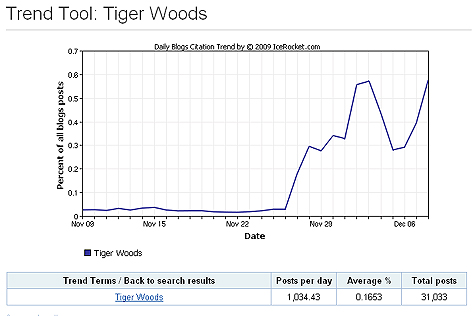
If you did not notice Tiger Woods has been in the news a lot lately. How much? Lets take a look at some visual representations utilizing some of the exact tools that you would use to monitor your brand. Then I’m going to ask you a very simple question at the end of this post.

First we’re going to use the Trend search from Blog Pulse to create a graph that plots “buzz” about Tiger Woods in the blogosphere. We’re going to look at a 6 month window.

How about some search analytics from Compete? Notice an uptick?

Icerocket also tracks blog mentions and real time search trends, look at it’s graph and check out the numbers below the graph.

One of the most impressive and visually appealing of the tools that I used was from Trendrr which allowed us to track qualitative, quantitative, real-time, sentiment, and competitive trends. For the purpose of this post, we looked at Google results, tweets from Twitter and blog posts on Google..

Driving the point home, we now look at Google Trends.

So your team Tiger or your the brand manager for your company and you see these kinds of results. What are you going to do to repair this? What is your first step? How would a large organization manage its reputation after taking a hit like this? What does Tiger do now? What will repair a reputation damaged to this degree? What does Nike do?

The De-evolution of Twitter

How do we move the needle back to conversations? Beth Harte and I were talking about how there seems to be a dearth of conversations on Twitter these days. A year ago we were complaining about the growing cacophony of echo in the Twitter sphere. Now it appears that everyone doesn’t have time to talk, so they just shoot a title and a link out with or without attributes.

My advice would be to take the time to talk with the people that took the time to talk with you. take the time to say something instead of just pushing another link out. Value just doesn’t lie in the quality of the information that you share, but also in the quality of what you have to say.

However the irony is not lost on me on the way that I choose to promote this post. I will go to Twitter and tweet the title and the link. How do you “fix” that?

Twitter goes to India and Japan

Twitter Shows Global Ambitions With Moves in India and Japan

Cuts SMS Deal With Indian Telecom and Launches Mobile Service in Japanese With Banner Ads

India has roughly 457 million mobile subscribers, a massive population that, despite a fondness for SMS, hasn’t been able to receive Twitter updates via text. That all changed this week when Bharti Airtel, India’s largest mobile provider, inked a deal with the massively popular microblogging service that will allow subscribers to send Tweets at the usual text rates and receive them for free.

This just in: They still don’t have a business model but are valuated at a billion dollars.

Posted via web from marcmeyer’s posterous

Share this Post