What’s wrong with social media?

baseball

If I told you I was going to offer you a job where you failed 70% of the time would you take it?  Probably not. What if I told you that I know of just that type of position where anyone worth there salt would kill to be a part of that organization.  Any clue yet? Its Major League Baseball. They pay their players millions of dollars per year to hit a baseball three out of 10 times.  That’s it just 3. The expectations of hitting it 4 out of 10 times are so unrealistic that it is barely mentioned in conversations. It’s rarified air.

If you close 3 out of 10 deals or you are supposed to sell 10 cars and you only sell 3, should you keep your job?

Anthony Bradley from Gartner has spent the past year collecting  social media cases. he’s collected 200 solid social media cases out of over 350 cases, in which he’s tossed out those that either were not really social collaboration, or were clear failures.

His findings?

  1. Cases with good ROI metrics are rare.
  2. Cases with well articulated business results are few.
  3. Cases with activity metrics are more common.

Ok that’s worrisome.

While his research indicates that if you measure success by business results, the failure rate is very high, If you were to measure success by adoption rates (social activity metrics), which is what a lot of social media folk seem to be zeroing in on these days, the failure rate is still high. So regardless of whether you are measuring business results or adoption rates- the failure rate is still high.

What the hell are these people doing?

Interestingly enough, one of his sources for cases was the social software technology vendors, and by a large margin this group could not articulate the specific business value their clients gained by using their products. I find this odd since this would mean that they essentially did not have a) a business plan or b) were never in it to make money or c) just didn’t really focus on that measurement thing.

Again, what the hell are these people doing? Better yet, maybe we should ask, what are we doing? We’re the ones using this stuff. Are we fricken freemium zombies?

Paying baseball players millions of dollars to hit a curve ball 3 times out of 10 I get. There’s a business plan in there. But are we as a group collectively just following the masses down the path not really knowing where we are going but content to just go with the flow? Developers and users alike? Why would they build social tools or nets that failed the majority of the time?

Are we ignoring the fact that failure might be the most common trait in social media?

I still cringe at the thought of the business plan that’s wrapped around ad revenues, but apparently Web 2.0 still seems to be pretty comfortable with that, and not much more. I would think that one would do everything in there power to reduce the odds of failing, but this data right now or what Bradley is asserting, just doesn’t support that hope.

I hope the data is flawed. because if it’s not, I guess we will continue to invest in and support failure. In an open and transparent fashion of course.

Share this Post

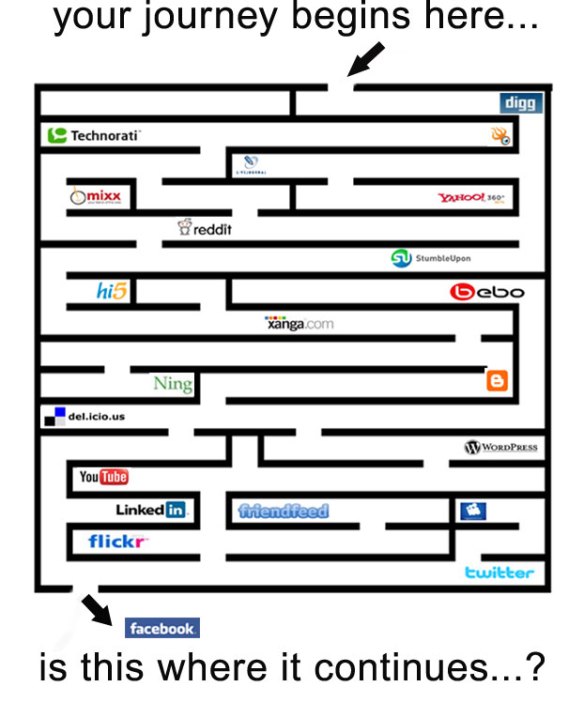
The Social Media Maze

Did you ever read the book, “Who moved my cheese?”

It is the story of four characters living in a “Maze” who face unexpected change when they discover their “Cheese” has disappeared. Now think about your journey of discovery with social media. Doesn’t it somewhat work in the same way? You keep looking and searching for the right fit for your needs regardless of whether you are a business or individual?

At some point, the social network, tool, or service ends up either not delivering what you want, or what you need, so you embark on the journey of finding the next best thing out there. Lots of dead ends, but you keep going.

the-journey2

Share this Post

Social Media Saturation Yes, Maturation No.

baby steps

Not another post about social media…Yes and no, but indulge me.

Yesterday Jason Breed of Neighborhood America and I were talking about elevating our game with hashtagsocialmedia in the same fashion that #Journchat tried to do Monday night on Twitter. Journchat, if you were not aware, hosted some live sessions in a number of cities that coincided with their regularly scheduled Monday night session. It worked to a certain a degree if not for the sake of trying. They get props for trying to raise their game.

Meanwhile, I had been expressing to Jason that I would like to see that eventually happen with Hashtag Social Media as well-namely some type of larger more event like type of setting for #socialmedia; and it was then that Jason brought up a seriously major point.

“What could we say or do that people have not already heard countless  times?”

Which led me to pause, reflect and nod my head in agreement. I think he’s right.  Has social media or the writing and talking about social media reached a level of saturation? In my opinion yes. But with a caveat. Yes, for those of us on the front lines and in the bubble. What more can we read and or write about that has not already been said? What power list have we not seen? What 10 sure fire ways to do something in social media have we not bookmarked, read or saved a half dozen times? How many blog posts about social media measurement have resonated with you? Whose Venn diagram have you saved and shared with your colleagues? How many slideshares about social media have you embedded?

Saturation yes. Maturation no.

After Jason and I agreed that though much has been said and repeated about social media, we both then agreed that there is still much, much more to learn, share, and expound upon. If we were to look at the Gartner Hype Cycle for example or even just your traditional bell curve, and we were to determine where social media, holistically speaking, was located  on the curve, we would both say we had not even come close to critical mass.

Why?

Before you can run you have to walk. before you can walk you have to crawl. The history of social media is but a mere blip on the radar that is social computing, networks and clouds. Its a starting point that we have to get beyond. Let’s quit spinning our wheels about what it is and get to, “What it can do and how”.

We can all continue to write about things that we have all read countless times in different forms, and then we can slap each other’s backs and share it amongst ourselves. or we can step beyond that monotone and truly start to think about social media on business levels and use levels and not adoption levels. Am I wrong or am I just too close to the subject?

Share this Post

The Humanity of Online Social Networks Offline.

universal

Call it the missing link, no pun intended, but after spending 2 days at Universal Studios in Orlando, and watching the mass of humanity at play, I was able to see a cross section of society that one is not afforded in the online world no matter how deep one is into it.

But one tends to think (or rather I start to think) how this crowd source spends its time online and in social networks-if at all. Yet, there were so many similarities between what occurs in an online social network and what I saw, that I just had to share 10 of them with you.

#1 What recession? With waits ranging from 2 hours to 15 minutes, The 2 theme parks we attended were not hurting for customers. $12 dollars to park and no less than $60-$75 per person to get in. Think of Universal Studios as this massive social network, and in a sense it is. But no walls and no silos. The point being- If people want it, they will pay for it and they will wait for it, they will walk miles for it, and they will suffer in the heat for it.

#2  People of all ethnic backgrounds, shapes, sizes, ages and color can some and be welcomed without judgment. Truly a melting pot, both literally and figuratively. A social network where anyone could come in and be themselves with others…Hmmm…

#3 People like to show their individuality, their uniqueness and their affinity to products, teams, people, brands, looks and passions. Their “niche” was in attendance and the park was their platform. This included tattoos, team jerseys, devotion to designers, bands and brands from head to toe, and everything in between. I could have easily segmented everyone there into specific groups, all with healthy memberships.

#4 Everyone was in a fishbowl. I watched, they watched, we watched. From people eating like pigs, parents shouting at children, couples young and old making out, people in wheelchairs, people in scooters, people who didn’t need to be in scooters, folks trying to scam to the front of lines, people not understanding directions, rules or each other, people helping each other with pictures, others letting others in front of them in lines, extreme acts of kindness and of course mean people. What’s my point? Everything and anything was there to be seen. I didn’t have to look too hard. Sound familiar?

#5 I saw zero tie in anywhere with any type of  current social network-which led me to wondering…

#6 How much of this demographic was engaged online via a social network? My initial thought was less than 30% of the total attendees. They just didn’t seem to be the types. Maybe I am way off on this. I did see the potential, just based on the number of digital cameras present, that photo sharing would seem to make the most sense in tying in the activities within the theme parks into sites like Flickr or Facebook. Kodak are you reading this?

#7 Zero tie in with SMS-This was glaring and seemed to have a huge upside as well as potential for either integrating with buying food or a Fast Pass or perhaps park, ride, wait, and show information. 95% of the people there had mobile devices. How was that leveraged?

#8 Tremendous potential to make the experience better for its most important asset, the people that shell out hundreds of dollars per day to attend. It can be even better but I think a certain aspect of smugness permeates the overall park experience for the sake of printing money. In other words,  “We have a hot property, so though the experience could be better, we don’t need to really worry about it…”

#9 Some attractions had zero intuitiveness and thus getting lost even with the map was an issue. Directions were an issue.  Assumptions in the capabilities of the attendees were perhaps over estimated. Hard to change? hard to upgrade? Hard to improve upon?

#10 Technology played a part in the design of each and every ride there to enhance the experience and the destination, but technology could be used even more effectively to enhance the journey all along the way.

My thoughts are this. What makes online social networks work is the individuality, yet the common thread that all people possess. This is obviously the key, or can be the key offline too. The struggle in both scenarios for marketers is trying to tap into that. The struggle for managers is how to deftly address the wants, needs and desires of every segment. The key might be right in the middle of the crowd. The crowd…It’ s in the crowd.

Note* Perhaps one way for us to reduce healthcare costs might be for Universal Studios to quit serving up the Western Diet to so many who obviously  indulge in this far too often. More than 40% if not more who were at the park, were overweight..

Don’t be a Social Media Dick…

NO_JERKS

Wanna know something great about social media? If you’re a dick (in the slang sense), eventually people will know it. Why? Because of the transparent nature of the platforms and its associated tools. You see, if you hang yourself out there far enough, your personality starts to show. Take Twitter for example. If you Tweet long enough, patterns start to form. Just like in grade school, high school and college and at your work. You start to see the personalities of the people that you “hang with” every day.

I used to say and still do, that you can determine the true personality of someone by how they carry themselves in sports. Be it on the basketball court, the golf course, a pick up game, anything.  If you act like a jerk, then it will show.  If you bust your ass, people notice. if you’re a team first type of person, people notice. If you’re a dick, people notice. Well guess what? The same holds true in social media.

Here’s the thing though. In this uber networked world we now live in. You really don’t want the tag of being “the dick”, or even “that bitch”, for that matter. No one wants to work with those types of people, no one wants to hang with those types of people and no one certainly wants to hire or refer that kind of person.

For those that might be the aformentioned, It’s not about trying not to please everyone either; and it’s not about being hard or cool or contrarian. Or trying to have this badass persona. You don’t have to. it’s boring and childish. It’s about being real. and being a realist. Look, we’re all scratching and clawing for the same things here, but if I felt the need to write this, well then you can pretty much figure out that something must be awry.

There’s a term that we should all strive for and one that I think is the ultimate compliment that can be given to someone. If someone says that you are “good people”, consider it the equivalent of being knighted. For someone to say that you are “good people” means that you treat people fairly, you’re generally nice to everyone, and everyone is on equal footing with you and vice versa. It doesn’t get any better than that. It doesn’t mean that you can’t have your moments, we all have them. But for the most part, you’re a solid citizen. In this case, the offline world can and should mirror the online world.

In social media, you can tell pretty quickly and pretty easily who the good people are. Even more so, you can eventually tell who the dicks are. Don’t be  one.

Share this Post

When the social media relationship ends…

The_Way_We_Were

In my previous post about nurturing relationships, I was skewered a bit for not really pinning down the how’s and why’s as much as I was alluding to going out and just doing it. Ok, I get that. perhaps another post is in order in which I suggest specific tools on how to nurture a relationship via social networking. But in the meantime, I wanted to tell you a quick and true story about what happens when the relationship goes bad in social networks.

It goes like this

About 4 years ago I had created an online community to support the sales and marketing efforts of a CPG. Why did I create it? Initially I thought it just made sense to put up a KB with some bells and whistles, but it quickly became evident that something larger was needed just because of the amount of emails and feedback we were getting. I’d like to claim it was some great epiphany but no, it just made sense.  So the community was born. 5000 members strong.

Mistakes are made

I decided to manage it. You’ll be pleased to know that I was not transparent and I hid behind a cleverly stupid name. Mistake #1.

Mistake #2, though we had created a rules and regulations, TOS, policies page, I did not adhere to enforcing them. I would capitulate time and time again in my efforts to make everyone happy. Lesson #1/Mistake #2, You cannot possibly make everyone happy as a community manager.

As I kept my distance from the community and only appeared on an as needed basis, my stature took on the persona of something that resembled the all powerful and mighty Oz. I would come in periodically, settle a dispute swiftly, siding with the person who I didn’t want to piss off and away I would go. Further alienating people as I went. Mistake #3 Not abiding by the TOS, having little or no affinity to the members of the community, and essentially being completely out of touch with the nuances of the community.

To alleviate this headache, I appointed 3 moderators to buffer the criticism. The problem was I gave them too much power and they instituted their own brand of vigilante justice. Mistake #4 I was now playing favorites and siding with the moderators who may not have had the best interests of the community at hand, since they were not being paid and were merely the “appointed” brand champions of the community.

Mistake #5 Instead of reasoning and understanding and trying to empathize with the passionate members of the community, I would throw down the swift hand of justice. I would warn members and then subsequently kick them out. Some got second and third chances, others did not.

When the social network relationship goes really bad.

Instance #1 The person I kicked out, did a blog post on how he would like to kick my ass and kill me. Now this person did have some issues but instead of me trying to reason with this person, who was by the way, a brand champion- I kicked them out. This person was a very very popular member of the group and  once gone, weakened the core group of passionate users and brand champions. Mistake #6 I didn’t realize how important this person was until they were gone.

Instance #2 Another brand champion was just a bit too busy on the site. Always emailing me, IM’ing me with suggestions, how to’s, criticism, you name it. I took it all in stride but he was always seeing how far he could push things in regards to what he would do for the sake of the group and to his page within the site. I found myself always having to check his page, his comments, his posts, and his avatar to see if he was behaving. I was also periodically geting complaints about him from other members, as well as the mods. Which then meant that I had to talk to him  and tell him to chill. It was getting old.

I had warned him on numerous occasions and he would comply and behave for a bit, but not for long. The last straw was him dropping some code on some of his pages which locked down the site for quite some time. That was it. He had to go. So I kicked him out.

From bad to worse

Did he go quietly? No.In short order he did the following: He found every social site that I was a part of and did everything in his power to make my life miserable. He either trashed me, the site, or the product. When he wasn’t doing that, he was creating multiple and I mean multiple personas, and coming back into the community, and proceeding to again, trash me, the product, the company and anything else he could think of to disrupt the site. It was a community nightmare to the nth degree.

So what did I do? I tried to follow behind him and clean the mess up, but that proved virtually impossible. So I did the only thing I could do. I reached out to him and brought back into the community, back into the fold. Why? Because it was easier to “manage him” within the community rather than outside of it. It was a very unpopular decision. Mistake #7 The best move turned out to be the worst moved followed by an even worse move.

By now, most people had had enough and to be honest, at this point, things were starting to die down. The brand champions were moving on, the passion was waning, and there was nothing really happening at the corporate level-that was keeping people involved and engaged in the community.

Lessons learned

So yes, in a sense, the moderators and the administrators certainly didn’t help things. Nor did we learn from our mistakes or adapt from them. But on a larger level, the community life-cycle, the people that made the community thrive, and the site as a whole, were diminishing, either by my actions or just the natural progression of things. Could it have been prevented? Hard to say. The easy answer is yes, but how long would that have prolonged the shelf life? Relationships begin and end and begin again, all the time. In some cases it just wasn’t meant to be and in others it is. In this one, there are valuable lessons everywhere, you just have to know how to look,  and not necessarily where.

My point is this. All of our social relationships right now are thriving in one way or another but for how long? The natural progression of things dictates that most of them will flame out. At that point what is left? What do we have for the effort? Your takeaway?  Understand the value of purpose before the relationship begins in earnest knowing that there is the distinct possibility that the relationship will end.

Share this Post

How to nurture conversations in social media

In social media, social networking and in this web 2.0 world, there is one thing that is and must remain consistent. That is the art of conversation. In order for it to “work”. Conversations have to ensue, they have to abound, and they have to be maintained. Beyond “just” having a conversation, there has to be a beginning, a middle and an end. Or a purpose, right? What social media has really done has created the means to have conversations in ways that 10 years ago we could only imagine. But beyond the means, you now know so much more about the person you are now having a conversation with. And if you don’t know that much about that person, you now have the ability to find out, rather quickly too.

There’s the old school version of communicating

rotaryphone

And there’s the new school.

social-media-icons

But neither works if you don’t adopt the mode of give and take or… serve, receive, and volley..

Sorta like…

pong

In social media, you can serve and hit against the backboard all you want, but you will never get anything out of that except becoming adept at repetition. In other words, you can create social network profiles on all of the hot social networks, and you can write really great blog posts, but if you don’t take the time to go out and share you, your personality and your content with people that have similar interests and tastes, it will die on the vine. Learn how to share your content. Social Poster is a great place to start, but beyond that you need to decide where you and your interests fit in.

Here’s the best example I can think of.

When you first go into Facebook it’s just one big funnel. But eventually most of you find your way, your groups, your peeps, or your tribes. But once you do, joining doesn’t guarantee anything.

Here’s another example.

Penn Station in New York to the outsider can seem incredibly confusing. But really, it’s pretty efficient. What it does is that it funnels and routes people from the suburbs into the city and back again. Like Facebook, each person from their distinct city, town, and neighborhood at the beginning and end of the day can find their way out of town and back home and vice-versa again at Penn station. With a little research, some directions, some effort, and some help, someone can walk off the street and get to the neighborhood, town, suburb or city that they need to get to in the surrounding New York/New Jersey area.

penn

With a little research, some directions, some effort, and some help…you can get where you need or want to go.


Share this Post

20 reasons why social media is such a popular subject…

smm

Below is my tongue in cheek look at why social media is such a popular subject to talk and write about. Feel free to add yours to the bottom of the list.

  1. Because it seemed like a good way to make new friends
  2. Because bloggers see the traffic that comes to their sites every time they write about it, so it must be good.
  3. Seems like a good way to drum up more business for the agency
  4. The content is always fresh because no one has a clue as to what they are talking about
  5. You can be vague and  no one knows it, including yourself and your clients
  6. It’s a good way to become an authority on something in less than a month and then let lots of people know it.
  7. You have a more open forum to complain about things that are free
  8. No one has a clue to what you’re talking about, so you can bullshit your way through lots of  client meetings!
  9. You can become an expert in a little over a week
  10. You  get to use your i-phone
  11. You can let  more people know that you are also a “life coach”
  12. You can waste weeks doing it and still bill the client for the Facebook fan page you built that has 12 fans
  13. You can wax poetic about it on Twitter and get lots and lots of followers
  14. The conferences look like fun
  15. Because though it’s not dead yet, it still has a pulse
  16. Bloggers and spammers smell the link juice in the water
  17. Because there are still a lot of people out there that ask, “Is it like Myspace?”
  18. Because you can measure ROI so clearly
  19. Oh.. and it because it’s easy.
  20. * Seriously * Because collectively we made it that way.

The social value of your relationships

socialweb

This has been on my mind lately. It was amplified yesterday by a tweet by David Armano who tweeted the following:

Have you ever bought something from someone you felt you had a relationship? That’s the ROI of social business…

At which point I responded back with:

@Armano Value..think about your offline relationships-the ones that mean the most, are the ones that carry substance.-same with buying habits

So here’s the deal. In your offline every day world, what relationships mean the most to you? They are the ones that are not superficial. Right? The relationships that have substance, meaning, and value.

Less chit and more chat

The ROI of social business. the ROI of your relationships, as hollow as that might be, are both the same- The ROI is the value that you have built up in that relationship. Both from a business and personal standpoint. If you have cultivated a relationship, then you place a high value on it and what it might return. The less that you have put into it, or what you have received, should be consistent with your expectations and effort.

The same applies to any “online” social network or offline. Though it may seem shallow at first to only say that you only put stock in the people that bring value to you and what you do-it’s actually the truth. It has nothing to do with the technology, the platform, the hardware or the software.

Whether we care to admit or not. We all look for value, we may not say it, but it’s true. Online and offline, value in the people that we connect with, drives our relationships.

Thoughts?

What Social Media is Not

After a few client meetings over the last few days, I found myself going backwards. so I decided to throw this slide deck up. I’m thinking of just pointing any and all future clients here.