Social Media Marketing:Less of Big and more of Small

I jumped in on the weekly #brandchat discussion that was happening on Twitter yesterday to answer the following question:

What do small businesses need to be doing less of?

Great question. Here was my answer…

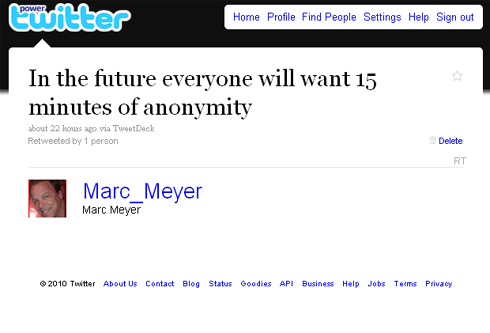
Less of Big and more of Small.

I got an “amen and a hallelujah for that tweet. What did I mean? Hold tight because I’m going to use a couple of baseball references again, but I will keep it short and simple.

The first is this. Did you know that baseball players get paid millions upon millions of dollars to fail seven out of ten times? That’s right. They generally have to hit the ball three times out of ten, and they are considered good at what they do. Why? Because it’s so damn hard to do.

We often overlook or I should say, most seem to think that implementing social media can be done by…

A monkey.

What ends up happening is that folks bail out after a month or so because talking to people, customers,  monitoring sites, creating consistent content, is hard and it’s labor intensive. You have to really work at it and be diligent. Sorta like hitting a baseball.

Not everyone can hit .300.

Funny thing is, baseball players who do hit the ball 3 out of 10 times, work very hard at it, constantly. Some are gifted and it comes naturally-the rest, which is most of them, have to work just to get near .300.

Same goes for creating and planning and implementing social media. It’s hard and not for the faint of heart. You have to believe and trust in yourself and your abilities to get it done.

But you know what? Being a singles hitter or maybe  someone who hits the occasional double in baseball  aint a bad thing. We all can’t be big hitters. Playing small ball is OK.

In the social media world, there are a lot of choices and sites and things that you can do so that you or your client can be seemingly everywhere. That’s really tough and can lead to some serious social media burnout.  But here’s a better idea. Quit trying to be a home run hitter. Play small ball. Be really good at hitting singles and the occasional double. Meaning? Be really good at blogging. Have a solid Twitter strategy. Be honest about what each piece of social engagement is going to bring back. In the baseball world that’s the equivalent of knowing you cannot hit a curveball. Know your limitations and be really good at what you can be really good at.

The payoff? A really long career and a happy client.

In Social Media, Value Is Perspective

Yesterday I was listening to ESPN Radio and Three-time World Series champion Curt Schilling was explaining some of the finer points of baseball, when he came up with the following nuggets of wisdom. They were so insightful for the world of baseball, but when I got to thinking of them more, they started to resonate into other areas. Check them out and tell me what you think.

  • Bad managers lose games by getting in the way.
  • Good managers manage people.
  • Evaluating talent is a crapshoot
  • Value is always perspective.

That last one stopped me in my tracks. Value. Value is perspective. He was talking about how GM’s have to look at talent from the perspective of what it means to the organization and how it can help them, regardless of a person’s age, salary or diminishing skills.

I naturally equated value to what we do in social media and thought that…

Not only is value perspective, it’s subjective as well.

In other words, The way you use social media might not be the way the others do “it”, or the way I might use it, but if it’s working for you and your organization, then who am I to tell you to stop? I can suggest some other things to compliment it, or tell you why it might not be a good idea to do this or that, but in the end if it ain’t broke-don’t fix it.

Value to your organization will be perspective.

Think about that.

The takeaway? You can define engagement through social media anyway you like- just as long as it’s working for you.

For you baseball peeps, here is the interview with Schilling

17 Tweetchats for Social Media, Marketing and PR folks

Yesterday I threw out a tweet about 125 twitter chats worth checking out on Google Docs. I thought I might condense it a bit and focus not only on Tweetchats that I was familiar with, but also those that would benefit the Social Media, Marketing and PR folks out there, and which also had solid participation as well. If I have left any out, please drop me a line and include it in the comments section.

1) Hashtagsocialmedia-#socialmedia Of course I’m partial to the one I co-founded with Jason Breed Advancing the Business of Social Media every Tues noon EST. New topics & new industry thought leaders and A-listers host the tweetchats. Great discussions. all archived and easily searchable

2)#4change is a monthly tweetchat on how social media is helping to create change

3) #b2bchat is a weekly conversation for B2B marketers; Thursdays 8 pm Eastern.

4) #Blogchat is a chat on Sunday nights from 8-9pm CT that was started by @MackCollier to discuss blogs and best practices.

5) #Brandchat is a discussion between experts, strategists, and those interested in learning more about personal branding and managing their personal brand.

6) #Hcsm The Health Care Communication & Social Media community hosts a weekly Twitter conversation about communication and marketing practices by Health Care organizations, including use of social media

7) #Innochat A Tweetchat on innovation

8. #Journchat Conversations between journalists, bloggers and public relations folks started by Sarah Evans

9) #Kaizenblog Discusses using kaizen in *business strategy* Started by Valeria Maltoni

10) #pr20chat PR 2.0 chat for conversations about PR related issues and SM implications, started by Beth Harte

11) #SEO411 Weekly chat to collaborate with colleagues and other marketers about their questions and ideas about SEO.

12) #SMCEDU Discussions about Social Media / Higher Education

13) #Socentchat A monthly discussion on social entrepreneurship, focusing on a particular topic or field each month, eg. Mobile Innovation; Fostering Soc Ent at universities; Support Women; eHealth; etc.

14) #Socpharm Weekly chat on pharmaceutical marketing and social media.

15) #Solopr Open discussions that serve as a companion to the SoloPRpro.com blog, designed for independent PR and MarCom pros – and those who’d like to be. Active hashtag throughout the week, with chats taking place on Wednesdays at 1 p.m. ET, Started and run by Kellye Crane

16) #TNL TNL is TalentNet Live. the #1 monthly hashtag chat for recruiters on Twitter that takes place the last Wednesday of each month at 9pm Eastern at #TNL. Login at RecruitingBlogs.com

17) #U30pro The chat that focuses on issues and trends surrounding young professionals.  All ages welcome and encouraged to join.

There is no point in using Twitter for your business. Wait, Yes there is…

Given some recent Twitter data that shows that most people don’t actually “use” Twitter-Why in the hell should we sit here and tell SMB’s to use Twitter to listen, to monitor and “be” where there customers are when a) Their customers might not be on there, b) They don’t have time to use it and c) Those customers or competitors that might be using it are using it wrong and d) There is essentially nothing there. So chances are, you may not see the point in using Twitter and I don’t blame you.

I can excuse SMB’s for claiming that they don’t have time, because I know of all of the things that sit on their plate, but to be honest, I can also see why they might be skeptical to use Twitter. Turn it on- and it looks like a sea of useless information.

I have a suggestion though and I have a reason why things are the way they are.

If Twitter is not working the way you want it to or expect it to, or in the way you were told it would work…

Change it.

If you’re looking at the state of the Twittersphere in your local area and it truly is pathetic, and it’s giving you cause to think that maybe it’s not worth your time.

Change it.

Be proactive. You start the conversations! Why no be the one to lead and to “make it work”?  You may have to add hashtags that matter. You may have to do more than just pimp your stuff.  But if  you were expecting to “turn on” Twitter and see this wellspring of opportunities and conversations and companies and customers talking about your company-Guess what? It still may be too soon. It may have to start with you. You may have to be the early adopter because there are just not a lot of people using it in your area or wrapped around your business, your product, and your company.

You may not have a choice. But that does not mean that Twitter does not “work”. You just have to work a little.

This weeks #Social Media Topic: Connecting With Consumers Through Social Media

Posted: May 3rd, 2010    By: Jason Breed

The title of this post pretty much sums it up.  So often we get caught up in frameworks and checklists and strategies and everyone is running around looking busy.  Meanwhile, back at the ranch where the real work happens, consumers are still being marketed online.  How could this be?

It is helpful sometimes to take a step back and take a look at what you are doing from the outside looking in.  Consider how your consumers view you online and where they view you.  You might begin to understand why your social programs are performing the way they are.  So many strategies stop at the tools so you end up with a blog or a Facebook page and the strategist goes home.  Inevitably the same marketer or communications person does what they know and starts blasting messages.    As a result, the consumers that you were trying to get closer to actually end up further away.  To translate this back into social media jargon, you end up with an audience of lurkers (assuming they stay that long) when you are attempting to get those consumers engaged.

Jake McKee 90-9-1.com

Jake Mckee’s infamous 90-9-1 pyramid comes to mind.  If you do not make it easy, fast and safe for consumers to engage you will end up with more than 90 percent lurkers trolling your content.  On the other hand, if you take the time to create baby steps of engagement like a simple “thumbs up/down”, share this, or even a one question “quick poll” your audience will begin to engage more.  This helps to establish trust as well.  With trust comes responsibility though.  If you allow members to digitally attack each other via comment threads, etc then you will end up with the same 4 people running your site like street dogs marking their territory on trees.  Curating community content to keep it safe will go a long ways for members to want to contribute and connect with greater frequency.

Once they are connecting with higher frequency, what’s your plan then?  What messages do you want those consumers sharing?  Your consumers have 2 experiences with every interaction they have with you.  Those 2 experiences are perception and reality.   If you ask for suggestions, get them and never respond or even acknowledge them, the consumer’s perception is that you really don’t care.  All of these experiences get crafted into a story that is told and re-told online, at dinner parties, at the gym and anywhere else someone brings up your store, brand or product.

If consumers are your storytellers, then shouldn’t you have a plan to help shape that story every chance you get?  Two main themes are emerging: 1) enable consumers to connect with you more frequently and 2) have a plan in place to help mold their story about you once you do connect.  Sound straightforward?  If it does then you have never had to a) manage a community first hand, b) never been responsible for results or c) all of the above.

By design, our moderator has a lot of experience doing both.  Kyle Lacy is the head of Brandswag and a highly sought after social media practioner for businesses.  Kyle will lead a discussion around how to better connect with consumers by converting more passive consumers into active consumers of your brand and what to do once they become active.  This discussion will follow our weekly Tuesday event schedule taking place 5/4 at noon Eastern.    The topic and questions will be:

Topic: Connecting With Consumers Through Social Media

Q1) What are ways to move customers up the interactive chain from lurker to influencer?

Q2) What’s the value of storytelling vs. messaging?

Q3) How can you get customers to take action on your behalf and tell the story for you?

The event will begin with Q1 at noon eastern followed every 20 minutes with the next questions.  To follow along and add your POV simply track #sm58 via any Twitter client or follow along via our LIVE page.

Posted via web from marcmeyer’s posterous

What drives participation in a social network?

If you’re a social media consultant like Jay Baer, or a larger organization like Accenture for instance, one of the constant constants in social media is the amount of education required to get people all on the same page, before anything can really be accomplished.

With that being said, once people are “there”, and they “get it”, they can see pretty quickly what the trans-formative nature and power of  social media is like, and what it can do.

But it took a post from the The Next Great Generation to open my eyes to what we are really talking about here and what really drives participation in social networks. It’s amazing that I can be so immersed in it and not really see what is going on. Check out these quotes from the post:

There was no validation that what I did was comment-worthy, no “cute” notations on Yelps, no retweets of my witty Twitter updates

and

Social media validates my feelings and actions. Seeing them online makes them real and takes them out of me, much in the way that I imagine it would be to keep a diary.”

What is the common theme there? Validation. Simply put, what we do in our communities needs to be validated. No one likes to create content in a vacuum. Conversations become just that, conversations, when someone responds to you. We need that reaction. the dialogue, not the monologue. Be it positive, negative or indifferent-the social creature in us needs the juice.

As well, by simply creating and putting it “out there” validates our existence in these social networks. We become “part” of the dynamic of the group, of the community. You are a creator and you’re validating yourself for the group.

Crowds applause-that validates. Social Media flash mobs go nuts over corporate missteps-they validate each other in unison and then are further validated by Twitter, blogs and reaction from the company itself. All forms of validation.

You write a blog post or tweet something or create a video, or write a review-you do it because you want to become part of something and it all rings hollow until someone notices and says something. Blogs were and still are great because not only did it provide a forum and platform for self expression but it also provided instant feedback.  It validated both readers and writers.

Social media engagement is all about validating each other and our experiences and the content that we have created and…shared

Consider:

  • A high number of views=validates
  • A high number of blog comments= validates the topic
  • Trying to creating a video=searching for validation
  • Snarky comment on Twitter=need for validation

The list can go on and on but I have to thank the folks over at TNGG for validating what I had completely missed in this space. You see, it’s the little things that can sometimes go completely unnoticed, and once you notice them, they aren’t so little after all.

This Weeks #Social Media Topic: Managing the Marketing Mix: Which Channel is More Effective?

Posted: April 26th, 2010    By: Jason Breed

On its surface, this topic is a “status quo” topic, one that fits into the traditional advertising model that says radio, television and print are channels therefore the Internet is a channel too.  Agencies and old-school marketers feel comfortable when discussing digital as just another channel.  They figure if a portion of their budget allocated to digital and they tweak their messaging to match the medium then Whoalla! we are all new-age digital marketers.

The problem with this approach is it assumes consumers are the same and want the same messaging pushed at them to interfere with their online entertainment just like they consume television or radio entertainment.  Consumers have changed!  Consumers do not shop the same, communicate the same, consume content the same nor do they react the same to advertising.  When it comes down to it this topic cannot be about marketers adding a new channel, it has to be about those marketers who can adopt to changing consumer behaviors and those who cannot.

Consumers no longer want to be talked at, they want to be engaged with.  They want to see who prepares the food and talk with the baggage handlers, they want to feel they have a voice in determining the features of their next car model and want to help select what charities their soda maker donates to.   The majority of companies today are not set up to handle this new consumer.  Decades of closed systems and legally approved content are getting in the way of companies trying to interact with the consumer.

So what is this post about then?  Even though consumers are changing their behaviors by the second, companies can not move that quickly.  Companies need to have some transition period to move from traditional to digital and it’s not just in the way they advertise.  This is a cultural shift,  a systems shift, a shift in processes and approvals to a more distributed workforce.  This is much more than simply a messaging shift.

This post is about transitioning.  Many times, the only way to move the needle or to convince traditional executives is with proof.  That proof comes in comparing what they already know and are familiar with and in a way that they understand like reports and measurements that can compare traditional apples with digital apples (apples to apples).  If you measure traditional marketing with reach (ie. magazine has 100k circulation + 2 times pass along and costs $5k) and sales (call volume rises when our infomercial airs and conversion increases 12%) then your digital marketing reports cannot use language like followers, subscribers and linkbait, they must be consistent.  The good news is with proven success comes additional funding and a higher tolerance for experimentation.

Once you are able to measure and report consistently across traditional/digital and begin to show positive results, how do you determine how much is the optimal amount to spend on each?  Again, a fully integrated interactive marketer does not allocate a bucket of monies per channel.  Integrated messaging and consumer engagement is determined by the need at the time.  If a customer makes an online mess, it may require an online video response or it may require an actual television ad to express your point-of-view.  In order to stay flexible and meet your daily needs you cannot have a pre-allocated budget based on channels that was set 9 months ago.

In staying with the theme though, you need to be able to show value as you transition from traditional advertising to more integrated.  You have to show that any investment is worth the return before executives will release additional funds and approve more experiential marketing.  In light of that, what is the right mix?  Ford transitioned 25% of their marketing budget to social.  Seems like an arbitrary number but what is the right mix for your company as it transitions from what it was to what it needs to be?

To help us get a better handle on the right marketing mix for your company, we are bringing in a moderator this week who not only understands the measurement and monitoring side, she also understands the business side and promotes the advancement of companies into a more integrated marketing approach.  Amber Naslund, the Director of Community at Radian6, understands organizational change is just as important as technical change is and knows how to get people there.  While there is before digital (traditional) and after, more importantly there is a during or a transition that not many can talk to except Amber.  This week’s topic and supporting questions are as follows:

Topic:  Managing the Marketing Mix: Which Channel is More Effective?

Q1:  How do you know your traditional marketing efforts are effective?

Q2:  How do you know your digital marketing efforts are effective?

Q3:  What is the right budgeting mix between traditional & digital?

Be sure to join us Tuesday April 27 at noon Eastern and participate by following #sm57 from any Twitter client or simply goto our LIVE page during the event.

Posted via web from marcmeyer’s posterous

The catalysts of social media

Earlier today I mentioned that I would love to use the words granular and linear when I talk to people about social media and marketing, but my mind doesn’t work in a linear or granular fashion. I’m more of a black and white type. I like to distill things down.

As I was walking my black and white dog this morning I was struck by a notion that really, what might be driving widespread social media adoption are 2 simple things.  Word of Mouth and Search.

A social network happens because of what? Because someone told us about it or we did a search. Pretty much, right?  Yes there may have been an accelerant( see traditional marketing) that drove us to the social network, but for the most part how we get there is pretty simple.

Children, Parents and Social Media, the need for education

This past Monday, I sat on a panel in Naples Florida where we talked about social media and children. It was put on by the Collier County School Board and the panel consisted of law enforcement officials, representatives from Naples High School, and an individual from the Naples Daily News as well to name a few.

Throughout the 2 hour discussion I was amazed at what I heard but not surprised, and thus I jotted down some things. Three of the recurring themes coming from everyone’s lips on the panel were:

  • Education-It might seem as if that is a redundant thing to say in this type of setting, but it cannot be stressed enough how important it is to not only educate your children on the perils of certain aspects of social media, but how important it is to stay on top of it as well. the big follow up question to this was, “Where are we supposed to go for that information and education?”
  • Accountability-Social media has now made everyone accountable for what they do and what they say now. Yet children do not realize the larger implications of their online actions and interactions in social networks. As parents it’s important to understand the broader implications of social media missteps.
  • Communication-Ironic that the “thing” that helps us communicate with more people, seems to reduce the amount of communication  amongst us. But in order to stay on top of what your child is doing and who they are doing it with, what they are saying and who are they saying it to, and what they are sharing and uploading and who that is with, you have to communicate and you have to do it a lot. In other words, talk to them, ask them questions, be proactive not reactive. Don’t be afraid to dig a little.

Along with the discussion were a few links that I had suggested that parents take note of:

Knowem.com-KnowEm allows you to check for the use of your brand, product, personal name or username instantly on over 350 popular and emerging social media websites.

UsernameCheck.com Similar to Knowem.
123people.com-123people is a real time people search tool that looks into nearly every corner of the web to find comprehensive and centralized people related information consisting of images, videos, phone numbers, email addresses, social networking and Wikipedia profiles.
Facebook.com/help/?safety-Facebook takes safety very seriously and strives to create an environment where everyone can connect and share comfortably. Find answers to a variety of safety questions here.
It starts with this and continues with a willingness to educate and share. Social Media is not bad and I had wished that we might have spent some time on the positive things of social media-Perhaps another session is in order for that.