Social Media Rock Star Syndrome

Twankers, Rock Stars & Gurus – Authenticity In A World of Exploding Egos

The term “Authenticity” get played out a lot.  I mean – ALOT!  It gets used to discuss personal branding issues like what kind of avatar should you use and how to disclose if you get paid to communicate a product or experience.  Authenticity is used to discuss ethics in business including can you outsource moderation of your community or what if corp communications manages the CEO’s blog?  Most of the discussion comes down to the distaste for people trying to be posers online.  The fact is whether online or off, people are going to stretch the truth (or outright lie).   It happens.

This week, we wanted to change up the conversation a bit and look at it from a personal perspective.  Authenticity is a way of being and not something that can be attained by following some corporate policies.  While there many people who start out being truly authentic it’s interesting what happens when some get a few wins under their belts.  Somewhere they begin believing everything they hear and their ego gets in the way of what was once rational thinking.  Kind of a “forgetting your roots” scenario.

Then we have the people who stay true to their character despite success or sometimes fame.  Our moderator this week certainly fits the latter description.  Rohit Bhargava is a SVP at Ogilvy 360 Digital  Influence (which he was a founding member) and is the author of the award winning book Personality not Included.  Despite his success, he remains truly authentic at every level.  How does he do it? We”ll find out this Tuesday at noon EST.

Something a bit different this week as we will start out with everyone sharing their thoughts on who, today, exemplifies authenticity whether famous or not.  Then as everyone joins we will start with Q1 that asks an interesting question.  For businesses looking to get established in social media, do you need to task someone who has already built up their own personal brand or can you be successful in building a corporate brand even though your personal brand is not established?  The next question should be a hot one.  Let’s say you have social media success in the consumer packaged goods industry, are you qualified to lead a team from the healthcare industry?  In other words, is social media the same across industries or do you have to specialize.   Then Rohit will tackle a question that centers around the idea that some contend extensive personal branding can detract from a company’s branding efforts.  This week’s topic and questions:

Topic:  Twankers, Rock Stars & Gurus – Authenticity In A World of Exploding Ego

Pre Q1: Who do you feel lives up to being authentic in the digital world?

Q1: Do you have to ROCK your personal brand in SocMed before you try to ROCK your company’s?

Q2: Does Social Media expertise transcend industries?

Q3: Does personal branding compete with or add-to your Company’s market influence?

With Rohit, we are in for a fun chat that is sure the raise the bar for all of us.  Plan on joining us Tuesday at noon EST by following the #sm34.l

 

Posted via web from marcmeyer’s posterous

Gov 2.0,The FDA, and Social Media

FDA_web_logo

Listening to The FDA hearings on promotion of FDA regulated medical products using the internet and social media tools, was both fascinating, frustrating, and groundbreaking.

First and foremost it’s a glimpse into the process in Washington of the FDA trying to learn more and to get up to speed on topics such as:

All of this done through snackable content consisting of no more than 10-15-20 minute presentations to an FDA panel.

More importantly however, what struck me was the ability to listen and watch the FDA hearings online, comment and share what we heard and saw via the Twitter hashtag #FDASM and then read the follow up blog posts from some of the participants. One suggestion: The FDA panel would be smart to go back and read the #FDASM back channel, because the conversation there, was both enlightening and incredibly observant.

As well, Google Docs spreadsheet had been created so that users can see  speaker name, company, presentation, and email and talk to those who are viewing the document at the same time that you are!

Transparency is reaching Washington.  Gov 2.0 is in action for the people. This doesn’t mean that this will speed up the process of the FDA doing anything within the next 3-6-9 months based on what they have learned, but now people have been able to glimpse something tangible, and actually participate in more ways than ever before. Hopefully Washington is starting to get it.

I applaud the FDA  for realizing that they need to understand the power of online medical information, the power and impact of search, and the power of social media, and the effect that it can and does have on consumers and..the way that Pharma can manipulate it. This is a big step and yet at the same time a small step. Either way, they are both steps in the right direction.

Social Media Solution #98-Make your own Kool-Aid in a down economy

koolaid

I don’t always drink my own Kool-Aid but I think I have a good reason. I don’t have time to wait for certain aspects of social media to “Take-Off”. That’s a mistake on my part and I need to remember that social media  is labor intensive.

I’m guessing you might not be drinking the social media Kool-Aid either. Or eating the dog food for that matter. You have to do what you have to do, and do it quickly, right? I get that. Believe me, I get that. You see, I’m fighting as hard as I can to stave off the creeping vines of an area hit hard by the recession and subsequent mortgage fallout. We all are. It’s hard; and never has the value of what you do and what you propose ever been more under the microscope. So the notion to abandon social media has not been lost on me.

You see, chances are, if you have game, you are not the only game in town. I know I’m not.  So even though I know my stuff and I know social media can do wondrous things for companies, that’s not necessarily an automatic “win” for either one of us. I have to compete with those that can do it and those that are pretending to do it. Because of that, I have to prove myself and prove success constantly, and show I’m drinking the Kool-Aid. All of it. And you have to do it too.

Wouldn’t it be nice if companies had the time, the patience and the resources to do it right? And to implement what I propose and for the dollar amount that I suggest? You betcha, but they don’t and neither do I. Neither of us has much time. Do I tell them what they want to hear? No. As much as I want to, I can’t.

So how do we ride out this storm? How do I ride out the storm?

  • Keep drinking the Kool-Aid
  • Work harder
  • Work faster
  • Think differently
  • Listen more
  • Do more
  • Do more with the resources you have
  • Eliminate the “Why’s”
  • Increase the “Why Nots”
  • Focus
  • Don’t cut corners
  • Go the extra mile
  • Over deliver.
  • Exhaust the possibilities.
  • Fish where the fish are.
  • Think.
  • Strategize.
  • Give more
  • Share more
  • Give back
  • Believe the harder you work, the luckier you get.

And remember…

Don’t just drink your Kool-Aid. Make the Kool-Aid.

November 10th #Socialmedia topic-Social Media’s Impact on Business and ROI

Social Media’s Impact on Business (and ROI)

gas_powered_blender

Feeling like stirring the pot a bit this week so we thought a discussion on ROI should do it.

ROI certainly can stir the pot.  But, saying that most of everyone’s conversations on this topic are not actually ROI, rather Impact on Business (IOB), takes the act of stirring and turns it into a blender.  Ahh, much better!

So let’s start by saying that just because it’s “social” does not mean it should be held up to standards typically defined by financial returns whether in business, government or non-profits.  Someone can start a blog or join twitter simply to better understand the tools or to connect with associates they just met at a conference.  This becomes truly social and may at some point have an impact on your business whether financially or some other measure but does not need to be tied into sales goals just because an employee wants to post office pictures so other offices can see how they decorated for the holiday party.  That’s a beginners first step into social computing but not what we are interested for this discussion.

What we are looking for here is to better define and understand what we sometimes mean when we refer to ROI as a verb instead of referring to ROI as a financial metric.  The real definition of Return on Investment (ROI) is: gain from investment minus cost of investment, then divided by cost of investment.  Business books are written, classes are taught, and undergrad studies are derived from this very straightforward metric.  When I talk about ROI, I try to dumb it down a bit into either: 1) increase revenues, 2) decrease costs, or 3) increase in shareholder value and that assumes a financial investment of course.  So why then, does the term ROI get thrown around so much in the context of social media when no financial gain or costs saved are referenced?

Impact on Business (IOB) is the actual term that should be used when discussing things like: # of followers, brand awareness, mentions, impact, conversations and what ever else you can think of that is not related to a financial calculation.  The impact of an employee being nice on twitter is great.  The fact that the customer decides to continue service (Retention) as an indirect effect does not make the time that employee spent on Twitter an actual case for ROI.  It is however, IOB. Olivier Blanchard actually was the first that I know of to begin this discussion a few months ago here.  Companies all over are using social media to have an impact on their business like Kodak measuring Smiles or any company promoting their Facebook fan page.

Many industries discuss IOB like fast food, IT, or big box retailing and it affects every company’s business in some way or another.   You can even consider different departments of a company and the impact of HR, Payroll, PR, Sustainability, Operations play in a company.  Although often not connected directly to revenue, a company would have a difficult time without those departments.  Impact is easier to measure if you don’t have to tie it back somehow to ROI and ROI is much easier to measure if you don’t try to include calculations of impact.  To lead our discussion this week is Jacob Morgan, a principal at Chess Media Group, who focuses on Social Media ROI.  Jacob is well versed in this type of discussion and brings a lot of expertise to the table.  The questions will attempt to progress the discussion from ROI as a catch all phrase to the differences between Impact and ROI for businesses and how to align them.  They are:

1.  Whether Impact or ROI, what “Investments” could be measured to prove out value in Social Media?

2.   How can you prove value from Impact or ROI to executives to continue or try Social Media?

3.  What are some examples of businesses attaining true ROI from Social Media?

Plan on joining in this discussion Tuesday 11/10 at noon EST.  To join either follow #sm33 on Twitter or follow our LIVE site.


Posted via web from marcmeyer’s posterous

Talent is Everywhere On the Social Web

I met Sue Spaight through Twitter. She’s one of the smart one’s but she won’t tell you that. But what she will do is call bullshit on you if she has to. She’ll force the one’s who are smart, to think about another box and not just the one they’re currently thinking outside of.

I had the pleasure to meet Sue a few months ago and even though our conversations were too quick, I was glad to see that she was just as genuine in person as was her written word.

For that reason, another really smart and genuine mutual friend of ours,  Tom Martin of  Zehnder out of my home town of New Orleans, turned me onto Sues’  “Realist Guide to Successful Social Strategy”.  After viewing it I asked if I might embed it. Sue gave me permission to share it and I think it’s worth sharing.

Is the social web the answer to our ailing economy?

I’m going to guess that for a majority of the people out there, the answers that they seek are not in social media. Nor is social media the answer for a lot of businesses that have fallen on hard times. But damned if they are not looking.

They lift up the hood and they see this

social-media-logos

Yet the number of searches going on for the term “social media” per month hover close to half a million. So for most, when they get those search results, and try to make heads or tails of them, it looks like this:

wires

Yet people are wanting to know what it is and how they can make it work for their business. They’re searching for the answer. And the answers they find come from people who have never done it.

They are social media virgins

What social media has done for a lot of small businesses and large ones as well, is it has provided hope at a time when there is not a whole lot of good news to hang your hat on these days.

Hope is not a bad thing because it’s closely aligned with dreams, and right now for a lot of people, that’s all they can bank on. It’s why they wake up every day. Except hoping social media is going to change your business, it’s culture, and the people using it, and ultimately save it, is crazy. You’re looking for a quick fix and sadly, social media is not a quick fix. That doesn’t mean however, that it doesn’t work, because it does.

But there are people out there claiming that they can make social media work for your company and save your company quickly. Be wary. be very wary.

Social media is not the solution to what is ailing you. In fact, there is a strong likelihood that what is ailing you, is completely out of your control. But you are looking for ways to break out, to try something, anything that will turn the tide in your favor. So you’re looking at social media, looking at it hard.

The ripple effect of a bad economy if you will, causes you to look at everything in a different light. Including social media.

Yes, Social media is transformational, it just doesn’t happen over night. I wish it did, but it doesn’t. Chances are, the more you can wrap your arms around what social media can’t do and what it’s not, the better off you will be.


The Depth of Your Social Media Growth

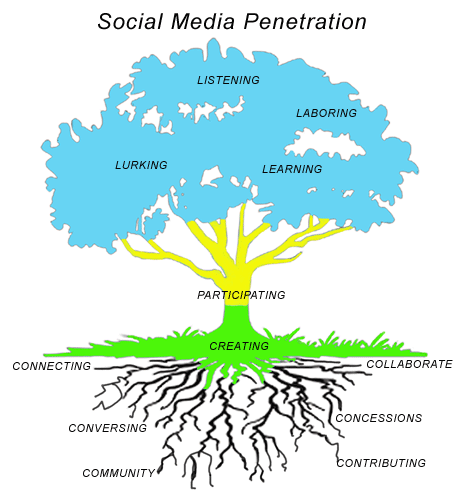
If you were to look at the following image, what would you say the expanse of your social media exposure, involvement or engagement would be?

smpresence

Let’s assume that  we all start off as seedlings in social media, and as we learn more, we grow. As the tree grows, so does our comfort level. Eventually we branch out and we all go in different directions, yet we all come from the same seed. We all have the same background and the same foundation.

It should all start with listening, learning, lurking and laboring. Lurking? Yes, lurking. Call it passive participation, but we all have done it. We watch the conversations, wondering where we can insert ourselves into them. If we don’t we lurk, we hover if you will.

Laboring? Even passive participation takes work. It takes effort and you have to put forth effort.

As we progress and grow, we become more comfortable in our need and desire and ability to contribute to the conversations around us. It’s a natural progression. But to make the leap to creating content is a bit more longer and takes a little bit more growth.

On the surface and by the looks of the tree, it almost seems that we all should or could be part of the yellow on this tree. However even those that are most comfortable with social media right now are not part of the yellow.Yet the desired or expected outcome from participation and creation lies in the blue areas of the tree.

Yett if we look at Forrester’s Social Technographics results, surveys show that when it comes to social content 21% of online US consumers are Creators, 37% are Critics (those who react to content created by others), and 69% are Spectators, meaning that the majority of people in Forrester’s survey would find themselves more at the root level of the social media tree.

Look at Jake Mckee’s model. The 90-9-1 Principle where 90% of users are the “audience”, or lurkers. These people tend to read or observe, but don’t actively contribute.

9% of users are “editors”, sometimes modifying content or adding to an existing thread, but rarely create content from scratch. and 1% of users are “creators”, driving large amounts of the social group’s activity and  driving a vast percentage of the site’s new content, threads, and activity.

If we look at it from that standpoint then the tree will be inverted, where it’s all about how “rooted” you are and how deep your social media penetration is. The deeper, more involved you are, the more rich the experience is.

smpresence2

So which version of the tree are you? Where do you see yourself? Should the tree be a 100 year oak or a common weed?

#SocialMedia TweetChat led by Scott Monty-A different approach

Ford’s Fusion 41 Challenge – What Are We Missing?

October 26th, 2009

Sit down and buckle in (literally), this week we are taking the #SocialMedia discussion in a very different direction.  Instead of learning during these chats, we have been asked by Ford Motor Company’s Scott Monty to helpford-logo-big teach.  If you are not aware, Scott is on a tear of late with the tremendous success of the Ford Fiesta Movement, he is now going for the equivalent of an encore with the Fusion 41 challenge.  Their newest challenge asks for:

  • Current 2010 model Ford Fusion owners/leasees to apply for the challenge
  • Eight (8) teams (to include the owner and four (4) team members each) will be selected
  • Ford will provide a 2010 Fusion model to each team to compete with
  • Teams will perform a series of challenges taking place over a 3 week period.
  • To coincide with the Fusion Hybrid’s 41 mpg rating, the challenges will take place every 41 hours
  • Team members will complete a task and “hand-off” like a baton to the next member
  • All the while, team members are required to post content and updates across their social networks online

The winning team’s leader will get their new 2010 Fusion paid off and the team members will get free gas for a year.  If you want all the rules check here.

So how can all of us help Scott Monty and Ford Motor?  Well, hang on a second and we’ll get to that.  First, it’s important that you understand where they have come from and where they are going.  This deck from Scott’s recent keynote at OMMA Global 2009 provides a good overview and some insight into Ford Motor’s social media marketing strategy.

View more presentations from Scott Monty.

If you notice, the last content slide lists “Listening to our community for suggestions”  and that, my friends, is why we are all here.  Scott has asked for input regarding Ford Motor’s latest social media marketing project, the Fusion 41 challenge.  The format will be similar to prior weeks with 3 questions, a new question every 20 minutes.  The difference is the questions.  Scott will be providing insight into the planning of the campaign and we will be providing recommendations in how to think differently and possibly add a new dimension to the initiative.

Yes that’s right, for an hour we will all be honorary social marketing consultants for one of the hottest social media brands out there.  Please note: any suggestions made by you during this one hour +/- event are provided for Ford Motor and Ford Motor may use your suggestions at will.

Topic: Ford’s Fusion 41 Challenge – What Are We Missing?

Q1: Evaluate the WOM/Influence strategy

Q2: Evaluate the online marketing strategy

Q3: What are we missing to make this truly exceptional?

Posted via web from marcmeyer’s posterous

On Leadership and Chris Brogan

Last week I talked a lot about pushing the envelope in how we approach social media leadership. And with good reason. If we’re to get to that next level, we have to quit talking and start walking. Quit repeating and start leading. Raising the bar if you will.

For a lot of you, you have the 101, 201, 301 and 401 classes down, and it’s now time to graduate. You don’t need any more proof and you don’t need to talk about it any longer. It’s time to put rubber to the road. But I have a feeling a lot of you are going to miss the critical underlying point of all of this.

You’re going to miss the point about how much work it takes.

Whether it’s your “personal brand”, your company, or your client, there is still a lot to be done on the “roll up your sleeves” side. Case in point, Chris Brogan, who most of you should know or heard of, is not an overnight success. Before Chris became the face of the social media industry, speaking everywhere and seemingly showing up at every major conference, I knew him as just a content producing madman providing direction in the nascent world of social media.

Today, he still cranks it out, but there is even more on the plate than ever before. Yet he has more than put his time in, and yet he still has not relaxed or let up. He even says as much in the below videos. To that end, Chris even managed to host one of our Hashtagsocialmedia tweetchats!

He’s reaping the rewards of his efforts just now.

In his 3 part series Chris doesn’t so much give you the secret to his success, as much as he he merely lets you know that he is far from being an overnight success and that he has been busting his ass for the better part of 11 years. The secret sauce? The harder you work, the luckier you get. Enjoy the videos.

Share this Post