This weeks #socialmedia tweetchat topic: The Next Big Thing is So Last Year #sm49

When: Tuesday, March 2nd / Noon Eastern
Hashtags: #socialmedia, #sm49
Topic: The Next Big Thing is So Last Year

    In the 49th edition of this popular and long-running chat series, Greg Verdino of Powered and Crayon fame,will be tackling on of his favorite topics and biggest business bugaboos — marketers’ exuberant (and often irrational) obsession with the next big thing, the flavor of the month, the latest but not-necessarily-greatest shiny object. We’ll plan to cover riff on three key questions:

    • Why are marketers so obsessed with the next big thing even though so many turn out to be next big busts?
    • How do you balance the benefits of strategic innovation with the risks of constantly chasing shiny objects?
    • What’s the one social media “old thing” most marketers still get wrong?

    Posted via web from marcmeyer’s posterous

    so you think all social media relationships work?

    so there’s this “social media” guy. he’s very influential or seemingly so and everyone seems to know him and like him. except me. i don’t like him, but i have a legitimate reason. i asked him to do something for me and he agreed to do it, but getting him to lift a finger was very difficult. i was getting rock star attitude coupled with “i’m really busy” bullshit.

    i pressed him to get off his ass and he pushed back.

    i apologized (1) since i was asking him to do something for me. i apologized (2) some more and blamed it on crossed wires when communicating. it never got any better. i got more rock star attitude.

    i apologized (3) one more time and not only did it not get better, but the project was a complete bust because he decided to just suck at it. he mailed his effort in. nevertheless, after all was said and done, i thanked him and apologized once more via twitter(4) and even via email (5)

    since then, i’ve continued to try and reach out to him casually from time to time to see indirectly if all has been forgiven or forgotten, and have been acknowledged zero times; and thus, have come to realize that with some people it is just not meant to be. i’m sure he’s a great person and by all intents and purposes, he appears to be and if he got to know me, he’d learn that i’m not so bad either-but i guess neither one of us will ever find out.

    you see, not every social media connection or relationship results in this beautiful harmonious situation. some of them suck and some just don’t work.

    at the end of the day, we’re still square pegs running around with round holes…

    Is your reputation based on popularity?

    Last week I wrote about how I was rethinking the whole influencer thing and I wanted to explain what I meant. Actually what I meant can be explained in the title of this post, but I’ll expound just a bit more.

    Because of the nature of today’s media and how it is packaged and produced, there has never been a larger premium placed on popularity. Unfortunately, because of that, authority loses out. So what happens? Reputations  are rooted in results  that emanate from the right media channels, total number of views, high follower numbers, saying the right thing at the right time, or  just not being vetted properly.

    For example, someone that we should look to for trust, authority, leadership, knowledge and guidance, might lose out to someone like this…

    Thus you and I may be putting value on something that may be a “Knock-Off”.  You know what a knock off is? The $10 item that looks like the real $500 one. No one knows the difference, unless you start to really “look”.

    So how does one build a solid reputation in the social media world? How do you become a trusted source of information, a treasured resource, a valuable asset?  Maybe you can answer the question if we pull the term social media off the board. Pick any industry you want. Take the media out of the equation. How do you assign trust, leadership and knowledge?

    How is it assigned to you?

    You build it over time. It’s cultivated over time. It’s earned. Don’t treat your online relationships as commodities and don’t base the relationship you create on arbitrary numbers. And don’t let it define how you are perceived. You wouldn’t do it offline, so why do it online? If you want to be a difference maker in social media, it first starts with making a difference; and not with having more followers, friends and fans.

    I have a client…

    I have a client who has been with me for quite some time now, and last week I got a really strange email.  It merely said.

    Call me.

    So you know what went down. I knew what was up. When I called him last week, he told me that maybe it’s time to end the relationship. But in a nice way. He told me that business has been way down and I knew that it had been, so it came as no surprise.

    No amount of speaking to customers through various means of social media and optimizing websites was going to make their business pick up given the sorry state of the economy in portions of the rust belt. Though they are a national company, a good chunk of their business is in the Northeast. Plus they sell a frivolous type of product.

    And yet, as soon as he told me that, the heart skipped a beat and the little sweat you get on your temples started to form and I immediately went into “save” mode. But there’s one problem with this.

    He may be right, it might be time to cut the cord with one of my oldest clients.

    I know it’s a sobering thought because no one wants to see their favorite client walk, but the reasons it might be time are many. For starters, what I set out to do for them has been 100% successful. I was brought on as an SEO and social media marketing consultant, and I’ve done everything and more for them. I’ve been their tech source for information and I really felt that I have indeed helped them.   Here’s a short list of “some” of things I’ve done for them:

    • Reworked/redesigned website for better customer engagement.
    • Created a major SEO campaign that optimized complete site for hundreds of  keywords all of which now rank organically on first 3 pages of Google.
    • Created a Flickr campaign to optimize their thousands of images and to contribute to Universal search results.
    • Created a blog that drives significant traffic and also ranks organically on first page of Google.
    • Created Facebook Fan Page-nominal success but contributed to overall brand awareness.
    • Created Twitter account that results in10% CTR and 2-3% sales on all links.
    • Responsible for online sales growth and higher average sales ever year except one. 2009…

    So though he’s telling me the gig might be up, and he’s probably right, I’m sitting over here wondering what more can I do? Are there things that I have not yet tried that might get me a double, or a triple even, instead of  a weak ass bunt? Something big…Impactfull… I’m not so sure. Maybe…

    The last thing I really want to do is take their money for not doing anything, but short of making the horse drink, I have led the horse to the proverbial ocean. Problem is, it’s an ocean, it’s salty and we’re gonna have to look around for an oasis and it might take some time, and might cost some money. Both of which are in short supply right now.

    Will my client be better served by someone else with like minded skills? Selfishly I say no, but that might not be the case. I do know this though, they will not find someone with more value than me as it relates to what they deliver and what they charge.

    So at the end of the day, as I peel through Peter Kim’s wiki, looking for that “thing” I haven’t done yet, thinking there might be some “other” things I could try, the reality is, as you know, that not every social media solution is the right solution for every client.

    I don’t know what else I can do but maybe just shake their hand, maybe give them a hug, thank them for being such a great client, and end it.

    Rethinking the whole influencer thing

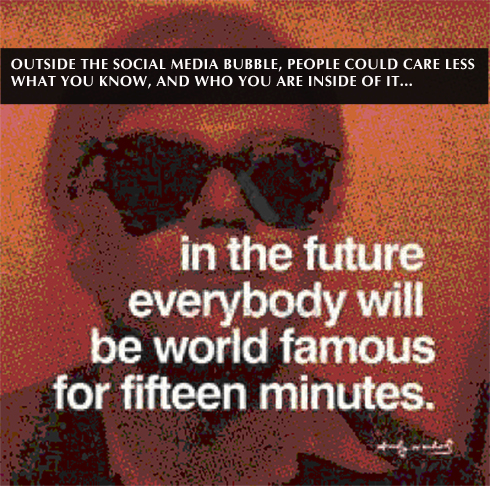
    Rather than try and throw together a post with lots of juicy links about a sexy topic that might get lots of love and some retweets, I wanted to just throw this thought out there. It has to do with bubbles. in this case, social media.

    For the majority of us, we operate in bubbles. Our lives consist of numerous bubbles. work bubbles, play bubbles, family bubbles… In some cases, our self importance is derived from our bubbles. What do we mean to the people that are in our bubbles? I’d like to think that I influence those in my work bubble. My work bubble is pretty much the social media space. Even more importantly, and a larger question is, What impact do you have on people that are not in your bubble? What does your name and your credentials mean to them? Damien Basile was right when he said:

    Online influencers with large followings are not the offline influencers.

    But there’s the rub. In order to have true impact we need to be able to influence those with our knowledge and understanding who are “outside” the bubble, those that are offline.  That’s hard to do. Does what I do really matter to those outside the bubble? Not really, what they might want to know is how what I know can make them better at what they do. It’s less about influence and more about performance for them.

    This week’s #Socialmedia Tweetchat Topic: Social and the New Model For Market Segmentation #sm48

    So you know by now that we attempt to shake things up a bit and challenge people to think differently about topics and their impact on business.  Our topic this week is no exception and with the skills of our moderator, we are going to test those limits.  This week’s discussion is around market segmentation and how social can change how we approach it.

    Market segmentation is more than what markers do with homogeneous products before deciding which actress to use in the commercial to best reach a desired consumer group.  Market segmentation is defined by Wikipedia as:

    “A market segment is a sub-set of a market made up of people or organizations sharing one or more characteristics that cause them to demand similar product and/or services based on qualities of those products such as price or function.”

    This is a good start as a definition, however this does not even begin to scratch the surface.  How do we take this to the next level?  To explore ways by which to re-imagine consumer grouping, we must get past the traditional segmenting like demographics, geography, income, even behavioral.  For many marketers, they look at data models that break out behavioral with layers of demo and geographics mashed in.  This modeling then determines a budgeted ad spend for a period in time like 3 or 6 months where the messaging is developed, pricing assigned and commercial created.  The problem is that by the time the ads hit, the data models have shifted and the intended groups have moved on.  Now with peer reviews and endless product content the real-time web is heavily influencing consumer preferences  that continue to change with increased velocity.

    Savvy marketers have been using insights for more than just marketing also.  Savvy marketers use segmentation for product development, pricing, marketing channel, and even customer retention.  Using the last example, customer retention, the segmenting considers factors like profitability, strategic fit, product version and longevity.  Can you service your customers differently with better targeting for profitability or would you be more proactive with customers who were ripe for renewal or upgrades?  Now consider going beyond your internal gates and imagine the results if you combined internal factors along with external or social listening capabilities.  Maybe that customer who is really loud socially is a drain on your profitability.

    So what this means is that the social web is having a profound affect on preferences, therefore insights that are not derived in near-real time are simply missing the mark.  If we open our research and insights departments to the social web, how can they can they use these tools that have never been considered before?  Every company will find different value in different social instances, however there are some great new possibilities that are emerging:

    • What if you titled the buckets of your listening tools with Underserved, Disenfranchised and Contemplators?  Could you use that insight to build better products or price more according to near real-time inputs?
    • What if you targeted people who played Mafia Wars on Facebook or joined relevant fan pages.  Could you use those applications for consumers to self segment themselves and find commonalities?
    • What if you targeted people who used certain hashtags (#) on Twitter or similar platforms.  Could you infer commonalities from everyone who tweeted #farm, #beer or #sweets?

    Understanding and using social segmentation is challenging.  The pace at which social moves and the pace by which people flutter around digitally are simply exhausting.  Marketers like General Mills and Coke are early adopters of social segmentation and blazing a trail for others to follow.    This week’s moderator Ken Burbary is going to help us sort out this topic.  Ken manages the social media duties for Ernst & Young where he develops these types of solutions for their respective clients.  The topic this week is:

    TOPIC: Social and the New Model For Market Segmentation

    Q1) Is traditional market segmentation still relevant?

    Q2) What should be more important for Brands: social segmentation or engagement?

    Q3) How are you segmenting your customers with Social Media?

    Please join us Tuesday 2/23 at noon EST by using #sm48 on Twitter or follow our LIVE page

    Posted via web from marcmeyer’s posterous

    Social Sales: Caveat Emptor

    Further, they made him feel part of an inhuman process.  He felt rushed by the experience, felt like there was a lack of personalization and their representative didn’t really grasp the intricacies of SEO, social media or even their brand.

    That paragraph comes from a post I read this morning from Adam Singer about digital marketing not scaling in which it struck a nerve that had deadened for me as of late. Which is, organizations have an incredible need for sales people that are the forward facing, people facing conduits of their organizations, to know the space first and the product second.

    What’s my point here? Bottom line- Sales people need to know their shit. Especially in the social media space.

    Not only that, you, the sales person, can’t be just talking it. You better be walking it as well. Why? If you want to me to use, test-drive or buy your social media solution regardless of what it is-I want to see that you are actively playing in the social media space. Why? because then and only then might you understand the people, the social business challenges facing companies, and the ever-changing landscape that is social computing.

    Know this: If you try to pitch me, at the least, I’m going to do my homework on your company, but then I just may do my homework on you. If I can’t find out anything about you and your social presence, what does that tell me? It might mean that you may just be selling the solution. It’s a just another job to you, and you might not really understand the significance of relationships, people, interactions, engagement and conversations as they pertain to you, your company and your potential customers. Caveat Emptor.

    10 social links, posts and sites you might have missed

    Each week I try to put out a post that highlights some of the sites, posts, and resources in the social media space that have been shared by others and in which I think are worthy of sharing with you. Some are great posts, others are sites or links that just resonate with me, and still others will make you better at what you do.

    The first resource or link comes from Louis Gray who is one of the few people who shot us down when we asked him to host our weekly #socialmedia tweetchat. Actually he didn’t shoot us down, he didn’t even respond.

    1) Nevertheless, this post The New 2010 Social Media Data Flow, With Buzz is about content creation on multiple platforms and data flow, who see it, where do they see it and how to avoid duplication. He makes some very valid points on how to proceed.

    2) Not all the good stuff is on the left coast or right coast, sometimes it’s in Minnesota, from Zeus Jones.  Check out this Fantastic Deck!

    3) If I were you, I’d keep my eye on Google and their plays in the social space, they are looming larger and larger. What do you think Buzz is? Even more so, check this article about Google and Aardvark

    4) We talk about the need for social media rules, guidelines and policies. Well, look no further than this resource of 117 social media policies

    5) Another thing I talk about constantly is the fact that video is becoming more and more, a larger piece of the digital landscape. You need to understand the significance of that. With that being said, Companies and or sites like Fliqz, will become more valuable.

    6) This is just a cool interactive site from Wrangler and you’ll see why as soon as you check it out

    7) Suppose you were one of those folks who still doesn’t quite understand the whole Twitter Hashtag thing, well here’s a post that answers every question you may have ever had about them.

    8. Wanna make a PDF out of a URL? Well now you can!

    9) I absolutely love paging through this site from time to time, and you will too. Check out Overheard.it

    10) and lastly, Crowdeye Twitter search has some potential, what do you think?

    Do you have a site that I should look at and that I should share with everyone else? Let me know!

    C4S5AZ9CTSGH

    As social media matures your ability to scale will diminish

    As more and more client works begins to come through the door, a funny thing is starting to happen. I’m having less conversations with my peers. What’s more, I’m seeing less conversations. What’s worse, with Google Buzz launching, another network has been created to have more conversations…with ultimately the same people. Which begs the question:

    How many networks is too many networks?

    I’ve been maintaining for awhile now that as more social networks appear that have cool bells and whistles, that we feel we must join because of that cool “it” factor, the more our conversations will become diluted. And what ultimately happens is we make guest appearances on these social sites. We blow in for a drink and we’re back out the door.

    What does this all mean? It means we can’t scale too well. It means as more and more networks are created and developed to be Facebook killers and Twitter killers, the more time that we’re going to need to at the least, kick the tires, create a profile, contribute to some conversations and give it a test drive which further diminishes the value of our time that we may devote to ourselves.

    To me, to properly scale means that everything within your control grows at a controllable and manageable rate. Manageable being the operative word there.

    Clients will always have our attention first but as we continue to grow that side of the equation, the other side will suffer. The side that helps us learn, grow, contribute and be a part of the ongoing conversation that is social media.

    How do we scale? How are you doing it? How can you do it better?