The Consistency of Being Inconsistent in Digital

The only constant in life is change-François de la Rochefoucauld

Sometimes I think the toughest part of my job is trying to stay current.  And I’m supposed to be a thought leader? Ha! So if I’m thinking that, what does that mean for you or the CMO, the CTO or the Director of social, or digital marketing or marketing? It means we’re all in the same boat. It means we don’t have a lot of time to learn something, prove something, sell something, justify something and then run it up the food chain to the C-suite and back then back down. What’s more, let’s add the pressure of 3 concrete tenets in the digital space:

  1. Is what you’re doing making the company money?
  2. Is what you’re doing saving the company money?
  3. Is what you’re doing driving or building equity for the company?

If what you’re doing, does not concretely answer in the positive one of the above 3 questions, the clock is ticking. Digital is moving so fast, that it is really hard for a lot of digital leaders, or social media managers to show the results that are required from their C-suite counterparts.

Therefore, the one way to break through the light speed pace of digital is to know these five thnigs.

  1. Anticipate that things will change
  2. Be agile enough to change
  3. Be open to change
  4. Be inclusive
  5. You can’t manage digital if you don’t measure digital-but know what metrics matter.

Some things do remain constant besides change in digital though. It’s up to you to figure out what works for your organization and to build out from there, but always keeping an eye on what’s next. Be agile.


Is social media territorial? Should it be?

I was walking the dog the other night and watched as he “marked” his territory and naturally I thought about the  natural Tug-o-War that occurs with social. The desire for different departments wanting to own the “rights” to social media. Why do you think that is? Look at how strongly some people feel about the subject!

Danny Wong, the co-founder and Lead Evangelist for Blank Label says that PR should own social media because that department knows “what the appropriate messages are for the company’s followers.”

According to Chris Koch’s B2B Marketing Blog He just comes right out and states, It’s official: Marketing owns social media management, in which I agree with his next question, Now what?

Chris Kieff strongly believes, as usual, that it’s the bailiwick of the HR department and that HR should own social media; and if you don’t think there’s an opinion on that, look at the responses he got to his post

Lastly, Steve Radick thinks we all own social media. Wait cancel that, he thinks no one owns social media.

Now I’m confused.

But let’s think about this for a second. A dog marks his territory every day. The same territory every day. Why does he do that? Because another dog came along and marked the exact same territory as his own as well. This happens every day without fail. So the dog marking dance happens every day without fail. Sniff, then mark. Over and over and over again.

It’s simple really, it’s  not about ownership, it’s about establishing that you as an organization, are consistently there every day,  and making sure others know that you were there…every day, and that you are going to be there…every day. That’s all consumers want.

Does Engagement Equal Action? Should it?

Yesterday on an early morning flight to Detroit, I watched as the flight attendants went throughout the cabin pushing food and drink on the passengers. The passengers were prompted to look on page 26 of the inflight magazine to view what was available and what the cost was. When the flight attendants came to each row, the passenegers either looked up and told her no, looked up and told her yes and what they wanted, or never looked up. So how does the apply to social media marketing or even digital marketing?

Example #1. Let’s say you got the passenger to view what was on page 26 by tweeting the link. They clicked through but they didn’t buy. You now have some customer data so you know they were interested but they still didn’t buy. Would we call that enagagement? Through social media? Were there KPI’s that were met?

Example #2. The passenger views a YouTube video on what is being sold inflight. An hour after seeing the video, they buy a Coke. Engagement through social media? Measureable?

Example #3. The passenger here’s the message, reads the magazine, sees the tweet and views the video, and does nothing. Were they engaged?

I think sometimes we confuse social media impressions as a KPI. In social media, Engagement should be better defined with some type of actionable, measureable outcome. If someone clicks on a tweeted link and reads a blog post that prompts them to buy, but they don’t buy right away-Was it an actionable event? It’s actionable and measureable but generally it’s not measured because the action did not take place right then.

The waters in social media are warm and inviting to marketers but if they don’t better define what a successful outcome is and don’t better understand the subtle effect of an engaged action that takes place “later”-then they are going to always be dissapointed.

From Interruptions to Interactions-The Irony

Greg Verdino of Powered, wrote a book called microMarketing. I was asked and honored to review chapter 5. Before I give you my 2 cents on that chapter I have to tell you, it was probably one of the easiest reads on social media marketing that I’ve read in a while. If you swim in the waters of social media, you will know or be familiar with the numerous stories that Greg tells in his book. Though I knew all of these stories, it was great to read Greg’s insight and “take” on how little things mean more in the large vast wasteland of content hungry consumers and creators.

This is significant in that I just wrote yesterday about I think that Twitter as a network is declining, but as a placeholder for media consumption it has exploded. Greg’s book highlites the little in a big world and how THAT can be effective in getting your message heard or your product launched or service sold.

Now chapter 5. Find out about Henry Posner A fascinating story on how someone can be a late adopter but still utilize the nuances of social media marketing with an intense desire to connect with their customers and succeed. To quote Greg:

By applying the principle of surprise and delight to selected online interactions, businesses have the opportunity to generate goodwill and stimulate positive online word of mouth both online and off.

What does this mean? Here’s your bullet points of  what your online social interactions should consist of. These, for the most part are industry agnostic. They can apply to any business.

  • Establish a credible voice-Be an authority
  • Lend a helping hand- Don’t expect something in return
  • Kiss your customers on the cheek-Delight them.
  • Offer Thanks
  • Put a human face on the business

What you need to know-Quoting Greg again(It’s easy to do)

Doing the right small things to shift from interruptions to interactions lays the groundwork for making a related-and no less disruptive-shift from marketing in an artificially constructed (and artificially constricted) prime time to engaging consumers in real time.

The irony you ask? Small might be the new black.

Why are companies allowing you to operate without a net in social media?

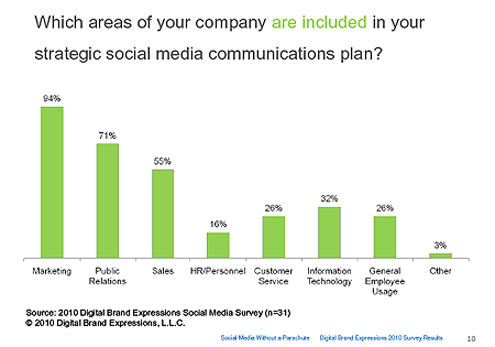
And yet it’s happening, alot! According to a May 2010 study by Digital Brand Expressions, 59% of social marketers are operating “without a game plan.” How is that possible? I’m not sure who is at more fault here, the marketer or the company they work for? I would understand that a small number might not do this, but half? Six out of Ten are just creating Facebook, Youtube and Twitter profiles?

What’s the point? Geez! From that same study the distribution was interesting for those that “did” have a plan..

What’s up with HR? Last time I checked HR is one of the easiest departments to integrate social in to. No plan for HR and it’s social media recruitment and vetting of candidates

And last, the irony of it all. This is the one that makes me chuckle-It’s like admitting that seat belts save lives but I’m still not going to wear one.

Clearly, we still have a long way to go in this industry…

Is social media marketing too labor intensive?

I was looking at a list of clients that I had worked with over the past couple of years and it’s well over 40.  It’s not a big number, but what caught my eye was that I had created a matrix of what I had done specifically for each client.

More importantly what struck me was that as much as I had done, in the grand scheme of things, a lot was predicated on how much the company I was working with embraced what I was doing.

It’s easy to assume someone is not working when it seems something is not working…

Some of these companies embraced what I did and others did not, so the results were mixed. In some cases, I made mistakes, which made me better the next time I did it, but it also gave some individuals within these companies the notion that social media does not work. What they needed to say was that, “We needed to give it more time”.

Here’s what’s interesting.

“Doing” Social media can sometimes give you the impression or sense that you have done or accomplished a lot, but the reality is that as a channel, as a stand alone entity, it needs the support of a lot of other “things” in order to truly “work” and be most effective. And then, it works best if it’s in conjunction with all the other activities, marketing or otherwise within your organization or the organization you’re working with.

What do those activities look like? Here is a slight list of some of the activities that were done with my clients and that I do for clients.

  • Increase awareness of and interaction with a company’s brand through brand mentions and participation in social networks
  • Create a community for customers and fans
  • Create new business opportunities or leads through landing pages and targeted email campaigns supported by social media
  • Create listening posts
  • Monitor Buzz, mentions and opportunities
  • Instruct and show companies and clients how to use social networks to sell directly to consumers
  • Build and create databases
  • Increase traffic to websites through social bookmarking
  • Create and manage Facebook fan pages for products, communities and companies
  • Create microsites using social platform providers
  • Create and manage multiple blogs
  • Show and educate brands and companies how to use social networks and how to act on those social networks
  • Create and Post videos
  • Create widgets
  • Create customized social media landing pages to reflect brand
  • Did/Do a ton of research on clients, their partners and/or their vendors through their social media presence and engagement
  • Write  key word rich/tagged social content to optimize search
  • Engage brand champions to become consumers, creators and leaders within communities
  • Measure everything

So as you can see, it’s a lot, and it’s not even a complete list of all the things that I have done or that it can encompass.  Funny thing is, that social media can sometimes give you the sense or a business for that matter, as I said, that you’ve accomplished a lot more than you really have. Or at least that might be the false perception of the client. The actuality again, as has been said many times by myself and others, is that social media marketing and engagement is very labor intensive. You just have to look under the hood. How do you feel about that?

18 reasons a social media snake oil salesman might want out

Last week I wrote a post that got a tremendous amount of love from the folks over at social media today and rightly so, it was all the reasons why I love social media.

But what if you were sick of it? What if you were a snake oil salesman trying to cash in on the social media phenomenon and you were starting to realize that this social media stuff sucked? What might be your reasons for getting out and jumping into real estate short sales or something?

Your excuses, er reasons might look something like this:

1) You didn’t realize how much work it took

2) You realized that people aren’t into your “get 200 Twitter followers” for $19 a month program

3) Your social media certification classes didn’t really take off like you thought

4) Stealing other peoples content was hard work

5) Spamming hashtags wasn’t driving any business

6) No one is calling you or responding to your sign up landing page with exclusive offers and social media tips

7) People were not sharing your viral videos that you stole created

8. Strategy? What strategy?

9) The trusting client is pissed because the Twitter account you created for them with the 30 tweets, 30 followers, and the 5000 people you’re following, hasn’t really amounted to anything

10) There was too much to learn

11) You’re tired of RT’ing others on your 6 month old Twitter account

12) You never figured out what that Facebook vanity URL thing was

13) Case studies? On what?

14) Social media is dead anyways

15) You hate creating content and no one was coming to the blog

16) Social Media ROI isn’t important

17) It doesn’t work

18) When someone asked you about Gowalla and Foursquare you looked at them like this…

Share this Post

Social Media Marketing:Do you know enough to know where to begin?

Good question right? What’s the simple answer? Maybe not. If you are a marketer thinking about social media marketing then there is a good chance, if you have not done anything yet, that its because you just don’t have enough information yet.

On Monday in Tampa, I attended and spoke at a conference titled Social Fresh, at that conference, during Maggie Fox’s keynote, she nonchalantly asked the audience how many of them were marketers. Surprisingly, more than 80% raised their hands.

Clearly, 2 things became evident: One, there is a need for more social media conferences down in the belly of the  state of Florida(that in and of itself is worth another blog post) and two, marketers were indeed starved or looking for answers/solutions to the primary social media marketing puzzle/question. The How To. Implementation. Why haven’t they done it yet?

In this post I want to address those issues so that you can get started with social media marketing.

According to Equation research, one of the primary barriers for social media marketing adoption for brands or agencies is that they just don’t know enough about social media to know where to begin.

But why? Why is it taking this long for marketers, agencies, brands and businesses to learn about social media? For some of us, we have been talking about and writing about social media for almost 4 years.  Is it fear of social media? Do we have so much on our plates that we don’t have time to check social media out?

Maybe.

Is it because your falling back on the excuse that you can’t measure social media? Please tell me that’s not the reason. If so, then please have a look at Olivier Blanchard‘s deck on the basics of social media ROI. Once you have rolled through it, I think and hope your fears on the ROI issue can be put to rest.

Another valid reason that may be preventing you from adopting social media may be budgetary. That can certainly affect any and all social media marketing efforts, as well as marketing efforts in general. If you got no money, then you go no money.  However, I do want to point out that the barriers for entry into social media are relatively low. In fact your only costs when first starting out will be or could be design and labor.

So know this, getting into “it” is easy. In fact Chris Kieff suggests just listening for the first 6 months before you do anything else. It’s quick to set up and easy to do.  I’m not adverse to that strategy, but think that maybe 2-3 months might be just as effective. But the point is, by listening for a bit, that gives you a feel for how things work in social networks and how brands, conversations, posts, links and search results all evolve because of social media.

Managing it takes a little bit more skill. My friend Jason Falls who writes a great blog on all things social media  marketing related, has a post on managing social media marketing. Though it’s from 2008, it’s still relevant and valuable even today. There are some great tips contained in the post.

So you might say you don’t have enough time.  Hey just like everything else in life, it’s all about time management and being efficient with your usage of time. Social media marketing is no different.  I have often said that social media marketing can be an incredible time suck, but the way to work thru that, is to make sure you have a plan every day that applies to your social media marketing strategy and speaks to your social media tactics. Above all stick to it. This includes your personal social media interactions. You have to know how much you allow yourself each day to engage on your own social networks.

Another issue that prevents marketers from even starting and which might be completely out of their hands, is there could be legal constraints. I can tell you from first hand experience how difficult it can be sometimes when any copy or any site designs that you create have to then pass the litmus test of legal. It seemed that everything we did was always not with the customer in mind, but always under the auspices of, “I hope legal is cool with this…”

Beyond that, you may have corporate policies that may prevent your marketing department from engaging in social media, if so, it’s up to you to try and get corporate to look at the bigger picture of social media marketing and its effectiveness. Help them create a social media policy both internally and externally that allows you to use social media in your marketing efforts! Work with them, because there could be a very high likelihood that they have no clue of social media and thus they will err on the side of caution and completely lock down your efforts and attempts at social media marketing.

Lastly, I will say this. Given that search results can return articles and blog posts that rank high on the how to’s of social media and social media marketing, I think it’s important to trust one’s peers and their associated networks. What I’m saying is that if you have questions, go to Twitter and ask a trusted and valued resource. I rely on my network. Rely on yours and get started. it’s not too late.

10 Killer Social Media and Web 2.0 Links

What people say about a brand or a company is equal, if not superior, to what the brand or company says about itself.-Me

I told you I was tapped out creatively on Twitter, but here are the 10 links I promised you.

Prezi

BuzzGrader

Skip1

Blue Fuego

Slick Plan

Peer Set

The 8 Irresistible Principles of Fun

Top 10 Social Media Presentations

10 Social Media Strategies From Top Brands

Attention

Lastly…

True Social CRM should be invisible for the vendor and transparent to the customer-Me again

The Top 45 Objections To Using Social Media

perry_mason

If you’ve been in the business of social media for any length of time, whether you have been selling it, marketing it, or implementing it, you will have heard one of the 45 objections below. What really makes this list though, is that the majority of it came from you and your clients and your experiences.  It was crowdsourced from Twitter!

However, There’s a larger and more important issue here though, and it’s one in which you can and should, use this list as your cheat sheet. YOU need to be able to answer all of these objections. Or at least anticipate that your clients and prospects will be voicing these concerns and more.

Feel free to add to this list.

1)  Why should I? I don’t need to. Just because everyone else is doing it, doesn’t mean I have to.

2)  It’s a fad, I’m going to stick to what works for our business

3)  It costs too much

4)   I’m in no hurry

5)  I have no desire

6)  It will require too many resources within our company

7)  I’m worried about the legal ramifications

8)  We’re better off by doing nothing

9)  To risky

10) You can’t measure it

11)  We give up too much to the customer

12) We won’t make any money

13) We can’t control the message

14) We don’t know the first thing about social media

15) It will take too long to pay off

16) It will take too long to implement

17) It’s just a blog, twitter and Facebook- What’s that going to do?

18) I can do it/we can do it ourselves

19) It’s not worth it

20) Our customers are not on social networks

21) It’s too complicated

22) We can’t control our employees using it

23) I can’t it’s a legal issue

24) We want to control the message

25) We can’t support with our current management/management   doesn’t support

26) We’re B2B so there is no reason for us to engage consumers

27) It’s a regulatory issue. So no guidelines in place.

28) No trust

29) Don’t want to acknowledge negatives

30) Not our customers

31) Don’t have time to adapt to the technology

32) Social Media results are not easily visible to non-users

33) Fear of change and the unknown

34) Not our target market

35) Our customers don’t use social media

36) Our deadlines are more important than your Tweet goofs.

37) Privacy issues

38) No ROI potential

39) Lack of expertise

40) Lack of a market

41) We already do social networking, we have a facebook fan page.

42) Too complicated & therefore, we’ll look for alternative options

43) We’ve been fine without it

44) We’re waiting for it to mature

45) We tried it, it didn’t work.

46) ?

What are we missing?

Share this Post