From Interruptions to Interactions-The Irony

Greg Verdino of Powered, wrote a book called microMarketing. I was asked and honored to review chapter 5. Before I give you my 2 cents on that chapter I have to tell you, it was probably one of the easiest reads on social media marketing that I’ve read in a while. If you swim in the waters of social media, you will know or be familiar with the numerous stories that Greg tells in his book. Though I knew all of these stories, it was great to read Greg’s insight and “take” on how little things mean more in the large vast wasteland of content hungry consumers and creators.

This is significant in that I just wrote yesterday about I think that Twitter as a network is declining, but as a placeholder for media consumption it has exploded. Greg’s book highlites the little in a big world and how THAT can be effective in getting your message heard or your product launched or service sold.

Now chapter 5. Find out about Henry Posner A fascinating story on how someone can be a late adopter but still utilize the nuances of social media marketing with an intense desire to connect with their customers and succeed. To quote Greg:

By applying the principle of surprise and delight to selected online interactions, businesses have the opportunity to generate goodwill and stimulate positive online word of mouth both online and off.

What does this mean? Here’s your bullet points of  what your online social interactions should consist of. These, for the most part are industry agnostic. They can apply to any business.

  • Establish a credible voice-Be an authority
  • Lend a helping hand- Don’t expect something in return
  • Kiss your customers on the cheek-Delight them.
  • Offer Thanks
  • Put a human face on the business

What you need to know-Quoting Greg again(It’s easy to do)

Doing the right small things to shift from interruptions to interactions lays the groundwork for making a related-and no less disruptive-shift from marketing in an artificially constructed (and artificially constricted) prime time to engaging consumers in real time.

The irony you ask? Small might be the new black.

Why are companies allowing you to operate without a net in social media?

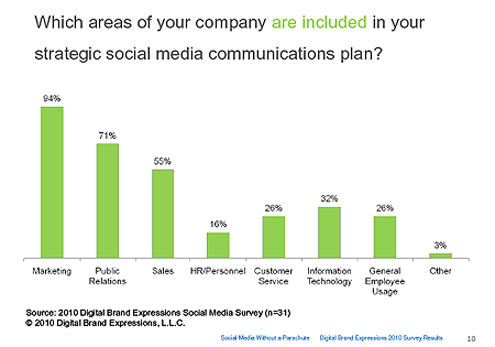
And yet it’s happening, alot! According to a May 2010 study by Digital Brand Expressions, 59% of social marketers are operating “without a game plan.” How is that possible? I’m not sure who is at more fault here, the marketer or the company they work for? I would understand that a small number might not do this, but half? Six out of Ten are just creating Facebook, Youtube and Twitter profiles?

What’s the point? Geez! From that same study the distribution was interesting for those that “did” have a plan..

What’s up with HR? Last time I checked HR is one of the easiest departments to integrate social in to. No plan for HR and it’s social media recruitment and vetting of candidates

And last, the irony of it all. This is the one that makes me chuckle-It’s like admitting that seat belts save lives but I’m still not going to wear one.

Clearly, we still have a long way to go in this industry…

Is social media marketing too labor intensive?

I was looking at a list of clients that I had worked with over the past couple of years and it’s well over 40.  It’s not a big number, but what caught my eye was that I had created a matrix of what I had done specifically for each client.

More importantly what struck me was that as much as I had done, in the grand scheme of things, a lot was predicated on how much the company I was working with embraced what I was doing.

It’s easy to assume someone is not working when it seems something is not working…

Some of these companies embraced what I did and others did not, so the results were mixed. In some cases, I made mistakes, which made me better the next time I did it, but it also gave some individuals within these companies the notion that social media does not work. What they needed to say was that, “We needed to give it more time”.

Here’s what’s interesting.

“Doing” Social media can sometimes give you the impression or sense that you have done or accomplished a lot, but the reality is that as a channel, as a stand alone entity, it needs the support of a lot of other “things” in order to truly “work” and be most effective. And then, it works best if it’s in conjunction with all the other activities, marketing or otherwise within your organization or the organization you’re working with.

What do those activities look like? Here is a slight list of some of the activities that were done with my clients and that I do for clients.

  • Increase awareness of and interaction with a company’s brand through brand mentions and participation in social networks
  • Create a community for customers and fans
  • Create new business opportunities or leads through landing pages and targeted email campaigns supported by social media
  • Create listening posts
  • Monitor Buzz, mentions and opportunities
  • Instruct and show companies and clients how to use social networks to sell directly to consumers
  • Build and create databases
  • Increase traffic to websites through social bookmarking
  • Create and manage Facebook fan pages for products, communities and companies
  • Create microsites using social platform providers
  • Create and manage multiple blogs
  • Show and educate brands and companies how to use social networks and how to act on those social networks
  • Create and Post videos
  • Create widgets
  • Create customized social media landing pages to reflect brand
  • Did/Do a ton of research on clients, their partners and/or their vendors through their social media presence and engagement
  • Write  key word rich/tagged social content to optimize search
  • Engage brand champions to become consumers, creators and leaders within communities
  • Measure everything

So as you can see, it’s a lot, and it’s not even a complete list of all the things that I have done or that it can encompass.  Funny thing is, that social media can sometimes give you the sense or a business for that matter, as I said, that you’ve accomplished a lot more than you really have. Or at least that might be the false perception of the client. The actuality again, as has been said many times by myself and others, is that social media marketing and engagement is very labor intensive. You just have to look under the hood. How do you feel about that?

Social Media Marketing:Less of Big and more of Small

I jumped in on the weekly #brandchat discussion that was happening on Twitter yesterday to answer the following question:

What do small businesses need to be doing less of?

Great question. Here was my answer…

Less of Big and more of Small.

I got an “amen and a hallelujah for that tweet. What did I mean? Hold tight because I’m going to use a couple of baseball references again, but I will keep it short and simple.

The first is this. Did you know that baseball players get paid millions upon millions of dollars to fail seven out of ten times? That’s right. They generally have to hit the ball three times out of ten, and they are considered good at what they do. Why? Because it’s so damn hard to do.

We often overlook or I should say, most seem to think that implementing social media can be done by…

A monkey.

What ends up happening is that folks bail out after a month or so because talking to people, customers,  monitoring sites, creating consistent content, is hard and it’s labor intensive. You have to really work at it and be diligent. Sorta like hitting a baseball.

Not everyone can hit .300.

Funny thing is, baseball players who do hit the ball 3 out of 10 times, work very hard at it, constantly. Some are gifted and it comes naturally-the rest, which is most of them, have to work just to get near .300.

Same goes for creating and planning and implementing social media. It’s hard and not for the faint of heart. You have to believe and trust in yourself and your abilities to get it done.

But you know what? Being a singles hitter or maybe  someone who hits the occasional double in baseball  aint a bad thing. We all can’t be big hitters. Playing small ball is OK.

In the social media world, there are a lot of choices and sites and things that you can do so that you or your client can be seemingly everywhere. That’s really tough and can lead to some serious social media burnout.  But here’s a better idea. Quit trying to be a home run hitter. Play small ball. Be really good at hitting singles and the occasional double. Meaning? Be really good at blogging. Have a solid Twitter strategy. Be honest about what each piece of social engagement is going to bring back. In the baseball world that’s the equivalent of knowing you cannot hit a curveball. Know your limitations and be really good at what you can be really good at.

The payoff? A really long career and a happy client.

10 little things SMB’s might be missing when launching social media

I use SMB’s as an example here, but when reading Todd Defren’s latest blog post, apparently it is something that permeates organizations both large and small. What is it?

What are companies (SMB’s) usually missing when jumping into the social media waters?

  • They’re missing the point.
  • They’re misunderstanding the commitment
  • They think you can outsource it
  • They think it’s a switch
  • They don’t try as hard as they could
  • They don’t measure it or…
  • They measure the wrong things
  • They lack knowledge
  • They’re expectations are unrealistic
  • They don’t give it enough time

That’s it.

But you know what the great thing is about all of the above bullet points? They all can be fixed.

How?

  • Education. Education will help them get the point, but they need to know where to get that education. You can help them.
  • Understanding the hard work involved will address a lot of the unknowns. We can all relate to what happens with hard work. But there needs to be an emphasis and a complete understanding of how labor intensive social media can be.
  • You can outsource it, but it’s easier to understand when you don’t, the more you understand, perhaps the more capable you are of knowing what you can and cannot do internally.
  • It is a switch but when you treat social media as such, others can tell, they see your lack of commitment-they see the half ass effort.
  • If you don’t try, then what should you expect? I’ve always said, if you give 100%, then no-one can ever say that you didn’t try. You can take it out of the equation. But make sure you’re working smart.
  • You measure your efforts when you sell, when you advertise, when you hire, when you buy etc. etc. so this is no different. You just need the right tools to measure the right things.
  • Look up the definition of social media ROI and that will tell you what you should measure with social media.
  • Social media changes daily; the tools, the sites and the cool things, they change daily. Stay current. Pick 10 sites and dump them into a reader and read it every day.
  • Create reachable goals.  Teams and coaches create goals-you should be no different.
  • Set up your expectations tied into your goals and give it all a legitimate time frame. But know it is a long term deal.

Now go get it done!

5 simple ways SMB’s can readily adopt social media and get rolling in one day

I recently spoke at a little breakfast meeting of a 100 people or so and I knew that the economy was  still being unkind to small business owners. I knew they were still trying to wrestle with the alternative options that social media might provide. But coupled with wrestling whether to make the leap or not,  was the notion that commitment to social media is labor intensive. They already wear a lot of hats and now they have to somehow integrate social media?

So I thought it might be prudent to provide 5 simple suggestions on what an SMB can do right now to become part of that conversation. Yes, there will always be a learning curve, but we have to start somewhere and then build from that.

1)  Get a Twitter account. Beyond just having a Twitter account that’s not doing much, learn how to use it to your advantage. Why? because you want to be able to monitor and listen to conversations about you, your product, your company, your industry, your customers and your competition.  You can listen for opportunity and you can use Twitter as an ad hoc arm of customer service and reputation management.

How do you do all that- You use a 3rd party application like Tweetdeck which allows you set up individual columns for each of the above mentioned. The good news? In theory if you don’t want to have conversations, that will not prevent you from mining valuable data. The other good news? You don’t have to sit there and wait for it to unfold. You can peel back the tweets to your hearts content! This might take less than an hour to set up. Even less if you already an account.

2) Create a Facebook page. I know, you’re probably thinking, “you’ve got to be kidding me”? Well you know what? I bet you already have a Facebook page anyway right? So what makes this any different? What…? That it’s for work?  Given that businesses can now create vanity URL’s on Facebook you have a great opportunity to grow your business using basic Facebook  features for as little as an hour a day. Most of you have a customer base and there is a good chance that some of them are loyal. Facebook allows for you to connect with your customers. At the least it allows you to promote offers, ask questions and engage your customers. Setup is minimal. About an hour.

3) Create a Linkedin profile. Again, you should have one of these anyway but there are some cool little features buried in Linkedin that can help you network with like minded professionals, look for new resources and partners, connect with current and past work colleagues and if need be, look for a new job. Pay particular attention though, to the Question/Answer section of Linkedin.  There is some gold in that thar section. Set up time 2 hours but once it’s done, you’re done.

4) Now link your Twitter account to Facebook and link you Twitter updates to LinkedIn so that all of your twitter updates, if you do them, will flow across all of your networks. If you ever feel so compelled to contribute, converse, share or become part of the conversation, you’ll only have to do it once and everyone in those 3 networks that are part of “your network” will see it. This might seem a but complicated, but it’s not, you just need to check out those links. Time it takes? An hour

5) Now go to your website and put these 3 links or icons to these social sites on your website. Make sure that they are prominent so that people that may be looking for you and what you may offer can find them. The point is we want to make sure that we are providing as many ways as we can for customers and prospects to talk to us. They are your lifeblood and THEY are using social networks with or without you. Get in the game. It may take you an hour.

Now here’s the last thing. Even if you are not an “A” personality and you’re somewhat passive. You still have relationships with your close friends and relatives, right? What do those conversations and relationships consist of? Are they about what you had for breakfast? Perhaps, but there is so much more to them. And the reason they are your friend in the first place, is because you are interesting and you have something in common with that person. You both are exchanging and sharing value. Guess what? the same holds true in social networks. Value begets value. Even if your not a content machine like a Chris Brogan, you can still carve out a niche for you and your company.

Now go get ’em.

Share this Post

18 reasons a social media snake oil salesman might want out

Last week I wrote a post that got a tremendous amount of love from the folks over at social media today and rightly so, it was all the reasons why I love social media.

But what if you were sick of it? What if you were a snake oil salesman trying to cash in on the social media phenomenon and you were starting to realize that this social media stuff sucked? What might be your reasons for getting out and jumping into real estate short sales or something?

Your excuses, er reasons might look something like this:

1) You didn’t realize how much work it took

2) You realized that people aren’t into your “get 200 Twitter followers” for $19 a month program

3) Your social media certification classes didn’t really take off like you thought

4) Stealing other peoples content was hard work

5) Spamming hashtags wasn’t driving any business

6) No one is calling you or responding to your sign up landing page with exclusive offers and social media tips

7) People were not sharing your viral videos that you stole created

8. Strategy? What strategy?

9) The trusting client is pissed because the Twitter account you created for them with the 30 tweets, 30 followers, and the 5000 people you’re following, hasn’t really amounted to anything

10) There was too much to learn

11) You’re tired of RT’ing others on your 6 month old Twitter account

12) You never figured out what that Facebook vanity URL thing was

13) Case studies? On what?

14) Social media is dead anyways

15) You hate creating content and no one was coming to the blog

16) Social Media ROI isn’t important

17) It doesn’t work

18) When someone asked you about Gowalla and Foursquare you looked at them like this…

Share this Post

Anger, Denial, Acceptance in a Digital Agency

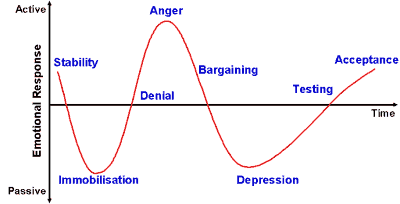
I’m so thematic. The flow of my blog posts have gone from one extreme to another. But for good reason… Anger at clients for parting ways with me. Denial of the fact that clients are not paying me and now acceptance. Acceptance that though I indeed love what I do and know how to do it well, it may be time to do it for someone else. Though having your own digital agency is cool and fun and certainly sexy, it also presents its own set of unique challenges.

In fact, there have been instances over the past 2 1/2 months or so where I have gone through every stage on this graphic.

It goes something like this:

  • Shock stage: Initial paralysis at hearing that one of my best clients is tightening it’s belt and will no longer be utilizing my skills.
  • Denial stage: Trying to avoid the inevitable, I angle to salvage the deal by offering an alternative service/skill and the client agrees but at a rate that is substantially less than what I was charging.
  • Anger stage: Frustrated outpouring of bottled-up emotion. I’m now pissed that it has come to this and want to take it out on something, so what do I do? I write a blog post about it.
  • Bargaining stage: Seeking in vain for a way out, I work doubly hard with my other clients to make sure that they are happy and look for new business. I realize that times are tough and everyone thinks they can do what we do.
  • Depression stage:  My other large client has now missed 2 invoicing periods and now I have turned into a collection agency and have stopped work on their account. The final realization of the inevitable is starting to sink in. It might be the realization that maybe having a digital agency in Southwest Florida wasn’t such a good idea in such crappy economic times.. So to combat this bout of depression, I wrote a post about the situation. It seems to help some but offers little solace.
  • Testing stage:  I call this the looking for answers or seeking solutions stage. I have decided to use my network to see what else is out there, determined to make the best of a bad situation. I know the timing is not exactly the best right?  But sanity is important right now.
  • Acceptance stage: I’m realizing that it’s not only tough to run your own agency, but it’s also tough to do the majority of the work, job the rest out, manage it, find more clients, look for talented people, stay current, do proposals, write posts etc. etc., Knowing this and coming to grips with the situation  has allowed me to finally find the way forward, and realize that yes, I still love social media so much that I blogged about it. 🙂 but I can have more of an impact on a larger scale in another capacity. So though I will continue to consult in some capacity as I go forward, it’s time to see what else is out there as well.

Share this Post

15 reasons to love social media

My last few posts have been about the darker side of social media and thus I wanted to clear something up.  I am the biggest champion of social media that you will find and here’s why. I may get a little spicy sometimes, but that doesn’t diminish all the “good” things about this crazy space and all that it delivers to us daily. So get a gander at these 15 reasons and when you’re done reading them add your reason to the mix.

1)  Today I have a very large network of close and semi-close contacts that I can reach out to at a moments notice. Chances are, you do too! 4 years ago, I did not have anything remotely close to this type of network.

2) If I need a really good PR firm for example, I can contact that person today and we’d know each other well enough to have a very nice conversation… without the usual vetting process. The confluence of PR and social media ain’t no coincidence.

3) If I wanted to have someone guest post on my blog and bring their incredible smartness and knowledge to the table, all I have to do is ask. Have you ever thought of asking someone? You should. There might be some really smart folks in your network and you might not even know they are following you!

4) If I have to refer a killer web design person to someone, I can do that in 5 seconds. I’m sure you know of someone too. I could come up with a list of 10 in no time.

5) Need a good email marketing company? I know one or two. In fact, I got to know someone from a pretty cool company just in the last 2 months,  Thanks network.

6) How about a good social media monitoring company? I can help you, I know a few good people there. What’s great about this one particular company? They don’t push the product, they just act like normal people should act.

7) Want to know who you need to contact in regards to social media and non-profits? Here’s one for you. Thanks to social media, these people have a chance to influence us in a way that allows us and them to make a difference in this world. We need more of that.

8. Because of social media, my network, no matter how jaded or pissed I can get sometimes, allows me to  get jaded and pissed… and they’re ok with that. They still like me in the morning. 🙂

9) Social media has allowed me to contribute to one book and create a rough draft for another. It’s allowed me to present at conferences, write articles in magazines and speak on the radio and create projects that connect some very dynamic people together.

10) Without social media none of us would be allowed to share the cool things we are doing 24/7/365. That doesn’t mean we always care about all of it, but you have a channel to express yourself now that you didn’t have before.

11) If I need help, all I have to do is ask. Need proof? Check out the 50 people that have hosted Hashtagsocialmedia. I asked and they said yes.

12) If I’m asked to help or assist on something, and because I generally know who is doing the asking, I don’t hesitate, thanks to social media.

13) Because of social media, when I meet someone for the first time, like a Jason Falls for example, I generally am “not meeting” them for the first time. We already know each other.

14) Because of social media, we have something to talk and write about every day.

15) If I didn’t know you before and now I do, chances are it’s because of social media.

At the end of the day, it’s still all about the relationships, the connections, and the conversations. For that, I’m thankful.

Social Media Marketing:Do you know enough to know where to begin?

Good question right? What’s the simple answer? Maybe not. If you are a marketer thinking about social media marketing then there is a good chance, if you have not done anything yet, that its because you just don’t have enough information yet.

On Monday in Tampa, I attended and spoke at a conference titled Social Fresh, at that conference, during Maggie Fox’s keynote, she nonchalantly asked the audience how many of them were marketers. Surprisingly, more than 80% raised their hands.

Clearly, 2 things became evident: One, there is a need for more social media conferences down in the belly of the  state of Florida(that in and of itself is worth another blog post) and two, marketers were indeed starved or looking for answers/solutions to the primary social media marketing puzzle/question. The How To. Implementation. Why haven’t they done it yet?

In this post I want to address those issues so that you can get started with social media marketing.

According to Equation research, one of the primary barriers for social media marketing adoption for brands or agencies is that they just don’t know enough about social media to know where to begin.

But why? Why is it taking this long for marketers, agencies, brands and businesses to learn about social media? For some of us, we have been talking about and writing about social media for almost 4 years.  Is it fear of social media? Do we have so much on our plates that we don’t have time to check social media out?

Maybe.

Is it because your falling back on the excuse that you can’t measure social media? Please tell me that’s not the reason. If so, then please have a look at Olivier Blanchard‘s deck on the basics of social media ROI. Once you have rolled through it, I think and hope your fears on the ROI issue can be put to rest.

Another valid reason that may be preventing you from adopting social media may be budgetary. That can certainly affect any and all social media marketing efforts, as well as marketing efforts in general. If you got no money, then you go no money.  However, I do want to point out that the barriers for entry into social media are relatively low. In fact your only costs when first starting out will be or could be design and labor.

So know this, getting into “it” is easy. In fact Chris Kieff suggests just listening for the first 6 months before you do anything else. It’s quick to set up and easy to do.  I’m not adverse to that strategy, but think that maybe 2-3 months might be just as effective. But the point is, by listening for a bit, that gives you a feel for how things work in social networks and how brands, conversations, posts, links and search results all evolve because of social media.

Managing it takes a little bit more skill. My friend Jason Falls who writes a great blog on all things social media  marketing related, has a post on managing social media marketing. Though it’s from 2008, it’s still relevant and valuable even today. There are some great tips contained in the post.

So you might say you don’t have enough time.  Hey just like everything else in life, it’s all about time management and being efficient with your usage of time. Social media marketing is no different.  I have often said that social media marketing can be an incredible time suck, but the way to work thru that, is to make sure you have a plan every day that applies to your social media marketing strategy and speaks to your social media tactics. Above all stick to it. This includes your personal social media interactions. You have to know how much you allow yourself each day to engage on your own social networks.

Another issue that prevents marketers from even starting and which might be completely out of their hands, is there could be legal constraints. I can tell you from first hand experience how difficult it can be sometimes when any copy or any site designs that you create have to then pass the litmus test of legal. It seemed that everything we did was always not with the customer in mind, but always under the auspices of, “I hope legal is cool with this…”

Beyond that, you may have corporate policies that may prevent your marketing department from engaging in social media, if so, it’s up to you to try and get corporate to look at the bigger picture of social media marketing and its effectiveness. Help them create a social media policy both internally and externally that allows you to use social media in your marketing efforts! Work with them, because there could be a very high likelihood that they have no clue of social media and thus they will err on the side of caution and completely lock down your efforts and attempts at social media marketing.

Lastly, I will say this. Given that search results can return articles and blog posts that rank high on the how to’s of social media and social media marketing, I think it’s important to trust one’s peers and their associated networks. What I’m saying is that if you have questions, go to Twitter and ask a trusted and valued resource. I rely on my network. Rely on yours and get started. it’s not too late.