What do we search on? Matters of life and death

The terms “pregnancy” and “cancer” were the two most frequently searched health terms in February, receiving 8.8 million and 7.7 million search queries respectively according to comScore. Which can lead us to 2 conclusions and 2 theories.  I think you can separate the 2 terms into two camps and 2 distinct demographics. The first demo is a younger generation that is worried about and curious as to what pregnancy is about, what it entails and what to expect. The next demo, is our aging boomers. They are as concerned about death as they are about prolonging life.  Think about it. Pregnancy and cancer are really, life and death. One is something you think about as you enter into the world as an adult, the other is what you are concerned with as you try to stay on this earth as an adult. As morbid as that may seem, it’s true. It’s as black and white as 2 distinct topics can be in regards to one’s health.

As you venture into looking at other search terms, you can easily track what time of year it is, what state the economy is in and how those things affect your health. Health terms that were frequently searched in February include “flu” (1.8 million) which would make sense, since that is the height, generally of the flu season; and depression also (1.8 million). Depression it seems,  occurs as we fall into the long winter nights and misery that accompanies winter and perceived or real economic hardship. The next most searched health issues were diabetes (1.7 million) and addiction (1.4 million). Though not much can be said about diabetes being a surprise, since poor eating habits and lack of any physical excersize can ceratinly contribute to this, which America is definitely guilty of, it’s good to see that it is getting the attention that it needs. Addiction is the dirty little secret that permeates every family throughout the US. Everyone knows someone who is an addict, is a friend of a friend, or has a family member who is or was. A sad fact, but definitely makes sense in regards to search.

 Interestingly, “Pregnancy,” is searched 17 times more often than the most popularly searched prescription brand name, “Chantix.” The second most searched term “cancer” had 1 million queries specific to the term “breast cancer.”

“It’s not too surprising that some of the most common health conditions, such as diabetes, depression and flu, have made the list, but it’s interesting that these terms generate fewer searches than significantly less prevalent conditions like cancer and pregnancy,” said Carolina Petrini, comScore senior vice president.

“A reason for this may be due to life-changing nature of a cancer diagnosis or a pregnancy.”  Life changing…

Most Commonly Searched Health Conditions
February 2008
Total U.S. – Home/Work/University Locations
Source: comScore, Inc.
 
Search Term                   Search Queries
                                   (000)
Pregnancy                          8,841
Cancer                               7,718
Flu                                    1,824
Depression                        1,807
Diabetes                           1,758
Addiction                           1,407            
Herpes                              1,340
HIV                                     976
Anxiety                               910
Stroke                                872
HPV                                   861
Bipolar                                861
Cholesterol                          816
Headache                            763
Menopause                          667
Hepatitis                              614
Arthritis                               600
ADHD                                 573
Asthma                               569
Fibromyalgia                        551

10 Insights From 11 Months Of Working At Google

Here is a great piece on someone NOT bashing Google for being the great company that they are: http://www.kaushik.net/avinash/2008/02/10-insights-from-11-months-of-working-at-google.html

The top 10 hottest Social Networking Widgets

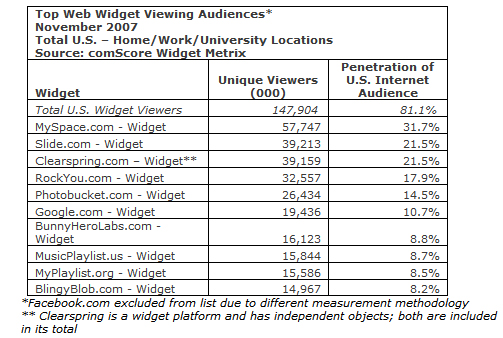
 Comscore released the November 2007 U.S. rankings of the top web widgets. For those of you who do not completely understand what a widget is, it’s essentially independent objects or an object that can be embedded or downloaded onto another site and can be used as a tool, have automatic content updates, or are or can be interactive. Though they go by the name of “widget”, Facebook calls them “applications” and Google calls them “gadgets.”

In November 2007, nearly 148 million U.S. Internet users viewed widgets, representing 81 percent of the total audience. MySpace.com widgets had the widest audience, reaching more than 57 million Internet users, while Slide.com ranked second with 39.2 million viewers. Google.com has the sixth widest widget-viewing audience with more than 19 million viewers.

What’s the “skinny” on what widget usage means to the lay person? Simply put, it means that widget usage can be computed as eyeballs on the site, which also means that if the widget is cool, you can bet others will go to get the widget. The widget is essentially another form of advertising. If they have your widget, that means they came to your site or heard of your widget from someone else. Word of mouth, Seth Godin, word of mouth!

Having said that, take a look at these November numbers.

Comscore Widgets

Obviously MySpace is the dominant player here but look at the others on the list. Slide for example is the largest personal media network in the world, reaching 144 million unique global viewers each month and more than 30 percent of the U.S. Internet audience. They help people express themselves and tell stories through personalized photos and videos created on Slide.com and viewed anywhere on the web or desktop.

Slide’s products — including Slideshows, FunWall and SuperPoke! — are popular on top social networking and blog platforms, including MySpace, Facebook, Bebo, Hi5, Friendster, Tagged and Blogger. Slide is also the leading developer on Facebook with more than 84 million applications installed and the most active users than any other developer.

Clearspring though is NOT a social network. Clearspring is the leading provider of cross-platform widget services. Their goal is to make it easy to use content and services from across the Internet to weave personalized experiences. Clearspring is the leading enterprise-class widget syndication platform. With our out-of-the-box syndication solution you can quickly repackage your existing content and services as viral widgets and syndicate them across multiple platforms.

RockYou is a leading provider of applications and widgets on the web. RockYou widgets include photo slideshows, glitter text, customized Facebook applications and voicemail accessories that are simple to use and enable people to frequently refresh their online style. RockYou has over 35 million users, serving over 180 million widget views per day in more than 200 countries. RockYou applications are customized for easy integration across all social networks including Facebook, MySpace, Bebo, Friendster, Tagged and hi5. RockYou’s cost-effective, results-focused advertising platform is the largest Ad Network on Facebook and the most dynamic method for rapidly acquiring Facebook application users. New applications can reach over 100k users in 24 hours, spanning a suite of applications across multiple publishing partners

Photobucket Owned by News Corp is the most popular site on the Internet for uploading, sharing, linking and finding photos, videos, and graphics.  Photobucket, According to Comscore is: 

  • 24.1 Million unique site visitors/month in the US, and 34.6 Million unique site visitors/month worldwide.
  • #1 most popular Photos site in the US.
  • #3 most popular Entertainment/Multimedia site in the US.
  • #7 most popular Entertainment/Multimedia site in the world.
  • #24 in Top 50 Sites in the US and
  • #47 Top 100 Global Sites

The next one is BunnyHerolabs, bunnyhero pets bebo app the pets have been available on bebo for a while now as “widgets,” but now bunnyhero pets are available as an application on bebo’s new application platform.

What this means for bebo users is now when they adopt a pet on bebo, they can add the “bunnyhero pets” application. With the new application, they are able edit their pets after they’ve added them to their profile, like changing their pet’s name and color.

Next are the Musicplaylist.us and myplaylist.org widgets, which are a no brainer in the land of “can’t-miss” and “must-have”, widgets. And lastly if you ever wondered where all of the kitschy graphics on the MySpace pages was coming from, look no further than, and the name seems awfully apropos, BlingBlob.com. BlingyBlob.com, for us uninitiated, is the hottest source for FREE high quality graphics, animations, Flash and much more for your MySpace page, personal site, or blog. Makes you giddy, doesn’t it?

Look for music, video and image sharing widgets to continue to evolve to an extent that perhaps one day they become part of someone’s v-card or email signature, along with the location of their MySpace, FB or Linkedin pages.

Global search revenue will reach $60 billion by 2011

As if Google and company did not make enough money, by years end, global search revenue will reach $30.5 billion according to a recent JPMorgan report which hinted that investors still should view the web as a good  “buy” or investment.

Contrary to the dot com bust of the early 2000’s, 2007 was actually a very good year for internet companies. In fact, due to the rising world GDP, according to the report, internet companies with a global reach would continue to enjoy a healthy profit due to the broad and seamless appearance of a global marketplace. Conversely, the US GDP growth has slowed in recent years.

By 2011, look for search revenues to exceed $60 billion according to the report. A lot of this groth will be tied into paid search as a global marketing vehicle. The growth will also be attributed to keyword price inflation and increased web usage. Tied to this will be an increase in the user experience and increase in click-through rates for all sites.

Death of The Library and rise of the Kindle.

Unless libraries can tailor everything that they do and stand for towards the digital universe, their days as a wellspring of knowledge and information are numbered. After reading an article titled, “The Impatience of the Google Generation” in wich the author and the responses essentially come to the conclusion that the current generation and younger generations for that matter, are essentially impatient when it comes to how quickly they can find and receive information, I can only assume that the last place that they would want to go is a place where their information was in a hard bound book!

OK, so yes libraries have computers that are tied not only to their volumes of hardbound books but also to search as it relates to the internet. But riddle me this: Why would I go to a library and search for a book when I could log onto a computer and find the same information? Says the 18-24 old student. I know it’s deeper than that, but lets put ourselves in the place of someone in college or younger. A) every college student, or a good portion of them now have their own laptop. So now they “walk” around with access to any and all information/research that they will ever need.  Bogus wikis notwithstanding. and B) They are so accustomed to getting information readily, that going to a library defeats the purpose of  library research per se.

 Of course, they can still go to the “quiet” library to get work done. And there are still certain things that a library provides or possesses that a student still might need or utilize, but…the thinking is,”It’s all here on the internet”!

Generation “C” (content) has no use for a library. In fact I would venture to guess that funding on local, state and federal levels for libraries is constantly slashed in favor of more digital type programs or programs that lawmakers feel have more importance.

Having said that, here is one more thing for you to chew on.  The Amazon  Kindle is an electronic book device launched in the US by Amazon.com  this past November.  It uses an electronic paper display, reads the proprietary Kindle (AZW) format, and downloads content over Amazon Whispernet, which uses the Sprint EVDO network. This means that the Kindle can be used without the need for a computer. Whispernet is accessible through Kindle without any fee. On the release day, the Kindle Store had more than 88,000 digital titles available for download. Amazon’s first offering of the Kindle sold out in five and a half hours. It retails for $399.

Think about it. People still want to read but they want it condensed and more than just portable. So does this mean that the Dust jacket will go the way of the Jewel Case and album art? If the latest advances in media, music and entertainment are any indication, it appears that that will be the case.

What’s not to like about Google?

You know there are always going to be people out there who will despise anything and everything that Google does and stands for. Of course we all know that they secretly use Google and if they were approached to work for Google, they would pause for about a split second before they accepted. 

Further enhancing it’s reputation as a company concerned with more than just search, Google recently announced that they were going to to use their incredible power as it relates to information and technology to help people better their lives. Google is rolling out five core initiatives that will be the focus of its philanthropic efforts over the next five to ten years. Google.org, the philanthropic arm of Google, will collaborate with experienced partners working in each of these fields, investing its resources and tapping the strengths of Google’s employees and global operations to advance its core initiatives.  

Today’s announcement includes more than $25 million in new grants and investments to initial partners. The resources come from a commitment by Google’s founders to devote approximately 1 percent of the company’s equity plus 1 percent of annual profits to philanthropy, as well as employee time.   Below is a listing of how the money is going to be disbursed:

$5 million to InSTEDD (Innovative Support to Emergencies, Diseases and Disasters) to improve early detection, preparedness, and response capabilities for global health threats and humanitarian crises. InSTEDD will work with the community of relief and response organizations, governments, academia and top scientists around the world to address gaps in information flow with software and other technology-based tools and services.

$2.5 million to the Global Health and Security Initiative (GHSI), established by the Nuclear Threat Initiative to prevent, detect, and respond to biological threats.

More than $600,000 to Clark University, with equal funding from the Gordon and Betty Moore Foundation, for Clark Labs to develop a system to improve monitoring, analysis and prediction of the impacts of climate variability and change on ecosystems, food and health in Africa and the Amazon.

$2 million to Pratham, a non-governmental organization in India, to create an independent institute that will conduct the Nationwide Annual Status of Education Report (ASER) as well as large scale assessments in the education sector.

$765,000 to the Centre for Budget and Policy Studies, a Bangalore-based analysis group, to create a Budget Information Service for local governments to facilitate better district- and municipal-level level planning in India

$660,000 to the Center for Policy Research, an action oriented think tank based in India, to increase the debate and discourse on issues of urban local governance and urban service delivery.

$4.7 million grant to TechnoServe to provide general support to expand Technoserve’s efforts to support enterprises, spur job creation, and strengthen poverty alleviation programs globally, and to develop and implement a business plan competition to support entrepreneurs in Ghana and Tanzania

$10 million to eSolar, a Pasadena, CA-based company specializing in solar thermal power which replaces the fuel in a traditional power plant with heat produced from solar energy

RechargeIT is a Google.org initiative that aims to reduce CO2 emissions, cut oil use and stabilize the electrical grid by accelerating the adoption of plug-in hybrid electric vehicles and vehicle-to-grid technology. Google.org launched a $10 million request for investment proposals this Fall, and will invest amounts ranging from $500,000 to $2 million in selected for-profit companies whose innovative approach, team and technologies will enable widespread commercialization of plug-in hybrid electric vehicles, electric vehicles and/or vehicle-to-grid solutions.

Granted that $25 million is not a lot of money initially when looking at what Google makes every day, but is certainly a step in the right direction and sets an examples for other like minded tech companies to either fall in step or raise the bar in regards to philanthropic endeavors.

Google Mobile- The Android Demo

I’m back on the mobile kick as of late and thought everyone would like to see this video demo, for those who have not seen it. It is very very cool. Watch out iphone is all I can say! The maps feature is extraordinary.


Google stats for November, no surprise here.

Google accounted for 65.1% of all US searches in the four weeks ending Dec. 1, while Yahoo Search, MSN Search and Ask.com received 21.2%, 7.1% and 4.6%, respectively, reported Hitwise. The remaining 46 search engines it tracks accounted for less than 2.0%. Thus if you’re an internet SEO/marketer and you’re strategy is to concentrate on the second tier SE’s, you might want to rethink that strategy. Furthermore, if you are tempted to pay money to be registered in “thousands” of search engines, our question to you would be, why?

Further enhancing marketers claims that niche based selling is the way to go, Google is also growing as a source of traffic to key industries, Hitwise said. Search engines remain the primary way internet users navigate to key industry categories, with Google leading the way.

Three categories – Travel, Entertainment, and Business and Finance – had double-digit increases (Nov. ‘06 to Nov. ‘07) in the share of traffic coming directly from search engines. These three categories revert back to a comment I made in an earlier post about the top 15 web searches: We as a society only care about being entertained and making money.

Google Magazine; Another off-road attempt.

Google filed a patent back in May of 2006. The patent essentially says that Google wants to give users the ability to search and browse their own content, and receive an electronic or hard copy version of the final product. And that final product will include advertisements highly relevant to the user.

…the customer interface documents may be provided via a kiosk. For example, kiosks containing the customer interface documents may be provided in stores (e.g., Target, supermarkets, retail stores, etc.) in a similar way as picture kiosks are currently provided in such stores.

So instead of buying your current niche based magazine, which I thought was fairly targeted. Google thinks that they can provide a publication that is so targeted that advertisers and readers will stumble over each other to advertise and buy it respectively.

So  Mens Health, Cosmo, Road and Track, Playboy, etc etc. are essentially missing the boat according to Google. But what I am not sure of is, how does Google plan on carrying this out? Do I go to a Google Kiosk and instead of grabbing the magazine of choice, I go to a screen pick out the articles that interest me and print? And with that, I get a very targeted group of advertisers geared right towards my articles’ subject matter and my general interests? How long would this take? What if I have to grab a train?

In theory I can understand it, because in most magazines, very seldom does the publication meet the complete needs and the criteria of the reader. Now some may read it cover to cover, but for the most part we thumb through the ads (some of which may not be geared towards you) and we go to the articles that interest us. Can you imagine? Our own personal magazines with all the content developed for us and by us and packaged by Google; with advertisers using a Google interface selling the things that would totally interest us and us only? All I can think is a) freaky scarry and b) cool.

So it’s not too far off now in the sense that our social bookmarks are essentially the content that we like, or the sites that we like, ordered, and condensed and available to us 24/7/365. Taking this to the next level would be creating a hard-copy of  your social bookmarks; that would NOT require a reader or a laptop or a PDA.

Amazingly enough, doesn’t this sort of fly in the face of technology in that we are reverting back to paper environment? In a time when newspapers are folding and consolidating, and magazines are relying more and more on advertisers to stay alive,  perhaps this is the type of lifeline that they have needed all along. Though the final iteration will not be close to what we’re talking about here, it seems certain that something, to the extent that you will  build your own “magazine”, seems right around the corner. Your content and your advertisers. And why not? If someone asked you to name the type of products you wanted to be pitched on, you could do it. It happens all the time now with cross promotional items and websites and double opt-ins and every other piece of online marketing out there. The more they know about you, the more targeted the offer!

Chew on that for a bit. Building you own magazine with your own preferred content and your own preferred advertisers. The only thing standing in the way is speed and ease of use. I sense another slipstream opportunity here for the remora like companies who build their products on the basis of other companies products. So let’s just see what happens. Either way, Google is certainly keeping it interesting.

Google is everywhere, you just have to look!

OK so when is Google NOT in the news? They seem to be everywhere these days. Such as the latest:

LOS ANGELES / MOUNTAIN VIEW, CA—November 1, 2007—MySpace, the world’s largest social network, and Google, Inc. (NASDAQ: GOOG) today announced that they are joining forces to launch OpenSocial— The partnership spearheads an initiative to standardize and simplify the development of social applications. Today’s announcement underscores MySpace’s commitment to supporting standards that foster innovation in an increasingly social Web.

But if we delve further, I think you’ll find that Google might be getting into business partnerships and alliances that we never thought possible.

Take for instance influencing children at an early age:

Behold Jimmy, a seemingly normal kid:

jimmy-the-google-dominator.jpg

But If we look closer, we can see that, yes indeed their appears to be a tattoo of sorts on his upper arm. Holding his arms in the air victorious, jimmy celebrates knowing he got in on the IPO. He has already secured his first round of funding by the way.

google-tattoo.jpg

Next we have Google heading in to the inner city. Sensing a huge push of viral marketing and word of mouth on the latest pair of  Air Jordans. Google has hitched a ride, so to speak.

google-jordans.jpg

Knowing that we are a sports crazed nation, Google has decided to move into the NFL and bank on the New England Patriots and their stellar QB, Tom Brady. Everyone likes a winner. Can you say bandwagon?

_loves-google.jpg

 Look Closely, Yep you guessed it, Google sweat towels for all of you QB wannabe’s out there. BTW, Tom Brady is endorsing Google Search for 6 years and $360 million. Let’s  move on.

Of course Google realizes how important brand image is and thus knowing that Chicago is making a play for the summer olympics, they have decided to buy the Olympic brand.

google-olympics.jpg

Shrewd move if you ask me. Google really hasn’t gotten into the sports marketing arena as much as others, so this is certainly a way to get seen, what do you think?

Speaking of shrewd, there is no one more shrewd than Larry Ellison of Oracle, don’t you think? And he’s been quiet lately, too quiet.

larry-ellison-makes-a-play.jpg

Lastly, we were doing a tour in D.C. the other day, and we just love those White House tours, and they brought us by the oval office. Well I know you’ve heard about Lincoln slept here blah blah blah… But how bout Segei and Larry slept here….? I knew the government was hurtin for cash when I saw this:

google-in-the-ovaloffice.jpg

Maybe you can’t see what we saw up close, so we took a quick pic.

the-google-brand.jpg

You guessed it. At least we all know who we have to answer to from now on. As if you didn’t know that already! And you thought Al Gore invented the internet!