3 Reasons Why Viral Video Inspires

First I want to tell you that I’m encouraged. You’ll understand why after you see these videos.

1) Let’s start with TED. I have tweeted in the past why you should start your day with a TED video, and here is testament to that reasoning.

2) Prepare to be awed and amazed at the fearlessness in this next video.

3) and this one..humans creating and playing.

You see, as we head into 2010, the human spirit for creating and sharing and expressing and pushing the envelope of what is possible in this world will always trump the bad in those that are hell bent on destroying that spirit.

This weeks #socialmedia tweetchat topic: The Future of Socialnomics

social-media-revolution

Social media: The most important change in business or the biggest waste of productivity?  Looking back, 2009 brought about some better examples of the value that social media brings to businesses yet social is still very much an unknown quantity to executives and hard to execute by practictioners.  In short, it comes down to the economics of social media or, Socialnomics.

In order for social media and social networks to be truly transformational in the corporate world, they need to show value.  Many of the efforts of 2009 were experimental while there were a few glimmers of hope including Ford Motor Company and the acquisition of Zappos (a buisiness built almost entirely on social media).   We have discussed the need to move from campaigns to conversations and the importance of hiring an agency that has the skills to best serve your company.  For a better understanding of some metrics, Erik Qualman has put together a widely viewed video on the idea of socialnomics. Socialnomics 09

Most of the digital experiments using social media for businesses has happened on two primary consumer networks: Twitter and facebook.  In looking into the future, what will be the goto networks next year?  What does it take for these networks to entice companies?  It’s apparent that size does matter.  How about quaility though.  Does it matter if the digital network has elements of quality without the quantity of users?   Consumers are using social networks to connect with old friends and get access into “a day in the life of” whoever they follow.  Will that be enough in the future though?  What will consumers require out of their digital interactions with brands?  So many questions and not enough answers.

To explore the value and economics of social media we went to the source.  Charlene Li has been the source of information for many of us since her days at Forrester, her bestselling book Groundswell and now with her company Altimeter Group.  Charlene has influenced corporate executive boards for many years and this week we have an opportunity for her to help shape this discussion.  So what does 2010 and beyond bring for the industry?  That’s what we will discuss:

Topic: The Future of Socialnomics

Q1: What social networks will prevail in 2010?

Q2: How will consumers use them in the future?

Q3: What will the value metrics look like for consumers / businesses?

This week’s chat will take place Tuesday December 15th at noon EST.  Follow along using #sm38 or on our Live site.

Posted via web from marcmeyer’s posterous

10 social sites, posts and tools worth checking out

I’ve said it before and I’ll say it again. My Twitter stream is my RSS.  Below is a compilation of sites that make me better at what I do. They cover the gamut of posts, tools and resources that someone new to social media or not, should investigate and bookmark and then share with others who might benefit.

1) This first post title 30 top blogs for social media updates is pretty good, simply because there were a few blogs (not many) that I did not know about. As well, the post also contained some links to other worthy posts.

2) If You Care About Search, You Must Care About Social Media and I do. This post rocks it contains video interviews with Vanessa Fox-pay attention to her video, she brings up a lot of solid valid points about search and social- As well as Lee Odden who stresses that you cannot ignore the intersection of search and social.

3) Check out the rankings of the Big Money Facebook 50 of the best brands utilizing Facebook. How many are you fans of?

4) A couple of weeks ago Shel Israel did an interview with E-consultancy promoting his new book Twitterville. If you don’t know who Shel is, Google his name. Pay attention to the examples Shel mentions in the interview.

5) Neoformix is a cool data visualization site, which for me helps in dumbing things down for yours truly so that I can sometimes understand them better.

6) Check out the 11 players in this post on the  brief history of social network enterprise collaboration tools How many did you know about?

7) Sally Falkow is really a smart person, she recently cranked a pretty sweet slide deck

8. I’m a big fan of the Inbound Marketing University (IMU) they offer free marketing retraining programs for marketing professionals—as well as marketers between jobs—looking to gain new skills to get ahead in the competitive workforce.

9) Here’s a quick one, How popular is your website in the web 2.0 world?

10) Lastly I thought this was cool, monitor Twitter lists for keywords with Listimonkey

Share this Post

Monitoring The Tiger Woods Brand

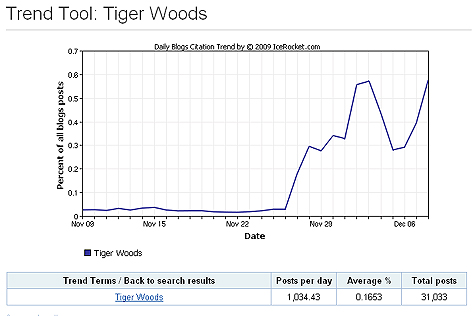
If you did not notice Tiger Woods has been in the news a lot lately. How much? Lets take a look at some visual representations utilizing some of the exact tools that you would use to monitor your brand. Then I’m going to ask you a very simple question at the end of this post.

First we’re going to use the Trend search from Blog Pulse to create a graph that plots “buzz” about Tiger Woods in the blogosphere. We’re going to look at a 6 month window.

How about some search analytics from Compete? Notice an uptick?

Icerocket also tracks blog mentions and real time search trends, look at it’s graph and check out the numbers below the graph.

One of the most impressive and visually appealing of the tools that I used was from Trendrr which allowed us to track qualitative, quantitative, real-time, sentiment, and competitive trends. For the purpose of this post, we looked at Google results, tweets from Twitter and blog posts on Google..

Driving the point home, we now look at Google Trends.

So your team Tiger or your the brand manager for your company and you see these kinds of results. What are you going to do to repair this? What is your first step? How would a large organization manage its reputation after taking a hit like this? What does Tiger do now? What will repair a reputation damaged to this degree? What does Nike do?

Social Media Thought #4: The Thought Leader

Last year there was a Nissan spot, where 2 guys are driving and the one exclaims to the other, “I am the man”! His buddy looks at him and says, “If you have to say you are the man, you are not, the man.”

In the upper right hand corner of Twitter, where a person’s bio is located, you will frequently see that someone will either attach 7 titles or more to their bios or..will call themselves a social media thought leader, guru, ninja, or egads… expert.

Which leads us to today’s simple post.

Some can and should let others know that they are thought leaders-it’s a short list; and for the rest, it’s up to your peers, customers and your clients to determine whether you are a thought leader. If you are, then it will happen. If you are not, eventually people will realize that too. Your work will speak for itself.

This weeks #socialmedia Tweetchat topic: The Future of Advertising & the Role of the Agency

The Answer: Railroads, Newspapers and Advertising AgenciesDog Chasing Tail

The Question: What industries have / will decline because they did not understand what business they were in?

To take a skit from the great Johnny Carson, this could easily come true.  Much like railroads never adapted to other forms of travel and newspapers can’t shake their dependency on selling ads only on pulp products, the traditional advertising agency model is evolving.  For many years now, the advertising model has been morphing and traditional agencies seem stuck in their old ways.  They have left such an opening that new cottage industries are popping up all over to take on what’s being dropped beyond the old model of creative storytelling.  These new players are coming under the guise of digital shops, interactive shops, social media marketing shops and even traditional public relations (PR) firms are getting into the mix by creating their own digital practices. 

If that’s not enough, now you even have independents and consumers now coming up with extremely creative concepts and execution.  For $12 and change you can now create a super bowl commercial, build an entire Brand out of yourself or even take on the entire multi-billion dollar industry to develop creative for a multi-national brand.  A little imagination and a video recorder have altered the way consumers think of their involvement with a brand and completely re-structured how the corporate world must react to consumers ever changing interests, power and influence.  More importantly (and this is where the agencies are not effective) companies need to do more than just react to this new consumer, they must involve and engage the consumer in ways that are not even imagined yet. 

So how do agencies compete with all of the boutique industries popping up and the unique competition from near free crowdsourcing?  We’ve spoke here about the need to transition from campaigns to conversations and crowdsourcing is the equivalent of guerilla warfare as no one knows who the creatives are or where the production is coming from.  In fact, the media industry has struggled with managing the quality of crowdsourcing for years now and are even further away today from capitalizing on it than they were 4 years ago.  Traditional agencies seem well positioned to handle both of those challenges yet many are in denial and still calling crowdsoursing a “fad”.  Those are only some of the reasons there are dozens of these new age companies starting up to solve specific areas of untapped needs in the new agency model.

While the agency world is busy chasing it’s tale, Brands are still required to sell more product to new markets.  As a result, companies (and here) are gearing up their own resources to meet the challenge.  They are creating great products and product experiences then inspiring their consumers to tell their story for them.  So that begs the question if Agencies are even relavant anymore?  I certainly believe they are but now in their current form.  I always go back to an analogy I’ve been using for a couple of years: Just because you can go to the market, buy a chicken and some spices does not mean you can cook like Emeril LaGasse.  And the same holds true in this industry.

To bring some relvance to this dialogue, we have recruited on of the best thought leaders of the “New Agency World”.  Edward Boches is the Chief Creative officer and leads the Social Media practice at Mullen, a full service modern agency.  His insight is not only transforming the way Mullen does business, but also the way much of the industry is beginning to think about their businesses.  The topic and questions are as follows:

Topic: The Future of Advertising & the Role of the Agency

Q1:  What is the model of the ideal agency?

Q2:  What skills and talents are needed?

Q3:  How much should brands do in-house vs. outsource to agencies?

In keeping with our end of the year theme, this week’s focus on the future of advertising is sure to broaden your ideas of what advertising is and where it belongs with your company large or small.  The format will stay consistent with the first question at noon EST and following questions every 20 minutes.  To manage the conversation we will use #sm37 for the event.  Be sure to join us this Tuesday December 8 at noon EST as you will not want to miss an opportunity to interact with one of the industry’s most progressive minds.

Posted via web from marcmeyer’s posterous

The De-evolution of Twitter

How do we move the needle back to conversations? Beth Harte and I were talking about how there seems to be a dearth of conversations on Twitter these days. A year ago we were complaining about the growing cacophony of echo in the Twitter sphere. Now it appears that everyone doesn’t have time to talk, so they just shoot a title and a link out with or without attributes.

My advice would be to take the time to talk with the people that took the time to talk with you. take the time to say something instead of just pushing another link out. Value just doesn’t lie in the quality of the information that you share, but also in the quality of what you have to say.

However the irony is not lost on me on the way that I choose to promote this post. I will go to Twitter and tweet the title and the link. How do you “fix” that?

Coca-Cola knows how to work the crowd on Facebook

As I was reading through The Big Money Facebook 50: Companies making social media work.article yesterday, I saw that Coca-Cola was the number one brand on the list. I wanted to see why so I decided to check it out. When I got to their page I was greeted with this.

Which prompted me to ask or question on Twitter the following:

The answers came fast and furious. Surprisingly or not, they were mixed and I can see why. As social media marketers and brand execs struggle with the best way to have conversations wrapped around their brand, they always run the risk of reverting back to a push style method of marketing. And that’s the rub.

What if consumers prefer that method? Or just don’t care? They just want whatever the brand is willing to give them for free, and they don’t care. So with that being said, giving up all of my contact information, profile information and my friends information for what might be behind the welcome screen doesn’t matter. Apparently not. Or the promise of what might be behind the curtain is compelling enough for me. Given Coke’s status as the number one brand on Facebook according to this list, I think we know the answer.

So what’s my point? Yes the conversations are important but sometimes  customers don’t want to talk with brands, they just want what the brands are willing to give them provided the customer is willing to give up its privacy. Do you really think that Coca-Cola is that sexy of a brand to be worshiped all the way into the #1 spot on Facebook? No. It’s the allure of what might be.

Social Media Thought for the Day #3 Social Obsolescence

I’m struck by what Geoff Livingston titled his book from 2007. “Now is Gone”. It almost seems prescient. Content is content just for a day and almost seems irrelevant if it is from last week. Social sites are only as good as the purpose they serve right now. Fame is fleeting, personal brands last only as long as your last Google update and social networks continue to evolve.

What does this mean? When a social site no longer serves the needs of the people that participate, those people move on. Though there might not be a thing wrong with it. The site has become obsolete.

See the consumer-in reponse to Tom Martin

Tom Martin from Zehnder Communications recently wrote a blog post entitled “Be the Consumer”, in which he laments that to truly understand the consumer you must be the consumer.  Says Tom:

Only a person that actually uses a product or service can figure out new uses for said service/product. And that, to me at least, is where the money is at… innovation.

But as he is dead on with this, I had a conversation with a start-up yesterday in which they wanted to be all things to all demographics with their product offering. I ventured that why not try to be really good with a smaller market segment first? That way you can get to know your market segment a little better-what makes them tick, the how, the why and the what for. Be the consumer but see the consumer as well.

Yes let’s be the consumer to innovate, but let’s see the consumer that you’re going to innovate with. One thing that social nets have taught us if anything, is that everyone hangs in a network for a reason. At the least, they probably identify with that group within that network for at least one reason. Find it.

To expound on Tom’s point,  If you’re going to sell to me, at least take the time to find out where I am, what I do and how I do it. Do your homework. Innovate.

See the consumer. Be the consumer. Become the consumer.