The Social Media Pitfall of Assumptive Collaboration

Last week I was working with a client and we were at a critical juncture of a web development project in which we were discussing the jumping off points for their initial foray in social media. We were doing this by merely adding social elements to the website in the form of a few actions.

The first was instead of creating “a website” we decided to create it in WordPress so that we would have the latitude to “turn on” commenting for starters. let me back up, I just used the word “we” but in actuality the directives were coming from me and the developer. I had suggested Worpress and a specific WordPress developer.

During the development phase we ( the developer and I) decided to make the commenting more robust and so we decided to go down the path of Disqus. Disqus is a great product for those with social profiles who bop around a lot from site to site. It eases log in issues and multiple identity problems. We were on the fence about creating a community but we (the developer and I figured we could roll it out a week or two later). As an aside-let me also add that by doing this, the user would have had to create 3 separate user ID’s to access various parts of the site.

Do you see a recurring theme here? I haven’t mentioned the clients input at all and or their input in the whole decision making process? Well, that’s because at this point,  it’s very one sided. As a consultant I was not doing my job. I wasn’t consulting. I was dictating. You could argue that I was doing what I thought was best but I wasn’t really listening to the client.

A big mistake and I should have known better.

The developer and I were not out to just “crank” this project out with all the bells and whistles-well maybe we were, but what we got caught up in, was creating a site that fit our “needs”. The development fit my needs of what I thought the client needed. Me and the developer were on the same page. High five’s everybody!  I thought I had a good handle on what the client wanted or needed, I just neglected to educate, provide options and offer suggestions.

So while we were creating  this kick ass solution for us, I failed to remember that my client was just getting started with social media; and more importantly their customers might not be very social either.

Luckily, the client, in a stern but understanding way explained to me what was happening. At first my gut reaction was, “What are they talking about”? But then it hit home. My comfort levels were not theirs. My expectations were not theirs. Their level of understanding and comprehension was not mine. I failed as a consultant. I was an ally but I was keeping them in the dark and not listening. I wasn’t asking questions as we were going along.

I was collaborative but assumptive.

The good news? I realized it, thanks to them pointing it out. I backtracked and caught myself and was able to understand what I was doing. I apologized profusely and went back to the developer and we were able to make some things right and simplify some other things. I still have to get them to a level where they understand the thinking, the tools and the platforms that revolve around social media-but the lesson this time, the learning, it was all on my part. Next time, I might not be so lucky.


The Intrinsic Value of all this Social Media stuff

I was driving into Pittsburgh today to meet with a couple of clients and I was on the phone with one of my friends who told me that he had been talking with a local ad agency about social media. Before I cut to the chase, the agency is a major player in Pittsburgh but by no means a social media player.

This may help with what he said next. He goes on to tell me that the agency told him that social media is not effective and pretty much a flash in the pan type of thing.  he goes on to say that a lot of hype surrounded it early on, but after the hype, there is not much there. As I’m listening to him the opinion of the agency all of a sudden started to sound more like his opinion and it was at this point that I cut him off.

I told him that I’m not going to sit here and defend it, but I will say that you are both wrong. Which got me thinking about the intrinsic value of it all. Are they right? Is this all bullshit?

It’s as simple as this.

The intrinsic properties of social media lie in the conversations; and those conversations depend only on that thing; the conversation. What happens after that is up to you and the person that you’re having the conversation with.

There.

Is Twitter really working for you? 10 questions

Have you ever thought about who sees your tweets?  I often do. I was reading an article in The New York Times Sunday Magazine titled, “I Tweet, Therefore I am” in which the author Peggy Orenstein ruminates

How much, was I shaping my Twitter feed, and how much was Twitter shaping me?

She goes on to say that “The expansion of our digital universe has shifted not only how we spend our time but also how we construct identity”. She’s right you know. We tweet for others. Or do you tweet just to tweet? No, you tweet so that you can be heard by others…To have conversations, to network, to create business opportunities. But do you want to know something that might make this a losing proposition?

 The others that we tweet for, really consists of about 1% of the total number of people following you at any given time. In other words, if you have 126 people following you (which is the average) chances are when you tweet something, 12 of them are reading it or might read it. Let’s knock that number down further and say of those 12, 2 may respond.

Depending on what you say and when you say it, the audience that you are playing to, really consists of a minute few at any given time. Which means depending on your professional background for instance, what you tweet may truly be shaped by that small group of people that a) decided to follow you in the first place and b) actually decided to respond or aknowledge your tweet.

Consider this: According to Harvard Business Review study from last year  the top 10% of prolific Twitter users accounted for over 90% of tweets which implies that the pattern of contributions on Twitter is more concentrated among the few top users which further implies that Twitter resembles more of a one-way, one-to-many publishing service more than a two-way, peer-to-peer communication network.

So if you have 126 followers,

  1. Who is really deciding what you tweet? 
  2. Are you being heard?
  3. If so, by how many at any given time?
  4. What is the net result of your tweeting?
  5. Does this mean that although we talk about Twitter being about quality, it is truly driven by quantity to be effective?
  6. Do we need to define or redefine what being “effective” on Twitter really means?
  7. What do your tweets consist of?
  8. What are you hoping to get out of what you tweet?
  9. If your 126 followers are for business purposes, is your Twitter strategy really that effective with such a small number?
  10. Since joining Twitter what have you gotten out of it?

It might be time to step back and evaluate what you are doing on Twitter.

The Top 10 Ways Social Media Confuses You

Some of us are tasked everyday with telling people how great social media is and how transformational it can be. Do you want to know why it can be so tough for us to sell someone on it? All someone has to do is a common search on some common perceptions of social media and you get the following.

  1. 10 Ways Social Media Is Changing Our Lives
  2. Google, Yahoo, Bing Say Twitter is Stupid
  3. Why Social Media is a Waste of Time for Most Local Businesses
  4. Social Media can be a game changer
  5. Who owns social media? Who cares?
  6. 15 reasons to love social media
  7. Why I hate social media
  8. Social media is not for all SMB’s
  9. Why we love social media
  10. Why social media is not for everyone

and your bonus is a deck from David Armano from Edelman Digital *Social Media is Dead– Long Live Common Sense!

Wouldn’t you be confused to?

What happened to the Ah-Ha moment?

Do you remember the first time you got a blog comment? Or the first time someone followed you on Twitter. Pretty cool wasn’t it? All of a sudden this static world of reading and consumming media changed-overnight. All of a sudden we all had voices.

I remember the first time I connected with an old friend on Facebook. It immediately showed me the power of the platform and it’s infinite possibilities. Which naturally lead to these thoughts- “I can’t beleieve they found me”, “Wow do they look old” and “I wonder who else is on here”? I truly believe it was those 3 thoughts that fueled the desire for more from users who both created and consumed Facebook content. It was like crack.

Depending on your background and skillsets, the early days of social media for a lot of us, were so wonderous and so filled with curiosity. Connecting with new people who were your peers, and then having these really deep discussions through blog posts and comments or tweets on Twitter, took the power of social media for us and elevated it.

We blogged about it. We waxed poetic about it. We told whoever was listening about it, and even those who might not have been listening, how cool and powerful this thing called social media was. We were all evangelists who had Ah-ha moments.

But something has happened. The Ah-Ha moments are diminishing.

Do you remember when the internet first exploded on the scene? How everyone was enamored of it? Or how about when the iPod came along? Do you remember the cool commercials and the desire to have one, how great it was? Is it still like that? It’s not, is it? Why?

The problem?  Mass consumption and the expectations of consuming as it relates to creating.

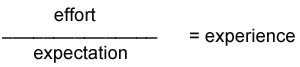
Like any addiction, as you continue to consume, it takes more and more effort to satisfy the craving.  In social media your magical moments were created by you, but moreso by your connections. It’s just they were driven to you inversely by your effort.

We want more Ah-Ha moments but…they are just few and far between now. You’re probably thinking well a sage veteran already had their moments, it’s only for the newbies…Really? Is that the way it supposed to be? Can’t we have more?

In the “social media” beginning, your effort to have conversations equaled  a great experience because the expectations were so low and there just weren’t a lot of people in the space.

But as social media has evolved and Facebook now has it’s 500 millionth user,  the web 2.0 experience has changed what we think, what we know, and how we use it. Our experiences have been dulled and our desire for new and shiny has increased, all because of us. Why us? Because the tools and platforms that make up social media, have allowed us to create and  experience things at levels that would have blown our minds 3 years ago. Demand is way up, experiences are way down and expectations have never been higher.

Our social media experiences are just that. They are merely experiences now. Our expectations are getting so high that we’re likely to be disappointed by our experience. I worry that our expectations keep rising not only in waiting for the next big thing, or the next great connection, or great business deal, but also for the type of content we consume. Why? It creates the  false assumption amongst creators of content, that what will please us needs to constantly be elevated.

A more potent solution.  Bigger, better, faster.

Funny thing is, what really has driven growth and adoption, more than anything else-hasn’t been technology, though it has helped, it’s been about the human element. It has been about the Ah-ha moment.

It’s always been about you, me and them. We are responsible for our Ah-ha moments. They are there. We can have them anytime we want.

Social Media is Easy*

*But that doesn’t mean that you know how to do it. It doesn’t mean that just because the barriers of entry are so low in social media that you know what you’re doing.

What Happens When the Mega Personal Brand Leaves the Company?

This past week something occurred that seems to have slipped by people rather quietly. Frank Eliason is leaving or has left Comcast. For those of you that have been dialed into social media for awhile, this is significant for a number of reasons and you’ll know why.

The biggest reason is that we, the social media community lose our poster child/case study of how one person with one tool/platform can transform how a company operates in the social media spectrum of customer service. Can some of you even count the number of times you might have used ComcastCares as one of your social media “examples” 2 years ago.

If you don’t know who @Comcastcares is or was, it was merely one of the first  large companies/individuals to take Twitter and use it as a direct bridge or line of communication into Comcast customer service for real time/any time help of customer service issues.

When social media case studies were few and far between, Frank’s work at Comcast was our shining example of Twitter and customer service. We name dropped Comcast along with Zappos and Starbucks and Jetblue.  So much so that Frank’s personal brand grew, and grew and grew. Not because he was promoting himself, merely this was just the effect of his social media success.  @Comcastcares was as much Frank as it was Comcast. They were synonymous with each other-interchangeable if you will.

Which lead to an interesting conundrum as well as the second reason why Frank’s leaving is significant. It’s something in which a lot of us in the social media community had often talked about, tweeted about, written about and speculated about, and that’s this:

What happens when the personal brand behind a company becomes larger than the company because of social media? What does the company do? One of the other questions we threw around early and often as well was, What if that personal brand leaves the company, what happens then?

Well guess what? It’s finally happened. Frank, little did you know but you may be  creating another case study for all of us. Good luck, and thanks for setting the table, taking chances, and leading the way for a lot of companies and people that will have no idea that you might be reason they are using Twitter for customer service. 🙂

Should Your Social Networks Mingle?

A lot of the apps and web services that come across the desk lately have to do with consolidation and aggregation. In fact, back in April there was a pretty good post in Social Media Today on 7 social media aggregation tools that you should use that caught my eye. I went through the list and I was familiar with 4 of them. But there’s a larger point I want to make here.

Actually 2 points.

Point #1. I’m going to use Yoono as my first example. Yoono connects you to your social networks and messengers. It unifies your status updates into a single stream of information and lets you update your status across all your social networks at once. Social media sites that are currently supported include, Facebook, Twitter, MySpace, LinkedIn, FriendFeed and Flickr. Messenger services are available through Google Talk, AIM, Live Messenger and Yahoo Messenger.

But what if each network has specific audiences? i.e. Facebook is family and friends. Twitter is your peer network. Linkedin is a business networking network and Live Messenger is say for your customers or something like that. My networks are somewhat broken out like that. I don’t want them to overlap. I don’t want my Facebook friends to receive my Twitter updates. I don’t want to pollute, so to speak, my otherwise “clean” Linkedin network with my Twitter updates. Occasionally I add the #li hashtag to a tweet, but otherwise I keep them separate.

You might be asking why I keep them autonomous but my simplest of reasons is that my networks are not all “business” related and conversely not all are intimate and or personal. Consider it strategic but it works for me. Different networks, different messages.

Point #2.  There’s an assumption that we need consolidation and aggregation. I would say yes and no. I definitely think that having universal logins is heading in the right direction but there is one issue that I have with that. Profiles matter but they almost have to be a bit different for each network. People sometimes need to push out a different yet more effective profile per each network. Linkedin vs. Twitter vs. Facebook vs. Myspace. Different niches, different networks, different profiles.

Consolidation yes aggregation maybe.

More and more we are becoming members of more networks. That won’t be changing. I’m not sure there is an answer for posting updates that populate across all networks in which your networks understand the meaning. I may be looking at this too hard from a business standpoint and that’s OK. But the bigger picture is that consolidating our social networking effort is what we all want because we’re all hell bent on laziness or efficiency-take your pick. It’s just that  aggregating or mingling them with any type of contextual adaptive effectiveness might be trickier.

The top 10 social sites, links and posts you might have missed this week!

I haven’t done one of these posts in awhile but let’s get right to it.

1. Paul Chaney shot this out today; Deliver your content to the social web with dlvr.it

2. I loved this post 7 reasons social media agencies are like advertising agencies; 8 reasons they’re not by Rob Petersen

3. If you’ve been living in a digital cave then chances are you’ve been missing an amazing social media marketing awareness campaign being done by Old Spice this week.

4. Watch this interview with Charlene Li and Clay Shirky with Andrew Keen on connectivity. Fantastic insight.

5. As video looms larger and larger, you need to understand the proper mechanics of optimizing your video content for SEO.

6. Read this interesting piece on how social media marketers rig the social media machine.

7. Instant messaging anywhere with Beejive

8. You need a QR code.

9. IM, Email and social networks in one easy to use app! It’s Digsby.

10. Check out MediaFunnel. Coordinate and manage your social media presence.

* From Tom Martin we have TweetyMail which seems really really cool!