When Social Media Strategy Becomes Irrelevant


What’s important? Every day online and in the social media bubble we talk about ROI and the strategy and the channels used to grow your social media presence and impact. Here are 3 examples where social media has never figured more prominently and yet it had nothing to do with strategy or ROI, but had everything to do with the engine that does drive social media, PEOPLE.

This past Friday, YouTube created the YouTube Person Finder a channel that is aggregating video messages from the victims and the people affected by the massive earthquake and tsunami that hit northeastern Japan more than a week ago. No strategy, no ROI justification-Just YouTube realizing that they could create something that could help people in a time of need.

Meanwhile Google, creates the Google Person Finder which is pulling all relevant search information about people affected in the region into a simple interface. You can either supply information that you know about someone or you can search information posted about someone you know. On top of this, Google has created the Google Crisis Response Page which in my opinion should be shared by everyone just based on the amount of information posted and updated on it.

A Facebook Causes page was recently created to support and raise awareness and funds for the earthquake and tsunami victims.  The page is called Help Japanese Earthquake and Tsunami Victims, and it allows Facebook users to donate anywhere from $10 to $500, or they can join the cause and share it with their Facebook friends.  So far they have raised $240.000  This might not seem like a lot but every bit of it will help. Additional Facebook resources can also be found here  Global Disaster Relief on Facebook page.

This is bigger picture stuff here and at the end of the day has nothing to do with business strategies or ROI but has everything to do with people using the power of social media to make a difference when it matters most-People in need. Impactful stuff…
 

Socially empowering your employees-What’s taking so long?


We talk and write about the ways to grow a business using social ALOT. Companies are obsessing over it. Even the really really big companies want to harness the promise of the prospect, the power of the existing customer and the potential of repeat business-All using social media.

Yesterday, I was talking to a manager of one of those really really big companies. We talked about empowering their employees to engage in outbound social media marketing- That’s a fancy sentence for basically letting your employees tweet and share things about the company on company time. The comment back was, “They are hourly employees, “We can’t do that-We can’t trust what they might say”…

That sentiment is not on an island.

Two days ago I was talking to a salaried employee of another large company who told me that they could not access Facebook from their work computers. Two thoughts came to mind. One-employees can use their mobile devices at any time to circumvent those rules and two, there is a lack of trust coupled with a fear factor of what that employee might do that is preventing this company from taming the social beast.

I mention the 2 scenarios because in both situations we’re talking about employees both salaried and hourly, in which trust is a huge issue.

How do you leverage the power of what your employees can do for you in social media in order to grow your company? Your customers would welcome the socially empowered employee representing your company. We are entering a time in which it is expected and in some cases demanded.

What is the exception and what is the rule? The rogue employee using social media or the empowered one representing all that is good about your company?

What Was Your Enchanted Moment?

I’d like to think that we’ve all had “enchanted” moments in this space. I have had at least two, maybe three. The space I’m referring to specifically is the digital/social media, online marketing space.  Moment #1 possibly occurred when I built my first website. That was pretty cool. It looked pretty bad but there was something to be said about doing it without the aid of templates and the myriad of tools and programs available today. I got better, but the light really went on from that first experience.

Back in 2005 I sent former Apple Evangelist, Guy Kawasaki, an email; and to be honest, I didn’t really expect a response. The email was a general, ” Oh Sensei, What is the path” type of inquiry. At that time I had recently read his book The Art of the Start and also had stumbled onto Guy’s website/blog, How to Change the World.  After reading the book and the blog I was beyond energized and knew what I needed to do and was merely hoping that Guy was as genuine as I thought-and  by responding to my email, he would only validate the notion even more. Though at the end of the day, I didn’t expect a response.

Well…He did respond. The key there? He responded. The content of the email? I can’t really remember. What struck me was that he responded. It opened my eyes to the power of connections, the power of having a direct type of access to someone who you might have thought was inaccessible. It was the power of social to me on a very small but large scale all wrapped into one. That was truly Enchanted Moment #1.

Moment Number Two: I initially got into social media because of my SEO background. I found out rather quickly how one could “game” blogs for SEO and reputation management with hyper linked signatures embedded with key words. It was apparent pretty quickly that this worked so at the time I wouldn’t pay much attention to the content of a blog as much as I did to the page rank of it. Then one day I read a post that struck a nerve.  I commented and they commented back. Whoa. What is this dialogue? This is better than hoping or waiting on an email response from Guy Kawasakai! It was real time, it was genuine, and it added these immediate reciprocal layers of texture to a static web and a static job function that really opened my eyes to the social possibilities of the web. The moment was huge for me. It changed the way I did things and the way I thought about things.

In 2011, it would appear that my three experiences have come full circle. Last night I finished an advance copy of Guy Kawasaki’s latest book Enchantment. I was asked to read and review it and I have to say, I probably would have read it without him asking me. Here’s the point or here’s how much things have changed for me since that day back in 2005 when I sent Guy that email. Not to revel in the reasons why I was selected to read and review the book because it really can be completely subjective, the fact is that my influence and opinion and networks mattered. That’s pretty cool. That’s the power of social, the power of connections and the power of the web. It has shaped my life and my career over the last 6 years all in a positive way. So in a way, Guy has been part of my enchanted moments  from the beginning and now in the middle.

Now the book Enchantment:  It took 2 flights to finish it. A quick read. I didn’t have to struggle to find the meaning of the things I was reading. It was as easy a book to read and understand as you will find. The tag line, “The Art of Changing Hearts, Minds and Actions”, could not be more appropriate.  After every chapter is a quick snapshot of someone’s moment of enchantment in their life or career which adds an additional aspect of “human-ness” to the book. It’s real. It’s Tangible. Guy’s style is so non invasive and I think that’s the takeaway. I’m glad I read it, will probably read it again and I will ultimately give it to someone who can benefit from it.

Enchanted moment #3? Having Guy host our weekly #Social Media Tweetchat-That would be full circle. Stay tuned! The key? I just have to ask. Truly the power of social.

Have you had your enchanted moment yet?

Corning Creates an Impactful and Viral Video

Watch this video from Corning. When I first saw it, I was amazed at what was possible with glass and then what caught my eye was the number of views-5.8 million views in less than one month. This is isn’t a funny video. It’s not scandalous or malicious or of someone getting hurt. It’s simply about the many uses of glass. Something to ponder the next time your company wants to create a video. Was it Corning’s intention that it garner close to 6 million views, 14,000 likes and almost 3,000 comments? I don’t think so…


Monetizing Facebook


Let’s look at three situations.

We’ve all been wondering either on the behalf of the company’s we work for, or the clients we serve, or for ourselves- How can we leverage Facebook to actually make money?  Recently, Social commerce platform ChompOn, threw down the gauntlet by publishing some data on how much a Facebook share and tweet is worth.

For those who have never heard of ChompOn, they are a site/service where you’re able to create  Groupon like widgets to embed on your website.

Real quickly, for shares and tweets, ChompOn was able to attribute sales to the original action, so they took the total revenue attributed to each action and divided it by the total number of shares/tweets. For likes and follows, they had to estimate attribution by looking at their traffic references and subtracting out purchases made through shares/tweets as well as purchases made through direct traffic.

I don’t know. It seems like such an inexact science. I know it’s based on The notion of group buying shares and likes and tweets but still…Can we be that precise on the value of a share or a tweet? If we were, I would think much more would be happening in this space and business. Is that why Groupon was valuated so high?

    Next we have some data by Emarketer in which it was reported that US marketers will spend $3.08 billion to advertise on social networking sites this year. Additionally, that growth in spending will bring social media ad dollars to 10.8% of the total spent online in the US.

    US Social Network Ad Revenues, 2009-2012 (billions and % change)

    What’s not surprising though was that the primary driver of the change in projected spending is because of greater ad spending on Facebook.

    ”2010 was the year that Facebook firmly established itself as a major force not only in social network advertising but all of online advertising,” said eMarketer principal analyst Debra Aho Williamson, author of the upcoming report “Worldwide Social Network Ad Spending: 2011 Outlook.” “In 2011, its global presence is something multinational advertisers can’t ignore.”

    Facebook Ad Revenues, 2009-2012 (billions)


    These numbers just blow me away. Look at the change in revenue from 2009 to 2012 in the US alone!

    OK last one here. Recently SmartPulse  conducted a poll in SmartBrief on Social Media — asking:  Have you bought ads on social networks? If so, did the ads deliver a high return on investment?

    The choices consisted of the following:

    • No, I have never purchased ads on social sites — 64.86%
    • Yes, I have bought ads on social networks and the return on investment was low — 27.03%
    • Yes, I have bought ads on social networks and the return on investment was high — 8.11%

    I’m going to echo the question that was broached in the body of the survey results: “Why is the ad spend on social sites growing so rapidly, and will it continue?” I’m then going to affirm the next statement:

    I am astonished by these ad-sales figures, since everyone I seem to ask either says they’ve never purchased social ads, or they have bought ads, but would never do it again because of extremely low return.

    Am in the bubble that ignores banner and display ads? Perhaps. isn’t the click thru something like 1/2%?  I get it that social networks understand that their main source of income is always going to be derived the majority of the time from advertising. Facebook it would seem, is ideal then, given their 600 million registered users; because it can indeed provide a platform to purchase highly targeted ads based on specific demographics. But I think this highlights a bigger issue-No one is challenging a better way to make money either via Facebook or in social, either from a platform perspective, aside from a subscription model, or from the advertiser/brand side.

    So of the three scenarios. Is a Facebook share really worth $14? Are advertisers wasting money on Facebook? What advertiser is making money on Facebook? What brand is doing a killer job of utilizing Facebook to make money and can prove it?


    The Relevance of my Online Relationships has Risen.

    Game changer alert! It’s not what Google knows anymore. It’s now going to be about who you know, who you are connected to, and how connected you are that will affect the results of your searches. Let that sink in for a second. The time has come where social and search are no longer sharing the same clothes. No, they are now joined at the hip sharing the same clothes!

    Read this snippet below from Google’s blog post about social search

    Is this is a good thing? I think so, there is definite relevance to our existing relationships when doing business. Case in point, I use my Twitter followers and also the people I follow on Twitter as a de facto RSS feed for information about the work I do and the research I need to do my job. So tying that information literally into a search feed, is essentially the same thing.

    What this will get people to do possibly, is change the nature of the online relationships they have, they make, and that they curate. It may in fact increase the value of content created and networks joined, as well as the volume and frequency of participation. So this begs the question, Will this increase the noise or the signal?

    Here’s some more info about it.

    Social Media Conundrum #12: Justin Bieber is popular, but he’s not influential?

    I can’t believe I’m going to weigh in on this, but I saw a tweet from a notable social media analytics consultant in which the following was stated for the umteenth time.

    Popularity does not equal influence…

    I immediately thought, “Could Justin Bieber and Lady Gaga sell product”? Isn’t that influence?I then had to go look up a quick definition of influence.

    in·flu·ence

    ˈɪnfluəns/ [in-floo-uhns] noun, verb, -enced, -enc·ing.

    the capacity or power of persons or things to be a compelling force on or produce effects on the actions, behavior, opinions, etc., of others

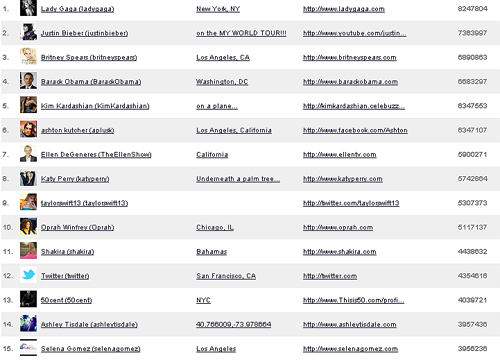
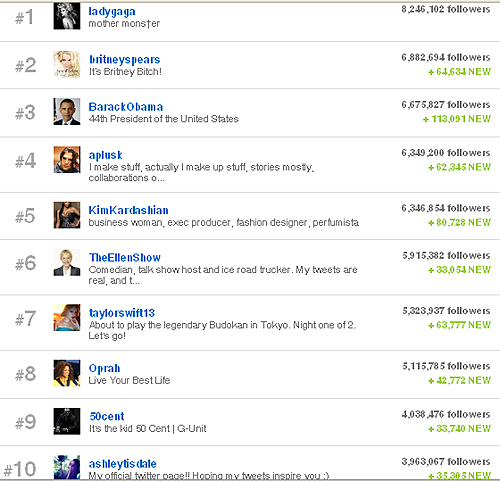
    First I wanted to check something on Twitaholic: The top 15 people being followed on Twitter.

    This is a list of the top 15 most “popular” people on Twitter. Let’s look and see who could sell or who does sell product. Let’s pare the list down first.

    We have Justin Bieber, Lady Gaga, Britney Spears, Kim Kardashian, Ashton Kutcher, Ellen, Katy Perry, Taylor Swift, Oprah, 50Cent, Ashley Tisdale and Selena Gomez. 12 Celebrities from the world of entertainment. Immensely popular. But are they influential? Can they produce a compelling action on someone to buy product? Could they change behaviors and opinions? Can they influence people to buy stuff?

    Lady Gaga sells video sunglasses for Polaroid, headphones for Beats by Dre, phones for VirginMobile, and a host of items and services via product placement in her videos. All this adds up to roughly $5-$10 million per year.

    Rather than quote the whole  article from Guy Kawasaki, read about Guy’s experience at a Justin Bieber concert and the machine behind his persona.

    Britney has deals with Elizabeth Arden and Candies. Taylor Swift has deals with Sony and CoverGirl. 50 Cent has deals with Reebok, Vitamin Water, Right Guard, PlayStation, and Steiner Sports.

    We could easily go through each celebrity on this list and view the products that they sell. They sell the products because they can influence buyer behavior based on their celebrity, based on their popularity.  Am I wrong? I know sales are one thing and fame is fleeting, but because of their celebrity and popularity they can influence buyer behavior right now. Right?

    How can you possibly say no? Isn’t that influence? What am I missing here? Help me out.


    Content is under scrutiny? It’s about time.


    Creation, curation and aggregation. We all probably fall into one of those categories. We do one of those. I do. I don’t dispute blog posts like this Why Content Curation Is Here to Stay. I get that. What I have a problem with is the type of content creation we run across when doing brand monitoring work for clients. It’s falling into two camps.

    Here’s the first.

    Recently we were doing some work for a very prominent client where in the analysis of brand mentions we had to sort through thousands, yes thousands, of useless pages of content on websites that were set up  as splogs to drive better search results around pages geared towards Google Adwords. This is troll like stuff.  This is not new. Useless web pages have been appearing high up on search result pages for awhile now.  So Let me ask you a question. I assume that most of you who read this post are fairly savvy web users, but when you do a search-what part of the search result do you look like?  Me? I look at the URL under each search result. and that in and of itself can be revealing-sometimes content that you think is going to be worthwhile turns out to be crap.

     I’m using Google search results as the prime example here.

    I thought we were getting the best search results possible? Maybe not.  For a lot of us Google is part of our everyday lives. We are slaves to the rhythm of search as much as we are to what Google returns to us.  Google and search dominate the web. The conundrum? To get traffic to your webpage, you have to appear high in Google’s search results. Which in turn means that you must create some type of content that works for Google. Thus the incentive to learn or understand SEO and Google’s Algorithm i.e. game the system, is huge.

    Google will admit that the quality of it’s SERPS is higher than it has ever been; in terms  of comprehensiveness maybe so, relevance  may be debatable. They might be the first to tell you that there is a proliferation of sites that rip off other people’s content because they’re too lazy to build their own audiences based on fresh content and fresh thoughts and ideas; and that is a problem. Yep, the rise of the “content farm” which is heavy on volume and light on fresh, original content is upon us.

    Google has been making changes to its algorithm to keep low-quality sites from appearing high in searches, according to Matt Cutts in a blog post last month. But he also wrote that, despite Google’s efforts,

    The fact is that we’re not perfect, and combined with users’ skyrocketing expectations of Google, these imperfections get magnified in perception.”

    I cannot tell you how frustrating it is to have to sort through garbage search results both personally and on behalf of a client; to be bogged down with the process of weeding through content farms.

    “As pure web spam has decreased over time, attention has shifted instead to ‘content farms’, which are sites with shallow or low-quality content,” Cutts added.

    I got into SEO years ago and understand the game.  High rankings in search have always been driven by the number of pages/sites that linked to it and how prominent they were ranked and what pages and sites were linked to them. There were always “other” little things involved, but to me it was always about the hub and spoke model. What sites were at the end of the spoke and so on and so forth. Oh yea, and one other thing-Content.

    Marketing departments and SEO companies understand this. Thus,  they’ve been creating “landing pages” buried inside corporate sites to hit all of the different possible combinations of keywords of a search query relating to their company/ industry. Bloggers do it by linking to each other. It works, content farms work, and that’s part of the problem.

    The bigger part of the problem? Large companies are catching on. They know this and are willing to play in this grey area space that Google doesn’t police very well, and we, the people that do searches, suffer for it. As it turns out, they are getting away with it. Or are they? The latest to be identified according to the New York Times is JC Penney.  Large and small companies will continue to game the system like this until a) they are caught and penalized or b) Google in particular-fixes the algorithm. Until then, content farms will continue to rule and the research that you  and I do on behalf of clients, will still take three hours instead of one.

    If only there were a way for monitoring companies to weight and kick out splogs and obvious content farms…hmmmm.

    How Accountable are you with your Social Media?

    Recently the spate of social media faux pas’s would tend to make one wonder if putting yourself “out there” is really worth it. The novice I’m sure is wondering that, as well as the expert. Why all of a sudden are people not caring or simply not thinking about what they tweet or what they say on a social network? This thought is what drove the following deck that I will be presenting this weekend in Orlando

    On Brand Experience

    When I was in grade school, one Christmas in particular stood out for me but not for the reasons you might think. My parents were not getting along at the time and for whatever reason, I received a ridiculous amount of presents from my father. Some of which I was not even interested in nor had I asked for.  I found this odd and yet this one thought was not lost on me even at that young age-I thought that my dad was trying to buy my affection.

    I remember thinking that why couldn’t he just spend more time with me? Why couldn’t he have just hung out with me and talked with me? That’s all I wanted to do. I didn’t need presents. Well maybe one or two but…

    Now let’s think about the brand experience. Before the age of social media, we really didn’t talk about the brand experience. It didn’t really have a name. It was just marketers trying to sell something. However, once consumers found their voice-It became readily apparent that they wanted a say so in what they wanted from the products they bought.

    Pay attention to that last sentence.

    It’s funny but sometimes I think we have been beat down so much as consumers that we misconstrue good customer service as a warm “live” voice on the other end of a phone. Great customer service? Someone who cares. Ironically, Brand loyalty starts out with the intent of the consumer hoping to get something from the brand, but then is actually cemented by something as simple as a conversation or recognition that you actually exist.

    That’s all we really want. We just want to talk.