Consumer Empowerment or Why Brands Can’t Afford to Falter

Danny Brown is right.  2 days ago he wrote a post about brands that drive  customers away. Essentially saying/asking, why give your customers, the loyal one’s, a reason to leave. I loved his examples and his post is a quick must read. But let me take his thought a step further.  Recently WebTrends released a whitepaper in which they analyzed the website traffic of Fortune 100 websites based on ‘unique visits’. The study revealed that 68% of the top 100 companies were experiencing a negative growth in unique visits over the past year.

Now we might easily attribute that to the rise of social and particularly to Facebook possibly, but what the research revealed was that Facebook was gaining tremendous popularity as a destination to connect with brands online, and is increasingly chosen over the websites of certain companies. Partly because when customers went to the websites-those sites were still stuck in 1990’s “brochure-ware” mode.

Do you want to give a customer or potential customer, an easy out and an easy path to the competitior? Beyond Danny’s examples of bad customer service experiences, make their initial destination location and landing page user experience a bad one and that should do the trick.

Though there are websites sustaining traffic in spite of Facebook, I’ve said all along that when Facebook catches up with an e-commerce solution that makes the brand experience simple and efficient,  the corporate website is done. This is not an if, it’s a when, and it’s already happening.  When we add mobile and mobile social to the mix, the old adage of you never get a second chance at a first impression will have never loomed more large.

It is time for brands and retailers to understand that it’s not neccessarily about surviving online with a website that has a multitude of itabs that point you to all it’s web properties, it’s more about understanding why people seek out your web property in the first place. What does your user want and expect from your brand online? If you’re a commerce site, or you sell product online, then why complicate the landing page with a corporate look and feel and experience? I don’t care about who your board of directors are! But I do want to possibly buy your product. Make it simple. Want to get ahead of the curve? Then you need to understand, TODAY how mobile and social play into the user experience, you MUST  measure and improve the  performance of all your social, mobile and web entities-KNOW WHAT YOUR USERS WANT AND EXPECT.

Survival for brands and retailers will now be predicated on a customer expectation that is high, seamless, one click in theory, and will eventually be one site in nature. Ok so if we take into account Danny’s post that brands are doing everything they can sometimes to drive their loyal customers away and visits to corporate sites are down-what is happening?

Consumer empowerment is what is happening. Choice is happening.  And brands not recognizing the new age of the educated and enlightened consumer, and moving slowly to adapt, is what’s happening. Stop getting caught up in the minutiae of why you’re moving so slow. Let’s go.
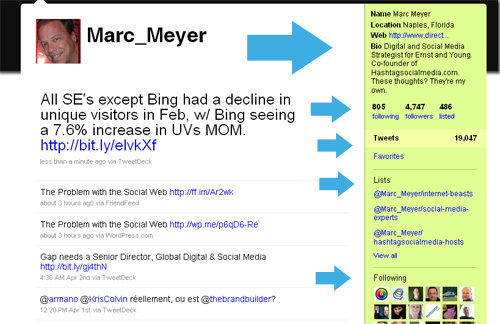

You know what Twitter needs to Fix?

I know, it’s a loaded question but it’s simple really. It’s the one area that needs attention and really hasn’t received much of it. See if you can figure out. I apologize for using my page as the example.

The Bio section. If we’ve been saying that numbers don’t matter and that it’s all about quality and not quantity, then that notion pretty much renders alot of what you see on the bio section as useless. Right?.  Here’s a really quick suggestion. Since we have the ability to publish content across multiple social platforms at once, perhaps we should see what networks one is a part of. Twitter needs to empower it’s users and allow them to take advantage of a new bio design that leverages more of who they are and not their “personal numbers”. The current bio section was cool when Twitter first launched 5 years ago. Right now it only serves to answer the most rudimentary of questions-that most frown on anyways.

What do you think?

The Problem with the Social Web

Competition is a good thing. Burger King is across the street from McDonalds. Chipotle sits a few hundred yards from Moe’s, Sprint and AT&T offer virtually the same thing. At the end of the day it’s about choice and personal preference that decide whether we go for the hamburger or the hamburger, the buritto or the buritto, or the phone or the phone. Sure we might get a recommendation or suggestion from someone, or we might be motivated by some type of incentive-but ultimately, you make the choice to choose…

Two years ago my friend Jason Breed and I created Hashtag Socialmedia– a tweetchat that revolved around talking about the business of social media. We patterned the chat around the rise of tweetchats that had distinct hashtags associated with them-our model came from Sarah Evans and her #journchat, which at the time was virtually the only tweetchat out there.

Her idea became our idea. But with additional bells and whistles and a different topic. The same but different. What drove both were the variety and types of people that participated. Was it a form of “Me-too”-ism? Maybe. But we weren’t competing for the same eyeballs and ears, so it didn’t matter. We took the basic concept of a tweetchat and made it our own.

In the larger picture of the social web though-there is Facebook, Twitter, Linkedin, YouTube and blogs. Those are your so called starting points in social and then everything else sorta falls into lockstep behind them. I’m generalizing blogs, but if you insist, I could go with WordPress, Typepad and Blogger.

The point is this.  Right now we are stuck in the Me too phase of social. I see things being created that are offshoots of the basic premise of connecting, sharing and communicating-but nothing that is transformational. Nothing that is altering the way people do business.

If anything, I still see the adoption of social media taking longer than I expected.

Consider the following statements:

“We have a blog, come read it and find out cool stuff about our company”

“Come join our community and learn more about us”

“We have a Twitter account, follow us we may say something insightful”

“Come see our Facebook page and fan/like us”

“View our Youtube videos and share them”

“Download out mobile app and receive valuable benefits”

“Register for our email newsletter and print coupons”

See what I mean? We’re all drinking from the same well. Doing what we’ve been told works.  We’re all in the same bathtub and the toys in the tub are the same one’s that were there last week, last month and last year. Any new additions to the tub will be the same “type” of bath toys that are currently available, but nothing really new that may spur me to take two baths in the same week!. I know, what a ridiculous analogy-but my point being that I’m afraid that we’re stuck right now and it might be awhile before we become “unstuck”.

Recently I read where, First it was AOL, then it was Microsoft, then it was Google and now it’s Facebook. I’d say that was pretty safe. But look how different each was from the previous NBT.

It’s safe to easily sit here and say that Facebook is “it” right now, but also with the aspect of Twitter, Linkedin and YouTube  being variants of a solid basic notion that Facebook understood early on which is this:

All of those above mentioned platforms all have a solid foundation of “ease of  sharing, creating, connecting and communicating” at their core. There is no mystery about that. Sure, we’re exploring different ways that those can be exploited-but nothing really different. It’s “Here’s what you do, here’s how they work, the rest is up to you”- Now go do it.

The mystery is in what’s next. We obsess on it. But I will say this- We don’t need another Facebook. We don’t need another Facebook competitor either. We just need a better experience-but right now I don’t know what it looks like or where it’s going to come from.

Neither do you.

Does Twitter Work?

About once a week I usually get the question, “How does Twitter work? or What’s the deal with Twitter?” And yet throughout the course of a week as well I will also hear the following:

  1. Twitter doesn’t work
  2. How can people spend so much time on Twitter
  3. Twitter has no value

Then couple that with the following from Business Insider and one might really start to question it’s actual value.

There are 56 million accounts on Twitter following 8 or more accounts. There are only 38 million following 16, and just 12 million following 64.

To the casual observer, this all might mean that Twitter is a complete waste of time. To that I say that’s fine, I’ll keep using it for as long as it’s still available. For me, Twitter is invaluable. I’ve made deeper and longer lasting connections to my peers because of it; and because of that, because of those networks, it not only opened a lot of doors, but it also helped me get my current position at E & Y.

If you have doubts on how to use Twitter and still think it’s not worth it,  listen to and watch Tom Martin’s Slideshare presentation on getting a job using social media.

For those that use Twitter and use it as a platform for media consumption as well as sharing and connecting with peer networks-I imagine their opinions of it will be completely aligned on the pro side of it being completely beneficial to them doing their jobs.

Throw the numbers out.


Sure I love the conversation but…

I used to be a social media purist but I’ve evolved. Why? Well we have evolved.  We being the one’s that were there early on who experienced the magic of connecting with someone as smart as  say Gavin Heaton or Tom Martin and having them host our social media tweetchat. Or having that cool, deep discussion with a person like David Alston from Radian 6 when his company was just starting to gain traction, or becoming really good friends with someone i respect as much as Beth Harte. But what made all of those discussions and conversations cool was that we were connecting. Great for us but what about B2B?

There was always the missing component. An outcome. A means to an end. The Why and the What for.

At least that’s what companies wanted to know. And still want to know. They wanted a better value proposition. Some get it but others are still struggling with this. Yea social media is cool but what’s it all mean? What’s the point? To have conversations or make money?  Give us a business use case.

Well yesterdays news of the Salesforce aquisition of Radian6 is a game changer. It’s a watershed moment.  I still like being a purist at heart when it comes to social media but we have to justify its usage. Quite honestly, We have been fighting the good fight for quite some time. Justifying it’s relevance. Educating the masses. But adding strong measuremaent and analytics to social media engagement as it pertains to customer service and sales and lead generation, does just that.  The folks at Sales Force believe that.

With this Salesforce/Radian6 deal, and Lithium grabbing ScoutLabs and MarketWire folding Sysomos into the mix, you are now seeing an alignment of B2B with social beyond just the conversation. Social will always live inside of marketing and PR, but tying it to business functions has now come to the forefront. And the way that become legitimate is by adding measuring and monitoring functions that are directly applied to making money, saving money, and building equity.

Like I said, Watershed moment…


Is it ever wise to knock the competition?

Talking about the other team is a fine line. On the one hand by acknowledging that they exist, you acknowledge that they are a threat and you are aware of them. By not recognizing that they are in the room, you risk not respecting what they might be doing to to succeed in the same space as you. As I said, a fine line.

A healthy respect is one thing but the one thing you should never do is give the competition an advantage of any sort. Either in the press, in person or otherwise. It’s called bulletin board material. Some teams thrive on that. Some teams need it. Some ignore it and others use it as examples that they are the one’s to beat.

Take what a senior executive from one of the world’s largest computer company’s said about one of the most notable and recognizable companies in the world and a direct competitor the other day:

“They’re  great if you’ve got a lot of money and live on an island. It’s not so great if you have to exist in a diverse, open, connected enterprise; simple things become quite complex,” Their global head of marketing for large enterprises and public organizations, said to CIO Australia.

“Their product with a keyboard, a mouse and a case [means] you’ll be at $1,500 or $1,600; that’s double of what you’re paying. That’s not feasible.”

Even in business. Think it, but don’t say it to everyone “outside” the firewall.  It’s not like they needed ammo but it’s like saying, “Yea Kobe has 5 rings but he still can’t hit the 11 footer off the backboard…”


The Dark Side of Viral Content

Black to beat Bieber for YouTube’s most hated…

via Know Your Meme

This is your brain on Rebecca Black.

Tween sensation Rebecca Black will see her parent-financed video “Friday” beat Justin Bieber’s “Baby” for most disliked YouTube video within the next few days, if not hours, reports ReadWriteWeb. It’s an exciting, yet unsurprising development for the 13-year-old sensation whose Auto-Tuned masterpiece of mediocrity became the cool thing to hate on the Internet barely two weeks earlier.

While mainstream media critics, including this one, contend that “Friday” rates about as high on the Lame-O-Meter as pretty much everything else in current popular culture (with the exception of insanely overlooked NBC sitcom “Community” which is GENIUS), the Internet begs to differ.


Will Color be the NBT in social? Or will it fade?

Think fast!

Find someone. Take pictures together.
Party. Play date. Lunch?

Simultaneously use multiple iPhones and Androids to capture photos, videos, and conversations into a group album. There’s no attaching, uploading, or friending to do. Share together in a new, moving social network. Just look around.


You may have no idea what I’m talking about. yet. Color is a photo sharing/social network app  launched last week, and it was  not a quiet launch either. Mostly because of the massive funding ($41 million), and a complete lack of documentation about how people should actually use the app. Count me as one of those still somewhat in the dark…

I loaded it, opened it, saw that I must upload my pic, no other instructions after that. I messed with it for about 10 minutes. Closed it and thought-$41 million huh? Did someone leak Color too soon? Is bad buzz better than no buzz? Do they even care what we think? Why launch an app like that w/o even some cryptic, requisite instruction on how this is supposed to change out social being? I agree that mobile photo sharing is definitely a route worth pursuing, but I’m still sitting here wondering what the business application could possibly be.

But let’s dig. So if it’s mobile social photo sharing, then, for instance we could pull the photos of specific events all  into one bucket w/o a lot of the fat right? We can see what everyone is seeing from that event, from different perspectives and vantage points right? That’s kind of cool. I’ll keep playing with it but as of this writing, I have rose-colored glasses. 🙂

If this is supposed to be the “Next Facebook,” I’d say they have a long way to go. Which reminds me, how is Diaspora and it’s quest to being the NBT in social coming along?

What does Viral look like?

Do you know who Rebecca Black is?

Rebecca Black  is a 14 year old singer. She started attracting attention this month after a single she recorded and produced was released on YouTube and iTunes. The song’s video was uploaded to YouTube last month and received roughly 1,000 views in the first month. No big deal right? Then something happened. The video went viral. Really viral.  In mid-March it started acquiring millions of views on YouTube in a matter of days, becoming a top trending topic on Twitter and getting both good and bad media coverage. The operative word there being, coverage. As of yesterday, first-week sales of her digital single were estimated to be around 40,000 by Billboard, and the video had over 38 million views on YouTube.

38 Million Views

That’s what we call Viral.

Anti-Social Media-The Anonymous Comment

The new iteration of the 4th estate is represented online with gusto. Outlets such as MSNBC and Scripps insist on traveling at hyper speed with us on the information super highway. They have embedded the social tools and capabilities into their new web sites to allow us to have a voice. We can now weigh in on virtually anything on their websites with our thoughts and words. There is one looming and large problem though.

We have to be babysat. With good reason.

It’s like children who look around and realize that no one is watching and thus decide to do something stupid. I find it amazing that adults view the ability  to freely and anonymously comment on any story, as a green light for stupidity and hate.  Not realizing a few things:

  1. It has no value
  2. You’re weak because you hide behind a computer to make your anonymous comments
  3. You could be found

That’s not social media. That’s anti-social media. It has zero redeeming qualities. And yet we sit here and question criticize large media outlets for a) Not being transparent b) Not allowing comments and b) Censoring their comments because of 1st amendment rights. And they do the same-To allow anonymous comments or not?

In some cases some media outlets allow everything, some allow nothing, and still others blur the lines on what is acceptable. They prune foul language and spam and yet some things make it through. The bottom line, they can’t just “let it go”. It can’t run itself. People are incapable of behaving.

Here’s your example:  You are a media outlet and you post a story about someone dying in a car wreck and through the open commenting system, some of the comments say something like, “He probably deserved it”? or “He was a jerk”.

What do you do?

Your bonus question. The commenter has revealed themselves. Do you allow the comment or not?