18 reasons a social media snake oil salesman might want out

Last week I wrote a post that got a tremendous amount of love from the folks over at social media today and rightly so, it was all the reasons why I love social media.

But what if you were sick of it? What if you were a snake oil salesman trying to cash in on the social media phenomenon and you were starting to realize that this social media stuff sucked? What might be your reasons for getting out and jumping into real estate short sales or something?

Your excuses, er reasons might look something like this:

1) You didn’t realize how much work it took

2) You realized that people aren’t into your “get 200 Twitter followers” for $19 a month program

3) Your social media certification classes didn’t really take off like you thought

4) Stealing other peoples content was hard work

5) Spamming hashtags wasn’t driving any business

6) No one is calling you or responding to your sign up landing page with exclusive offers and social media tips

7) People were not sharing your viral videos that you stole created

8. Strategy? What strategy?

9) The trusting client is pissed because the Twitter account you created for them with the 30 tweets, 30 followers, and the 5000 people you’re following, hasn’t really amounted to anything

10) There was too much to learn

11) You’re tired of RT’ing others on your 6 month old Twitter account

12) You never figured out what that Facebook vanity URL thing was

13) Case studies? On what?

14) Social media is dead anyways

15) You hate creating content and no one was coming to the blog

16) Social Media ROI isn’t important

17) It doesn’t work

18) When someone asked you about Gowalla and Foursquare you looked at them like this…

Share this Post

I have a client…

I have a client who has been with me for quite some time now, and last week I got a really strange email.  It merely said.

Call me.

So you know what went down. I knew what was up. When I called him last week, he told me that maybe it’s time to end the relationship. But in a nice way. He told me that business has been way down and I knew that it had been, so it came as no surprise.

No amount of speaking to customers through various means of social media and optimizing websites was going to make their business pick up given the sorry state of the economy in portions of the rust belt. Though they are a national company, a good chunk of their business is in the Northeast. Plus they sell a frivolous type of product.

And yet, as soon as he told me that, the heart skipped a beat and the little sweat you get on your temples started to form and I immediately went into “save” mode. But there’s one problem with this.

He may be right, it might be time to cut the cord with one of my oldest clients.

I know it’s a sobering thought because no one wants to see their favorite client walk, but the reasons it might be time are many. For starters, what I set out to do for them has been 100% successful. I was brought on as an SEO and social media marketing consultant, and I’ve done everything and more for them. I’ve been their tech source for information and I really felt that I have indeed helped them.   Here’s a short list of “some” of things I’ve done for them:

  • Reworked/redesigned website for better customer engagement.
  • Created a major SEO campaign that optimized complete site for hundreds of  keywords all of which now rank organically on first 3 pages of Google.
  • Created a Flickr campaign to optimize their thousands of images and to contribute to Universal search results.
  • Created a blog that drives significant traffic and also ranks organically on first page of Google.
  • Created Facebook Fan Page-nominal success but contributed to overall brand awareness.
  • Created Twitter account that results in10% CTR and 2-3% sales on all links.
  • Responsible for online sales growth and higher average sales ever year except one. 2009…

So though he’s telling me the gig might be up, and he’s probably right, I’m sitting over here wondering what more can I do? Are there things that I have not yet tried that might get me a double, or a triple even, instead of  a weak ass bunt? Something big…Impactfull… I’m not so sure. Maybe…

The last thing I really want to do is take their money for not doing anything, but short of making the horse drink, I have led the horse to the proverbial ocean. Problem is, it’s an ocean, it’s salty and we’re gonna have to look around for an oasis and it might take some time, and might cost some money. Both of which are in short supply right now.

Will my client be better served by someone else with like minded skills? Selfishly I say no, but that might not be the case. I do know this though, they will not find someone with more value than me as it relates to what they deliver and what they charge.

So at the end of the day, as I peel through Peter Kim’s wiki, looking for that “thing” I haven’t done yet, thinking there might be some “other” things I could try, the reality is, as you know, that not every social media solution is the right solution for every client.

I don’t know what else I can do but maybe just shake their hand, maybe give them a hug, thank them for being such a great client, and end it.


The Ideal Skillset for a New Hire for an Agency

I made a comment earlier to someone that it is really hard to find someone or people that have depth and breadth across the board. In fact this exact discussion took place at Social South late in the Summer by a pretty smart group of folks worth following on Twitter. The group included  Scott Schablow, Tom Martin, Jason FallsDavid Griner, Beth Harte and myself.

The question or challenges continues to present themselves to me and that is, trying to find someone with a blend of skill sets that can take on the challenges that this new marketing and communications world has presented us with.

What types of skills are needed? Here’s a quick list that I threw together, I know I’m missing some obvious ones, if so let me know.

  1. Understand the nuances of customer service and why the customer matters
  2. The ability to understand technology’s big picture as well as the small stuff
  3. PR skills-“the how tos”, “the whys”; and “the what fors”
  4. Soft listening skills
  5. The ability to write a blog post with tags, links and proper attributes
  6. Know how to comment on a blog and why
  7. Know how to post a blog post and where
  8. SEO skills-How to write for SEO
  9. How to write PR releases with SEO in mind
  10. An understanding of social media
  11. A deeper understanding of social media
  12. How to use Twitter and what the purpose of twitter is
  13. How to write an email-I know it sounds simple but…
  14. How to create an email blast and send it properly
  15. How to write a proposal
  16. How to monitor a brand across multiple channels
  17. An understanding of basic HTML. CSS would be nice
  18. The ability to use Photoshop to some degree
  19. The ability to use a MAC or a PC well.
  20. The ability to present in front of a group-speaking skills, remember them?
  21. The ability to create a PowerPoint presentation
  22. An understanding of UI-know what sucks and why
  23. The ability to manage your time effectively
  24. Know how to prioritize
  25. Know what web tools can make your job better and make us better
  26. Don’t be afraid to voice your opinion,it matters
  27. The ability to share and be selfless, it’s important
  28. The ability to learn quickly and absorb it
  29. The understanding that everything that you create digitally, now is this close to being consumed publicly.
  30. The ability to change direction on the fly

Though it would be nice to find the person that had half of the skills mentioned above or perhaps knowledge or understanding of 3/4 of them, I know that might be asking too much. If I can get someone who knew a few of them, that’s a start.

Does this seem like I’m asking too much of college graduates? I don’t think so. This is a new world where having expertise or a degree in one discipline just won’t cut it anymore. Our industry requires that you have knowledge in lots of areas. It almost demands it. The good news is that a lot of graduates and individuals are already armed with these skills. The bad news is, it might be changing tomorrow.

Coca-Cola knows how to work the crowd on Facebook

As I was reading through The Big Money Facebook 50: Companies making social media work.article yesterday, I saw that Coca-Cola was the number one brand on the list. I wanted to see why so I decided to check it out. When I got to their page I was greeted with this.

Which prompted me to ask or question on Twitter the following:

The answers came fast and furious. Surprisingly or not, they were mixed and I can see why. As social media marketers and brand execs struggle with the best way to have conversations wrapped around their brand, they always run the risk of reverting back to a push style method of marketing. And that’s the rub.

What if consumers prefer that method? Or just don’t care? They just want whatever the brand is willing to give them for free, and they don’t care. So with that being said, giving up all of my contact information, profile information and my friends information for what might be behind the welcome screen doesn’t matter. Apparently not. Or the promise of what might be behind the curtain is compelling enough for me. Given Coke’s status as the number one brand on Facebook according to this list, I think we know the answer.

So what’s my point? Yes the conversations are important but sometimes  customers don’t want to talk with brands, they just want what the brands are willing to give them provided the customer is willing to give up its privacy. Do you really think that Coca-Cola is that sexy of a brand to be worshiped all the way into the #1 spot on Facebook? No. It’s the allure of what might be.

See the consumer-in reponse to Tom Martin

Tom Martin from Zehnder Communications recently wrote a blog post entitled “Be the Consumer”, in which he laments that to truly understand the consumer you must be the consumer.  Says Tom:

Only a person that actually uses a product or service can figure out new uses for said service/product. And that, to me at least, is where the money is at… innovation.

But as he is dead on with this, I had a conversation with a start-up yesterday in which they wanted to be all things to all demographics with their product offering. I ventured that why not try to be really good with a smaller market segment first? That way you can get to know your market segment a little better-what makes them tick, the how, the why and the what for. Be the consumer but see the consumer as well.

Yes let’s be the consumer to innovate, but let’s see the consumer that you’re going to innovate with. One thing that social nets have taught us if anything, is that everyone hangs in a network for a reason. At the least, they probably identify with that group within that network for at least one reason. Find it.

To expound on Tom’s point,  If you’re going to sell to me, at least take the time to find out where I am, what I do and how I do it. Do your homework. Innovate.

See the consumer. Be the consumer. Become the consumer.

Can you go left?

Basketball court

In basketball, there is a term that really separates the wheat from the chaffe so to speak, and it’s all based on a person’s ability to dribble the ball and to a certain degree, shoot the ball.

Fundamentally, those are 2 very important aspects of basketball. Shooting and dribbling right? So what enhances those 2 skills? Well if you’re right handed, chances are you will dribble with your right hand and you will shoot with your right hand and you will favor the right side of the court.

From a marketing, and social media marketing standpoint. You will play to your strengths. You will go or you always go with your right hand. With what you already know.

Now back to the hoop court. The most dangerous players are those with enhances skills and abilities. These are players who have a “handle” and…can go left. In other words, as they are going down the court, they can dribble with their left hand or right with ease, and shoot with either hand as well.

They can change hands on the fly and not skip a beat. They can adapt to any situation because they have the skills to do so. Were they born with those skills? Chances are they were not.  They trained and they practiced. But you don’t see that part. You just see the finished product.

One of the first things a coach looks for in an up and coming player is whether the player has a “handle” with his left hand. Can that player go left? It takes about a minute to assess and if you have 100 kids for example, trying out for 12 spots, it quickly becomes one of the main determinants.

Why is this important? Without the ability to dribble with your left hand, you essentially cut the court in half. It becomes useless, You can never go over to that half of the court because you cannot dribble with your left hand. So you favor the right side-all the time. I repeat all the time.

The same applies to  social media and marketing, you will lose unless you can bring more to the table than the next person. Oh, and you better be able to back it up.

Just as it is on the court, shit talkin’ can only take you so far and at some point, you have to start walkin’ it.

So how bad do you want it? What skill sets are you bringing to the table? Can you enhance what you already know? Do you always go to your right?

Branding Conundrum #17 Kleenex speaks out

You know you got problems, when you feel you have to create this…

kleenex

But is it a problem? Perceived or otherwise?

Share this Post

The New Black

misterbell

The reviews are in…

1. “Easy enough to use so that a four-year-old could operate one”

2. The development included adapting it to distribute entertainment and news…

3. A review of it  highlighted its potential for widely distributing entertainment,

4. Individual homes had access to music 24-hours a day…

5. The potential existed for “half a million subscribers spread all over Europe”…

6. “I have often marveled why a country like the United States with its amazing enterprise and development has not produced one of its own…

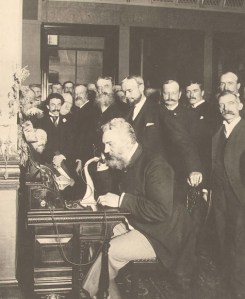
Nope, these are not reviews for the internet. It’s not a new social network and it not a general review of  social media.

They’re for the phone!

One has to wonder whether our ideas have really changed that much since the advent of the telephone. The ideas haven’t changed, just the means to communicate have.

Today, our online communications goals revolve around the following:

  • We want to talk-we want to be heard
  • We want to have conversations.
  • We want to distribute content to the masses
  • Entertainment, news and music
  • Keeping it simple.
  • We want to make money
  • Subscriptions models still make the most sense
  • The United States is still getting bashed for something.

What does this tell you? A lot has changed? Not much has changed? At the end of the day, we strive to communicate in the easiest most profound ways possible.

Our most basic human desire is still to talk and to listen. We are motivated to make it as  simple as possible to have a conversation. We are constantly pushing the envelope of ways to connect, to share and to listen to each other and others. Look at all the apps and programs that revolve around this notion. Simplifying our lives, consolidating our contacts, streamlining our relationships. All for the sake of communicating.

Isn’t it amazing that those 5 statements could have been made this past Monday? and yet it was over a 100 years ago! So what is your take-away from this post?

Talking and listening will always matter. We will always be captivated and motivated and willing to pay for entertainment and music. Keeping it simple is still a priority in our lives, and the only business model that appears to still make sense, is a subscription model. Ironic isn’t it?

<!– ckey=”11D222B7″ –>

Share this Post

Social media is free…but I’m not

free

It’s been one of those days… so I’m going to allow myself just a wee bit of time before I snap out of it.  I’m going to vent. It started this morning when I heard back from a prospective client who liked the 5 page social media strategy overview document but…

The “but” was they wanted more specific details on what I was going to do. I told them that I would give them the specifics in time. but that I thought that it was important that they understand the how and the why before we got into the how to and the what for. I did this because we’re talking about a client that knows virtually nothing about social media.

If I would have given them the latter, 2 things would have happened. 1)  It would have been so over their head that they would have not understood and probably bailed and or 2) Believe it or not, they could take the document and either try and implement it themselves, or use it as a blueprint with another company and leverage their new found knowledge. You might not think that happens, but it does, as well as some other things  Why?

The ease of entry into social media is less than zero. I can sign up for a majority of social networks in less than a minute. I can create social profiles in less time. So the assumption with a lot of companies and people is, “What is so hard about being social”? or creating a Facebook page, or a Twitter profile?and you know what? They are right. It’s easy.

Boom.

The thinking is really as simple as the majority of social interfaces that you see. Just create a profile and now you’re part of the social media revolution. You don’t need a consultant or a company to tell you how to do this. It’s easy. Plus there’s all of these killer blogs and sites with free information on social media, all these free tools, you can just figure all of it out on your own.

Sure. You can figure it out until it falls flat and you have one comment on your blog post. You have 19 registered members in your community, or you have 5,000 followers and you’re  following 5,000 but you have 111 tweets and zero conversations. Or maybe that Facebook page of yours has 56 fans but is doing nothing else. Or the YouTube video you made, has driven approximately 24 views.  When stuff is free, you get what you paid for.

There are some seriously smart people in this space. I value what they do and say and we value what we do and say, and we value what we create. But we also are working for a living. As much as we would like to give it away, we can’t. As it stands, the majority of people in this space, give away a lot. In fact, the amount of time that a lot of the social media marketing people that I know, give away, is extreme.  In terms of amounts of their time and resources-there is not a more giving  bunch. That’s the essence of social media.

But… at the end of the day, bills have to be paid and you’re going to have to take that leap of faith.

I’m done venting.

Share this Post

How are you driving people to your social media presence?

cattle

What are you planning to do to drive people to your social media presence? And do you have the money to do it? I read this question this morning and thought, boom, dude you nailed it. It was a post in Clickz by Sean Carton. Though he didn’t really answer it.

So lets talk about that. What are your plans? You have gotten the gig, but now you are tasked with driving traffic to all of the social media properties that you have set up for the client.

Quick question though. Is that really a function of social media managers? To drive traffic? Or is that a pure marketing function? A search function? Something you pay for? Something you outsource?

I digress. So what are you going to do get these communities/social media personas jammin?

I think first and foremost, as Jason Falls has so aptly put it,

To be effective in social media, whether as a marketer or just an ordinary participant, you must, first and foremost, communicate well.

Ok so you have that down, you can communicate with the best of them, now what?

Well if we’re to look at social media as a messaging and communications type of activity, wouldn’t that responsibility ultimately sit on the shoulders of PR? Should PR pros be responsible for driving traffic to social media networks?

Or is it something a marketing department should do? Does a community manager do that?

Wait, I’m blurring the message here. Let’s go back.

What are you going to do to drive traffic? I don’t care if you’re in marketing, PR, or IT, you have been tasked with making this social media thing work, so wutcha got? And don’t go telling me we need to define our objectives and align them with our strategies. We get that. Yea I know numbers don’t truly define success but they certainly are going to determine a lot of things going forward. So pick your poison.

  • We have blogs-what’s your plan to drive readers?
  • You’ve created a Facebook fan page or group page, how many friends are you going to get and then what will you do with them?
  • You’ve create a social network on Ning now what?
  • What is your plan to grow your Ning group or your community?
  • You’ve got that Twitter profile rolling, what’s your goal? Do numbers even mean anything anymore? How many conversations are you looking for?
  • Now that you have that podcast where are you going to find that audience? What is going to compel them to tune in every week?
  • Wikis are a cool collaborative tool if people know about them and feel compelled to contribute. So why should they do anything with yours? Out of some benevolent stroke of contributing for contribution’s sake?
  • Is a big budget going to make it easier for you to create these communities? You know once your PPC campaign ends, your traffic might leave to..
  • What if you do suck at communicating? Then what?
  • Who should be responsible for the success or failure?

What I keep coming back to, is that with each bullet point, it still helps to define the purpose of why you are doing it in the first place. Here’s the problem though. There are a lot of hours involved in any of these activities, and if any company or person is going to work on these, then we or you need to see something on the back end that is justifiable. Is that ROI? Could be. Is it return on engagement? Well…

Try selling the story that because of social media, you had one killer conversation or engagement per blog post. Or you have 30 really awesome friends on that Facebook fan page. Or you helped 1 customer out who found you through Twitter…

I’m not sure those type of numbers can justify the time suck and investment of resources.

So I ask you again, what is your plan of action for driving traffic to your social sites and communities.