Coca-Cola knows how to work the crowd on Facebook

As I was reading through The Big Money Facebook 50: Companies making social media work.article yesterday, I saw that Coca-Cola was the number one brand on the list. I wanted to see why so I decided to check it out. When I got to their page I was greeted with this.

Which prompted me to ask or question on Twitter the following:

The answers came fast and furious. Surprisingly or not, they were mixed and I can see why. As social media marketers and brand execs struggle with the best way to have conversations wrapped around their brand, they always run the risk of reverting back to a push style method of marketing. And that’s the rub.

What if consumers prefer that method? Or just don’t care? They just want whatever the brand is willing to give them for free, and they don’t care. So with that being said, giving up all of my contact information, profile information and my friends information for what might be behind the welcome screen doesn’t matter. Apparently not. Or the promise of what might be behind the curtain is compelling enough for me. Given Coke’s status as the number one brand on Facebook according to this list, I think we know the answer.

So what’s my point? Yes the conversations are important but sometimes  customers don’t want to talk with brands, they just want what the brands are willing to give them provided the customer is willing to give up its privacy. Do you really think that Coca-Cola is that sexy of a brand to be worshiped all the way into the #1 spot on Facebook? No. It’s the allure of what might be.

Branding Conundrum #17 Kleenex speaks out

You know you got problems, when you feel you have to create this…

kleenex

But is it a problem? Perceived or otherwise?

Share this Post

Brands: You can’t hide and then expect to participate in social media

pickup-basketball

So I’m late. There’s a killer pick up game of basketball going on down  at the park.  I know they play every Monday , Wednesday and Friday at 5pm. For weeks I sit and watch them. This time I’m gonna play. There’s 11 guys including me. They pick up teams and I don’t get picked. WTF? I know I can play with these guys, their games are weak. Yet, I still don’t get picked. Why is that?

Because they don’t know me. Even though I’ve been watching them for weeks, they don’t know me. I could have easily played dozens of times over that span of time and yet I chose not to. Now when I want to, they don’t want to let me, because they don’t know me or anything about me. I’m not even a  familiar stranger to them.

All I had to do was take that first step and become part of their little community. I don’t even rise up when they needed a 10th guy so they could run. Benny, Joe, Arnold, Rambis, Chris D, BV, California, Stick, Coach, and Jackie, could have used me but I stayed passive and quiet. Just watching.  All it would have required was an occasional appearance in one of their games, and I could have played any time I wanted. Minimal effort on my part to get the ball rolling.

You’re a brand, thinking about social media. Thinking about community, about your customers, about growing your reach and your depth. Thinking about getting in. What should you do? How would you do it?

20 Twitter brands behaving badly

brands

I was doing some research for a Twitter webcast that I have coming up, and something caught me by surprise. I came across a post featuring the 100 most mentioned brands on Twitter. While the list is interesting, what I thought was more interesting and what prompted this post were the number of brands that were mentioned(talked about) a significant amount of times and the ones that I could think of, who did NOT have a twitter presence.  Some might not think much about it. But to me, given what is happening with Twitter, I think it is somewhat significant. Why? What a golden opportunity to talk with people about your brand that already talking about YOUR brand!

Below is a list of large brands that are currently doing a really poor job of managing the Twittersphere. This easily could have been a much larger list.

  1. Nike
  2. Apple
  3. Microsoft
  4. Coca-cola or Coke
  5. Sony
  6. Adidas
  7. Nokia
  8. Skittles*
  9. VW or Volkswagen
  10. Subway
  11. Mercedes, MercedesBenz
  12. Audi
  13. Heinz or Hjheinz
  14. Lexus
  15. Budweiser/Budlight
  16. Rolex
  17. Levis
  18. Converse
  19. Toyota
  20. Mountaindew

As a marketer you are challenged every day for marketshare, eyeballs, mentions and anything else that can get people talking about and engaging your brand. For big brands, people already are talking about you. Good or bad They want to talk about you. Twitter allows you to do both. You can listen to what they are saying and you can create communities of brand champions. Yet these 20 are a) slow on the draw b) don’t care and or c) are too arrogant to “bother” with Twitter. We’ll see how long that lasts, but know this, There are many many more.

Share this Post

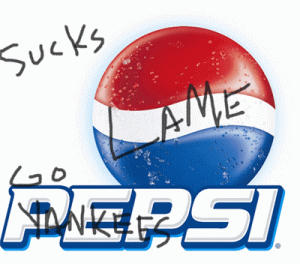
Here we go again, Yankee fans chant,”Pepsi Sucks”.

pepsico

Oh brand managers, where art thou?  Apparently Pepsi didn’t read my earlier post on why brands move so fast on damage control. Maybe they should. Why? Because they need to move pretty damn quick to soothe the Yankee Fans they pissed off with their promotion of giving away free Yankee tickets and Pepsi-Cola products. Call it the anti-promotion.

In an Adage post titled, Pepsi Promotion Ends With Chants of ‘Pepsi Sucks’ Pepsi shows what happens when brand managers and product marketers fail to plan. They can plan to FAIL! can you say #PepsiFail?

pepsi

Watch how quick this anti-promotion spreads virally on Twitter and the blogosphere. Brand managers, have you learned anything yet?

Why do we move faster for damage control than we do for brand control?

hallelujah

Can I get an amen? OK maybe it’s too soon in this post to ask for that. But really, I could not help but to think about the shitstorm that has happened over the last 7 days with Dominos and Amazon, and that maybe companies big and small, might want to take the time to better understand how they go about branding themselves either using social media or not.

I know, we’re not talking about a branding issue here. Or are we?

You see, it’s not so much how they brand, but rather, how fast, or the pace and the speed in which they do it. The reason I’m thinking out loud about this, is that I’ve now watched in 3 very high profile cases (Amazon, Motrin and Dominoes) how quickly large brands have moved to incorporate damage control via certain media channels, formats and vehicles- which led me to postulate-

Why don’t they move this fast in branding in general, controlling the brand or creating and shaping the message? What’s holding them back?

I suppose we can sit here and be quick to criticize or answer that question by stating a) If they are moving too fast then they must be trying to shove the message down out throats, and grab market share. And of course we know that’s not cool with their core audience, the blogosphere,  social media pundits, marketers and the Twitter mob, etc., etc., etc. Right?

Or… We could criticize them for moving too slow and missing the boat and of course that’s not cool with their core audience, the blogosphere, social media pundits, marketers and the Twitter Mob…Right?

So they can’t win.

But what strikes me is this. Have you ever heard this statement? “You never know how fast someone can run until they’re running for their life.”  Which always begs this question: Why don’t they run like that all the time?

Social Media and Community Mistakes I’ve made

As the VP of Marketing for a dot com start up geared towards IT professionals and major corporations, I assemble multiple focus groups consisting of average Joes to get their opinion on the UI. Not realizing until after the site is built, that perhaps it might have made better sense assembling the typical actual user of the site in garnering user feedback. Huge error.

After having started my first user based community wrapped around a very popular consumer product, I manage the community as if I am a dictator. I say no to everything and listen even less. Big mistake!

These are but 2 of the mistakes I’ve made in my journey through marketing, communities and social media. Encouraged by my friend Mack Collier who has a similar post right now over on his site The Viral Garden, I decided to recount some of the mistakes I’ve made in social media, marketing and managing communities.  I think this is a very viable topic right now for a number of reasons, as you will soon see.

Mack mentions that people who are entering the space for the first time-be it social media, marketing, managing communities, blogging, or whatever-may fear that doing anything, any misstep, will be met with criticism, or perhaps a stiff rebuke. Which is not the case at all, in fact Mack’s point is this:

When it comes to social media; no one knows everything, and everyone makes mistakes. I’ve made more than my fair share

Don’t buy into this ‘I don’t have anything to say/tweet/post about’ nonsense. Get out there and make your mistakes, because that’s the best way to learn. And besides, one of those ‘social media experts’ has probably already made all the same mistakes you will

So along with the other 2 mistakes I made above, let me highlight some of the bigger ones I’ve made.

2002 I set up a knowledge base, a BBS, and an instant chat function all to allegedly help our customer service dept. Results?  Customer service didn’t know how to use the complicated KB and neither did the customer. The BBS was too complicated as well and the chat function crashed constantly. 0 for 3.

2002, I created an online community that instantly becomes popular and balloons to 3,000 users. At which point, I endear myself to no one as I kick out some of the brand champions for what were in hindsight, petty transgressions. It’s at this point that I am called out for the first of many times, and issued my first death threat as well. Major screw up on my part!

2003 I’m still not listening to the customer.  Thinking that perhaps silence is golden as a community manager, I participate very little when the complete opposite was needed at the time. FAIL.

2004 A new product and business unit is created. I create new sites that get tremendous traffic but do very little analysis of the trends, the topics, the hot buttons and customer suggestions flowing in from email and I funnel them to Customer Service, because “I’m too busy!”   Apparently, they never read them either. Product tanks. My fault for not listening, at all.

2005– I start blogging to create better brand recognition. But I know nothing and blog/spam with zero regularity. The only gain I see, is a minor SEO bump, but realize that it came from me commenting. So rather than genuinely read blogs, I decide to just lamely comment for hyperlink purposes. It works for SEO but I get nothing out of the exercise.  At which point I’m just an SEO loser/hack gaming the system. FAIL

2006 I start blogging again but this time it’s out of a need to communicate with customers better. Obviously I’ve seen some light somewhere.  But I read very few other blogs and comment even less. Not realizing that blogging is a 2 way street. It takes a full 6 months for that fact to sink in.

2006-2007 I engage in a full blown reputation management endeavor utilizing  social bookmarking, blogging, and participating in multiple social networks. Only problem-I’m not engaging earnestly. Another problem, I create persona’s in the name of the company but not in my name. I’m not transparent, not even close. Apparently I realize the SEO implications but still don’t get that its all about you being you and the conversation. I’m everywhere and I’m not. The reputation management campaign has worked and yet I have zero traction. I still have not understood the basic principles of social media. FAIL

2007– The light is starting to go on a bit more, but it still has not dawned on me to come out from behind the curtain and be myself. It takes the last 6 months of 2007 to realize that transparency actually works in creating better conversations. In the meantime I start joining social networks on behalf of products instead of myself, and continue to push the message as a brand marketer instead of engaging and listening as a person. Mistake

2008– I was very active but not always in a good way. In 2008 I created “more” social networking accounts instead of concentrating on the few where I have become part of the communiy. I blog about too many different things not realizing that my traffic came from being consistent and on point. I also sometimes still forget that traffic comes from participating and reading other blogs. I also forget that the best way to create value and more long lasting relationships and perhaps derive business, is to go beyond thinking like a marketer and to think more like a friend, a peer, and a colleague. I realize now that from all of my mistakes that, as I told my friend Paul Chaney on his Blog Talk Radio show:

Active listening leads to active relationships that translate to real opportunity..

So you see, I’ve made a ton of mistakes, and those were just the one’s that come to mind immediately. The key though, is that I learned from them, and kept trying. But if you never step outside, you will never truly know what’s out there.  Bottom line is don’t be afraid to make mistakes. I have to think that regardless of your backgrounds , you have all made mistakes. Don’t let the mob mentality, or some random blog comment or snarky tweet,  sway you from trying and experimenting  in social media. Let it be a motivator.