What will be social media’s tipping point?

Malcom Gladwell defines a tipping point as a sociological term, “the moment of critical mass, the threshold, the boiling point. Tipping points are “the levels at which the momentum for change becomes unstoppable.” Joe Marchese said back in October that:

 As advertisers and agencies rely ever increasingly on individuals to pass along their marketing message, the advertising and marketing messages themselves must now achieve their own tipping points within the social media communities in order for marketing and advertising to continue to be an effective tool for brand advertisers.

Ok I get that. Perhaps advertisers and marketers have reached the tipping point in regards to how they are reaching the users of social networks, but ultimately I think they haven’t reached that point. I think the conversations that abound right now are of a substance that says, this is the conversation, do you know how to join it? Do you know how to leverage it? Are you aware of how it works? Do you get that the conversation does not start with your brand, it starts with the people that dig your brand?

As a marketer, you need to listen before you speak.

The answer for me is that no, marketers, and branders do not completely “Get it”. Thus the need for the social media evangelists, the brand evangelists, and the Seth Godins of the world to dumb it down for us and for them.  Why do they have to dumb it down? Because we, they, us, just cannot completely wrap our hands, our arms, our minds, arounud the monolithic beast that is the social networking phenomenon. There are a lot of moving parts. And I find myself daily explaining “it” to n00bs and people who actually know more than they let on.

For a marketer using social newtorks, a tipping point could be construed as a viral effect or a WOMM effect in which they can virtually sit back and watch the machine roll. To them, it means they have done their job, or so they think. To truly engage the user and the customer to use them as their champions is to create a conversation that breeds success beyond their wildest dreams. Because they have created buy-in on an exponential level.

Problem is, it has not happened often enough. And though it can be duplicated, and replicated, the moving parts, the variables, and the uncertainty of a social networks eco-system dictate that it will change and evolve and be ruled by the members and factors that you can never account for and not the marketers. But what happens AFTER a tipping point for a marketer in a social network setting? What is the life expectancy of the product, the user, the marketer, and the network? Can anyone provide me a case study for the “aftermath” of a tipping point for the aformentioned in a social network setting?

Has it happened yet? I doubt it. What’s intriguing is that in Geoff Livingston’s   blog in which he has a weekly round up called Blogs of fire, author Marinel Mones linked to Nick O’Neill of Social Times in which he states that social networking sites will die in two years. Does that mean SN’s will have flamed out, reached their tipping points and then crash and burned? Do we just move on? I dare to say we don’t and that saying something as ambitious as SN’s will die in 2 years is more of an attempt to grab some eyeballs than anything else. What do you think? I believe I asked a number of people in the 20 million strong soon to be dead  in 2 years Linkedin network where they thought social media and networks would be in 5 years and the answers were varied and deep and thoughtfull and none approached the answer of Nick O’Neill.

Do I think Social Networks will approach some type of tipping point? Yes, we will reach  some type of saturation point, but I don’t think we have yet, much to the consternation of Daniel Riveong, but much has changed in the 2 years since he wrote that it had already started to happen.

The saturation point might just be a case or situation where out personal saturation point will be determined by what we can manage and not neccessarily a case of too many choices. But…invariably our choices are determined by our friends, our niches, our desires, and huh? Marketers? and so it has now come full circle…

In conclusion I pull an excerpt from the NY Times in which Duncan Watts writes about culture, Hollywood and Justin Timberlake. Check out the sublte social networking undertone to this statement.

The common-sense view, however, makes a big assumption: that when people make decisions about what they like, they do so independently of one another. But people almost never make decisions independently — in part because the world abounds with so many choices that we have little hope of ever finding what we want on our own; in part because we are never really sure what we want anyway; and in part because what we often want is not so much to experience the “best” of everything as it is to experience the same things as other people and thereby also experience the benefits of sharing.

So 2 questions that I will continue to explore:

What is social medias tipping point?

and..

What is our own personal saturation level for social media?


Monetizing Social Networks. The simplest analogy possible!

Aside from the big players in social media making money via advertisers and cutting deals with some of technologies biggest hitters, there are more social sites that do not make money then there are those that do. What do they do? How are they going to make money?

Obviously one of the ways to create a social networking site that actually makes money is to niche-ify it to the extent that is speaks to a specific type of brand user and all the products or services that can be wrapped around the user. Picture the hot dog . Thats right, you are the hot dog. Your social network, the hot dog. You are going to be interested in all things related to you. 

Now the hot dog has the bun, the ketchup, the mustard, the relish,and the onions. All viable participants in the network. Including our friends chil and cheese. Couple with that will be napkins,  something cold to drink and perhaps to go with the hot dog, a side of chips.

All of these mentioned make perfect sense. They are viable, channel driven, niche driven, complimentary, cross promotional products that speak to the center of the social network universe known as is…the hot dog,

The problems arise when something that is totally irrelevant tries to crash the party. And interestingly enough, you would be surprised how often the following happens:

The best example of a lot of people trying to crash the party is perhaps the frenzy that is Myspace and Facebook. The frenzy of advertisers wanting to take advantage of million and millions of customers waiting(or are they?) to be pitched. Problems can arise from people who try and crash a party that they’re not invited to. Some great examples can be found in Jeremiah Owyangs post on brands that got punked by social media

As an advertiser, one just needs to know and it’s not like it’s that difficult. Are you the windshield, are you the bug? Are you the louisville slugger, are you the ball? Are you the hot dog? are you the bun? Or are you window cleaner that is the upsell to a box of triscuits?

10 Green Social Networks

Just because we’re in tech doesn’t mean that we can’t do our part to try and push for a greener space. Here is a great post on 10 green social networks that you need to know about.,

The top 20 streaming(free) music sites

According to compete, here is the latest list of the top 20 streaming music sites. Some interesting things to note about the list and what you should know: All of these sites now have some sort of social aspect to them in order to grow and kepp its user base. With that being said this list also shows that users like to listen to their music, they just do not like to pay for it very often as this graph will attest to.

So what’s new there? I had previously posted about the top 44  social music sites awhile back, but that list has expanded and changed since that posting.

Here is the latest list:

  1. Imeem Imeem’s expensive label deals, which allow it to offer on-demand music from all four majors, plus indies — combined with emphases on social networking and reaching out to blogs — have paid off handsomely. The site’s unique U.S. visitor count rose 58 percent over the previous March to 10.3 million.
  2. Yahoo Music Yahoo, which had acquired large music sites like Broadcast, Launch Media and Musicmatch in order to become the top-ranked music-streaming site in the country, has slipped into second place.
  3. AOL They’re still around? Actually I’m kidding, based on their #3 standing in the top 20!
  4. Myspace Music
  5. Project Playlist One of my favorites
  6. MSN Music
  7. Hypem A site that everyone should bookmark
  8. Pandora– Used to loop alot but getting better
  9. ILike Integrates lots of nice social network features
  10. Last.Fm Updates a lot and sometimes has an odd mix but maybe thats not so bad?
  11. Jango Has a very simple interface
  12. Live365 A pioneer, been around a long time, always good to have in the rotation
  13. Qloud very strong social media integration
  14. Mog Great tag line, but is it any good?
  15. ReverbNation Little bizy
  16. HypemThe Hypem1500 presents aggregate traffic to the more than 1500 music blogs tracked by the Hype Machine, a popular blog aggregator. The Hype Machine itself is ranked separately from its network at #16
  17. Deezer In 2007 launched a free on-demand music playback service
  18. Songza– Great clean and simple and easy to use interface
  19. Seeqpod The oddest name of the bunch but still pretty cool
  20. Muxtape

In conclusion, let me paraphrase Alex Patriquin : “As the music industry seeks to reassemble in the wake of digital distribution, it should recognize social streaming communities as the fastest growing opportunity in its evolution”

The dumbing down of America

Last week on HBO, they reran  CostasNow, a “sort of” sports oriented talk show hosted by Bob Costas, one of this nations most gifted sports authorities, scribes, oracle and overall mouth pieces for all things related to sport.  One of the segments featured  concerned the Internet and the impact of bloggers, as it pertains to sports. The guests were, Deadspin.com editor Will Leitch,  Pulitzer Prize-winning author Buzz Bissinger, and Cleveland Browns wide receiver Braylon Edwards.

First, let me say that Buzz Bizzinger was so caustic, so adamant, and frankly so foul mouthed in his opinion that the current state of blogging, Deadspin in particular, was taking writing, sports writing in particular, in a direction that demeans everything that he ever stood for, that I had a hard time really agreeing with anything he said regardless of his pulitzer prize winning credentials.

At least I think that’s what he was saying, when he wasn’t yelling and cursing. I was ready for him to blame the demise of sports writing on that “damn rock and roll”! But alas, he didn’t. I’m guessing he’s just a completely jaded sports writer that’s mad that athletes make more than him.

So I sat and watched this exchange and started to think about what has the blogging community, and social media, and really the internet, created? Or what has it taken away? It’s pretty simple to see what is has created. It has created this:

Lots of talking, lots of conversations and lot’s of communication.

But what has happened is that the users expectations are starting to be raised. The user wants to be engaged, entertained and dazzled by the latest technological advance when it comes to communications and media. The days of relying on a newspaper and Time magazine are slowly being replaced by the rise of the blogosphere, the kindle and podcasts.

So are the users expectations rising? Or better yet, are we raising expectations while lowering the barrier to understand and comprehend? Or, dare I say it, are we simplifying the way we want users to get their info? Are we compartmentalizing their intake of information in such a way that it now can be treated as fast food. Information that is gathered at the take-out window. To be digested before you get home.

Funny thing though, the more we as technologists try to simplify things, the more time we demand of others to use the things that will “simplify” our lives. Email streamlines our lives so that we can communicate with our frinds and family. Text messaging so that we can give or receive an immediate response. Our phone allows us to not only call or text but also allows us to go online and do research and or check email! If you’re worn out already and wondering how one folds this time into one’s busy schedule, keep in mind that currently the average American spends 30 hours per month onliine according to emarketer.

If you take into account all of the current activities that a U.S. adult uses the internet for: Email, Local search, IM, blog reading, watching video, and podcasting to name a few-The average internet user needs their info quick and dirty (pun intended), easy to read, to digest and ultimately easy to discard. It can’t be complicated, they don’t have the time nor the patience to wait. If it is any of the former, expect the bounce.

The internet is taking away our patience. We expect our results, our information, to be delivered to us now. What this breeds are expectations in other social settings that might not necessarily be realistic. We wait longer at traffic lights or so it seems, so we run lights that are more red than they are yellow, and for what? Because we don’t want to be late. We grow impatient in a line when trying to check out at a store because the sales person is having trouble with the RFID scanner. We want product now and are unwilling to wait. We expect service now because it’s the way it’s delivered to us online. Fast with no bullshit. If any exists, we are OUT OF THERE.

OUR EXPECTATIONS OFFLINE ARE NOW IN LINE WITH OUR EXPECTATIONS ONLINE

THEY’RE UNREALISTIC!

When they do not meet those expectations, we complain. Why are our experiences online so unrealistic? Because the online world has eliminated the human element. It delivers what we need and want instantly. That is not reality.  Online, the old adage “Good things come to those who wait”, never meant less that ever before.

In turn, if we can get what we want without having to deal with a human, that suits some of us just fine. Some desire as little human interaction as possible. Coupled with our desire to speed up things, is the desire to simplify. These 2 elements have prompted companies and developers to try and speed things up by over simplifying the processes involved in creating the speed. In essence THEY ARE DUMBING THINGS DOWN

Thus the more a developer can dumb down the learning curve by not sacrificing the performance of the app, the higher the chance that it will be embraced by not only the casual user, but also the development comunity as well as investors. Investors love something that is sexy and easy to understand or can be pitched in the elevator. If it can, and it’s fast and solves a problem, and speeds up a process, it’s a winner.

Tim Ferris comes right out and states that he receives 500 to 1000 emails a day…

To contend with this, I have virtual assistants in Canada and sub-assistants in Bangalore who filter my inboxes using processing rules in Google Docs. Connected via Skype and compensated via PayPal, this team translates a 10-hour task into a 20-minute phone call.

Simplification? Hardly. E-mail has dramatically increased the number of coping mechanisms required to handle communication, the net complexity as compared with previous alternatives.

“If the promise of technology is to simplify our lives, it is failing.” The wording of this proposition is tricky. To quote Bill Clinton: “It all depends on what the definition of is is.”

Ironically,  Tim is the author of the 4 hour work week and thus may or may not be a good proponent of encouraging more humanistic encounters with a hint of challenging the intellect of the masses. With that being said, Seth Godin puts it pretty bluntly when he says, “When you dumb stuff down, you get dumb customers.”


Why Linkedin is growing so fast.

As first reported by Mario Sundar, Linkedin grew 319% last year.  And to some this seems almost surprising. But if you really look at what Linkedin does, it brings more to the table than a hookup site like Facebook does. Does that surprise you that I said that I said that? Talk to your average college student and ask them what they use FB for. They might not admit it but it’s a mechanism to try and hook up without having to actually speak. it lessens rejection and makes eventual physical interactions less stressfull and less in your face. People on Facebook when talking to others, will say things they would never say face to face, and thus the reason FB is so popular with the 18-24 demo.

Now some would say that Linkedin’s growth could be attributed to the growth of social networking sites into demographics that traditionally stay away from social networking. As Nick Oneill wrote in Social Media Today, the Boomer generation has an increasing number of people on social networks. Users over 45 now account for a whopping 31 percent of LinkedIn’s user base.  But Linkedin is NOT a boomer-centric site. That’s not what is spurring its growth.

I don’t view boomer’s as a traditional user of Linkedin per se, I look at boomers as PART of the mix that is the sum of the parts that define Linkedin’s user base.

What’s happening, is that business professionals are  a) starting to see the value of being transparent and b) beginning to utilize the power of  online networking and c) understanding that social media can be used in a way that does not construe them as being too young, too trendy, too ignorant, too old, too un-tech savvy, or too uncool to their peers. They are comfortable with it, and they are now sharing that comfort level with others. So the effect has been viral! And…here is the last part no one will admit.

People are addicted to watching their number of connections grow. They are obsessive to the point that I wouldn’t mind taking a straw poll as to how many times a day the average LI user logs in to look for people, add people, and or reading about someone, asking a question, or answering one.  The question would be: How much time do you spend on Linkedin each day?

Case in point: With other demographics, when they get together, the first or last question out of their mouth might be, “Are you on Facebook?”  Whereas, now because of the prominence of social networks, that same general social networking question now resonates differently and has a more meaningfull response when professionals ask each other, “Are you on Linkedin”? 

Linkedin’s creation has allowed some of the old school traditional business processes to be bypassed, such as: the exchanging of business cards, leaving voicemail, sending intro-letters, putting together press kits, creating static web pages, mailing out brochures, and giving away swag. Anything to connect. In favor of a clear, non invasive, low stress evaluation of someone and their company. The ability to reach out to that person and their company now takes on a whole new meaning. Introductions to people and their companies now can be done efficiently and business relationships now have a  pre-existing comfort level that is in place between parties who actually may do business together. A streamlined engagement. Look at it as “hooking up” the professional way!

Micro Interactions

David Armano of Crtical Mass has a blog that I really enjoy. It’s called Logic+Emotion. Today I just ran through a great slide show presentation that was derived from something he said:

“We live in a world where the little things really do matter.  Each encounter no matter how brief is a micro interaction which makes a deposit or withdrawal from our rational and emotional subconscious. The sum of these interactions and encounters adds up to how we feel about a particular product, brand or service.  Little things. Feelings.  They influence our everyday behaviors more than we realize.”

6 degrees of social randomness

I saw this post in Adfreak about a social networking campaign on Facebook to combat the spread of a particular STD. The kicker was the campaign was dubbed “Spread it to beat it”…huhh?

Now here is a niche that no one will ever fess up to but all have travelled through at some point in their business lives. Check out EthicsCrisis Here’s an excerpt…

Clueless!

I had received an e-mail from an account manager whom I loathed for her inability to do her job correctly, even at the most simple level. After receiving this ridiculous e-mail from her, I wanted to send it to a peer of mine whom I had vented to to witness firsthand just how bad she really was. I flamed intensely on the forward, and then sent it off — only to realize that I had REPLIED to the e-mail, not forwarded it.

Do you ever want to draw on the back of business cards? Then check out Gaping Void

Guess what? The Wall Tweet Journal has contacted me!

Scott Van Pelt of ESPN has started to hit his stride at ESPN. He has now joined MIke Tirico as a cohost in the afternoon, as well he has his own hour. Good for him, he has the humor and knowledge to make the most of his time on air. FYI- Last night Lebron was fouled at the very end of the game and Caron Butler walked. Sure makes for some fun before dog days of summer begin. And yes Van Peezy, Deshawn is a punk. At least on the court.

Scott Van Pelt


Im reading a great blog at the moment by Gavin Heaton and eveeryone should hop on over when they get a chance and give it a good read!


10 sites to check out this week and pass on

Wow, it finally it might be warming up in the Northeast. And we’re only mid way through April! With that being said, you’re still going to have some down time here and there since you might be bumming a little that Kristy Lee Cook finally got the ax on American Idol.  So as you peruse all the info that you can get your hands on regarding American  Idol, here are 10 other websites you might want to check out that may deliver more a bit more than Idol updates.

Shout Out to Google

First off let me throw some major props out to Google.  If there is one thing that I will not stand for, it is the exploitation of children in any way, shape, and form, and child pornography would have to be #1 on my list. The fight against child pornography is getting an assist from technology designed by Google to help identify copyright-protected clips on its YouTube video-sharing site.

Four Google employees used their “20% time” — during which the company encourages them to pursue unofficial, out-of-the-box projects — to customize the copyright software for the National Center for Missing and Exploited Children’s program for identifying children in sexually explicit photos and video.

Software already has been used to match known images, but when new ones are submitted by law enforcement and service providers, analysts generally make identifications manually, often based on recollections. The center has recently employed facial-recognition technology to make those IDs easier, but with limited success.With the new Google tools, analysts can also seek matches based on other attributes, such as the color and shape of a couch or the wallpaper pattern in the background of a photo.

Anything to stop this in it’s tracks, I’m all for, so right on Google.

Next up is an Ad agency in Pittsburgh Called Smith Brothers I personally know these guys and they are a good bunch. They just received some major recognition out at the Adtech 11th Annual Awards Ceremony in San Francisco, The Brothers received top honors for Best Integrated Campaign for the Heinz Top This TV Challenge campaign – beating out hundreds of entrants from top advertising and interactive agencies worldwide Smith Brothers’ campaign featured the innovative use of messaging on the labels of millions of Heinz ketchup bottles and ketchup packets – combined with integrated support from print, TV and interactive advertising. The campaign invited consumers to visit TopThisTv  where they could create, upload, view and vote on the best consumer-generated Heinz TV commercial. To further promote and facilitate consumer participation, Smith Brothers formed a strategic partnership with Google and YouTube – and the response was unprecedented. The campaign received over 10 million views, 8,000 consumer-generated commercials and visitors to the site spent over 127,000 hours interacting with the brand while viewing and voting on the consumer-submitted videos Good job fellas.

You Guys Rock


On a side note that has nothing to do with Heinz or Smith Brothers, but plenty to do with branding, check out John Mayer and his ever evolving sleeve!

John Mayer\'s sleeve


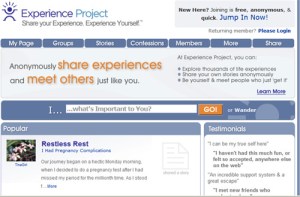
I came across this site the other day, though I’m not sure how. It’s called the experience project  It seems rather cool and unlike “most” social network sites. Here’s the description”

Experience Project is the first social experience website where you can anonymously share the experiences and personal stories that matter most to you. Quickly build a network of supportive new friends who understand your life, while exploring over one million life experiences told first-hand by people just like you. You can be yourself here.


The experience project

Awhile back, I had thrown a question out my Linkedin Network which asked whether social media sites were doing enough for the poor and underprivledged. The responses were interesting, but one of the sites that I was made privy to was a site called Kiva whose tag line is,”loans that change lives”. Essentially it is a social networking site that helps to put donors of cash in touch with 3rd world or developing nation entrepreneurs. A cool concept if you ask me. And it’s a way to give back through the power of a social network!

Kiva

Another site that caught my eye is called Friendfeed FriendFeed enables you to keep up-to-date on the web pages, photos, videos and music that your friends and family are sharing. It offers a unique way to discover and discuss information among friends. Hey anyway that I can keep the chaos that takes place on my desktop in some sort of order works for me, check it out and let me know what you think.

Ok, the spring time means lots of things in lots of places. In New Orleans, where I grew up it means 2 things to me. One is the Jazz Fest and the other is Crawfish. If you have never been to NO then you need to go to the JazzFest, generally the weather is awsome though there might be the occasional sprinkle, and the combination of music and food over a 2 week period is ridiculously fun.  Check out this small snapshot of a line-up:The Neville Brothers, Stevie Wonder, Billy Joel, Jimmy Buffett, Tim McGraw, Santana, Maze feat. Frankie Beverly, Sheryl Crow, Widespread Panic, Dr. John, Al Green, Diana Krall, Keyshia Cole, Robert Plant and Alison Krauss….Woooowheeee… Ok.. So if you can’t make it, then the next best thing might be a few pounds of crawfish. The above link will ship them right to your door. Live. You do know how to prepare them right?

I saw this sight Rollyo and all I could think of…well never mind what I thought, but it has a pretty cool app when it comes to search. And remember folks, just because Google is the big dog, doesn’t mean that the other breeds of dogs are bad…So Check out Rollyo 

This last site you will def have to bookmark. It’s called Workhappy. Hey, any website titled “work happy” is going to grab my attention. It’s sorta entrepreneurial based but I’m sure you know someone who could benefit from it.

I came across this other day to and it seemed sorta interesting, let me know if you had any opinion of it, good or bad. It’s called Loladex and the tag line is, “Local picks from people you trust…” What if you trust no one?

Social Media begs the following 50 questions:

Below are 50 questions that prior to the creation of social networks, had no home. But now, all of these questions have a relavent place in the hiearchy that is “social networking” and thus needed to be answered. Because, though there are millions upon millions of people out there that know about social networks, there are millions that are clueless. Before we start answering these questions, are there any that I might have neglected or forgot to ask? Let’s get to it then.

  • What is a social network? For this answer we head to Youtube. You can watch it now, or come back to it.


  • Is it like MySpace? Well maybe we should qualify what MySpace is!
  • What’s Facebook?
  • Is it like blogging? Hmmmm…first, let’s explain what blogging is!
  • How does it work? Social networks are  networks of relationships that we have formed that tie us to others that may have a something in common with us. Think the 6 degrees of separation game. Think about what happens when you meet someone new. You ask where they work, where they grew up, where they went to school etc etc. Eventually, you realize that this person knows the girl that you work with and is a relative of your best friends boss.  Even though you’ve never met before, you’re both part of the same social network — a friend of a friend if you will. So, Social-networking sites “make off-line relationships more transparent” by allowing us to see (with pictures, videos and links) who our friends are, who our friends’ friends are, and who our friends’ friends’ friends are — all in a supposed easy-to-use format. Like a MySpace or Facebook. When you create a profile on a social-networking site, you are putting yourself out there and saying, “Hey world here I am, who knows me? and who wants to be my friend? and who do you know?” You can use the social site to:
    • look up old friends; make new ones
    • share music, photos and videos
    • join groups based on interests such as politics, hobbies, sports, religion or pets.
    • find jobs or love; or network with other professionals.
  • Are you on MySpace or Facebook? If you are 18-34, This might be one of the key face to face questions you may ask of someone within the first 5 minutes of meeting them.
  • What do I do with it? Here is an interesting response from Marcel de Ruiter and his blog Shaping Thoughts
  • How many social networks can I join? According to Mashable, last year there were 350 that they thought were worth mentioning, but I imagine that that number has grown exponentially. Pick your niche and I bet you can find a social network for it!
  • How many hours should I spend in social networks? Although Jennifer Laycock has some thoughts on this, I’d say this depends on what you want to get out of your social network. Depending on the number of social networks you join, you really should pick just a few and develop those. It really should amount to time spent once you are home from work or school. But not to the extent that your school work or your job performance starts to suffer.
  • How can I grow my business with social networks? Entrepreneur.com has a great piece on how to grow your business using social media. But make sure you have a firm foundation and understanding of what you are getting into before setting out. This also will allow you to ask better questions, should you choose to have someone grow your business with the help of social media.
  • What is the value proposition of being in a social network? According to Jill Konrath “A value proposition is a clear statement of the tangible results a customer gets from using your products or services. The more specific your value proposition is, the better. ”  However Jim Long seems to have nailed by saying that “At the end of the day, isn’t the value proposition that it connects people on a deeply personal level across time and geography? I think so, Jim…
  • What do I get? It all depends on what you want. Just like anything else, what you get out of it is in direct proportion to what you put into it.
  • Am I spending my time properly by being in or on a social network? A great post on this sits here, titled “Avoiding information and conversational overload from social media” My thanks again to Jennifer Laycock
  • Am I using it right? There is no right way or wrong way, though if you do nothing with a page that you have created, then chances are, not much will happen with it. Remember, the essence of social networking is to find your voice and find others who have the same voice. Finding others just like you is one of the primal instincts of mankind and animals alike. We like to run with our packs. Find your pack and the experience will be golden.
  • Am I using it wrong? See the above answer.
  • How do I know the difference between Facebook and MySpace?. Chris Salazar has an excellent post on this exact question, so for those who truly do not know the difference between the two check it out.
  • Do the developers really know what I want and care about on a social network? Of course they do… to a certain extent. Social networking sites are not successful unless they know or have an idea what people want. And ever since Facebook opened up their development platforms, the widgets are flying in. Widgets expand the things that you can do with your page and actually help you network with others.
  • Do I care what they do with my information? You should, so watch this:


  • If I am not on a social network, will I be scorned? Absolutely not. One of the biggest constraints to SN is the allocation of time that one has to set aside to “do this”. If you don’t have time, then thats fine. That would generally mean that you have your days and evenings filled with work, school and family obligations, in which case, there is nothing you can do about it and bridges will not be burned if you are not part of a social network.
  • Should I worry about social media and its effect on children? If you are a parent, if you do not do anything, then it’s like swimming in an undertow, you swim at your own risk. To not monitor what your children are doing online, not only in a social network setting, but in general, is foolish and ignorant. For more information on this subject try Connect Safely
  • What about predators in social networks? All you need to know on this subject can be found on the link, but if you are a parent you need to be vigilant and if you are a kid, just be smart.
  • Is social media measurable? According to Jeremiah Owyang “For many marketers who want to deploy a campaign on a social network, access to server metrics isn’t always available. As a result, they have to often visually monitor the interaction on the site, or measure click throughs to their site. In some of the more sophisticated platforms, a crude dashboard is provided.”
  • Is there a niche site out there for me? If so what can I do with a social networking site that is geared especially to my interests? There are tons of niche sites, in fact, in this blog, if you do a search and just title it top social sites, you should find something, better yet, here are the latest numbers for February of the top 25 social networking sites.
  • Isn’t it the same thing as chat and online forums and bbs’s? Yes and no. That is more Web 1.0 and social networking sites are more Web 2.0. Bbs’s are and were more static and had zero real time applications to them. Chat is and was real time but did not have the other tools attached to make the chat expereince more interactive and fullfilling. Social networks are more about sharing and creating and communicating. Its more about user generated content. Chat is just what it is, it’s talking and nothing more, to a certain extent.
  • It’s difficult for me to use, isn’t there a simpler way of doing it? Its going to get easier. As each iteration of social media evolves it will become more user friendly, more intuitive, and easier to set up. Remember, we are talking about something that is still really in its infancy.
  • Are there social networks for minorities? There are, though social networks are not, for the most part, geared towards any specific race, creed or color. There are some social networks, however.  that are geared more towards people of color. A primary example of this would be Black planet
  • If social networks are so cool, then shouldn’t they be available to the disadvantaged? That’s a great question and one that needs to be thrown out there for more discussion. Stanford University, touches on it here, but not to the level that it really deserves.
  • Will society eventually look down upon people who are not associated with a particular social network? I hope not, but if were to look into my crystal ball, it would seem to be heading towards a society where each person has a social network that he or she is a part of. To the degree that eventually your ID and who you are is also supported by your social network. Similar to Second Life, your social network will define you as much as your offline persona.
  • Why do I need it? You don’t. It’s a choice that you will come to on your own, once you get done reading the news, answering your email, doing a search, paying your bills and looking for flights.
  • What should I do with it? Again, it’s entirely up to you. Do nothing or you can do a little, or you can jump in with both feet. It’s your choice.
  • How is it going to improve my quality of life? The quality of your life is often defined by your friends and family and your job. Taking those 3 into the context of a social networking setting you could: Connect with friends you have not seen in a long time. Improve your relationships with existing friends.  You can connect with relatives that do not live close by. and lastly you can connect and use the power of social networks to either network with colleagues, find a new job, or improve the job or career you have now. How’s that?
  • How far can I take it? The possibilites are really quite endless.
  • What is the shelf-life for a social network? As of this writing, the big boys have no reason to believe that things will not get even better. However for the niche sites, because the business model is often supported by ad revenues, it will be tough. Though niche sites have a great value proposition, the numbers in regards to people will have to be somewhat strong for them to survive. And that remains to be seen.
  • Should I wait before I jump into a social network? You can take baby steps. You can try out some smaller sites or niche sites or even a shopping site for instance to just get a feel for what types of information is required, how much of yourself you want to put “out there” and what to expect in return. You will find that the larger sites are much more active, but in some cases, might be overwhelming. Take your time. Poke around.
  • If I was to use a social network, what would be the best one to use and why? A good question, Obviously the top 2 are always referenced but start with this top 25 and see if in the list, there is one that might catch your eye.
  • What separates a good social network from a bad one? Users, tools, content, and the technology. Is it always down? aAe there many users to begin with? What are some of the tools, widgets and applications they are offering that make a social network so fun to use? do they have a lot, a little? Ask yourself if this is the right group for you and go from there. Do some sleuthing, sign up and see, if not, just walk away.
  • Whats a widget and why do I care? You should. It’s what makes a social media experience that much richer. To quote Wikipedia just once, “A widget adds some content to that page that is not static. Other terms used to describe web widgets including: gadget, badge, module, capsule, snippet, mini and flake. Web widgets often but not always use DHTML, JavaScript, or Adobe Flash
  • Whats a mashup? Almost to the tee, a mashup is a way of combining more than one type of app with another to create a completely unique application.  It combines data from more than one source into a single integrated tool;  thereby creating a new and distinct web service that was not originally provided by either source. A classic example of a mashup is the combining of peanut butter and chocolate.. what did we get?   Fill in the blank____________
  • Does that matter to me? Yes and know, eventually all that you will want may be the result of a mashup.
  • How do I even attempt to create my own “page”? Thats the beauty of CMS and user generated content. No offense, but developers have really dumbed it down so that it really is quite simple to create and make your own page. And if you make a mistake, you can always go back and start over. Nothing is rarely etched in stone.
  • What kinds of time does it take to devote to social networking? Your time management skills will be tested, especially if you find your voice and your peeps. Eventually you may find yourself doing nothing but rushing home and jumping on your machine to check out your page and any action that might be associated with it. If it starts to hinder work and school, then you need to chill. Plain and simple.
  • Will corporate America take over social networks? It has to a certain degree With Newscorp buying MySpace and Microsoft sinking millions into an ad deal with Facebook, it’s inevitable that it is to happen. There is a lot of money at stake to be made and to lose, and corporate America isn’t about losing propositions. Can you say Murdoch and Gates?
  • Is there a place for social networks in society? Or is it a fad? They are here to stay. Though the social networks that you see now, may not be the social networks you see in 5 years. A lot can and will alter and change the look and feel and especially the technology running these networks, so stay tuned.
  • Don’t web developers just use it for driving traffic to websites? Some do. Social Media and Search engines have a major love-fest going on and it did not take search marketers long to figure that out.
  • Aren’t social media sites like just for collecting names so that I get hit on by advertisers? Yes and no. But right now that is the revenue model for most highly trafficed sites. Don’t forget, all of the sites we are talking about are free, so how else are they supposed to make money? Advertising and having access to the user information drives that train.
  • Will it help me get a job? There is a nice niche group of business related social networking sites. So the answer is yes.
  • Can I get famous? Maybe for the wrong reasons, though some seem to have carved out a niche for themselves say for example on You Tube.
  • Can I get a date? It’s possible, there are some social sites geared towards dating. Facebook actually has that potential, so we’ll go ahead and say yes.
  • Can I make lots of money? Again it’s possible. The potential lies within you, to leverage it the way you see fit.
  • It’s used to build brands right? Absolutely. Marketers are starting to realize that using social networks to build, promote and grow brands is and can be a very effective way to reach a sometimes unapproachable and skeptical audience.
  • Social networks are set up to influence purchasing decisions right? They can be. They can be used to support and promote products that ultimately you the consumer may buy. More and more marketers are setting up product-centric social networks in which the users are consumers and buyers of that product.
  • Why should I join one? Because everyone else seems to be talking about it and to not at least experience the power of it wouldn’t be any fun.


Well there you have it. Some answers are better than others. Some require more elaboration than I was willing to give and ultimately, I  may have left out a few that did not come to mind. That’s why you people are here. To help me out, to grow a powerful KB for those who do not know enough about the power of the social network.

Cheers