The dark side of communities

Much has been written about the positive aspect of communities and what they can do to enrich and enliven customer experiences. Jeremiah Owyang has written extensively about the good and the bad in communities. Specifically, using “the bozo feature” in trying to limit bad apples in communities.  Elsewhere,  Jake Mckee blogs about and knows a little about communites and what it takes for them to run smoothly.

But what happens sometimes is that the inmates can run the asylum. I actually read a comment on Jeremiah’s post that said that communities can be self policing. Branded communites or corporate communites CAN NOT police themselves. They have to have moderators and managers. Why you ask? Well let me share with you an open letter I had received a while back from one of my more popular members who I had to ban because of amongst other things, he was scarring people.

To Marc:

I never threatened anyone on the site, I merely told that person that I would hand deliver ALL of their posts to their home!  THIS IS MY PAGE!  You DO NOT come here and malign me…..you had better wake up and look around.  I am not a person you want to make mad. Maybe your bosses need to see some of the posts you have written to me??? You don’t own this site. We do. I do.

Maybe they need to know just how you ban people from a site for specific reasons, but continue to let two people CONTINUE to break the rules?? Maybe you should look at (Name Withheld) ADVERTISING on the site—clearly against the rules!!  Maybe you should see someone about “PULLING YOUR HEAD OUT OF YOUR ASS!!!!!!!

And for anyone else who reads this, Marc  works for (supplies company name, adrdess, and phone number) They make a good product, they just have lousy employees!!!!!!!

Also, if you would like to contact Marc with suggestions on just HOW to recover his head from his ass, then, by all means, try these…………..(supplies ALL of my contact information, including home address)         

I am sure that he would LOVE to hear from you———ALL OF YOU!!!!!!!  Delete that, Marc and kiss my ass! You don’t want to mess with me. You have been warned.

So this letter, which he posted on his blog and in the forum came after I had essentially told him that he could no longer be a member of the community.  He was able to post under another name and thus everyone would have read this had I allowed for it, or had I not been moderating the site. As it was, it stayed up on his blog for quite awhile.


So what would you have done? Would you have been scarred or felt threatened? The good in communities certainly outweighs the bad, but I feel for all the community managers out there who have to deal with this type of personality a lot more than you might think. People need to understand that  online communities, just like in real life, have good people and bad people. The more that users realize that it’s not the wild wild west in these settings, the better off we will all be.

Is the Forrester Groundswell biased?

I’ve been looking at the finalists submissions for the Forrester Groundswell Awards and I’m wondering if choosing the winning entries based on proof of business value might be looking at the value proposition the wrong way. I’ve blogged about and complained about how social media sites and networks need to have a better way to monetize what they’re doing, and lets face it we all want to make money.

But, what if I’m completely seeing this the wrong way? What if the value of a social network isn’t in the amount of money it’s generating, but it’s instead about the quality of the community and the value it brings to each and every member of that community? And THAT is the true essence?

I know this completely smacks in the face of why we go to work everyday. And it also reeks of the “if you build it they will come” mindset or is that blindset? but…. Should Forrester be focusing on a bigger “world view” of social media and social networks instead of proof of business value?

I also see that Forrester has segmented out the finalists  entries into a few distinct categories. Are these too broad? Or too narrow? Or too generalized?

Listening

Talking

Energizing

Supporting

Embracing

Managing

Social Impact

What would you add to this list that might make it more complete? Forrester says that they got over 150 submissions, 151 to be exact, and they have whittled it down to 128What made the other 22 unworthy? I know, I know, lack of proof of business value. I just need to look at what justifies a win in social media and social networks. It may go back to my what’s more important question: ROI or Engagement. So what is it?

*Note Forrester has since called me to clarify that no one has been eliminated or whittled down, and that ALL entries will be judged on their proof of business value. Apparently there was an issue with one of the pages. I stand corrected.

What can you do today that can empower your customer using social media?

“What can you do today that can empower your customer using social media”?

I was asked this by someone who works for an Amazon owned company. Their customers in this scenario are B to B but they also have B to C. The question essentially was. How can we get more ROI from our customers utilizing todays social media without going down the path of ” A blog”? What makes the best sense?

You see, their thinking is that everyone is doing the blog thing and in their industry, there is no way it will have legs, so what else is there that we can do? What will work in our space, knowing that we have to have some type of social media element? One of my points was that the B to B consumer might be slower right now to embracing the tools that social media might provide. Whereas, the B to C consumer might be more apt to utilize them. The thinking being that the B to B person is still in education mode and is going to stick to what’s tried and true in regards to traditional forms of marketing.

They seemed to think the same thing. And maybe I’m wrong, given the larger context that social media is being bandied about currently. But what does make sense for each group? Can you roll out a social media campaign for both groups that makes the best sense for both? And is it wrong to think that a blog just won’t work?

What should be the entry point? Krishna De wrote a post back in January on a similar topic, but the problem is, it was written in January. Does it still apply? Social media advances are moving at such a rapid rate that sometimes what made sense 6 months ago, might not be the case now. Jared Goralnick has some thoughts on this too but it’s more of a jumping off point for the person, not the organization who is trying to leverage social media to increase ROI.

Here’s a guest post on the My Creative Team blog site that makes a little bit more sense titled the roi of social media but the whole point is this. As a marketer you can sit across from me and educate me, but then at the end of the day, what are you going to do?  With that being said Mashable has a nice post on 5 things you can do to develop a social media plan for your business.  The list includes

  1. Listen
  2. Prepare
  3. Engage
  4. Go Offline
  5. Measure Success


In conclusion: To all the social media marketers out there, this is essentially what you are going to hear from your clients and customers to be when going down the path of social media:

TELL ME WHAT YOU ARE GOING TO DO! and then tell me how it will impact me and how long will it take. See the below chart from Marketing Charts

Post Conversation-What do we do now?

Once you get beyond the conversation, what’s there?  For each aspect or rather in each of it’s iterations, there will always be a result or an action. Conversations, regardless of the network they are swimming in, have to have some causal net result. If not, then it’s one big dinner party or bar, where the conversations have no substance, and we all go home and wake up in the morninh with a headache and ask what happened.

There is a great discussion about this exact subject going on in a few places that I would encourage you to visit. Over at Valeria Maltoni’s site the conversation agent, Valeria has always maintained that it was always about the outcomes of the conversation. And she cites numerous sources that in one way or another support this premise. I couldn’t agree more. You have to do something with the conversations that you have participated in. There has to be an outcome. Unless of course, you converse just to hear yourself speak.

But see, the difference is that in this Web 2.0 age, our conversations take on many different forms. We reach out to have these conversations in many forms and in each form, the effort on our part is the push and we want the pull from the other party. But the conversations may have a tinge of self aggrandizement unfortunately, and that’s where we might be missing the point. I think that these days people are realizing that some of the conversations may be disingenous. It’s the dirty little secret of the social-ness of what we are all participating in. Its the nature of the fluidness of social. It’s way too easy to start the conversation and it’s way too easy to manipulate the conversation in your favor. But most of us are hip to that and I think it eventually  sorts itself out. We’re able to police that part fortunately.

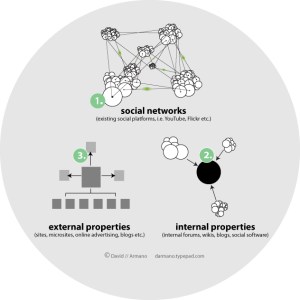
What happens next in each aspect is covered as well by David Armano  with another one of his wonderful graphic representations in which David essentially asks… We’ve identified all the different mechanisms and networks and tools to bring forth the dialogue and raise the level of everyone’s voice beyond the tinge of a whisper so, “What next?”.

You see in each “property” in the above graphic, conversations are and have been taking place. But what comes of them? Here is a quick example. Do we blog because we want to hear and read what we speak and write about respectively? No, we do it because we essentially want to talk and we want to be heard, and we want to engage others in a dialogue. Problem is, and I’ve noticed that perhaps this one tiny aspect is often overlooked- in order to be heard and in order to converse on or in a blog platform, it does not happen immediately. It takes work, and it takes effort, and I think to a large degree, most people underestimate that. Thus they abandon the endeavor. Do we need to make it even easier to be heard and engage others? Is it still to intimidating and difficult to join in the conversation?

The outcomes of conversations in each of David’s properties all predicated on various barriers of entry. Some not as great as others, but each still requires some effort in order to be heard. Do people want to work at their conversations? I don’t think so, but in each example, conversations and the endeavor of enagaging in them is not a passive activity. never has been, unless you like to lurk.

Another aspect often overlooked in the online social world, is that there is still the aspect of engagement. Type “A”‘s might still have an easier time of engagement than type “B”s. We still have to look at easing the transitions for N00bs. Once they are engaged in the conversation, they may be ok. But then we all come back around to the beginning. And we ask ourselves, “Now what?” “What comes of this?”

Seth Godin started an invite only social network called triiibes that was tailored to his forthcoming book. There are roughly 3000 people in this network and conversations abound. The problem is, I have to think, and do, that all the people in the network are in the “take” mode. A network where everyone is looking for, according to Steve Bridger’s comments to David, “what’s in it for me” can’t be very productive, or maybe it is? Conversations have to be equally 2 way, if not, they’re not called conversations, they’re called monologues. They have to have something more to them in each web 2.0 scenario. That’s what Valeria and David are getting at. We have all these tools, so now what? What do we do with all the various ways that we now have to communicate with each other. Perhaps a Conversation Manifesto is in order?

4 reasons to be excited about the next 5 years

According to the Gartner Hype Cycle, they have identified 27 emerging technologies to keep an eye on. They have also predicted that 8 of them will have a major transformational business impact. For that reason,  those 8 should be strongly considered for adoption by technology planners in the next 10 years. Of these 8, there are 4 that have caught my eye and thus have a particular interest to me.

The first of the 4 is Web 2.0. Although if you look at the below diagram, Web 2.0 is currently in Gartners “Trough of Disillusionment”. Though it almost sounds like some type of business purgatory, it will emerge within two years to have a transformational impact, as companies steadily gain more experience and success with both the technologies and the cultural implications-according to Gartner. If you cannot get excited about how Web 2.0 is transforming the web and the way we utilize it, then you just might not be geeky enough. That’s ok though, there are enough of us out there that truly are “giddy” about the direction we’re heading.

The next area that Gartner feels is about to explode is Social computing platforms — you’d have to be living in a cave on the island of Fiji to not suspect that consumer-oriented social networking sites, such as MySpace and Facebook, are causing companies of all sizes to evaluate the role that these sites, or various components of these sites, including their enterprise sized brethren, might do to transform and elevate the way that they currently communicate and do business. What’s more, the individual components and their ilk are forcing people to re-think what it means to be social, to re-evaluate what communities are all about, and how all of this can change the way we might interact with each other in the future.

If it hasn’t been obvious to this point what would be on Gartner list, its Microblogging— Thanks to Twitter specifically, and Plurk and Friendfeed to a lesser degree, microblogging is the new kid on the block in the world of social networking. But if microblogging is the new kid, it’s the new kid who can hit the ball out of the ballpark the first time he picks up a bat. The potential has already been leveraged by some pockets of the online community such as social media marketers and PR people, but it is also slowly being adopted by some forward thinking leading-edge companies who are using it to communicate with its customers, and employees. It’s becoming and will become another viable tool in a companies quest to engage it’s customer, communicate with the customer and brand their products more effectively.

Lastly, I’m going to lump 2 together. Corporate Blogging and Social Network Analysis I think that corporations, because of the advent of Web 2.0 technologies and the emergence of social networks and their niches, are starting to realize the importance of communicating like they never have before. We throw around the word transparency and I think it has never been more self evident what the upside can be to these organizations. As soon as Corporations can get a handle on the how’s and the why’s of blogging, they will be well served to incorporate it into their marketing mix. My suggestion would be to start with the book Naked Conversations.

Social Network Analysis is a natural extension of Web 2.0,  social computing platforms and microblogging. Because we are in the realtive infancy of these aformentioned technologies, the measurement of these is still as well, in it’s early stages. Analyzing the impact, the ROI, the level of engagement, the depth, the reach, the frequency, the conversations, the numbers- of social networks is something we talk about every day. An example of a company that does monitors social media would be Radian 6. As social networks continue to mature, look for this aspect as well to become robust and very vertical and very in demand.

So take a look at the diagram below, which ones get you excited to be in this space?

Hey, is my nose bleeding?

Humility tends to be in short suppply these days. I suppose after reading and writing about the importance of relationships, ego traps and hero worshipping yesterday that I might have at least learned something or had taken my own advice to heart. Something. Anything. It’s as if I just tuned out.

Yep, in the course of ohhh say 24 hours, I have been knocked down to size and humbled by one client. I was told I was not assertive enough by another would be client that I had been working with, who in hind sight wanted me to be more agressive and forcefull. And lastly, I had another potential client essentially tell me to give them what they had asked for and not what I suggested they need. All in less than 24 hours!

Hell, I even wrote a blog post titled, “Serve me what I want, not what you think I need”.  Talk about doubting yourself! What has this taught me? Alot.  Below are 10 points with associated posts that I need to always keep in mind and maybe you should too!

  1. The client will always be right. Always. Even if they’re not.
  2. You might be right, but the client doesn’t know you well enough to give you the business.
  3. You have to build trust incrementally.
  4. Assume nothing.
  5. Sometimes you just need to shut up.
  6. You are not as good as you think you are.
  7. There will always be someone who can do it better.
  8. Never underestimate the client.
  9. Always temper your actions with humility.
  10. Don’t forget where you came from.


Social media marketing’s 7 deadly sins

With apologies to all of the spiritualists out there, this post is not to make fun of the “real” 7 deadly sins. This is simply a way to magnify the importance of getting it right versus screwing it up seven times over. Over the last few days Peter Kim and I have exchanged emails over topics that swirl in and around social media marketing, and somehow this blog post evolved. I am not sure how it came up exactly, but then again, thats how a lot of these posts start. But the subject of this post seems to dovetail nicely into what is being discussed lately, especially on SMT.

So there’s a lot being discussed every day about social media marketing, what works, what doesn’t, why, how, when, etc etc. In the past I’ve written lengthy pieces on what social media isn’t, but how about 7 things that you better not do in social media marketing? That in and of itself would be something to throw up on the fridge with a  fridge magnet right?

1) In your push to increase customer loyalty and retention, you’ve driven your customers away with poor messaging, poor communication and complete disdain and compassion for them and the product they love. You’re Insincere and it shows. You nod your head and pretend to listen, but you decide that you know what’s best. That’s a bad choice.

2) In your zeal to hit the ground running with your product, you have failed to realize that the product has serious deficiencies and you choose to launch anyway. It could be that your product is either being hurt by the initial buzz of bad publicity, has been hurt or bashed by 3rd parties,  or the word on the street is, it just doesn’t work. Your product awareness campaign has only increased the awareness of how bad the product might actually be. Why? You were not listening and your timing could not be worse.

3) Because of #2, in your quest to create brand advocates you have created the anti-brand champions who have made it their goal in life to do everything in their power to make sure that your brand does not succeed. You made enemies and you continue to not listen and you decide to push on without addressing it. Could it have been, that you might not be listening or refusing to even try?

4) In pushing to roll out your social media marketing plan, you miss the mark completely and are marketing to the wrong people. In fact these people may have had their fill of social media marketers, social networks, and are essentially hip to the overtures of marketers in general. So again, in your rush to create new revenue streams, you’ve decided to beat a dead horse. Not knowing your customer and assuming you did. Bad. Guess what? You again must not have been listening.

Are you sensing the recurring theme here yet?

5) You decide to do it your way. You think your one way style of contacting and talking at the customer using the latest social media tools should work just fine in its own intrusive way. You sir or madam are not respecting the rules of engagement. You have lost your protocal compass. You have decided that frequency is better than reach and breadth is better than depth. You have not heard a thing that has been said.

6) You’ve decided that you need to hide behind a few layers. You don’t want the customer to know anything about you, the company, the realness of the people behind the product. Nothing. You have decided that a fake persona is the best route to driving sales and stickiness. Wrong. If you’re not being transparent, then you’re not being you. You have something to hide. One of the most important aspects of social media marketing it being transparent, or had you not heard that yet?

7) You’re not honest, you’re not who you say you are. This speaks as much to #6 as it does all of the rest.  But one of the keys to any relationship be it personal, or business is honesty. Just look at the code of ethics on the WOMMA They get it, and so should you. It may sound trite but keeping it real has never meant more than in social media marketing.  Oh yea, you might want to shut up and listen too!

I’m sure that there are tons of social media marketing faux paus’s that we can all think of it. In fact Jim Tobin over at Ignite Social Media has a nice post about it. The aformentioned 7 are just some that have really been standing out for me lately. And to be honest, I have made some of these, but I have also learned from these mistakes as well too, and have tried like hell to not repeat them.  Who was it that once said, “Those who cannot remember the past are destined to repeat it?” Last question, with the 7 points mentioned above, can you figure out what collective quality might benefit you the most?

Social media pie charts for 2008

Sometimes I feel like social media is like the following pie chart.

Where the majority of people are talking about it (blue), some are actually doing some pretty cool things in the space (red) and others wannabe in the space and think they are in the space (green) and very very few are actually experts (tan). What do you think? .

How does the user measure ROI in social networks?

I’ve been wrestling with this lately and maybe you can help. If I’m the social networking user and I frequent my favorite social network everyday, how should I measure my ROI? My investment of time to the site should be rewarded with what? The quality of my experience? What exactly is that? The number of people I meet? The real people I meet? the number of people I actually communicate with? The amount of conversations? Is it the stuff I create? The amount of personal interactions? the amount of micro interactions? The number of photos or songs I share?  Is it the quality of my everyday engagement?  Yes, yes, yes, and yes…..It’s all of those things. To each person, it is one of those, or all of the above.

So perhaps it looks something like this:

Do you see the dilemma though? I had previously written about user experience versus user interface, but what it really comes down to beyond the user experience is, the return on the user expereince or  the ROUE.  As a potential user of your social site, I need YOU the marketer, builder, architect or whomever- to show me quickly what my ROUE will be.  Because lets face it, I don’t want to work too hard to engage others or create content. Perhaps it’s the WIIFM paradigm? “What’s in it for me”.

Is it the tools that are available for the user to create UGC? Is that a big feature? It is for Myspace. Is it the ability to add hundreds of “friends”? It is to Facebook. Is it the ability to network with notable people in business? It is to LinkedIn. You see each site has a different ROUE to offer the user. What keeps the user coming back in each scenario is, when we boil it down- the response, the return, the pay-off, the money shot.  We are “geeked” by the response that we receive from whomever. The user investment for the user, is their time and efforts, and the reward for the user is a response from others. Write a blog and no one reads it, how much and how long will you write? It’s predicated on a response. Take nny user generated content created in a vacuum and the creator won’t be doing it for very long.

So perhaps the measurement should be Return on user effort as much as it is Return on user experience?  Think about why YouTube is so popular. Well, it’s a few things. It’s the ability to create content for free, the ability to share it, the possibility of getting noticed, a return on the user generated content, communicating with others, a response. Notoriety. 15 minutes of fame.

So next time you’re evaluating the NBT of social networks, Look at the ROUE.  Is the return on user experience and return on user effort very high? You should be able to determine that fairly quickly. In my follow up piece, I’m going to look at ROI and engagement and how we measure those as a barometer of social media success.