Business Myopia-The Need To Realign Hope And Reality With Your Social Business

A lot of companies are going to transition to becoming a social business and fail horribly at it. It’s not entirely their fault. You might be sitting there and asking why not. Look no further than their website. It starts there. Here’s a real world example. 3 days ago I was on the phone with a prospective client, before I got on the phone I did a little research. First I wanted to look at their source code. I wanted to see what they thought of themselves. Regardless of who built the site, the meta tags that lie underneath can tell you a lot about what a company thinks they are, of how they view themselves.

I know, in the grand scheme of things meta tags don’t matter, but ahhhh, they do. It let’s people like me get a quick understanding of whether a client or company gets the rudimentary element of knowing who they are and how they want to be perceived online. you know why? Metas matter but not in the sense that we were all told or taught years ago. Metas matter because they drive the creation of content, the creation of bios, and the creation of hyperlinks from Tumblr and Twitter to YouTube and Pinterest. Metas are your descriptors of you and your company.

If you can’t tell me who you are with hyperlinks, geo specific hyperlinks,160 characters in a Twitter bio,25 characters for an adwords title, and or 70 characters for ad text, then how are you going to do it for your customers? The point being that search will continue to love social but before you even get to the point of cranking valuable content about you and your business. You have to have your act together structurally, internally and digitally.

Go look at all of your digital touch points and see if they pass the smell test. Are you painting the right picture of how search views all of your current content. Understand that part of being a social business is that, regardless of whatever social channel your choose-the digital content that you will create, has to align perfectly with what you do offline and what you currently have online.

When customers or prospects do a search, the results that they get back tell more of a story about you and your business then you may be aware of, and sadly the results may contain content that you had no control of. By the time you see it, or become aware of it-it’s too late, it’s been indexed and it’s virtually impervious to reputation management fixes.

Don’t wait for that to happen, go check your digital house and see if it’s in order. Align reality with perception and make sure that as a social business you understand that you are now searchable and accountable for content everywhere, starting with something as simple as your source code. Metas might not matter in search, but in reality, they can tell us what you think your business is.

The Dawn of Social Mediocrity

Let’s do a hypothetical. You like western saddles.  You search for them every day on Google. Google gives you relevant results from a) your Google Plus peeps and then b) the most relevant, most SEO’d results. Let’s assume that your peeps straddle the lines of friends, family and business contacts, so the results or likelihood that there will be content from these people about western saddles may be 50/50.

You continue to search for info about saddles. I am a marketer that sells cowboy hats or western hats. I know that if I use the term “western saddles” as a key word, page title, hyper link, hashtag, splog site or blog post in some social networks or platforms, the  likelihood of you finding or landing on my pages might be pretty high. Why? Every link that you will find will ultimately take you to my western hat pages. I may or may not have much on saddles, but the bottm line is that I sell hats not saddles. Will you buy from my site? Maybe not. Of course I will or may affiliate links on my pages that will get you to a site that sells saddles but…the “quick” search has now turned into an hour’s worth of chasing the long tail of a bullshit game of bait and switch.

Is that a good user experience? No, but it’s the reality of search and social.

The more content that is created, the more that you have to choose from. The more that you have to choose from, the more of a chance that the content is watered down and possibly gamed. The more that search and social become intertwined, the more that you may become the victim of a bait and switch. Clicking on a link in the hopes that it is the right link-has become more precarious these days than it ever has.

The more that search and social lines become further blurred by the notion that content drives the machine, the more the user will get played. Pretty soon it won’t be social media any longer, it will be social mediocrity.

The Empowered Consumer Needs An Empowered CPG

Brian Solis from Altimeter Group used the term empathetic business models in a recent blog post titled, A Critical Path for Customer Relevance, Part 1, and though it sounds good and I would like for all businesses to “be” that in the end. I prefer not to use it to describe    an ideal business model, as much as I think it’s more of an idealistic business model, and I think he knows this. Here’s the exact quote:

A key objective for senior executives over the next several years is to use disruptive technology to get closer to customers, to improve relationships, and enhance experiences. It is a considerable move and the result will usher in a new era of adaptive and empathetic business models. However, this is a move that is easier said than done.,

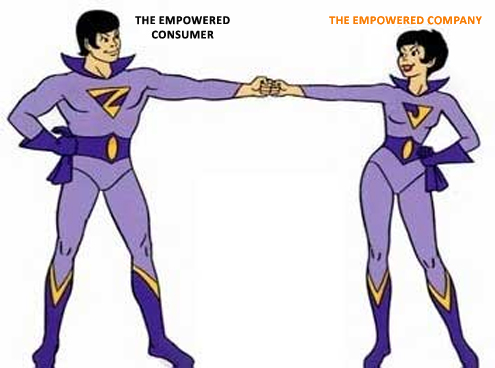
What makes more sense today, and Brian actually touches on it in the next paragraph, is how do we deal with the empowered consumer? I’m not so sure an empathetic business can deal with the an empowered consumer. I’m not saying they can’t, merely that it might be somewhat one sided.  What we need to look at is the empowered business and the empowered consumer together, as one. Put the two together and it’s lightening in a bottle. I think of the two as having the potential of the Wonder Twins. The Wonder Twins, are comic book superheroes. Their powers are activated when they touch each other and speak the phrase, “Wonder Twin powers activate!” This phrase is unnecessary and just a habit of theirs, but it’s catchy. Physical contact, however, is required. If the two are out of reach of each other, they are unable to activate their powers. As they are about to transform, they would each announce their intended form. “Shape of…”, “Form of…”

So think about this. An empowered business without the customer means nothing. An empowered customer who wants to buy from a business that doesn’t get “it” means nothing to that business-it’s just a lost opportunity to that business. Today’s empowered consumer has too many tools at their disposal to make an informed and educated buying decision. For a business to say, It’s a fad and it’s business as usual and the digitally empowered consumer will buy from us because of our history and are heritage-that just won’t cut it any longer. Today,  every CPG company has to have as much ammo as their customers. Has to.

So what good is the empowered customer without the empowered business? No one wins. No Magic. But…If we put the two together then we get, The Wonder Twins. The empowered consumer needs the empowered business.

Where Are the Jobs and What Can You Make In Social Media?

As I’ve said many times, I love a good infograph, thus, let’s introduce the Onward Search Social Media Jobs Salary Guide. Some interesting things to note here. One, there are a lot of good paying  jobs out there in the social media space. Two, I’m surprised that some of the positions and locations are not paying more. Given what is on the line for some companies, I would have expected more from some of the locations for the strategist and marketing manager positions. What do you think?

Social Media Jobs and Salaries Guide
© 2012 Onward Search

The 3 Levels Of Change Needed To Integrate Social Media

If You have not visited the blog site for the agency, We are Social, make sure you do. It’s a great resource of information. In particular, I was struck by an infograph that was up recently titled, Social Business-Social Media Integration. Within that infograph, I found this:

Which one do you think is the hardest? Which is the easiest? Which takes the least amount of time?

The Top 5 Challenges for Digital Brands in 2012

Last week in a very thought provoking Tweetchat hosted by Lisa Petrilli, the discussion, though swirling around how an introvert uses social media, somehow segued into driving website traffic. So my first thought was a poll was in order. But then I started to think about 2012 and the challenges that most brands will face and thus the basis for this post was born: The challenges for a digital marketer or a digital brand in 2012. What are they specifically as it pertains to the web?

1) Driving traffic–  The challenge in 2011 is the same in 2012. In order for people to know that you are open for business you have to get them to your website, your blog, your Twitter account or your Facebook page, right? Whether you’re a click and mortar or a web based only company, either or requires  more than just a cursory amount of effort revolved around driving traffic. So you have to think about things like:

  • Site design that incorporates SEO
  • SEM to artificially drive traffic
  • Some type of lead generation
  • Social site design geared towards your target audience
  • Content creation

All with the premise of driving traffic. Eyeballs.

2) Engaging that traffic-You’ve got them to your site(s) now what are doing with them? In 2011, it was all about doing “something” with someone once they had visited your site, your blog or your Facebook page. Well that hasn’t changed. In 2012, it’s imperative that we determine what engagement looks like. What does it feel like, what does it smell like? Is it conversational? Interactive? Is it wrapped around gaming? You have to test, you have to experiment and you have to understand that you have about 20 seconds to get it right.

3) Keeping the traffic-The segue from the last sentence in #2 says it all. You have 20 seconds. For some of my friends, when they are telling me a long story and I start to lose interest, I tell them to quit circling the airport, land the plane and get to the point. Marketers and brands will need to land the plane in 2012. Remember when websites were stuffed with content because marketers and webmasters thought that’s what we wanted? Guess what? The challenge now is to do more with less and strike the balance of keeping your users happy, engaged and delivering exactly what it is that they are looking for. Keep your users focused in 2012. Be iconic, keep it simple.

4) Converting the traffic-This is the holy grail of web marketing and sales. Doing something with the people that have come to your site(s). From the dawn of the internet, the goal has always been to convert the people that come to your site into either a lead or a prospect or a sale-Either for your company or your partners. This has not changed. The challenge in 2012 will be to further understand how to utilize the social tools, sites and platforms that now exist in order to convert the passive visitor into something other than a mistaken click, a browser or a passerby. In 2012 social will continue to help deliver customers to websites, but it still falls back on you to deliver on the promise of a good  customer experience. The biggest issue? Brands and marketers doing everything to get to the prom but not getting the kiss at the end of the night. Why? It will always be about the customer experience. Don’t discount the importance of search in this equation.

5) Getting the traffic to return-Repeat business, Word of mouth and increased sales, this is what it’s all about. It’s why people go into business, it’s why companies sell stuff. What’s better? The one off or the repeat customer? Why will people keep coming back to a website? Because  of the initial experience. How many people give a crappy website a second chance? None. They come back to good sites that are  easy to navigate, easy to understand, simple to use, that are safe, secure and trusted and they can find and get exactly what they want without much more than 2 or 3 clicks.  Put yourself in the place of your customer. Search for your own product or company the way they do. Do you/they find what they are looking for? Can you be found through search and social? What is your perception of the branded web experience? What are your competitors doing? What are your favorite sites? What brands do you follow on Twitter and Facebook? There’s a reason you follow them. You need to take that mentality into 2012 when it comes to marketing and branding your web presence.

Meet your own expectations as a consumer and flip them into those of your customers.

What Should Be The Outcome of Brand Conversations in Social?

Do big brands actually have conversations with the people/customers/prospects that friend, follow and fan them? Before we answer that, let’s talk about the dynamics of what we the consumer “feel” if a brand does talk to us. Happiness? A sense of belonging or inclusiveness? What should happen after the like?

What does a consumer want? Do they want content? Do they want to share what the brand says? Do they want something? Do consumers really want the following conversations?

Tom: “Maybe I should buy Famous shoe brand x shoes and walk to work, it would be quicker!”

Famous Shoe Brand: 2 hours later “Hey Tom, how’s it going today? What’s new?”

Tom: 5 minutes later “Not much, got in late today because of traffic”

Famous Shoe Brand: 2 hours later “Really? You’re in LA, was it the 405? What about taking the Santa Monica (10) Freeway east, the Hollywood (101) Freeway north through the Cahuenga Pass?”

Tom: 5 minutes later “Hey yea I never thought about that! Got any free shoes?”

Famous Shoe Brand: 24 hours later…”Nope sorry, but check out our new video and share it with your friends!”

According to eMarketer, Marketers know that building a Facebook page is not just about collecting “likes” but building relationships with  fans and getting them to share and discuss brand-related content.

Is the above simulated conversation the basis for a relationship? No, but maybe it’s a start. What might be Tom’s impression of the shoe brand now?

Social has created a situation in which brands  are now on the hook more than ever before for creating compelling, sharable, consumable digital content. Yes, at the end of the day engagement wins and brands are competing every day for the eyeballs of their digital consumers who have or haven’t liked their brand. In return they will get the interest and consideration of the user/consumer. Thus brands are banking on  consistent, high level, content posted daily being relevant and interesting; and that in return it leads to what?

Leads, conversions and sales right? Let’s not lose sight on why brands are doing this. But those same brands need to understand what the  digital, social, consumer’s expectation and motivation is as well.

A Reminder on Risk Mitigation in Social Media

Social is here to stay. Yea I know, understatement of the year right?  Businesses are starting to realize and understand that social provides or could provide another way to extend brand identity and establish a better connection to internal and external communities. Social is enhancing personalized interactions. But it’s also creating new found risks that old school solutions aren’t prepared to deal with.

Social media is altering the how, the when, the why and the who in companies large and small.  In a spin on former NBA player Allen Iverson’s famous diatribe on the value of practice, We’re not talking about practice we’re talking about a  game…

The new reality is that customers don’t shrug their shoulders and sigh when they are mistreated by a companies shoddy customer service. They load up and they fire back with both barrels. And in some cases they don’t let up, they mobilize others who have been treated the same way and then in a twist, others pile on.

What social has done is it has highlighted the significant risks and the serious damage to a companies reputation that can occur when brands either choose to ignore or are caught completely unaware of attacks to their reputation both internally and externally by both employees and customers.

Shape your company’s influence and don’t be influenced by your company’s ignorance or naivete.

Companies shouldn’t be forced into a proactive approach to anything. In the case of social media risk mitigation-ideally you want to be able to shape your influence and not be influenced by your ignorance …Organizations need to be able to control and counteract how their company is portrayed or might be perceived on the social web, if it’s damaging in any way, shape or form… This requires that companies are agile and able to create internal social reputation management plans and policies that address what detractors to a company’s site might say, what a company’s rogue employees might share with others on other sites, and most significantly, what things are said about your company on other sites that you are completely unaware of.

Does this sound like a plan?

The New Paradigm-Everyone has a Voice

The new paradigm. Everyone has a voice. The new reality? Even a 12 year old has the power to make things happen, quickly. Everyone has the ability to create buzz. Everyone has the chance to tell a story. Everyone has the platform to have something go viral.

Case in point: 12-year old Maddi Jane — who has been lighting up YouTube with covers that have racked up over a 145 million total upload views on her YouTube channel. Not limiting herself to just YouTube, Jane, back on Sept. 10, crossed the threshold of 400,000 fans on Facebook-with 500,000 not too far off.

As I tweeted yesterday” You can’t plan viral. Viral is an accelerated manifestation of itself. It’s something that takes on a life of its own”


The Biggest Challenge in Becoming a Social Business

Why do you think some organizations struggle with becoming a social business or a social brand?

Simple as this. Relationships. They are critical to external organizationl success both at the lowest levels and the highest levels. Just as internal relationships are important in maneuvering through the maze of most Fortune 500’s and getting things done, in the digital world, especially in social media, your networks and the relationships that you have within and without, can make or break any social-digital intiative that you have going.

Whether its with coworkers, colleagues or customers-relationships, the creation of and the fostering of them will actually determine your organizational, departmental and personal success in social and digital.

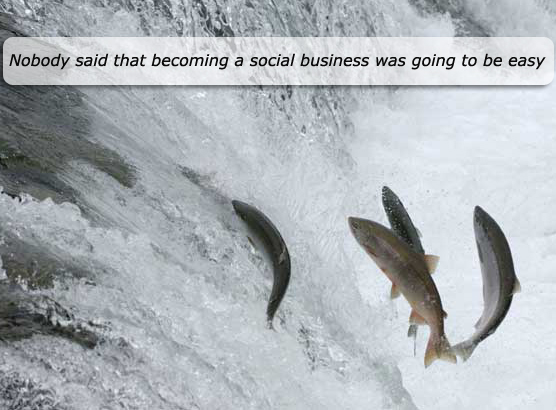
At it’s core- it goes back to silos. You need to recognize them and maybe… embrace them. Silos don’t work but they still do exist. Why do they exist? Traditional business structures. Command and control.  Politics. The way things have always been. Silos are the reason why sometimes social takes awhile to permeate large organizations. Picture salmon swimming upstream. It takes a while for them to get there because they are going against the current. In social, we’re all salmon. We’re headed in the right direction, it’s just tough sledding right now. Social is a struggle.

So why do organizations struggle with rolling out social? Unless it’s a top down edict from the C-suite, whoever the internal champions of social are, they will find that beyond having a compelling case, a strategy, a plan and tactics, what really will determine them going forward will be one of 2 things: 1) Their internal allies and their internal relationships with other departmental heads or 2) A catastrophic, game changing, reputation damaging event that happens via social.

Org.’s struggle because the advocates of social  find that swimming with the current is much easier than trying to get internal buy-in, getting someone to change course, change direction, and think differently and do it differently just based on a notion or based on the mere fact that everyone may be doing it.

Social is still new. Hard to even say that anymore but it’s true, it’s still new. It requires you to step out of a comfort zone. It requires you to go beyond the insulation of heads down work. It demands that you look up. Social is busting down the notion that just doing good work can be sufficient and can be the determinant of success. But creating a sea change in an organization and becoming a social business is going to require a marriage of the old school and the new school. It’s hard and it requires the forging of relationships.

That doesn’t mean that NOT becoming a social business is the death knell, it just means that eventually if you don’t adapt-you will be the fish swimming downstream when all the others are going in the opposite direction. Have you ever tried getting someone to take the road less traveled?