The Microcosm of social networks

One of things I love so much about what I do is how fluid it is. Not only personally, but as a whole, the industry and space  I swim in, is very fluid.   But within that fluidity are small pockets of conversations, networks and  silos of brewing relationships that enhance one’s ability to “be fluid”. As of late, I have noticed a lot of really interesting discussions that have bubbled up based on these principles of micro-networks and our ability to flow in and out of them.

David Armano who is all about micro-interactions, adds to his  growing volume of work, which I respect very much, with this  preso titled, “The Micro-Sociology of Networks.”

Slide#36 struck a nerve for me in which David says that Micro-social economics are Niche. For me, I picture the relationships I have in social networks, the relationships I have offline and the one’s I might have in a large stadium, Each has it’s own dynamic and niche quality.

Valeria Maltoni, another person who brings fresh thinking to everything that she touches, did the following post a while back titled Micro Interactions in PR In which she states that:

Public relations is the discipline that gets to the single interactions, the relationships, more closely.

The single interactions and or the relationships.  It’s as simple as this-Is it easier to develop a more intimate relationship with one person or 2 or 3 or 40? Every time you add another person to the conversation, divide the conversation, the relationships and the signal exponentially.

This  exponential division reminded  me of a tweeted conversation I had awhile back with Robert Scoble, in which I asked him, “Now that you have 70,000 followers, what is the percentage of “actual” conversations you have with your followers/or those he followed?”  His answer? When he was only being followed by 20,000, he spoke to 25-35% of them-meaning more than one tweet. Conversations. As the number has risen, it is now less than 10%. In Scoble’s case, I believe it’s always been more of a macro-interaction, but it works for him. But I think he would be the first to admit, that any value that he derives from Twitter, would still be on a personal micro-interactive level.

Recently, I was reading a post by Bernie Borges titled… The Lifecycle of Interaction in Social Media in which he discusses the collective wisdom and influence of communities, and I started to think about the “microcosm of a community” no matter how large or small.

On the one hand one might not think of a community as a microcosm, yet niche communities are in essence, reflections of larger less fluid communities, aren’t they? There is the chance that you are in this or that niche community, because of the rigidity of the larger network. You are, in a sense, a microcosm of a larger group. And because of the possible lack of micro-interactions, you chose to find one that met your needs.

Quick definition here from dictionary.com

mi⋅cro⋅cosm

human beings, humanity, society, or the like, viewed as an epitome or miniature of the world or universe

The fluidness of  online networks now allows us to be a part of many networks and create many realtionships. Sounds very reflective of the offline world doesn’t it? So it begs the question: Aren’t all online social networks, microcosm’s?  Subsets of society played out online?

In conclusion, as I’ve said, I’ve been thinking a lot about this lately, and the thoughts might be disjointed but as my friend Mack Collier mentions, I’m  removing the perfect filter from this post and throwing it up.

Don’t hide behind the brand

In part deux of my series on social media best practices for Ari Herzog’s blog Ariwriter, I had planned on talking about elaborating on the need to “experiment with effort” or “experiment with engagement”. By that I mean don’t just sign up or register on a lot of different social sites and expect the relationships to bubble up from there. Put forth some effort.

But in lieu of expounding on that I give you the second part in the series which covers hiding behind the brand. See what you think and let me know your thoughts.

As a follow up. I want to add that from the conversation that I did have with “the brand”, a dialogue did evolve, and a relationship with the person behind that brand was created. And you know what? That person turned out to be very engaging, enlightening, and earnest. And that would not have happened prior to our discussion about “People versus Brands”.

Where are you on the mountain?

everest-closeup

This post is inspired my Mother who is in declining health. She told me she was asked by her doctor, Where are you on the mountain, if your life is the mountain? Was she going up? Was she at the top? Going down?  My Mom answered that she was on the backside of the mountain, but she had her heels dug in. Good answer Mom.

But this led me to a broader question about what we all do and how we do it, and it is this.

If you’re career is a mountain, where are you? On the way up? In a holding pattern? Trying to find an alternate route? Or have you given up and turned back, satisfied by how far you’ve gotten. Satisfied that you at least tried. Or are you going to recharge the batteries, reinvent, re-plan, and give it another go?

If you are a marketer, where do you guage your level of experience on the mountain? You are a social media marketer, how well do you know the space if your map is the mountain? Do you forge on? Do you try and follow the path? The road less taken? Do you do what the Sherpa tells you? Are you a team player? Or are you in it for yourself?How much do you help people tethered to you? Are you pulling them? Are they pulling you? Or are you pulling your own weight?

It’s funny but when you get to the top, you really can’t stay there too long. But some like going to the top so much, they do it over and over, and they are successful a majority of the time. However, sometimes, there are things that are out of their control that prevent them from reaching the summit. But it doesn’t stop them from trying again. Why is that? How does this reflect on you, and what you are doing now? Where are you on the mountain?

Should bloggers be held to journalistic standards?

head1

Yes they should. But they’re not and that gets them in trouble.  remember the old saying, Measure twice cut once? That means you’ve only got one shot at cutting the piece of wood. The point being “make sure” you have the right measurement. Be sure about your post, before you hit publish.

Back in September I remember asking Brian Solis the exact same question at Web 2.0 expo in New York, “Should Bloggers be held to journalistic standards?” and he answered yes. Bloggers need to be held to some type of standard.Why did I ask Brian? Because he has a unique perspective, he’s a content creating machine and he cranks out volumes of noteworthy and spot on commentary about the social media and PR space and he is accutely aware of what he writes and says.

But a larger point is this.

Bloggers need to hold THEMSELVES to some sort of standard.

Why? Because when they start writing about people and companies and events- and if they have any type of influence, and they get it wrong-the backlash can be brutal for all parties involved.

Which leads me to the reason I’m writing this post. Yesterday Forrester analyst Jeremiah Owyang wrote a post about the social media company, Mzinga. It did not go over very well.  Suffice it to say that regardless of whether Jeremiah was correct in what he asserted or speculated, what happened next was nothing short of a shit storm.

Yes the mob mentality reared it’s ugly head again and yes Jeremiah was wrong in his approach. But at some point, 2 things need to occur. One, the Mob mentality needs to back off. and Two, Jeremiah needs to apologize.

After comment #19 Jeremiah realized he screwed up and he ultimately apologized and posted a retraction of sorts. However the mob continues to vent some 60 comments later. At last count there were 2 posts that were sympathetic.

So what do we learn from this?

Interestigly enough, even a Forrester analyst has room for improvement. It’s a simple as this for Jeremiah and actually speaks to a vlog I did prior to this post. One of the things we must do, as hard as it is, we must:

Practice a sense of patience.

Instead of rushing to break a story, perhaps it might make better sense to feel the situation out or better yet..”Measure twice, cut once”.

Ultimately, since we do not want to be policed by the mob mentality, we have to police ourselves, and hold ourselves to some type of journalistic standard. No one else will-unless of course you count the blog mob and twitterati.

Lastly, for the mob mentality. Ok  so you’re pissed. And you let Jeremiah know about it. Ok he got that. I get that.  But reiterating over and over again, virtually the same thing, gets tiresome, boring and lacks any type of  originality or constructive criticism.  Maybe the mob needs realize that pitchforks and torches never really worked that well anyway.

simpsons-mob-torches

Social Media best practices. Part 1.

Awhile back, Ari Herzog who writes a wonderful blog over at AriWriter.com  asked me to do a guest post on his blog for a series he’s doing on social media best practices. Rather than give him the usual written 500 words on the 7 things, 5 tips, or 4 factors that you absolutely must do in social media, I decided to mail it in and do a 3 part V-log instead. I hope he doesn’t mind! I’d also be curious as to what you might think of my 2 assertions here as well.

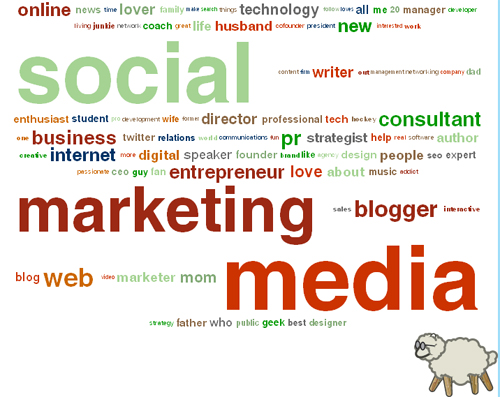
Twitter Bios Cloud

This is a word cloud generated from the bios of my Twitter followers brought to you by Twittersheep

Check out the underlying themes of the word cloud. It’s pretty obvious what my followers and I focus on wouldn’t you say? What does yours say about you and your followers?

twittersheep

People are the engines in social media

Its not the technology that drives the train, its people. Facebook, MySpace, Twitter, and Linkedin are nothing without them and their participation. Don’t ever forget that.

Sometimes we become so enamored with technology that we overlook what makes technology “work”. What do you think?

Mardi Gras and Social Media

mardi-gras-parade

Today is Mardi Gras and given that I’m here in Naples and I’m from New Orleans, I need to do the next best thing. I’m going to compile a list for you. The list is of people that I would want to buy food and drinks for and a short reason why. You see with drinks and food readily available, we could have some killer conversations.   Hell we already do, and there ain’t no food and drinks!!!! 

And isn’t what this all about? Social Media, Mardi Gras, being together sharing, talking, laughing, drinking, eating…So,  laizzes bon temps roulez

Say Hi to…

Mack Collier– great conversation, good person, here’s some beers for you Mack, followed by  a shrimp po-boy…:)

shrimp-po-boy

Arik Hanson Loves a good hoppy microbrew, so pull up a chair and crack one open.

Amber Naslund, she can bring it. Between myself, Arik and Amber the beer scene will be covered. I’d have beers with Amber anytime.

I gotta have someone who can bring the crawfish. Ahh Paul Chaney is in Lafayette, he can do it. Plus he’s a great guy. I’d split 15-20 pounds of crawfish with Paul!

crawfish1

This party needs some flavor and maybe I can show David Alston that his Canadian beer is not up to snuff. Molson? ick…:)

I can’t forget some Austin Flavor right? How about Peter Kim, Jack Leblond and Dave Gonzalez? I need to buy all three of these guys beers for their ability to share so much with me, for that, they can drink for free!

beers

What party wouldn’t be complete without some wicked people from the Boston area? Rachel Happe between sips of her Sam Adams, would be a welcome addition. As long as she kept the Red Sox talk to a minimum!

I’d buy a beer for good friend Jason Breed anytime, as long as it was a 2 for 1 special!

Speaking of Jasons why not have Jason Falls? He has an “in” over at Makers Mark! Plus, he’d be a welcome addition to any party.

I better invite George “Loki” WIlliams since he lives in New Orleans
and does write a blog called Social Gumbo!

I’d buy a few beers for David Armano provided he hooked us up with some Chicago dogs.. waddya say Dave? Plus he’s a good dude too. As big a heart as someone can have.

It goes without saying that 3 of my favorite gals would all be getting beers AND shots from me. Beth Harte, Liz Strauss and Toby Bloomberg. If They didn’t want that, then we’ll settle for splittin a Muffeletta from Central Grocery– Trust me you won’ be disappointed. These sandwiches are ridiculous!

muffuletta

I’d also like to have beers with the following: Sonny Gill, Daria Steigman, Ari Herzog, Nathan Taylor, Lisa Trosien and Shannon Paul, Todd Defren, Brian Solis and of course the Yat Pundit! Because they all are great conversationalists and thinkers and even more importantly, better people!

One more rule, You can bring 2 friends. Mardi Gras is all about blowin it out..so bring a friend or 2. Who ya bringin? and Where Yat?

Oh we need someone to do the music, any suggestions?

If you’re going to tweet from a conference..10 things I want from you.

I just read a guest post by Olivia Mitchell titled How to present while people are Twittering and it was very informative. but the following struck a nerve for me:

6. You don’t have to be physically present to participate Not only can you watch a live videostream of the presentation, but you can also tweet or chat with the physically-present participants.

I get this. There’s the back channel where people are tweeting like mad during the presentation and using hash tags to do so and supposedly that’s as much for the benefit of the people that are physically present as for those that are not. Though I have a feeling those that are not there are for the most part being completely ignored.

But here’s the odd thing. I can’t tell you how many times I get anywhere from 10-20 people at the same conference tweeting the exact same thing, repeating it word for word, and that’s very cool. I know not all of them have the same followers, so it might be fresh for each of their constituents but that tells me something. They are tweeting for your benefit and not for the benefit of the back channel. Why would they repeat what they heard to people that are present in the room?

With that being said then,  if you’re going to repeat and tweet for your followers then you need to know more about your audience, right? Or at least frame the scene for them..set it up, give it context. Perfect case in point is SXSW, its coming up and you may be tweeting from there and sharing some awesome presentations.  Common marketing sense bubbling up here, yea?

So here’s 10 quick tips I thought of for those who plan on Tweeting from a conference for the benefit of their followers.

1) Add or create a hashtag from the get go. Simply put, a hashtag in twitter parlance, is how things are tracked and followed on Twitter, here’s a more formal explanation. Usually these are predetermined, but nothing worse then someone spouting some heady philosophy on social media and you have no clue as to what generated the thought.

2) There’s an assumption that you are tweeting to people that are hinged on your every tweet. That’s not entirely true. So don’t act like it. Don’t forget this is a 2 way deal.

3) You need to assume that maybe we might want to respond back. Allow for it. You are not a court reporter.

4) What do you want from us? We might just tell you. You could ask.

5) Why are you doing it? For who’s benefit? Let’s make this a mutually beneficial experience.

6) You really need to allow the people who are reading your tweets, from the conference you are attending, to question your tweets/or their origin. Why?

7) Because you thought they were worthy enough to be tweeted in the first place, right? Engage the non-attendees as well.

8) How about framing the speaker, the forum and the topic for your readers? What are you hoping to learn/ and tell us in 140 characters or less!

9) You may have 300-900-1500 or whatever number of followers, but understand that not all of them are on and following you at the moment that you are tweeting. This rule might be different for those whose followers number in the thousands.

10) Instead of just repeating what you’re hearing, frame an opinion on what you just heard. I know I do. I want to challenge and think out loud. You have just as much capacity to do the same as they do. But share it with us. and perhaps you are in the back channel, but lets not forget about your “other readers”.

I’m not saying that a lot of notable Twitter do not does this already but  more and more people are starting to Tweet at conferences, and believe it or not they may not know why or for who or how. As Twitter grows, so will your number of followers obviously, and as well, not all of them will have the capacity and resources to attend some of the bigger conferences in other cities. But they will certainly benefit from you being there and from your tweets if you aknowledge and utilize your followers as a resource and ally as well while you attend.

Transparency-Where are you drawing the line?

tweet

Susan (Kang) Nam, aka @pinkolivefamily in Twitter asked the following question late today on Twitter: Point of transparency = where do u draw ur line? I said, The line has been drawn in the sand.  It’s changing fast.  Don’t believe me? Read David Armano’s latest post.