
Jake McKee promised that this might be the most significant thing I see/read/watch this year. In a sense he’s right. I love when people make me think. Clay Shirky made me think. And what he says makes sense. You might have to watch it twice but what I take away from it and told Jake essentially the same thing, are three things. 1) traditional media is scared shitless about what is happening right now. Consumers with voices? And the ability to use them? 2) We all have a surplusof cognitive surplus and 3) The old, one voice marketing to many with traditional channels of one way communication are dying on the vine.
Tag Archives: Marketing
Conversation Killers
Joseph Jaffe has a great article called “Conversation Killers: Why most viral marketing amounts to lazy, clueless chatter“. Much to comment on, but I wanted to throw it there for now.
Is Justin Timberlake a Product of Cumulative Advantage?
As anyone who follows the business of culture is aware, the profits of cultural industries depend disproportionately on the occasional outsize success — a blockbuster movie, a best-selling book or a superstar artist — to offset the many investments that fail dismally. Read on-
What will be social media’s tipping point?
Malcom Gladwell defines a tipping point as a sociological term, “the moment of critical mass, the threshold, the boiling point. Tipping points are “the levels at which the momentum for change becomes unstoppable.” Joe Marchese said back in October that:
As advertisers and agencies rely ever increasingly on individuals to pass along their marketing message, the advertising and marketing messages themselves must now achieve their own tipping points within the social media communities in order for marketing and advertising to continue to be an effective tool for brand advertisers.
Ok I get that. Perhaps advertisers and marketers have reached the tipping point in regards to how they are reaching the users of social networks, but ultimately I think they haven’t reached that point. I think the conversations that abound right now are of a substance that says, this is the conversation, do you know how to join it? Do you know how to leverage it? Are you aware of how it works? Do you get that the conversation does not start with your brand, it starts with the people that dig your brand?
As a marketer, you need to listen before you speak.
The answer for me is that no, marketers, and branders do not completely “Get it”. Thus the need for the social media evangelists, the brand evangelists, and the Seth Godins of the world to dumb it down for us and for them. Why do they have to dumb it down? Because we, they, us, just cannot completely wrap our hands, our arms, our minds, arounud the monolithic beast that is the social networking phenomenon. There are a lot of moving parts. And I find myself daily explaining “it” to n00bs and people who actually know more than they let on.
For a marketer using social newtorks, a tipping point could be construed as a viral effect or a WOMM effect in which they can virtually sit back and watch the machine roll. To them, it means they have done their job, or so they think. To truly engage the user and the customer to use them as their champions is to create a conversation that breeds success beyond their wildest dreams. Because they have created buy-in on an exponential level.
Problem is, it has not happened often enough. And though it can be duplicated, and replicated, the moving parts, the variables, and the uncertainty of a social networks eco-system dictate that it will change and evolve and be ruled by the members and factors that you can never account for and not the marketers. But what happens AFTER a tipping point for a marketer in a social network setting? What is the life expectancy of the product, the user, the marketer, and the network? Can anyone provide me a case study for the “aftermath” of a tipping point for the aformentioned in a social network setting?
Has it happened yet? I doubt it. What’s intriguing is that in Geoff Livingston’s blog in which he has a weekly round up called Blogs of fire, author Marinel Mones linked to Nick O’Neill of Social Times in which he states that social networking sites will die in two years. Does that mean SN’s will have flamed out, reached their tipping points and then crash and burned? Do we just move on? I dare to say we don’t and that saying something as ambitious as SN’s will die in 2 years is more of an attempt to grab some eyeballs than anything else. What do you think? I believe I asked a number of people in the 20 million strong soon to be dead in 2 years Linkedin network where they thought social media and networks would be in 5 years and the answers were varied and deep and thoughtfull and none approached the answer of Nick O’Neill.
Do I think Social Networks will approach some type of tipping point? Yes, we will reach some type of saturation point, but I don’t think we have yet, much to the consternation of Daniel Riveong, but much has changed in the 2 years since he wrote that it had already started to happen.
The saturation point might just be a case or situation where out personal saturation point will be determined by what we can manage and not neccessarily a case of too many choices. But…invariably our choices are determined by our friends, our niches, our desires, and huh? Marketers? and so it has now come full circle…
In conclusion I pull an excerpt from the NY Times in which Duncan Watts writes about culture, Hollywood and Justin Timberlake. Check out the sublte social networking undertone to this statement.
The common-sense view, however, makes a big assumption: that when people make decisions about what they like, they do so independently of one another. But people almost never make decisions independently — in part because the world abounds with so many choices that we have little hope of ever finding what we want on our own; in part because we are never really sure what we want anyway; and in part because what we often want is not so much to experience the “best” of everything as it is to experience the same things as other people and thereby also experience the benefits of sharing.
So 2 questions that I will continue to explore:
What is social medias tipping point?
and..
What is our own personal saturation level for social media?
4 More Social Media Luminaries
First I wanted to thank some of the gracious people who got back to me in regards to my post about 30 social media experts, evangelists and pundits. It was a fun list to compile and did not really expect to hear from some, and am surprised I did not hear from others. So much for the conversation? too busy? traveling? 3 day weekend? Nevertheless I want to thank Chris Brogan, B.L Ochman, Valeria Maltoni, Phil Gomes and Toby Bloomberg, Their responses to this post were more than gracious and reinforces why I read their blogs on a regular basis.
Sure, I know I should be bashing twitter right now, but Chris is all over it like a cheap suit, and there’s nothing I can think of thats going to change it except to say that Twitter is effin up in a big way. Maybe IT IS time to go over to Friend Feed? Actually I have, I just don’t use it as much…yet.
Meanwhile back at the ranch, One of our Top 30, who rocks the effin house, has graciously provided me with 4 more peeps/peers that we can add to the list. Here they are, and I must admit, they were great additions to this list.
Geoff Livingston
Rajesh Lalwani
Jeneane Sessum
Paul Chaney
I’m still open to add to this list as it might be a pretty cool list to maybe work up to 50. or maybe this is it? Maybe the conversation only consists of 34? You tell me.
Peace
-MM
The dumbing down of America

Last week on HBO, they reran CostasNow, a “sort of” sports oriented talk show hosted by Bob Costas, one of this nations most gifted sports authorities, scribes, oracle and overall mouth pieces for all things related to sport. One of the segments featured concerned the Internet and the impact of bloggers, as it pertains to sports. The guests were, Deadspin.com editor Will Leitch, Pulitzer Prize-winning author Buzz Bissinger, and Cleveland Browns wide receiver Braylon Edwards.
First, let me say that Buzz Bizzinger was so caustic, so adamant, and frankly so foul mouthed in his opinion that the current state of blogging, Deadspin in particular, was taking writing, sports writing in particular, in a direction that demeans everything that he ever stood for, that I had a hard time really agreeing with anything he said regardless of his pulitzer prize winning credentials.
At least I think that’s what he was saying, when he wasn’t yelling and cursing. I was ready for him to blame the demise of sports writing on that “damn rock and roll”! But alas, he didn’t. I’m guessing he’s just a completely jaded sports writer that’s mad that athletes make more than him.
So I sat and watched this exchange and started to think about what has the blogging community, and social media, and really the internet, created? Or what has it taken away? It’s pretty simple to see what is has created. It has created this:

Lots of talking, lots of conversations and lot’s of communication.
But what has happened is that the users expectations are starting to be raised. The user wants to be engaged, entertained and dazzled by the latest technological advance when it comes to communications and media. The days of relying on a newspaper and Time magazine are slowly being replaced by the rise of the blogosphere, the kindle and podcasts.
So are the users expectations rising? Or better yet, are we raising expectations while lowering the barrier to understand and comprehend? Or, dare I say it, are we simplifying the way we want users to get their info? Are we compartmentalizing their intake of information in such a way that it now can be treated as fast food. Information that is gathered at the take-out window. To be digested before you get home.
Funny thing though, the more we as technologists try to simplify things, the more time we demand of others to use the things that will “simplify” our lives. Email streamlines our lives so that we can communicate with our frinds and family. Text messaging so that we can give or receive an immediate response. Our phone allows us to not only call or text but also allows us to go online and do research and or check email! If you’re worn out already and wondering how one folds this time into one’s busy schedule, keep in mind that currently the average American spends 30 hours per month onliine according to emarketer.
If you take into account all of the current activities that a U.S. adult uses the internet for: Email, Local search, IM, blog reading, watching video, and podcasting to name a few-The average internet user needs their info quick and dirty (pun intended), easy to read, to digest and ultimately easy to discard. It can’t be complicated, they don’t have the time nor the patience to wait. If it is any of the former, expect the bounce.
The internet is taking away our patience. We expect our results, our information, to be delivered to us now. What this breeds are expectations in other social settings that might not necessarily be realistic. We wait longer at traffic lights or so it seems, so we run lights that are more red than they are yellow, and for what? Because we don’t want to be late. We grow impatient in a line when trying to check out at a store because the sales person is having trouble with the RFID scanner. We want product now and are unwilling to wait. We expect service now because it’s the way it’s delivered to us online. Fast with no bullshit. If any exists, we are OUT OF THERE.
OUR EXPECTATIONS OFFLINE ARE NOW IN LINE WITH OUR EXPECTATIONS ONLINE
THEY’RE UNREALISTIC!
When they do not meet those expectations, we complain. Why are our experiences online so unrealistic? Because the online world has eliminated the human element. It delivers what we need and want instantly. That is not reality. Online, the old adage “Good things come to those who wait”, never meant less that ever before.
In turn, if we can get what we want without having to deal with a human, that suits some of us just fine. Some desire as little human interaction as possible. Coupled with our desire to speed up things, is the desire to simplify. These 2 elements have prompted companies and developers to try and speed things up by over simplifying the processes involved in creating the speed. In essence THEY ARE DUMBING THINGS DOWN
Thus the more a developer can dumb down the learning curve by not sacrificing the performance of the app, the higher the chance that it will be embraced by not only the casual user, but also the development comunity as well as investors. Investors love something that is sexy and easy to understand or can be pitched in the elevator. If it can, and it’s fast and solves a problem, and speeds up a process, it’s a winner.
Tim Ferris comes right out and states that he receives 500 to 1000 emails a day…
To contend with this, I have virtual assistants in Canada and sub-assistants in Bangalore who filter my inboxes using processing rules in Google Docs. Connected via Skype and compensated via PayPal, this team translates a 10-hour task into a 20-minute phone call.
Simplification? Hardly. E-mail has dramatically increased the number of coping mechanisms required to handle communication, the net complexity as compared with previous alternatives.
“If the promise of technology is to simplify our lives, it is failing.” The wording of this proposition is tricky. To quote Bill Clinton: “It all depends on what the definition of is is.”
Ironically, Tim is the author of the 4 hour work week and thus may or may not be a good proponent of encouraging more humanistic encounters with a hint of challenging the intellect of the masses. With that being said, Seth Godin puts it pretty bluntly when he says, “When you dumb stuff down, you get dumb customers.”
Did I Say Jump The Shark?
I meant Killing cows

Seth Godin must see video
In a world of too many options and too little time, our obvious choice is to ignore the ordinary stuff. Marketing guru Seth Godin awhile back, spells out why, when it comes to getting our attention, bad or bizarre ideas are more successful than boring ones. And early adopters, not the mainstream’s bell curve, are the new sweet spot of the market.
Would you rather have a budget for offline marketing, online marketing or sales?
Below is a conversation I had with Fred Yee, President of ActiveConversion/FoundPages in regards to a question that I had posed to the Linkedin group. The Question Details are below, but the main question is in the title of this post.
——————–
Me: I once had a colleague who told me he rather would have a 2 sales people rather than x amount for marketing. I had another colleague or vigorously defended marketing and branding as something that could not be ignored. It ended in a stalemate. Is it possible to have one without the other and still be realtively successful?
On 4/23/08 11:50 AM, Fred Yee wrote:
——————–
Marc, I think I understand your question and although the ‘mix’ is important, and having all is important, I may have your answer if there is only one allowed.
Today I would say online marketing. You can do a lot with a website, search marketing and email marketing, which is low cost and bring leads in, so that even non-sales (owner, manager, admin and technician even) can engage to produce sales. It’s also why Google has 800,000 customers now…
Offline is good for branding and credibility but short on producing tangible sales. Sales people can close but they need leads and without decent marketing, it’s expensive sales.
Of course, there are situations and industries where online marketing doesn’t work that well or is outperformed by the others but in general I have noticed that it works well for most.
Links:
http://www.activeconversion.com
On 4/23/08 12:52 PM, Marc Meyer wrote:
——————–
Fred, I would have to agree with you in that given all of the online productivity tools that are out there, the advent and rapid acceleration of user generated content and the ability to leveredge them at little or no cost, an inhouse team that consists of everyone from the folks in HR to the folks in IT, to the people down the hall in management, all have the opportunity to brand and market and create sales leads and marketing materials and opportunities. Which means that a collaborative effort and a sense of ownership can do more for growing a company selling a product than a single marketing department operating out of a vacuum, an autonomous sales force working without sales leads or a management team demanding results without a budget.
Thanks for responding to a great thread.
Marc, what can I say? Having been pained by this for over 15 years, I totally agree. Great minds must think alike! Fred.
Marc
10 sites to check out this week and pass on
Wow, it finally it might be warming up in the Northeast. And we’re only mid way through April! With that being said, you’re still going to have some down time here and there since you might be bumming a little that Kristy Lee Cook finally got the ax on American Idol. So as you peruse all the info that you can get your hands on regarding American Idol, here are 10 other websites you might want to check out that may deliver more a bit more than Idol updates.
Shout Out to Google
First off let me throw some major props out to Google. If there is one thing that I will not stand for, it is the exploitation of children in any way, shape, and form, and child pornography would have to be #1 on my list. The fight against child pornography is getting an assist from technology designed by Google to help identify copyright-protected clips on its YouTube video-sharing site.
Four Google employees used their “20% time” — during which the company encourages them to pursue unofficial, out-of-the-box projects — to customize the copyright software for the National Center for Missing and Exploited Children’s program for identifying children in sexually explicit photos and video.
Software already has been used to match known images, but when new ones are submitted by law enforcement and service providers, analysts generally make identifications manually, often based on recollections. The center has recently employed facial-recognition technology to make those IDs easier, but with limited success.With the new Google tools, analysts can also seek matches based on other attributes, such as the color and shape of a couch or the wallpaper pattern in the background of a photo.
Anything to stop this in it’s tracks, I’m all for, so right on Google.
Next up is an Ad agency in Pittsburgh Called Smith Brothers I personally know these guys and they are a good bunch. They just received some major recognition out at the Adtech 11th Annual Awards Ceremony in San Francisco, The Brothers received top honors for Best Integrated Campaign for the Heinz Top This TV Challenge campaign – beating out hundreds of entrants from top advertising and interactive agencies worldwide Smith Brothers’ campaign featured the innovative use of messaging on the labels of millions of Heinz ketchup bottles and ketchup packets – combined with integrated support from print, TV and interactive advertising. The campaign invited consumers to visit TopThisTv where they could create, upload, view and vote on the best consumer-generated Heinz TV commercial. To further promote and facilitate consumer participation, Smith Brothers formed a strategic partnership with Google and YouTube – and the response was unprecedented. The campaign received over 10 million views, 8,000 consumer-generated commercials and visitors to the site spent over 127,000 hours interacting with the brand while viewing and voting on the consumer-submitted videos Good job fellas.

On a side note that has nothing to do with Heinz or Smith Brothers, but plenty to do with branding, check out John Mayer and his ever evolving sleeve!

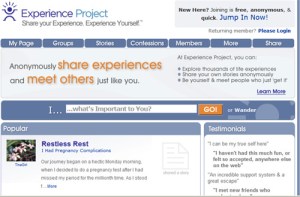
I came across this site the other day, though I’m not sure how. It’s called the experience project It seems rather cool and unlike “most” social network sites. Here’s the description”
Experience Project is the first social experience website where you can anonymously share the experiences and personal stories that matter most to you. Quickly build a network of supportive new friends who understand your life, while exploring over one million life experiences told first-hand by people just like you. You can be yourself here.
Awhile back, I had thrown a question out my Linkedin Network which asked whether social media sites were doing enough for the poor and underprivledged. The responses were interesting, but one of the sites that I was made privy to was a site called Kiva whose tag line is,”loans that change lives”. Essentially it is a social networking site that helps to put donors of cash in touch with 3rd world or developing nation entrepreneurs. A cool concept if you ask me. And it’s a way to give back through the power of a social network!

Another site that caught my eye is called Friendfeed FriendFeed enables you to keep up-to-date on the web pages, photos, videos and music that your friends and family are sharing. It offers a unique way to discover and discuss information among friends. Hey anyway that I can keep the chaos that takes place on my desktop in some sort of order works for me, check it out and let me know what you think.
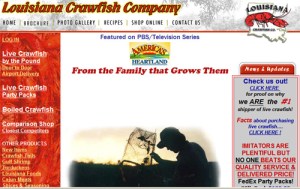
Ok, the spring time means lots of things in lots of places. In New Orleans, where I grew up it means 2 things to me. One is the Jazz Fest and the other is Crawfish. If you have never been to NO then you need to go to the JazzFest, generally the weather is awsome though there might be the occasional sprinkle, and the combination of music and food over a 2 week period is ridiculously fun. Check out this small snapshot of a line-up:The Neville Brothers, Stevie Wonder, Billy Joel, Jimmy Buffett, Tim McGraw, Santana, Maze feat. Frankie Beverly, Sheryl Crow, Widespread Panic, Dr. John, Al Green, Diana Krall, Keyshia Cole, Robert Plant and Alison Krauss….Woooowheeee… Ok.. So if you can’t make it, then the next best thing might be a few pounds of crawfish. The above link will ship them right to your door. Live. You do know how to prepare them right?
I saw this sight Rollyo and all I could think of…well never mind what I thought, but it has a pretty cool app when it comes to search. And remember folks, just because Google is the big dog, doesn’t mean that the other breeds of dogs are bad…So Check out Rollyo
This last site you will def have to bookmark. It’s called Workhappy. Hey, any website titled “work happy” is going to grab my attention. It’s sorta entrepreneurial based but I’m sure you know someone who could benefit from it.
I came across this other day to and it seemed sorta interesting, let me know if you had any opinion of it, good or bad. It’s called Loladex and the tag line is, “Local picks from people you trust…” What if you trust no one?
 Direct Marketing Observations