Hey people, let’s step it up.

I was sitting in the stands of a basketball gym a few nights ago and talking to one of the major movers of one of the top social media companies in the country, and I had asked him what’s going on at work. I like to see where they’re at sometimes since they are right in the thick of it usually, and I’m always impressed in the directions they head. He told me that they were looking to do more and to do bigger and better things with companies rather than just to pitch or create wikis, and blogs and communities and what not.

Don’t get me wrong, they “do” do more, it’s just that the perception or thought right now with other large companies wanting to get into the social media game is “this is what works with others-so lets do that”. He said they were looking to expand their reach and their depth of  what that can do instead of offering component driven solutions on large scales. Great strategy.

This made complete sense to me. In fact I had been mulling over that corporate perception and social media perception of late with the posts I had been reading in my reader and on some social sites I frequent. 

My thinking was it had become somewhat static, one dimensional and monotone like in its themes. Or maybe stale? Tired? Repetitive?

Think about it, we are creatures of habit and we do what the pack is doing. We see what works and we do the same. Isn’t that the way certain companies are approaching pitching social media solutions to large companies. They see what has been successful elsewhere and then take the same approach and basically say we can do that to? Yawwwwwwwwn. Go ahead and do that. But how bout you stretch out and take a chance on doing something bold and different?

Which was the essence of  what my friend was saying and I applaud their thinking for this. We, and they are only limited by our collective thinking of what social media can do. Right now we’re implementing what we know what works instead of turning it inside out and attacking it from a completely different vantage point.

 I implore that tact with some of the incredible collection of thinkers that I subscribe to. I personally believe that we have only scratched the surface of what social media can do and I plead with you to step back and really think about the ways and means in which we can take this piece of clay that is social media and shape it into things that we have not even begun to fathom as being possible. Let’s eliminate… the echo.

SEO and SMO are conversation starters.

Last year Jason Calacanis wrote a blog post how he thought that SEO and SMO were bullshit. Now I know in some parts Calacanis is approaching demi-god status and in other parts he’s villified to no end. Hell, he has 35,000 followers on Twitter, which is a fairly significant number of people who put a lot of stock in what he says. I’m one of those followers too. But that doesn’t mean that I agree with everything he says.

I had been thinking about the role of SEO and SMO in internet marketing lately and decided to do a cursory search and that’s when I found Jason’s article. It’s not the driving force behind this post but it does give it some legs since Jason and others have deemed some of what is done on the level within SEO and SMO circles as unacceptable.

Over the last year and half and even before that, I have engaged in some pretty healthy SEO as well as SMO for clients. And it has worked. I utilized what was available and knew what I was doing. According to Calacanis that would make me a snake oil salesman. Talking SMO then, Calacanis said the following:

Anyone who hires an SMO firm is an idiot. The whole point of social media is TO BE REAL NOT FAKE!!! Just be yourself and participate… that’s all it takes (and note, participation is not just putting in your own links, it’s voting/commenting on/submitting other people’s content too!).

To which I have to say that “SMO is the process of realizing that being authentic and strategic within a social media marketing context or environment can be beneficial.

Here’s a generic example. I have a demographic of women smokers in their mid 30’s for instance. They  happen to use Facebook. So I create a widget that provides them a way to maybe quit smoking and track the results and share them, which in turn drives them to a blogsite, a branded microsite and a branded community. To get this ball rolling, I’ve also seeded/posted articles related to all of these sites and the product and the campaign on Digg, Stumbleupon, Delicious, Technorati, Propeller and say Reddit. All of these linked together creates a tremendous opportunity and buzz for these users to not only meet, but also to share, and perhaps learn more about a product dedicated to them. Does this mean that what I have done is black-hat or disingenuous? No. Does it mean that I have taken certain elements, linked them together and have enjoyed the linky-goodness via SMO and SEO? Yes. Am I bad? Am I evil? Am I hiding? Am I not being “transparent enough”?  Why can’t I let these social bookmarking sites know about a product launch?

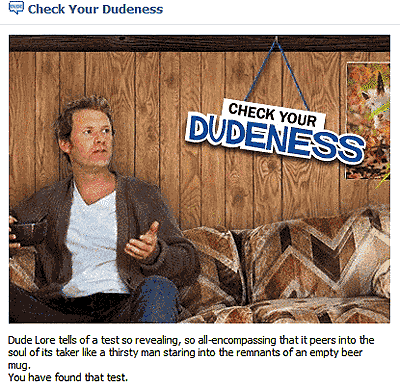
Want a good example?  Buddy Media created the Check your Dudeness app for Facebook-Couldn’t this be construed as some element of SMO? They’re taking a product, a branded one and using social media to promote it. Is that gaming the system? No.

We need to get away from the fact that what the system allows us to do, does not neccessarily mean that we are up to no good, or that we’re not being transparent enough. Ok I get it. I don’t need to be told over and over and over again to be transparent and authentic. Yes there is a difference between black hat seo and white hat seo as well as black hat smo, no doubt about it. Just check akismet for aspects of that. But.. most of your brand marketers are only using the tools that are available. I can show you at least 130 examples where companies used certain aspects of social media to promote or further their brand exposure using some of the above mentioned sites and tactics. This doesn’t mean that they are operating behind a cloak of deceit.

Listen, there is a big big difference between gaming the system and utilizing what is provided to promote your product, your brand, and your company. It truly boils down to how you use it. I’m all for engaging in conversations but someone has to start the conversation. The better you are at starting a conversation, the better your chances are of someone listening and responding back. Maybe we should be looking at not how to be transparent and authentic, but more on the proper way to enagage and start the conversation.

12 sites to check out and a MySpace story.

Sometimes I just want to effin rant about stuff going on in my life, but one of my mottos has always been to keep an even keel. I know, try keeping an even keel with all of the bullshit going on right now, right?. So with all of that noise, here are some sites and blogs that you should check out and or bookmark:

Crazy Egg is a site that provides visual representations of customer data and web traffic.

Keeping the theme of the egg, VideoEgg is a video ad network for online communities that connects brands to consumers with video and rich media across a network of more than 200 leading video and gaming sites, social networks and applications.

I was in NYC recently and relied heavily on this. I thought HopStop was invaluable.

Trendrr tracks the popularity and awareness of trends across a variety of inputs, ranging from social networks, to blog buzz and video views downloads, all in real time.

View and create user flows here @ Product Planner which is a product from Kissmetrics

Thinking of turning that white paper or ebook into something more? Check out Lulu, which I plan on taking advantage of.

Here’s a cool Linkedin app called social minder, though I haven’t tried it out yet, but it is on my to-do list.

Paul O’Brien provides the The Definitive Online Marketing Conferences List which is a nice list for all of us. Thanks Paul.

You will love Usernamecheck, this is very cool. Its very self-explanatory.

If you have not seen Gary Vaynerchuk’s keynote from Web 2.0 expo in NYC. Then here you go, it’s pretty damn good.

icharts listened and read my TechCrunch50 blogpost and got back to me, so I’m getting ready to take it for a test drive.

Lastly, let me tell you about the conversation I had with a MySpace sales rep named Jason Steingold this past week. He has been historically relentless in trying to get me to buy advertising for one of our products. Relentless to the extent that even though I have told him “no” half a dozen times. He’ll send an email to me stating to “just let him know when I’m ready”. and “we have some really good deals right now”. Oh Ok Fast Eddie, I’m on it.

He’s hammered me on the quality of the demographic for the one product we market, pitched me on specials,  seasonal deals, you name it. So I sent him an email back this last time that said that his price point was too high. My exact words were, “your price points are wayyy to effin high”. Ok my mistake, I should have been more professional.

That email I sent him was more conversational than most of the emails that I send him, at least to the extent that I said more than “no thanks”, but I figured I’d be semi-nice and congenial this time. Big Mistake-I’ve now engaged him and he immediately fires back an email saying the wrong thing or definitely taking the wrong tone and tact with me in implying my naivity, my stupidity and their massive size.

At a $.45 CPM?  What other social network that houses such a large amt of your demographic can you receive targeted inventory at a $.45 CPM? 


So I come back with, “yea but you have a minimum spend of what?”

He responds with… drum roll please…

200k minimum for the month….but you’d get a 72 hr out clause…..


Oh ok, cool, so I get the 72 hour out clause on a 200k minimum spend. Damn that’s a sweet deal. Spend $200,000 to make what? So here’s how the rest of the conversation via email went down.

Me: there’s your price point mah brutha

Him: 72 hr out clause?  That’s a great deal….you guys must not be in the business of making money….just trying to help you out, times is rough son.

Nice sales tchnique there, don’t ya think?

Me: Let me digress. Our typical customer for this product does not use social media. Just because you have data that shows 10 million users that “might” use this product doesn’t mean it’s our customer. Looked at broadly, we could say that everyone is a potential customer, and I could see why you thought or think that. Your comment about us not being in the business of making money-  you might wanna work on those closing techniques and avoid using that in the future.

Him: Who’s your typical customer exactly?  1 in 4 Americans is on MySpace….pretty much encompasses people from every walk of life….

Me: Thanks Jason

Him: You’re welcome! 

Moral of the story: No wonder sales people have such a hard time communicating, articulating and understanding their customers. They don’t listen. They push and force the message. He engaged me and he had me listening and did not handle an initial skeptical rejection well.


Is social media marketing guerrilla in nature?

When I wrote yesterdays post about the melding of guerrilla and social media marketing, I thought that perhaps that maybe I was a bit extreme in my analogy, but look at this diagram. Look at how they both share some of the same attibutes.

Guerrilla marketing and social media marketing-an imperfect, perfect union.

This blog post comes from a tweet that I just had which was prompted by a tweet by Jeremiah Owyang in which he said:

Next, we need to think if media spending decreases, will marketers lean on low cost social media even though returns are generally unknown?

This statement made me think that right now marketers, advertisers, small business owners- actually everyone, is thinking about how to do “it” for less. In other words how can they drive traffic and sales and leads and eyeballs to their sites and products on the cheap. Bring in social media. One of the great things about social media and user generated content is that it can be done for no cost or a low cost. And the results can be pretty amazing if done right. Enter Guerrilla Marketing. If done right,  guerrilla marketing  can and has been very very successful in growing brands, creating viral buzz, and driving sales, eyeballs and traffic to products or companies.  Why mesh guerrilla marketing with social media marketing?  Well, lets look at the definition of guerrilla marketing:

The term guerrilla marketing was coined as an unconventional system of promotions on a very low budget, by relying on time, energy and imagination instead of big marketing budgets. The term has since entered the popular vocabulary to also describe aggressive, unconventional marketing methods generically.

So if we take the basic tenets of guerrilla marketing and meld them with social media marketing you create this marketing synergy that has all the elements of:

Cheap+Viral+ Unconventional+Social= Marketing Nirvana

Social media can be “done” on little or no budget. It is time intensive, it does require energy, it can be viral, and there is no limit on your imagination. Right?   It is definitely not constrained by conventional wisdom, and we still do not know about all the creative ways that it can be used from a marketing standpoint.

So why not?

From here on out I’m going to suggest to marketers and companies that are stuck by the challenges of marketing in a tough economy and social media marketing in general, adopt the “Flavor Flav/Brigitte Nielsen marketing concept”. Loosely defined as an imperfect, perfect union of styles, personalities and standards, that underneath the hood, are very very similar and actually work. For now. Until we figure the rest out.

Clay Shirky Get’s It

Clay Shirky, is someone who “get’s it” in a big way. Take 8 minutes to watch this.

Vodpod videos no longer available.

more about “Interview Clay Shirky on Vimeo“, posted with vodpod


The social media food chain and A-listers

A-listers, movie stars, superstars and rockstars, every industry has them. Including ours. Social media, PR and Marketing. We love to worship them don’t we? We watch their every move. We’re fascinated by them. The only thing they might lack are the paparazzi and a posse. There’s just something about what they say and do and write that mesmerizes us. (Cue the chorus of angels) We have decided by our adoration that they hold the keys to the kingdom and thus we need and have decided to quote them and listen to them and follow them whenever we can. Is it wise? Seriously. Is it?

Admit it, you’d take some of that “rockstar” love if it was thrown your way. By that, I mean if you became an A-lister yourself, you wouldn’t turn down the title. Additionally, If they showed interest in you, or talked to you-you’d take that “bounce effect” as well, in a heartbeat. Hell, it might be why we all blog. We want what they got. It’s just that some of you might not admit it. It’s Ok. It’s not why I blog but the residual effect of the blog has certainly brought some notoriety with it that I was not prepared for, and thus I’m not going to reject it.

When you get right down to it, and where I might be in the social media food chain, I think I might be a J or K lister. And while we’re on the subject, lets ask ourselves why we are blogging.  That’s right you- “Mr. or Ms. Stranger that I don’t know yet I trust more than an advertiser”. You, The New influencer, What is your endgame goal here? Is it to be a new influencer?  To be a difference maker? A game changer?

Lets back up though.  That’s not the sole purpose of this post. The duel purpose is to figure where we should place the A-listers in the social media food chain.  Lets ask ourselves who’s eating who here? For example: I recently asked at one conference whether advertisers realized the influence that A-listers have just in the Twitter-sphere. I didn’t really get an answer to that. My point: Twitter followers look for A-listers, follow them immediately, and then jump all over those A-lister quality tweets. And why?

So let’s ask ourselves. What, if any, value or credence should we place with an A-lister when they utter anything? Be it in a micro-blogging platform, a conference, a blog post, a book, an e-book or a podcast. I know some have a body of work that certainly can belie their status. Others, are a tad bit more fuzzy. But even then, we have to be careful and we have to be selective of what we choose to listen to.

I say we read the menu, sample what you want, chew on what tastes good, and digest what will stay down.. Their’s is not the only restaurant serving something hot.

A couple of days ago,  Mack Collier wrote about why he enjoyed the SMBU more than SXSW because it was more of a teaching gig than it was a big “look at me” Rockstar, fest. and frankly, I’m down with that. In fact, if I think back on the last 6 speakers I’ve listened to at various engagements, 4 of them had the same M O.

You see, we’re all guilty of our own MO or modus operandi, as well. Ours might look something like this: We show up at a conference, and wait for “the name” or the “A” lister to talk. When they take the stage, we sit on the edge of our chair, try to tweet something sharp and clever and original and game changing that he or she might say in their slotted time. Then we watch them hustle through their slides and then.. . they answer 4 questions, and poof, they’re done. I know thats not always the case but bear with me.

We then sit there with a few thoughts: They are: “Have I just seen the second coming? Or, WTF was that?” Or, “Did I get anything out of that just now?” Or maybe, “I can’t believe he or she really looks and sounds like that”. All the while the A-lister has stepped off the side of the stage into a throng of social media, marketing or PR groupies. At which point, the exalted one” answers maybe 1 or 2 more questions while 15-20 others hope that he or she looks their way. It’s at this point that I might shake my head, mumble something to the effect, “when is a speaker going to learn how to at least  properly close their talk with something other than, “well it looks like my time is up, thanks.” Perhaps they should read Rohit’s blog post about how to avoid being a bozo when presenting?

In closing, I see that my time is up. But here’s your takeaway. There are a lot of people to listen to in this space. Some of them are not even close to being A-listers, and you know what? They still know their stuff. Maybe even more than the A-listers. Chances are, the A-listers might even be pulling their thoughts and content from them. It’s up to you to decide who you engage. Step back and decide why you are listening to them. Is it because “everyone” else is? Or because they make sense to you. If that’s the case, then stay the course. One last thought: If you’re blogging and you have a dedicated following, you might just realize that you are a thought leader yourself and not a follower of a social media A-lister with clay feet.  And there ain’t nuthin wrong with that.

Seize this moment to make a difference.

I wrote something down 2 weeks ago. Gary Vaynerchuck gave a keynote at web 2.0 expo in NYC and mentioned it and it’s still resonating with me. Ari Herzog, whos blog posts I’m enjoying more and more, blogged about it last week. And today, on September 29th 2008 it makes as much sense to me now than anything I’ve heard over the last few days let alone weeks and months. What is it? it’s this:

Legacy is greater than currency.”

I wish I could have thought of that. I know some of you are saying this right now-“Dude, do you have any idea of the financial straits I’m in?” Trust me, there are very few people right now who are not hurting, I get that. But the point of me letting you in on Gary’s point is this.

Times like these, lend themselves to people who can help others. Times like these allow people to really share their knowledge with those who can benefit the most from it.  For example, If you’re on the tech, or marketing side of the house, do you have any idea how much or how valuable the things you do or can do, are needed right now? The things, the actions, that you leave behind in your life will be greater than the money you made and the money you’ve accumulated. Your legacy, your footprint is more important.

Your legacy right now can be defined by what you do in the next 12-24 months. If you start today to define it. You can either complain or bemoan the current state of affairs or you can try and do something that can make a difference in your life which can inherently make a difference in others. It’s up to you. Are you going to take? Or are you going to give? It doesn’t have to be a lot. But reach out to someone and help them out. They really need it right now.

Maybe we need a national, “Reach out and affect someone’s life day?”

Are you a thought leader or a follower?

When I was a kid most coaches and teachers used to tell me to be a leader and not a follower. Amazing how we manage to find ourselves saying the same thing to each successive generation. Why? because it makes sense. But does it? I immediately think of the old saying, “too many chiefs and not enough indians”. Ok so now we should all be confused. Which should we be?  Do we need more indians or more chiefs? Rachel Happe brings up a great point in her post about The Wisdom of The Crowd in which she writes:

Crowds without leadership and inspiration are not necessarily better or worse than individuals.  But a crowd can become both more than the sum of its parts and less than its lowest common denominator depending on how it is inspired.

What this means to me is that although I might want you to be a leader, you might be better suited to be a follower. Some people are born leaders and some are born followers and some can become…. etc etc. However, in social media and Web 2.0, if we’re to look at the whole thing holistically,  the space reeks of the “follower mentality”. Too many people as I said in an earlier post are inclined to be of the “echo mindset”. They possess zero original thought. I’m not sure they are even actually participating in the conversation to be honest. To this end, they are not leaders, and they are shitty followers. So they bring nothing to the table. Period.

Rachel’s original post stemmed from one that Guy Kawasaki wrote on Dadomatic titled, The top 10 lessons his dad taught him in which #3 was:

Don’t follow the crowd. Initially, I thought that he was saying that most people were stupid–and I agreed with him. But I now realize that he was telling me not to follow the crowd because the crowd “mentality” can make smart people do dumb things. This is why I don’t believe in the “wisdom of the crowd” to this day.

Given the current state of all things political and economic, perhaps what we really need is original thought and not noise that has a new tread on it. I know it’s easy to just put some lipstick on the pig, forgive me for using the analogy, but try to step out from under the umbrella and look at things in the social media and web 2.0 world differently. I don’t need you to be a though leader or a follower, I just need you to think.


ROI vs. Engagment: The social media conundrum continues

I can’t tell how many times I’ve written about this, but for me, this topic is the key driving metric in whether a social media campaign is successfull or not.  I had planned on writing about something else this morning and literally had only been reading a few blogs when I came across an interview by Amber Naslund for Marketing Profs in which she interviews Kodak’s Corporate Media Relations Manager Krista Gleason and Chief Blogger Jenny Cisney to find out why their social media program is so valuable to their business, and how they’ve defined success.

It’s an interesting interview but check out this question on ROI. I have to give mad props to Amber for asking the question in the first place, because I think it gets to the heart and soul of social media marketing.

Q: How do you define your “ROI” from involvement with social media? Krista:


  • Feedback from readers and customers via the blogs and email
  • Invitations to speak at top-tier conferences, including BlogWorld and BlogHer
  • Links to our blogs from other blogs and online articles
  • Recognition from social media experts, like Mario Sundar and Debbie Weil, and traditional media, like Business Week
  • Awards: Earlier this year Kodak won three awards for our blogs—the PRSA Bronze Anvil, American Business Award (Stevie Award), and an Interactive Media Award

Her answer entails everything that would involve branding and exposure and face time and has nothing to do with making actual money. She is not selling anything. Her ROI is measured, but it’s measured by the interaction. The money aspect takes care of itself in it’s own way, but for Krista, ROI in her world is measured by the quality and depth and reach of her social media engagements.

Some would say that if she’s not making money then there is no ROI. Would you agree with that or disagree? What do you think her efforts have done for the Kodak brand?

*Then, lets end on Ambers post of 6 things she learned from Kodak and look at #6

6. ROI isn’t always about direct revenue.
No, I’m not saying social media shouldn’t HAVE an ROI. But I took notice that, on Kodak’s list of social media ROI, not one of them cited any dollar figures. It’s about building relationships, building your brand, and making people want to learn more about you. These are the things that drive revenue for your company over the long term, even if it’s a meandering path.