Social Media is the Platform for Bad Relationships too…

social_media_strategies3

There are people out there, that don’t like you. I know,  shocking isn’t it? For some of you, it might be. In social media we talk about,  and write even more about  how social media creates these magical relationships  of synergy, business alliances, and friendships. But what people rarely talk about, are the relationships that have originated from social networking-that have gone sour.

On the Today Show recently they did a segment about “friending” people on Facebook. And you don’t have to look too hard to find blog posts  about people who have written about breaking up via Facebook.

As you should know by now, relationships that are played out through social media channels take on another dynamic. There are many layers. The most prominent layer now being that all aspects of it, are out there for all to see. Warts and all. Sometimes I wonder if part of us wants everyone else to see whats going on. Of course we can  “choose” to make it or take it private, but a lot of us don’t. We want others, should things take a turn for the worse, to participate in the drama. We want people to choose sides.

What I’m talking about above  are truly personal relationships. But what of.. the business relationships that have occurred from social networking? Or the blossoming relationship? What are the business rules for that? What if your paths cross with many of the same people and your relationship with one of them has just turned sour? What do you do?

How are you going to play it?

Better start thinking about it.

I know I am, because it’s happening to me.

Social Media and Community Mistakes I’ve made

As the VP of Marketing for a dot com start up geared towards IT professionals and major corporations, I assemble multiple focus groups consisting of average Joes to get their opinion on the UI. Not realizing until after the site is built, that perhaps it might have made better sense assembling the typical actual user of the site in garnering user feedback. Huge error.

After having started my first user based community wrapped around a very popular consumer product, I manage the community as if I am a dictator. I say no to everything and listen even less. Big mistake!

These are but 2 of the mistakes I’ve made in my journey through marketing, communities and social media. Encouraged by my friend Mack Collier who has a similar post right now over on his site The Viral Garden, I decided to recount some of the mistakes I’ve made in social media, marketing and managing communities.  I think this is a very viable topic right now for a number of reasons, as you will soon see.

Mack mentions that people who are entering the space for the first time-be it social media, marketing, managing communities, blogging, or whatever-may fear that doing anything, any misstep, will be met with criticism, or perhaps a stiff rebuke. Which is not the case at all, in fact Mack’s point is this:

When it comes to social media; no one knows everything, and everyone makes mistakes. I’ve made more than my fair share

Don’t buy into this ‘I don’t have anything to say/tweet/post about’ nonsense. Get out there and make your mistakes, because that’s the best way to learn. And besides, one of those ‘social media experts’ has probably already made all the same mistakes you will

So along with the other 2 mistakes I made above, let me highlight some of the bigger ones I’ve made.

2002 I set up a knowledge base, a BBS, and an instant chat function all to allegedly help our customer service dept. Results?  Customer service didn’t know how to use the complicated KB and neither did the customer. The BBS was too complicated as well and the chat function crashed constantly. 0 for 3.

2002, I created an online community that instantly becomes popular and balloons to 3,000 users. At which point, I endear myself to no one as I kick out some of the brand champions for what were in hindsight, petty transgressions. It’s at this point that I am called out for the first of many times, and issued my first death threat as well. Major screw up on my part!

2003 I’m still not listening to the customer.  Thinking that perhaps silence is golden as a community manager, I participate very little when the complete opposite was needed at the time. FAIL.

2004 A new product and business unit is created. I create new sites that get tremendous traffic but do very little analysis of the trends, the topics, the hot buttons and customer suggestions flowing in from email and I funnel them to Customer Service, because “I’m too busy!”   Apparently, they never read them either. Product tanks. My fault for not listening, at all.

2005– I start blogging to create better brand recognition. But I know nothing and blog/spam with zero regularity. The only gain I see, is a minor SEO bump, but realize that it came from me commenting. So rather than genuinely read blogs, I decide to just lamely comment for hyperlink purposes. It works for SEO but I get nothing out of the exercise.  At which point I’m just an SEO loser/hack gaming the system. FAIL

2006 I start blogging again but this time it’s out of a need to communicate with customers better. Obviously I’ve seen some light somewhere.  But I read very few other blogs and comment even less. Not realizing that blogging is a 2 way street. It takes a full 6 months for that fact to sink in.

2006-2007 I engage in a full blown reputation management endeavor utilizing  social bookmarking, blogging, and participating in multiple social networks. Only problem-I’m not engaging earnestly. Another problem, I create persona’s in the name of the company but not in my name. I’m not transparent, not even close. Apparently I realize the SEO implications but still don’t get that its all about you being you and the conversation. I’m everywhere and I’m not. The reputation management campaign has worked and yet I have zero traction. I still have not understood the basic principles of social media. FAIL

2007– The light is starting to go on a bit more, but it still has not dawned on me to come out from behind the curtain and be myself. It takes the last 6 months of 2007 to realize that transparency actually works in creating better conversations. In the meantime I start joining social networks on behalf of products instead of myself, and continue to push the message as a brand marketer instead of engaging and listening as a person. Mistake

2008– I was very active but not always in a good way. In 2008 I created “more” social networking accounts instead of concentrating on the few where I have become part of the communiy. I blog about too many different things not realizing that my traffic came from being consistent and on point. I also sometimes still forget that traffic comes from participating and reading other blogs. I also forget that the best way to create value and more long lasting relationships and perhaps derive business, is to go beyond thinking like a marketer and to think more like a friend, a peer, and a colleague. I realize now that from all of my mistakes that, as I told my friend Paul Chaney on his Blog Talk Radio show:

Active listening leads to active relationships that translate to real opportunity..

So you see, I’ve made a ton of mistakes, and those were just the one’s that come to mind immediately. The key though, is that I learned from them, and kept trying. But if you never step outside, you will never truly know what’s out there.  Bottom line is don’t be afraid to make mistakes. I have to think that regardless of your backgrounds , you have all made mistakes. Don’t let the mob mentality, or some random blog comment or snarky tweet,  sway you from trying and experimenting  in social media. Let it be a motivator.

Social Media’s Pecking Order

 social media evolution

  • Kingdom
  • Phylum
  • Class
  • Order
  • Family
  • Genus
  • Species
  • Noob
  • Social Media Expert

As social networks increase so does your margin for error

This is a cautionary tale that I’ve been thinking about for awhile. Having noticed how much social networks and communities have grown exponentially recently, I’ve noticed that people do things within the context of what we consider New Media, i.e. social networks, and then ultimately regret it later.

The  evidence is everywhere. We see the demise of relationships, axes to grind, pure anger, mob mentalities, bruised egos,  bitterness, love, hate, and fraud all played out in glorious real time and beyond, thanks to digital footprints.

Some groups seem to be more comfortable with this aspect of Web 2.0 than others. Gen Y and millenials are used to, and comfortable with leaving their mark. They’re comfortable with the ability to express free form raw emotion on their social nets of choice. So much so that they take on the characteristics of an animal marking its territory.  They do not care about the repercussion of what they do online.   It’s all they know and it’s almost expected and assumed by their peers

Why do they continue to push the envelope? Why do they do “it” knowing that there could be major reverb from it? Some do not care and they are looking for the desired reaction and effect.

Maybe for others, they have no idea? I don’t think they do. At least Gen Y and Millenials don’t, nor do they really care at the present moment.

But that’s just one segment, what about the rest of us?

Some of us do it specifically for that purpose, to get under someone’s skin, to challenge and and to poke and prod what people say. Yet they regret nothing and apologize less. But for them, that’s their schtick.

Others do it and have no idea of the ripple effect it may have online. They have zero clue that their actions, their written word, their audio, that video, once it’s online, that content… ceases to be in their control anymore.

You see online, you lose that buffer of physicality. You lose the ability to “take it back”.  Your margin to screw up is increasing and you know what?  The statement, “Once it’s done it’s done” isn’t true. It ain’t done. You now not only have to deal with “it” when it happens, but you also have to deal with it every time someone finds it. For years to come.

My advice to you is if you want to use social networks as your primary means of communication, be prepared for any and all repercussions stemming from your interactions…. to now be public fodder.


5 life lessons I learned from social media this week

learning

Last night I was wondering what I was going to write about that hopefully someone new or old in the marketing, social media and PR space would understand. It’s been a crazy week but there were a few posts that caught my eye that led me to this topic.

The first was by Todd Defren about the value of modesty in which he mentions that some of the solid thinkers in the social media space are truly humble  about themselves and about what they have accomplished. Imagine that? The people that you admire in the space, have no idea how good they are and in the grand scheme of things, it’s not as important, as it is to help others. Humility in social media.

Another post that caught my eye immediately was authored by Steve Radick essentially stating that social media is scary and the reason is, social media gives everyone a voice, whether they want it or not. It can instill fear and it can intimidate. Which made me ask via Twitter if some felt intimidated or scarred to talk to some of the other better known Twitterati and the answer was a collective yes. Which made me immediately wonder if I did and how can I change that? How can you change that perception if it exists? it’s unacceptable so thus I learned about-Fear of social media.

So in 2 instances we have humility and fear bubbling up from social media. I wanted to write about respect and how we, as social media practitioners may not give newcomers enough of that and that stemmed from the following:

I did a vlog  on how I was going to start viewing social media differently; and the more I look back at that vlog, the more I realized that it’s not that others have to do anything different it was me. I complain about the echo and the people that repeat things but fail to really consider who might be the person behind it. Or really who is listening? I’ve judged, I’ve deliberated and I’ve executed before even doing any legwork to justify some of my criticism. For that I apologize. Though I still want to see more from both the N00bs and the sage veterans in this space, I certainly see that not everyone came aboard at the same time. And, they’re still coming aboard! I welcome you with open arms. I apologize with all my heart. Contrition in social media.

Lastly I want to tell you about the good in social media and the good that can come from community and how quickly people can open their hearts for others. David Armano for those of you who don’t know him has a friend that you should meet and get to know. I’m not going to steal David’s thunder but if he doesn’t do anything the rest of the year, he can rest assure that what he did for Daniela will have changed her life forever. Impactful. Social media can be love, can be generous and can be impactful.

So you see, even when I said I had nothing to write and  was struggling, it was there all along, right in front of me. To be honest, it’s always there,  sometimes it just takes the community we’re in to point it out to us in an ever so subtle manner. I thank you for that. and thus I have gratitude for social media.

Social Media in 2009 is as simple as this…

cash-register-1

I’ve read a lot of 2009 predictions of what’s going to happen with social media, but I think this one will work for me. This is what or how I’m going to measure every engagement and work hard at showing every client that I pitch on social media.  Hopefully you will understand and maybe, just maybe,  you might want to adopt this mindset as well. Here it is.

If you are a customer or client or marketer that is looking at social media as something you can possibly adopt or fold into your marketing intiatives, then measure social media this way..

Will social media save me a dollar?  or Will social media make me a dollar?

If you can answer either one of those questions with a yes, then why wouldn’t you try some aspect of it?  Simple.

Twitter is killing my blog

I just read a tweet, yep that’s right a tweet in which David Armano pondered whether Adam Kmiec’s blog post about the quality and frequency of some notable bloggers is diminshing because of Twitter… is true. 

Kmiec mentions that not only Armano, but Peter Kim and Joseph Jaffe are guilty as well of producing substandard  quality and quantity. I say he’s right. And though I’m not on the same level as those guys, I see it happening to me as well.

The proof:

David Armano yesterday penned, The world’s shortest blog entry

Joseph Jaffe recently wrote the post titled, “Who gives a shit about toilet paper?”

I’m not using David and Joseph as the poster children here, Adam already did, but I did think it was funny to look at their most recent blog posts. I liked both, but there was some delicious irony in it all. I know there are lots more of us twitter/bloggers out there whose craft might be suffering because of Twitter; and I can without a doubt tell you that I have tweeted wasted? some great blog post topics which have then transformed into some great twitter conversations. My posts are becoming shorter. Any coincidence? They’re becoming more rant-like. I feel like I’m mailing it in some time. Or maybe because there are so many good conversations going on, on Twitter, all the good stuff is being said in real time and doesn’t need to be elaborated on? I’m speculating, but you get the point.

 So what happens?

The digital footprint isn’t the same as if it were a blog post. It’s there, sort of, but for the most part it is gone.  I’m not sure how to strike the happy medium because I like both worlds. But my blog is suffering.

Thoughts?

Lets Focus

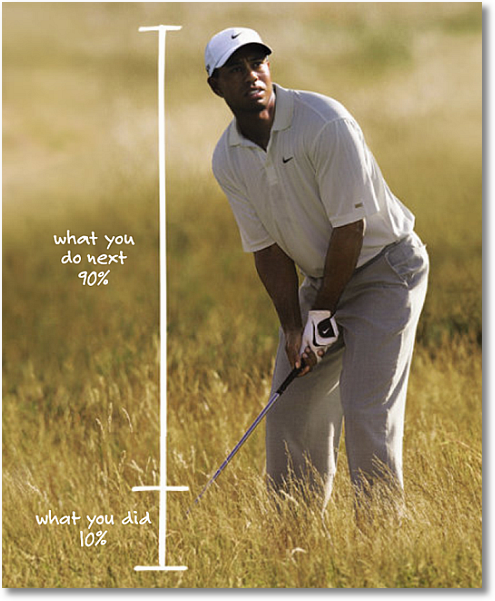
 tiger-woods-focus-on-what-to-do-next-accenture1

When thinking of writing another blog post, it’s often about social media, or marketing, or web 2.0. All really big topics, and all with champions and thought leaders in each. But chances are if you come here to my blog, you’re looking for something. I want to give it to you. But today what I’m going to give you is some advice. It’s advice I need to heed but don’t from time to time.

It goes something like this.

How many blogs are in your feed reader? Mine? Somewhere between 150 and 200. I would love to read them every day but I don’t. Maybe I should focus on about 10 per day and rotate them from time to time? Want some suggestions?  Instead of the obvious, here are some with some variety in the content like Valeria Maltoni, Mark Story, Peter Kim, Toby Bloomberg, B.L. Ochman, Paul McEnany and Beth Harte

How many social networking sites or groups do you participate in? Me? At least a half a dozen, maybe more. How many can I actively participate in? That’s a good question. Maybe 3, maybe 6 and not much more. I’d rather be really active in 3 instead of marginal in 6-10. How bout just Linkedin, Flickr, Facebook, Twitter, and your blog? 2 of those are somewhat passive so you could manage them all fairly effectively.

How often do you read email? Me? Too often to really even narrow down. But it least 2-3 times per hour. I’m not sure what I’m hoping to get, but surely it can wait an hour or 2 before I respond. I believe Tim Ferris says read it twice a day?

How often do you use Twitter? What actions during your day revolve around the usage and participation of Twitter? Me? I have Tweetdeck running from the moment I step in my office. Not sure if that is wise. Does Mr. Tweet enhance or hinder this?

I think you see where I’m going, but let’s continue.

What amount of your day is spent reading about what is going on in our country right now? I admit that my day revolves around what is happening on a local level (Naples, Florida) a national level, an economic level, and globally. Does it consume me?  No, but It concerns me, so I read a lot. Should I reduce that amount like I should email?

What am I doing about IT? and what can I do about IT? What can you do about IT?

You see the challenge here is that we have a tremendous amount of tool sets and new web sites at hand right now, from social media tools to web 2.0 tools, and we can use them to improve what we do. We can also use aspects of them to improve our companies, our clients and our prospects, but we need to focus on which tools will work best for whom. We need to focus on doing what we do better. We need to refine it. Hone our skills, if you will. We need to better manage our time, our focus and our ability to cut through the clutter of filling up our day with a lot of social media bullshit apps and web 2.0  alpha and beta sites. Focus on what you know and do it better. I know I’m going to try. I need to. We need to. I don’t have a choice and neither do you.

Sports and Social Media

We talk a lot about the fabric that is sports and how it is weaved throughout the daily routine of our lives. Whether we like it or not, we all have some type of passing interest in sports and our communities. Either on a local, regional, national, or international level. Face it, if sports didn’t mean anything it wouldn’t be a section of the newspaper. It wouldn’t have it’s own segment on the local nightly news and it wouldn’t dominate our attention every  four years, or every sunday in the fall.

But how has social media changed the landscape of how we view or participate in sports? Here are some sites and examples that have already or seem to be elevating how we use social media with sports.

Ballhype is a social news site that’s sole focus is on sports, but it uses sports content/news as an entry point to encourage more interaction amongst its users.

Sports-focused social media company Citizen Sports recently acquired a few social media application developers: Sportacular, Sport Interactiva, and FantasyBook.  Citizen Sports launched its first fantasy football app on Facebook in July, and the acquisitions of Sport Interactiva and FantasyBook add new fantasy sports content to the roster, as well as securing  Citizen Sports a coveted spot in mobile, as Sportacular has a leading sports application of the same name for the iPhone.

Yardbarker breaks down traditional barriers, allowing fans and athletes to debate sports, read and write articles, and watch videos. It also features thousands of sports websites and blogs,

Pat Coyle runs a site called sports marketing 2.o that is related to all things web 2.0 and sports. Pat is obviously understand the effect that social media is having on sports, as he also created the NING group, Sports Marketing 2.0

The Sports Business Journal recently mentioned the 5 people that you need to know in social media-

Open Sports Led by Mike Levy, the founder of CBS SportsLine.com this site is a comprehensive platform of products and services that brings together breaking sports news, social media tools, user generated content, fantasy sports games and multimedia applications.

Want to see a professional athlete who has leveraged his blog to a degree that journalists and fans use it for his latest sound bite? Look no further than the baseball player Curt Schilling

Then we have XOS technologies a leading technology partner for maximizing the value of content, commerce and services for sports organizations and fans.Whether it’s a coach assessing recruiting content, a video coordinator creating game-video highlights, a team streaming a press conference online or a fan engaging in interactive content.

Jason Peck uses his blog as a platform for sports, business and social media. In fact, Jason provides a great resource in his 50 sports social networking sites, which is a must bookmark blog post. Along the lines of citizen journalism in sports, look no further than Deadspin.

Mashable, the great provider of all things social media list related chimes in with it’s own 20 sports social networks, though it is a year old.

MVP Spot is an online community that provides amateur athletes the ability to showcase their talents to the world.

And SportMates is a global sports social network founded by a group of passionate sports fans who have created and managed some of the largest sports communities on the Internet over the last eight years. They have created an environment where fans and athletes from all cultures and geographical locations can share their passion for sports with likeminded fans.

The point of this post was really to show you that sports is permeating every thing at every level, related to sports. From fan blog sites, to communities devoted to teams and activities, to Facebook groups devoted to teams and athletes, to teams reaching out by creating social networks devoted to their most ardent of fans. and to  professional athletes themselves blogging.

Sports and social media are at the cross roads of fan participation like we have not seen at any other point in time sports. Look for it to continue to escalate with even more user generated content and platforms created to showcase that content. With that being said, look for the voice of the fan to become more and more prominent in the industry of sports.

What has been your “Ah-Ha” moment for 2008?

ah-ha

As we fall forward and 2009 approaches, I was reading a blog post in which the reader talked about her Ah-Ha moment in twitter and I started thinking about what was my “Ah-Ha” moment for 2008. Was it a connection? Was it one of those seminal moments with a client? A conversation? A conference? An e-mail? A tweet? A blog post that took the conversation to another level?

I’m curious as to what it might have been for you.

Given that 2008 might have been lean for some on certain levels, I’m sure you can still point to some thing or some moment in 2008 that might have either helped make the light bulb above your head brighter or just enriched you on a level that you never thought possible. What was it?

I’ve had many moments that were game changers this year but the one that stands out is the effect that Twitter has had on me professionally. In short, not only has it allowed me to connect with my peers but it has connected me to information and resources quicker than if I would have done the search myself. It has kept me dialed in to what matters in my industry and from a networking standpoint, there is no comparison. So to the 500 or so people that I follow, I want to thank you for providing me with my “Ah-Ha” moment in 2008.