Qualify the Why

Why do people buy your product?

Why do you buy one product and not the other?

Why do people hate you or your company?

Why do people love your product?

Why do people quit using your product?

Why do people talk about your products and company?

Qualify the why and then you can begin to understand the motivation of intent.

Should Companies Play it Safe in Social Media?


What does that mean exactly, to play it safe? Is that creating a Facebook page just to satisfy the critics and the bashers? Is it creating a Twitter profile “in case” someone maybe be talking about you so that you can claim that you and your company are proactively listening to the conversation?  Or is it a blog that has 3-4 posts over the span of 6 months?  Maybe, possibly, and perhaps?

One of the easiest ways to opt out of the social media revolution is to do just enough to satisfy the hacks that may be looking at your social efforts who then may be writing, speaking or commenting about your stuff and trying to poke holes at it. To be honest, if I was a company who didn’t have money, resources, or time (weak excuse) to dip a toe into the waters of social, I might do the same thing. Of course doing the barest of minimums also sets you up for the hacks who love to point out the companies who…do the barest of minimums. Or…doing the barest of minimums sets you up for nothing.

So what’s happening here?  Call it paralysis by analysis. Fear of talking, orRO-myopia. But the fact of the matter is that some organizations are so fixated on social but so unsure of what to do, or so obsessed with a wait and see mode, that they end up doing nothing or prefer to just sit back and do very little. Ironically they then claim that they are social, or that they’re doing nothing, because they’re waiting for things to sort themselves out.

Does either strategy ( I use the term lightly) work? Not really. Does it buy you time compared to your comptetitors? Maybe. You see, the easiset way that you could  measure your efforts in social would be to first measure how you’re doing compared to the competition. When I coach basketball and baseball- I want to know who is the best and why. Amazing players aside, preparation can go a long way. Once my teams are suitably prepared, we measure where we are by competing. Then I know exactly where to focus my practices and future game plans.

You’re in business to make money and you’re in business to compete against others that do what you do and sell what you sell. Do you scout them? How do you compare to them? What are you doing to improve what you do, as it compares to what they do? What makes you better than them? What are they doing with social media that you are not?

Playing it safe in sports means playing for ties or not caring whether you win or lose. If that was what mattered, then we wouldn’t have to keep score or root for any teams. In business we keep score by making money and surviving.  Social used the right way, could determine both.

Does Twitter Work?

About once a week I usually get the question, “How does Twitter work? or What’s the deal with Twitter?” And yet throughout the course of a week as well I will also hear the following:

  1. Twitter doesn’t work
  2. How can people spend so much time on Twitter
  3. Twitter has no value

Then couple that with the following from Business Insider and one might really start to question it’s actual value.

There are 56 million accounts on Twitter following 8 or more accounts. There are only 38 million following 16, and just 12 million following 64.

To the casual observer, this all might mean that Twitter is a complete waste of time. To that I say that’s fine, I’ll keep using it for as long as it’s still available. For me, Twitter is invaluable. I’ve made deeper and longer lasting connections to my peers because of it; and because of that, because of those networks, it not only opened a lot of doors, but it also helped me get my current position at E & Y.

If you have doubts on how to use Twitter and still think it’s not worth it,  listen to and watch Tom Martin’s Slideshare presentation on getting a job using social media.

For those that use Twitter and use it as a platform for media consumption as well as sharing and connecting with peer networks-I imagine their opinions of it will be completely aligned on the pro side of it being completely beneficial to them doing their jobs.

Throw the numbers out.


Sure I love the conversation but…

I used to be a social media purist but I’ve evolved. Why? Well we have evolved.  We being the one’s that were there early on who experienced the magic of connecting with someone as smart as  say Gavin Heaton or Tom Martin and having them host our social media tweetchat. Or having that cool, deep discussion with a person like David Alston from Radian 6 when his company was just starting to gain traction, or becoming really good friends with someone i respect as much as Beth Harte. But what made all of those discussions and conversations cool was that we were connecting. Great for us but what about B2B?

There was always the missing component. An outcome. A means to an end. The Why and the What for.

At least that’s what companies wanted to know. And still want to know. They wanted a better value proposition. Some get it but others are still struggling with this. Yea social media is cool but what’s it all mean? What’s the point? To have conversations or make money?  Give us a business use case.

Well yesterdays news of the Salesforce aquisition of Radian6 is a game changer. It’s a watershed moment.  I still like being a purist at heart when it comes to social media but we have to justify its usage. Quite honestly, We have been fighting the good fight for quite some time. Justifying it’s relevance. Educating the masses. But adding strong measuremaent and analytics to social media engagement as it pertains to customer service and sales and lead generation, does just that.  The folks at Sales Force believe that.

With this Salesforce/Radian6 deal, and Lithium grabbing ScoutLabs and MarketWire folding Sysomos into the mix, you are now seeing an alignment of B2B with social beyond just the conversation. Social will always live inside of marketing and PR, but tying it to business functions has now come to the forefront. And the way that become legitimate is by adding measuring and monitoring functions that are directly applied to making money, saving money, and building equity.

Like I said, Watershed moment…


When Social Media Strategy Becomes Irrelevant


What’s important? Every day online and in the social media bubble we talk about ROI and the strategy and the channels used to grow your social media presence and impact. Here are 3 examples where social media has never figured more prominently and yet it had nothing to do with strategy or ROI, but had everything to do with the engine that does drive social media, PEOPLE.

This past Friday, YouTube created the YouTube Person Finder a channel that is aggregating video messages from the victims and the people affected by the massive earthquake and tsunami that hit northeastern Japan more than a week ago. No strategy, no ROI justification-Just YouTube realizing that they could create something that could help people in a time of need.

Meanwhile Google, creates the Google Person Finder which is pulling all relevant search information about people affected in the region into a simple interface. You can either supply information that you know about someone or you can search information posted about someone you know. On top of this, Google has created the Google Crisis Response Page which in my opinion should be shared by everyone just based on the amount of information posted and updated on it.

A Facebook Causes page was recently created to support and raise awareness and funds for the earthquake and tsunami victims.  The page is called Help Japanese Earthquake and Tsunami Victims, and it allows Facebook users to donate anywhere from $10 to $500, or they can join the cause and share it with their Facebook friends.  So far they have raised $240.000  This might not seem like a lot but every bit of it will help. Additional Facebook resources can also be found here  Global Disaster Relief on Facebook page.

This is bigger picture stuff here and at the end of the day has nothing to do with business strategies or ROI but has everything to do with people using the power of social media to make a difference when it matters most-People in need. Impactful stuff…


Socially empowering your employees-What’s taking so long?


We talk and write about the ways to grow a business using social ALOT. Companies are obsessing over it. Even the really really big companies want to harness the promise of the prospect, the power of the existing customer and the potential of repeat business-All using social media.

Yesterday, I was talking to a manager of one of those really really big companies. We talked about empowering their employees to engage in outbound social media marketing- That’s a fancy sentence for basically letting your employees tweet and share things about the company on company time. The comment back was, “They are hourly employees, “We can’t do that-We can’t trust what they might say”…

That sentiment is not on an island.

Two days ago I was talking to a salaried employee of another large company who told me that they could not access Facebook from their work computers. Two thoughts came to mind. One-employees can use their mobile devices at any time to circumvent those rules and two, there is a lack of trust coupled with a fear factor of what that employee might do that is preventing this company from taming the social beast.

I mention the 2 scenarios because in both situations we’re talking about employees both salaried and hourly, in which trust is a huge issue.

How do you leverage the power of what your employees can do for you in social media in order to grow your company? Your customers would welcome the socially empowered employee representing your company. We are entering a time in which it is expected and in some cases demanded.

What is the exception and what is the rule? The rogue employee using social media or the empowered one representing all that is good about your company?

What Was Your Enchanted Moment?

I’d like to think that we’ve all had “enchanted” moments in this space. I have had at least two, maybe three. The space I’m referring to specifically is the digital/social media, online marketing space.  Moment #1 possibly occurred when I built my first website. That was pretty cool. It looked pretty bad but there was something to be said about doing it without the aid of templates and the myriad of tools and programs available today. I got better, but the light really went on from that first experience.

Back in 2005 I sent former Apple Evangelist, Guy Kawasaki, an email; and to be honest, I didn’t really expect a response. The email was a general, ” Oh Sensei, What is the path” type of inquiry. At that time I had recently read his book The Art of the Start and also had stumbled onto Guy’s website/blog, How to Change the World.  After reading the book and the blog I was beyond energized and knew what I needed to do and was merely hoping that Guy was as genuine as I thought-and  by responding to my email, he would only validate the notion even more. Though at the end of the day, I didn’t expect a response.

Well…He did respond. The key there? He responded. The content of the email? I can’t really remember. What struck me was that he responded. It opened my eyes to the power of connections, the power of having a direct type of access to someone who you might have thought was inaccessible. It was the power of social to me on a very small but large scale all wrapped into one. That was truly Enchanted Moment #1.

Moment Number Two: I initially got into social media because of my SEO background. I found out rather quickly how one could “game” blogs for SEO and reputation management with hyper linked signatures embedded with key words. It was apparent pretty quickly that this worked so at the time I wouldn’t pay much attention to the content of a blog as much as I did to the page rank of it. Then one day I read a post that struck a nerve.  I commented and they commented back. Whoa. What is this dialogue? This is better than hoping or waiting on an email response from Guy Kawasakai! It was real time, it was genuine, and it added these immediate reciprocal layers of texture to a static web and a static job function that really opened my eyes to the social possibilities of the web. The moment was huge for me. It changed the way I did things and the way I thought about things.

In 2011, it would appear that my three experiences have come full circle. Last night I finished an advance copy of Guy Kawasaki’s latest book Enchantment. I was asked to read and review it and I have to say, I probably would have read it without him asking me. Here’s the point or here’s how much things have changed for me since that day back in 2005 when I sent Guy that email. Not to revel in the reasons why I was selected to read and review the book because it really can be completely subjective, the fact is that my influence and opinion and networks mattered. That’s pretty cool. That’s the power of social, the power of connections and the power of the web. It has shaped my life and my career over the last 6 years all in a positive way. So in a way, Guy has been part of my enchanted moments  from the beginning and now in the middle.

Now the book Enchantment:  It took 2 flights to finish it. A quick read. I didn’t have to struggle to find the meaning of the things I was reading. It was as easy a book to read and understand as you will find. The tag line, “The Art of Changing Hearts, Minds and Actions”, could not be more appropriate.  After every chapter is a quick snapshot of someone’s moment of enchantment in their life or career which adds an additional aspect of “human-ness” to the book. It’s real. It’s Tangible. Guy’s style is so non invasive and I think that’s the takeaway. I’m glad I read it, will probably read it again and I will ultimately give it to someone who can benefit from it.

Enchanted moment #3? Having Guy host our weekly #Social Media Tweetchat-That would be full circle. Stay tuned! The key? I just have to ask. Truly the power of social.

Have you had your enchanted moment yet?

Social Media Conundrum #12: Justin Bieber is popular, but he’s not influential?

I can’t believe I’m going to weigh in on this, but I saw a tweet from a notable social media analytics consultant in which the following was stated for the umteenth time.

Popularity does not equal influence…

I immediately thought, “Could Justin Bieber and Lady Gaga sell product”? Isn’t that influence?I then had to go look up a quick definition of influence.

in·flu·ence

ˈɪnfluəns/ [in-floo-uhns] noun, verb, -enced, -enc·ing.

the capacity or power of persons or things to be a compelling force on or produce effects on the actions, behavior, opinions, etc., of others

First I wanted to check something on Twitaholic: The top 15 people being followed on Twitter.
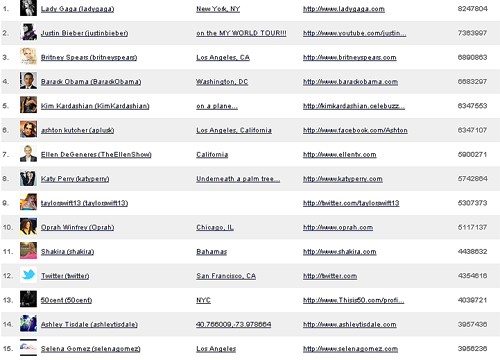
This is a list of the top 15 most “popular” people on Twitter. Let’s look and see who could sell or who does sell product. Let’s pare the list down first.

We have Justin Bieber, Lady Gaga, Britney Spears, Kim Kardashian, Ashton Kutcher, Ellen, Katy Perry, Taylor Swift, Oprah, 50Cent, Ashley Tisdale and Selena Gomez. 12 Celebrities from the world of entertainment. Immensely popular. But are they influential? Can they produce a compelling action on someone to buy product? Could they change behaviors and opinions? Can they influence people to buy stuff?

Lady Gaga sells video sunglasses for Polaroid, headphones for Beats by Dre, phones for VirginMobile, and a host of items and services via product placement in her videos. All this adds up to roughly $5-$10 million per year.

Rather than quote the whole  article from Guy Kawasaki, read about Guy’s experience at a Justin Bieber concert and the machine behind his persona.

Britney has deals with Elizabeth Arden and Candies. Taylor Swift has deals with Sony and CoverGirl. 50 Cent has deals with Reebok, Vitamin Water, Right Guard, PlayStation, and Steiner Sports.

We could easily go through each celebrity on this list and view the products that they sell. They sell the products because they can influence buyer behavior based on their celebrity, based on their popularity.  Am I wrong? I know sales are one thing and fame is fleeting, but because of their celebrity and popularity they can influence buyer behavior right now. Right?

How can you possibly say no? Isn’t that influence? What am I missing here? Help me out.



How Accountable are you with your Social Media?

Recently the spate of social media faux pas’s would tend to make one wonder if putting yourself “out there” is really worth it. The novice I’m sure is wondering that, as well as the expert. Why all of a sudden are people not caring or simply not thinking about what they tweet or what they say on a social network? This thought is what drove the following deck that I will be presenting this weekend in Orlando

Who Can You trust?

The Edelman Trust Barometer version 2011 came out recently and buried in the presentation deck are 2 slides I want you to check out.

Here’s #1

What this slide is implying is that consumers no longer trust their peers and that they would prefer to trust an authority figure like a CEO. Why is that? Call it the re-emersion of the authority figure. The authority figure exudes a sense of influence and trust and the people that are like you, can be influenced, and your trust in them is diminishing. Trust in leaders, their leadership, and their experience is growing. Does this surprise you?

Ironically we have said on many different occasions that consumers look to each other for product and company recommendations-they trust each other for their unfettered honesty. So what is happening? Why is it slipping or the pendulum swinging the other way?

Now let’s look at slide #2

Consumers trust search results when doing research on a company and not social media. Look where social media sits! Meanwhile search results are tied into real time social. So search may be the research conduit but the result still might a social media generated one.  Either way, a brand or company can say all they want about how search doesn’t affect sales or performance-I would beg to differ especially after viewing this slide. It surprised me. Did it you?

The bottom line. Search and social will still be prime components of trust but at the end of the day, who you are is going to determine levels of trust. Below is the complete deck for your viewing pleasure. Guess we better start looking at influence and authority some more.