5 posts not about you and your social MEdia self

I’m so sick of reading about the bad.  Actually I blame it on Shel Israel and his morning Twitter report on the sorry state of things. But Shel is just reporting it, it’s not his fault. So I’ve got 5 items for you to do some thinking on.  See if you can figure out the theme here.

Scott Monty drives a point home that all social media people on the inside looking out need to know, It’s not about you!

David Armano explains why giving begets giving prompted by Chris Anderson

Seth Godin explains why spreading yourself too thin aint’ a good thing.

The Kolbe A™ Index/Instinct Test: IQ tests tell you what you can do. Personality tests tell you what you want to do… the Kolbe A™ Index measures what you WILL or WON’T do. Check it out.

The rise of social media has made us all influencers and with that responsibility comes the notion that you can make a difference as long as you continue to give and not take.

See what the theme is? Social media and conversations are really not about you and what your needs are, they are about the other person or the community as a whole that you are a part of. Do what you do with the other person in mind for a day and see what happens. or better yet instead of trying to be some person everywhere, try concentrating on being some one in one place.

What can social media do for reputation management?


Alot has been written about online reputation management of late, and recently I was asked by a company to explain to them what I had done in regards to reputation management. So I’ve decided to recount what I did and what were the results.


About 18 months ago Emerson Directs’ web presence was no more than a brochure-ware site with no more than 3 pages of cursory content with zero traffic and zero web presence. all of its business was by word of mouth and referral. The only web presence was of SERP’s of information on an FTC settlement and consumer affairs reports on some bad customer service that occurred over 6 years ago.


Realizing that this had to have and was having a negative impact on the company and its ability to go out and get new business, I decided to do a few things. In short order, 1) I decided to create a new website, 2) a Social Media Optimization strategy wrapped around creating a number of social media pages devoted to the company-specifically the company name, 3) a blog site devoted to pushing out a more positive and leader like image for the company, 4) a robust social networking campaign 5) a Twitter persona in which I knew and hoped that people would go from the tweet to the blog site or to the website based on the quality of the tweet and lastly 6) be more visible and authentic with current and potential clients.


By creating the blog, it was another way of creating more content as well as another web site devoted to the Emerson Direct brand. As of today, The blog averages more than 10,000 visits per month, connects with clients, potential clients, and the casual reader, and has received numerous accolades. All of which were not my goal going on. They include ranking in the Adage power 150 The Power 150 is a ranking of the top 900 English-language media and marketing blogs in the world. The site is also ranked #23 of the Junta 42 which ranks the top 42 content marketing blogs. It’s also ranked oddly enough in the UK for top marketing blogs. It’s also part of the Big List of SEO blogs compiled by Lee Odden of Top Rank Blog. The indirect result of all of this, is people go from the blog to the website. The indirect direct result has been the creation of my personal brand as well, which has been cool and also very humbling since that was never my goal.


The residual effect of this effort has been tremendous in 1) driving traffic to a new site we built as well as 2) creating more opportunity for the company as well as 3) driving down the negative websites and 4) managing our website and companies’ online reputation in a more positive and proactive fashion and 5) I’ve become the de facto spokesperson for the reputation management campaign that Emerson Direct  undertook, as well as a champion for all things social media related and 6) Their phone has been ringing and 7) I’ve made some great new friends and contacts and 8. I’ve learned a ton and  9) respect so many others in the space now.


In regards to other forms of social media, I’d also created company related personas at nearly all of the top social networking sites, and even some of the lesser ones. I would venture that the total number was close to or had been 50. Some of those sites included YouTube, Delicious, Stumbleupon, Disqus, Propeller, Friendfeed and Twitter. All good viable ways of sharing content and changing a bruised reputation. Delicious is a prime example of my social media book marking efforts, in which I have over 600 bookmarks. That might not seem like a lot, but in the grand scheme of things it is.


I’ve toned all of this down now, as I’ve been able to dial it back, tweak it, and develop a happy medium with a consistent social media presence in the places where it’s most effective. Plus the time suck was killing me.

One note:  I also created a number of filters in Google Alerts, Summize  and Backtype that keep and kept me abreast of anything that was said or written about me, the brand, the company, or any of the products that they were marketing, which I highly recommend.


The culmination of these social media and reputation management efforts has been, to put it mildly, extraordinary. Not a day goes by where they do not see some type of positive ripple effect both professionally and or for me personally from these efforts. 

The interesting thing about this whole exercise has been, and some people might not realize this, the tremendous amount of effort and work required to maintain and do all of this. The payoff though has been well worth it. I also think it’s important to note, that you cannot afford not to be doing some variation of the above. What do you think? What more could I have done? Did I miss anything?


You have no idea how much you know

I was on the phone yesterday with a student from Columbia U who is doing her Masters thesis on a certain aspect of social media. We were on the phone because we exchanged a bunch of emails and she felt that maybe a call was in order. After 45 minutes of talking about all aspects of social media we were done. I hung up and I thought to myself; “Wow, did all of that just come out of me?”

Let me sum up what I chatted about.

  • I told her people like Scoble and Chris Brogan had devotional followings yet were different in nature and focus.
  • I mentioned that people like Brian Solis offer an interesting take on the landscape that is the ever-evolving moving target of social media.
  • I mentioned that she should check out Naked Conversations as a primer on what the blogging scene is all about and where it came from and where it’s going.
  • We talked about how Twitter is a great way to connect with Rock Stars, A-listers and thought leaders, but can still pull people into your circle that you have no reason why they are there.
  • I told her she should check out Danah Boyd and some of her work on Social media, teens and class divisions
  • We talked about why people do not contribute right away in social networks, though they have joined a community; and that it could be they’re just not completely comfortable yet.
  • As well, different demographics have different comfort levels in embracing new media.
  • We talked about communities and how individuals and brands operate within those communities.
  • I abused the words authentic, transparent, and “real”.
  • I’m pretty sure I did not take a breath.
  • I stressed that Chris Brogan is walking the line that separates saturation and Scoble like status.
  • I told her that Seesmic would be a good way to connect with people in regards to some of her social network questions
  • I’m pretty sure I mentioned David Armano
  • We talked about the goal of brand participators in communites and the challenges they face in trying to connect with their users and customers
  • I forgot to tell her which of my favorite blogs would help her in her research, so here’s the shortlist.

———————–

  • Brian Solis– Brian is very giving with his thoughts and observations on social media and PR,
  • Valeria Maltoni– If you want deep, thought provoking takes on all things social and beyond, I highly suggest you add her blog to your list 
  • Adam Cohen-Adam is a new add to my list but I enjoy his take and the variety of his posts
  • Ari Herzog-good writer, good take and his posts are timely.
  • Peter Kim-I’ve been probably been giving Peter too many props lately but man his stuff is so insightful.

So after all that, I sat there and started thinking. My first thought was that earlier in the day, I was explaining social media to a bunch of people in a doctors office. The first question out of their mouth was to ask if it was like an online dating site. Ouch.

Having my little chuckle to myself, my next thought was about what I just verbally spewed out to the grad student from Columbia, who by the way, didn’t know as much as I expected. This gave me pause to ponder what do I know? Was it alot? A little? 

Well, maybe I do know a little about some things but… I do know this. The people that I deal with, and talk with, and share with, and laugh with, everyday in my communities, know a lot. ALOT.  And everyone else outside of these circles or spheres that I float in, just might not. And that’s pretty cool. So I wanna thank you for letting me be a part of that.

19 things you should know about your world

  1. Did you know that China has over 253,000,000 internet users which amounts to about 17% of the world’s users?
  2. Did you know that China will eventually become the #1 English speaking country in the world? Or that
  3. The 25% of the population in China with the highest IQ’s …is greater than the total population of North America.  In India, it’s the top 28%.  Translation for teachers:  they have more honors kids than we have kids. 
  4. There are over 2.7 billion searches performed on Google each month.  Which speaks to a post I did about tech trends.
  5. The amount of new technical information is doubling every 2 years.  For students starting a four-year technical or college degree, this means that…half of what they learn in their first year of study will be outdated by their third year of study.  It is predicted to double every 72 hours by 2010.
  6. The U.S. Department of Labor estimates that today’s learner will have 10-14 jobs . . By the age of 38
  7. Predictions are that by 2013 a supercomputer will be built that exceeds the computation capability of the human brain.
  8. According to the U.S. Department of Labor . . .1 out of 4 workers today is working for a company they have been employed by for less than one year
  9. More than 1 out of 2 are working for a company they have worked for for less than five years.
  10. According to former Secretary of Education Richard Riley . . The top 10 in-demand jobs in 2010 didn’t exist in 2004.
  11. We are currently preparing students for jobs that don’t yet exist .
  12. The U.S. is 20th in the world in broadband Internet penetration.(Luxembourg just passed us.)
  13. 1 out of every 8 couples married in the U.S. last year met
  14. The average MySpace page is visited 30 times a day.
  15. The number of text messages sent and received every day exceeds the population of the planet
  16. More than 3,000 new books are published . .
  17. It’s estimated that 40 exabytes (that’s 4.0 x 10¹⁹) of unique new information will be generated worldwide this year
  18. The amount of new technical information is doubling every 2 years
  19. 47 million laptops were shipped worldwide last year


Many thanks to  Karl Fisch  and Scott Mcleod  who compiled alot of this data, which in the end, really gives you a sense of how very large this world is and how very small you are.  


 The only constant in life is change. Don’t be static.

Quit talking about Social Media and Go Make Some Money!

Ok so by now we all know the hows and whats of social media and social media marketing. At least, we better.  Hell, I’ve written a books worth of articles myself on the subject. And lately we’re all writing about how to use social media in a down economy. Or whether social media can survive the meltdown. Or how to use social media to deal with the crappy economy. It seems everyone has their take on what to do. Scoble says we should listen

 The Buzz Bin says keep a cool head and keep morale up. We can even go to extremes and ask Will the Recession Spell the End of Web 2.0? or we can go to the opposite end of the spectrum and be forthright and ask whether you would tell your employees and customers how bad it is?  Don’t get me wrong, those all are great and relevant posts, but we gotta move on.  So let’s take this to the next level.

Seriously, you do not have to look far to read another article about how one can use social media to improve their marketing, or how bad it is out there. Between the two, We get it. It’s in our face all day every day. But now, it’s time to get serious.

Scenario one:  I’m a big company and I don’t have time to be pitched and I don’t have time for social media marketing initiatives to ramp up, but I’m willing to try them. What can your social media marketing campaign, Mr. Agency/Marketer/In house CMO do for me right now? What can we roll out that will show immediate results?

Scenario two: I’m a marketer/agency. I now do not have the luxury of educating you Mr. Big Company on what social media is and how it can benefit your company- I now have to show you direct ROI with a timeline that is reasonable and cost effective. What’s your plan? And do you trust me? Because my ass is now on the line.

So wutcha gonna do? Do you have a plan? Playtime is over.

Even our “friends” over at Forrester have said, “quit dippin the toes and invest only in programs that can deliver on measurable metrics.”

So what are the programs? Do you even know? You can’t manage what you can’t measure. Page views and traffic aint gonna pay the bills. Talk to me. Do you have a plan? Which of these below can make you or your client money?

The 21st century Proust Questionnaire. Updated.

 Given our current state, yesterday I threw out the Proust Questionnaire to the blogosphere. It seemed like an interesting study in the human condition, especially now. But some of the questions, though applicable to Proust’s times, were not as timely or current to todays times. So I updated them. Here are the questions. Anyone for authenticity?

Would you prefer to rent or own a home?

What  electronic device makes you happy?

What can’t you live without?

Who’s your favorite movie character?

Who’s your hero?

What moment in your lifetime stands out the most?

Name a woman you most admire.

Can you name a famous painter? If so, who?

Who is your favorite band or singer?

What qualities should a man possess?

What about a woman? what qualities should she possess?

What do you like about yourself?

What job would you love to have?

If you could be anything, what would you be?

What makes you different from others?

What common trait do all of your friends have?

What do you need to improve about yourself?

What is your biggest regret?

What pisses you off the most?

What do you want to be when you grow up?

What’s your favorite food?

What’s your favorite website?

What is always in your fridge?

What’s the best book you ever read?

What magazine could you read anytime?

What famous woman in history most sticks out for you?

Who’s your favorite actor?

Who’s your favorite actress?

Do you hate anyone?

What skill would you like to have?

What is your fondest memory?

How would you like to die?

What is your current state of mind?

Self-discovery has never been in more need. I think today, our transparent self needs to get in touch with the people who are having a hard time being “real”. Not only does this extend beyond social media, but I see it permeating everything these days. It’s about disclosure and what we are articulating or trying to say. It’s about having conversations. You should send this to the people that are in dire need of having or participating in conversations. Lets talk, lets exchange, lets share. and then lets compare answers.

5 huge tech trends that you can’t ignore.

That’s it. Just 5. But why just 5? Because these 5 are rockin’ our world now and will continue to do so for the next 10 years. Do you remember the Gartner Hype Cycle? I blogged about it awhile back in regards to certain things we can be excited about over the next 5 years. Take a look at it real quick.

Ok Now look at this next slide real quick:


Ok, one more and I will let you off the hook.


So the hype cycle pretty much lets you know where certain “things” are in their growth development. It’s a great point of reference and doesn’t take a long time to figure out. Samw with the next slide, what does it tell you? It tells you that music is important to us. Always has, always will be. Here’s a quick 1 question quiz: What does the MySpace business model revolve around? Music and social networking. Ok So there’s 2 trends that will not be dipping anytime soon. Awhile back I wrote a blog post about the top 44 music related social networks and to this day it still pulls traffic. I recently tweeted a question as to what brick and mortar industry has completely dried up but thrived online-answer: music

Trend #1 Music will continue to thrive online and you cannot ignore it.

According to Comscore  In August 2008, Americans conducted 11.7 billion core searches, virtually unchanged from July, as Google Sites extended its lead in core search market share by 1.1 percentage points.

Search is, the gateway to everything that we do online. You may see some play in regards to trying to refine search into more of a niche based environment, but the bottom line is search will alway be the mainstay of any internet based activity.

Google Sites led the U.S. core search market in July with 63 percent of the searches conducted, up from 61.9 percent in July, followed by Yahoo! Sites (19.6 percent), Microsoft Sites (8.3 percent), Ask Network (4.8 percent), and AOL LLC (4.3 percent).

Americans conducted 11.7 billion searches at the core search engines, nearly identical to the number of core searches conducted in July. Google Sites handled 7.4 billion core searches (up 2 percent), followed by Yahoo! Sites with 2.3 billion and Microsoft Sites with 977 million.

In the comScore August 2008 analysis of the top properties where search activity is observed, Google Sites led with 10.2 billion searches, a 2-percent increase versus July.  That’s billion! Yahoo! Sites ranked second with 2.4 billion searches, followed by Microsoft Sites with 1 billion and AOL LLC with 839 million.

Trend #2 Search ain’t going nowhere.

According to Hitwise, MySpace.com received 67.54 percent of the market share of U.S. visits in August 2008 among a custom category of 56 of the leading social networking websites.  The market share of U.S. visits to the social networking site decreased 2 percent in August 2008 to 6.40 percent of all U.S. visits compared to July 2008. Visits to the category decreased 17 percent year-over-year. But check out the chart below:

What do those numbers mean to you? It means that MySpace had 66 million visits in one month and Facebook had 28 million. The fact of the matter is that social media and social networks are interwoven into the daily fabric of our lives. I know, it’s not like it’s earth shattering, it’s just not a fad anymore. It’s legit. It will continue to evolve and the potential will always be there for someone to do something different and exciting and unique with the social media application. Could that be you? I hope so.

Trend #3 Social networks will continue to evolve and grow larger and gain in importance.

A recently released UN study indicates that by the end of 2008 mobile phone use worldwide will reach 50% of the earth’s population for the first time in history. Although the percentage of mobile phones in North America, Western Europe and most of Asia is much higher than 50%, in developing countries, a mobile phone is still considered a luxury.

Mobile phone ownership rates have been rising significantly, almost at an exponential rate. Countries like  India, Brazil, and China are seeing crazy growth in the number of people owning a cell phone. In fact, China had an estimated one billion cell phone subscribers in 2007. At the current rate of growth, there will be over 3.3 billion cell phone subscribers worldwide by the end of 2008.

So there’s no escaping the fact that cell phones are now-another essential part of our daily lives. Grab the keys, grab the wallet, the purse, the backpack and the cell phone. Ok so we get that. But now, pay attention.

According to a recent online survey conducted by ABI Research, nearly half (46%) of those who use social networks have also visited a social network through a mobile phone. Of these, nearly 70% have visited MySpace and another 67% had visited Facebook. No other social networking site reached 15% adoption mobile adoption.

So what are these consumers doing when they access their mobile social network? They’re checking for comments and messages from their friends, with both of these features registering above 50% for mobile social network users. Posting status updates also has proven popular, with over 45% of mobile social users letting others what they are up to via their phone.
What we are seeing is a melding of 2 functions into one via the hub of the cell phone. Or is it the hub of the social network?  There’s no doubt that a social network is increasingly becoming a central hub for communication across online and mobile domains for a lot of people. Because it’s  allowing them to consolidate activities or processes. From text, to email, to chat, to phone calls, to exchanging of data, uploading images and downloading songs. The phone and the social net. allow thesee things to occur almost seamlessly. As a trend, the centralization of a consumer’s cell phone activities combined with their increased social network usage is only going to make adoption of mobile social networking more inevitable as we move forward.
Trend #4 The growth of the mobile social network will be steady and exponential.

Here is trend 4a for you as well:   comScore M:Metrics reports that in June 2008, 20.8  million U.S. mobile subscribers and 4.5 million European mobile phone subscribers  accessed search during the month, an increase of 68 and 38 percent from June 2007, respectively.  The U.K. had the highest penetration of mobile subscribers using search at 9.5 percent, followed closely by the U.S. at 9.2 percent.  That’s right, Mobile Search.

Ok last one-And it’s a no-brainer. Check out the slide below. It’s from December 2007, but the message is loud and clear.

Google Sites  ranked as the top U.S. video property in December with 3.3 billion videos viewed (32.6  percent share of videos), gaining 1.3 share points versus the previous month. YouTube.com accounted for more than 97 percent of all videos viewed at the property. Fox Interactive Media ranked second with 358 million (3.5 percent), followed by Yahoo! Sites with 340 million (3.4 percent) and Viacom Digital with 238 million (2.3 percent).

In total, nearly 141 million Americans viewed online video in December. Google Sites also captured the largest online video audience with 79 million unique viewers, followed by Fox Interactive Media with 43.9 million and Yahoo! Sites with 38.2 million. So if you don’t already know it online video consumption is growing at a sick-ass rate.

Trend #5 Online video consumption will evolve into an acceptable replacement for a TV.

In conclusion, here’s the most interesting aspect of them all. The hub for all of the above trends can and will be centered on one thing, Your cell phone.

Where does UGC rank on your trust meter? 10 perspectives on User Generated Content.

This is going to be an ongoing viral tweet. and I will continue to update. I think it’s a very important topic.

I’m going to start off with a great post from Steve Rubel titled ethical social media marketing that I think we should all read and send to others.

Next here’s an article from newsweek in which the author thinks that the UGC pendulum is swinging back towards the experts.

Better read this one user-generated content site gets sued by copyright owner for naughty uploading habits of users

From an SEO perspective we have: Maximizing SEO Returns with User Generated Content

Here’s a blog dedicated to UGC

Here’s a great article by Paul Chin about the value of UGC which I highly recommend.

Want to know about the rise of user generated content? Read this article from Entrepreneur

and then the dark side-or When user generated content goes bad

Are you someone’s user generated content? and All (User-Generated) Content Doesn’t Want to Be Free:

Now at this point you should be getting the gist. So, what are your thoughts on user generated content? Do you put more trust in your peers and communities than you do traditional media, online media and word of mouth? Who’s blog do you trust? who’s opinion do you bank on? Do you find yourself spending more time online than watching or listening or reading traditional media sources?

Take the UGC Survey

SEO and SMO are conversation starters.

Last year Jason Calacanis wrote a blog post how he thought that SEO and SMO were bullshit. Now I know in some parts Calacanis is approaching demi-god status and in other parts he’s villified to no end. Hell, he has 35,000 followers on Twitter, which is a fairly significant number of people who put a lot of stock in what he says. I’m one of those followers too. But that doesn’t mean that I agree with everything he says.

I had been thinking about the role of SEO and SMO in internet marketing lately and decided to do a cursory search and that’s when I found Jason’s article. It’s not the driving force behind this post but it does give it some legs since Jason and others have deemed some of what is done on the level within SEO and SMO circles as unacceptable.

Over the last year and half and even before that, I have engaged in some pretty healthy SEO as well as SMO for clients. And it has worked. I utilized what was available and knew what I was doing. According to Calacanis that would make me a snake oil salesman. Talking SMO then, Calacanis said the following:

Anyone who hires an SMO firm is an idiot. The whole point of social media is TO BE REAL NOT FAKE!!! Just be yourself and participate… that’s all it takes (and note, participation is not just putting in your own links, it’s voting/commenting on/submitting other people’s content too!).

To which I have to say that “SMO is the process of realizing that being authentic and strategic within a social media marketing context or environment can be beneficial.

Here’s a generic example. I have a demographic of women smokers in their mid 30’s for instance. They  happen to use Facebook. So I create a widget that provides them a way to maybe quit smoking and track the results and share them, which in turn drives them to a blogsite, a branded microsite and a branded community. To get this ball rolling, I’ve also seeded/posted articles related to all of these sites and the product and the campaign on Digg, Stumbleupon, Delicious, Technorati, Propeller and say Reddit. All of these linked together creates a tremendous opportunity and buzz for these users to not only meet, but also to share, and perhaps learn more about a product dedicated to them. Does this mean that what I have done is black-hat or disingenuous? No. Does it mean that I have taken certain elements, linked them together and have enjoyed the linky-goodness via SMO and SEO? Yes. Am I bad? Am I evil? Am I hiding? Am I not being “transparent enough”?  Why can’t I let these social bookmarking sites know about a product launch?

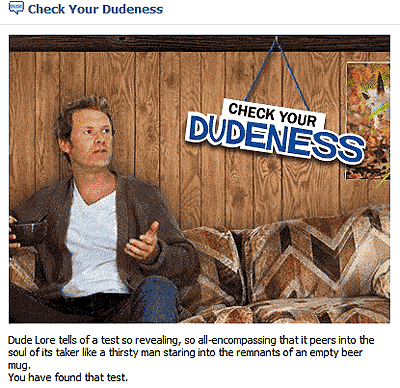
Want a good example?  Buddy Media created the Check your Dudeness app for Facebook-Couldn’t this be construed as some element of SMO? They’re taking a product, a branded one and using social media to promote it. Is that gaming the system? No.

We need to get away from the fact that what the system allows us to do, does not neccessarily mean that we are up to no good, or that we’re not being transparent enough. Ok I get it. I don’t need to be told over and over and over again to be transparent and authentic. Yes there is a difference between black hat seo and white hat seo as well as black hat smo, no doubt about it. Just check akismet for aspects of that. But.. most of your brand marketers are only using the tools that are available. I can show you at least 130 examples where companies used certain aspects of social media to promote or further their brand exposure using some of the above mentioned sites and tactics. This doesn’t mean that they are operating behind a cloak of deceit.

Listen, there is a big big difference between gaming the system and utilizing what is provided to promote your product, your brand, and your company. It truly boils down to how you use it. I’m all for engaging in conversations but someone has to start the conversation. The better you are at starting a conversation, the better your chances are of someone listening and responding back. Maybe we should be looking at not how to be transparent and authentic, but more on the proper way to enagage and start the conversation.

Is social media marketing guerrilla in nature?

When I wrote yesterdays post about the melding of guerrilla and social media marketing, I thought that perhaps that maybe I was a bit extreme in my analogy, but look at this diagram. Look at how they both share some of the same attibutes.