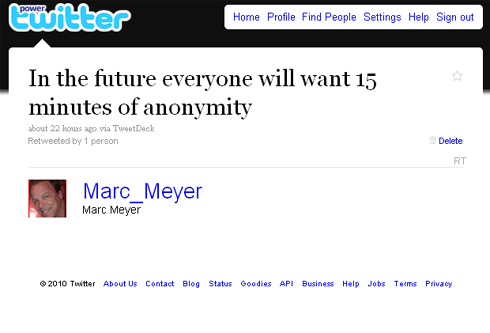
Social networks are redefining what a friend or a relationship really is

This is a post where I am right but so is Brian…

So yesterday I was talking via Twitter with Brian Dresher, the manager of  social media at USA Today. The discussion brought on by this tweet/thought:
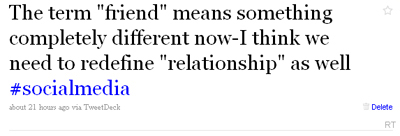
Brian followed that thought up with mentioning that “following” someone pre-Twitter meant something more akin to stalking than it did to something more related to complimentary. You got that right.

There was a bit more to the conversation but here’s the point that I want to get across- and I’m fairly certain that you would agree with me. If you don’t, that’s OK, these thoughts are my own.

Like it or not, Social networking is redefining terms of “social endearment.”

It’s forever changing the etymology of commonly used words; and I would say easily within a few years it will completely alter their understanding and perception as younger generations continue to evolve as digitals’  new natives.

Here are the prime and most glaring examples.

  • Friend-Means absolutely nothing anymore. All it means is that we have allowed the other into our networks, or vice-versa. Soon we will have to qualify what kind of friend you or they actually are.
  • Follow-At its core, to follow would mean to come or go after; proceed behind; go in a straight or obvious course. There is nothing in the social networking world that resembles that definition. But as it stands now, if I were to tell you that I follow him or her-there still might be a pregnant pause. That too will soon change.
  • Like-I don’t even know where to begin.
  • Relationship-the definition of the relation connecting or binding participants in a relationship would seem to closely align itself with today’s social networks. However, some now think that relationships can be built on the thinnest of determinants. Which lead to this next tweet from me:

It took Brian’s next tweet to add the proper context to all of this.

He’s right. I didn’t know Brian before all this social networking “stuff” started and now we have a casual business relationship because of it. It has become enhanced because of it. We have met and talked at a conference, and later this summer he is going to host a Social Media Tweetchat for us. Thanks to the power of social networks.

Is there a fallout to all of this? No not really. We’re just adding layers to the complexity that is online communication.  In order to get to or take a relationship to the next level, They’ll still have to be consummated at some point offline. Right? Maybe not? Maybe these new layers allow for less physical/face to face interactions?

Maybe not.

*I know there were a ton of other “social” words that don’t mean the same thing as they used to that I did not mention. I’ll leave that up to you guys. Anyone want to start a wiki?

The Value Myth of Social Media

I was reading the post 7 social media truths you can ignore this morning when I was struck by one of the last things mentioned in the post which said, Provide Value.

As soon as I saw that, I had to get this thought out.

Scene 1.

You’ve been dating your significant other for a few months now and have decided to end it. Why?

They’re not bringing enough value to the relationship. Of course that translates better into things like:

  • They were slobs
  • The snored
  • They couldn’t hold a job
  • They cheated

What does that look like in the online world of social media? I unfollow you on Twitter because all you do is tweet out links and you’re not giving me enough value in the relationship.

What did I expect? I’m not sure. A business relationship? Maybe.

I followed you based on what your bio said. Oh wait, I followed you because you followed me. Similar to picking someone up in a bar isn’t it? You looked hot, we didn’t really talk much, mainly because it was so loud and dark; but on the surface you looked promising. So I had no expectations in the first place.

Value or perceived value is so subjective and so hopeful isn’t it? It always is in the beginning.

Shouldn’t the value that we want or expect out of others be commensurate to what we are putting out there? I’m trying, shouldn’t you? Or is it one way, or one sided?

Scene 2.

If I’m on a basketball team and I bust my ass in practice and during games, I should expect that of my teammates right? What if they don’t? Should it bother me? Should I complain? Should I say something to someone? What if we still win? What if each component functioning on its own and in its own way contributes to the sum total of the parts?

Should I demand value from my teammates? If I don’t get it, do I quit? or do I focus on my own game and do what makes me who I am and let it go? Is that selfish? Is it up to me to tell them that they are not bringing enough value? What if that’s the best that they can do?

If I expect value from every relationship or scenario that involves other people and I don’t get it, what am I going to do? I can abide by that mantra in social media, or try to abide by it, but to honestly and genuinely expect it from every relationship that I engage in in social media, is going to render us all sorely disappointed. no two relationships are going to render the same results. That doesn’t mean that it has to suck. Or that you end it.  You can cultivate the good relationships. Just treat the rest of the relationships for what they are. Just people being people.

I am wont to say from time to time that the value you take in social media should be equal to the value that you make. I still believe that and I still tell others that. It’s a good cornerstone. But sometimes I think we focus too much on the Utopian way things need to be in social media instead of the way things just are or will be.

Is social media marketing too labor intensive?

I was looking at a list of clients that I had worked with over the past couple of years and it’s well over 40.  It’s not a big number, but what caught my eye was that I had created a matrix of what I had done specifically for each client.

More importantly what struck me was that as much as I had done, in the grand scheme of things, a lot was predicated on how much the company I was working with embraced what I was doing.

It’s easy to assume someone is not working when it seems something is not working…

Some of these companies embraced what I did and others did not, so the results were mixed. In some cases, I made mistakes, which made me better the next time I did it, but it also gave some individuals within these companies the notion that social media does not work. What they needed to say was that, “We needed to give it more time”.

Here’s what’s interesting.

“Doing” Social media can sometimes give you the impression or sense that you have done or accomplished a lot, but the reality is that as a channel, as a stand alone entity, it needs the support of a lot of other “things” in order to truly “work” and be most effective. And then, it works best if it’s in conjunction with all the other activities, marketing or otherwise within your organization or the organization you’re working with.

What do those activities look like? Here is a slight list of some of the activities that were done with my clients and that I do for clients.

  • Increase awareness of and interaction with a company’s brand through brand mentions and participation in social networks
  • Create a community for customers and fans
  • Create new business opportunities or leads through landing pages and targeted email campaigns supported by social media
  • Create listening posts
  • Monitor Buzz, mentions and opportunities
  • Instruct and show companies and clients how to use social networks to sell directly to consumers
  • Build and create databases
  • Increase traffic to websites through social bookmarking
  • Create and manage Facebook fan pages for products, communities and companies
  • Create microsites using social platform providers
  • Create and manage multiple blogs
  • Show and educate brands and companies how to use social networks and how to act on those social networks
  • Create and Post videos
  • Create widgets
  • Create customized social media landing pages to reflect brand
  • Did/Do a ton of research on clients, their partners and/or their vendors through their social media presence and engagement
  • Write  key word rich/tagged social content to optimize search
  • Engage brand champions to become consumers, creators and leaders within communities
  • Measure everything

So as you can see, it’s a lot, and it’s not even a complete list of all the things that I have done or that it can encompass.  Funny thing is, that social media can sometimes give you the sense or a business for that matter, as I said, that you’ve accomplished a lot more than you really have. Or at least that might be the false perception of the client. The actuality again, as has been said many times by myself and others, is that social media marketing and engagement is very labor intensive. You just have to look under the hood. How do you feel about that?

Social Media Marketing:Less of Big and more of Small

I jumped in on the weekly #brandchat discussion that was happening on Twitter yesterday to answer the following question:

What do small businesses need to be doing less of?

Great question. Here was my answer…

Less of Big and more of Small.

I got an “amen and a hallelujah for that tweet. What did I mean? Hold tight because I’m going to use a couple of baseball references again, but I will keep it short and simple.

The first is this. Did you know that baseball players get paid millions upon millions of dollars to fail seven out of ten times? That’s right. They generally have to hit the ball three times out of ten, and they are considered good at what they do. Why? Because it’s so damn hard to do.

We often overlook or I should say, most seem to think that implementing social media can be done by…

A monkey.

What ends up happening is that folks bail out after a month or so because talking to people, customers,  monitoring sites, creating consistent content, is hard and it’s labor intensive. You have to really work at it and be diligent. Sorta like hitting a baseball.

Not everyone can hit .300.

Funny thing is, baseball players who do hit the ball 3 out of 10 times, work very hard at it, constantly. Some are gifted and it comes naturally-the rest, which is most of them, have to work just to get near .300.

Same goes for creating and planning and implementing social media. It’s hard and not for the faint of heart. You have to believe and trust in yourself and your abilities to get it done.

But you know what? Being a singles hitter or maybe  someone who hits the occasional double in baseball  aint a bad thing. We all can’t be big hitters. Playing small ball is OK.

In the social media world, there are a lot of choices and sites and things that you can do so that you or your client can be seemingly everywhere. That’s really tough and can lead to some serious social media burnout.  But here’s a better idea. Quit trying to be a home run hitter. Play small ball. Be really good at hitting singles and the occasional double. Meaning? Be really good at blogging. Have a solid Twitter strategy. Be honest about what each piece of social engagement is going to bring back. In the baseball world that’s the equivalent of knowing you cannot hit a curveball. Know your limitations and be really good at what you can be really good at.

The payoff? A really long career and a happy client.

In Social Media, Value Is Perspective

Yesterday I was listening to ESPN Radio and Three-time World Series champion Curt Schilling was explaining some of the finer points of baseball, when he came up with the following nuggets of wisdom. They were so insightful for the world of baseball, but when I got to thinking of them more, they started to resonate into other areas. Check them out and tell me what you think.

  • Bad managers lose games by getting in the way.
  • Good managers manage people.
  • Evaluating talent is a crapshoot
  • Value is always perspective.

That last one stopped me in my tracks. Value. Value is perspective. He was talking about how GM’s have to look at talent from the perspective of what it means to the organization and how it can help them, regardless of a person’s age, salary or diminishing skills.

I naturally equated value to what we do in social media and thought that…

Not only is value perspective, it’s subjective as well.

In other words, The way you use social media might not be the way the others do “it”, or the way I might use it, but if it’s working for you and your organization, then who am I to tell you to stop? I can suggest some other things to compliment it, or tell you why it might not be a good idea to do this or that, but in the end if it ain’t broke-don’t fix it.

Value to your organization will be perspective.

Think about that.

The takeaway? You can define engagement through social media anyway you like- just as long as it’s working for you.

For you baseball peeps, here is the interview with Schilling

Children and Facebook-15 links to Help Parents Learn

This is where my head is at right now. I’m listening to the pushback from Facebook users and parents who are concerned about Privacy. I’m compiling an exhaustive list of blog posts and articles related to Facebook, children, and privacy and how it impacts all of us.

Stay tuned for the wiki. In the meantime, here are 15 links to posts that address the issues that dominate not only my thoughts and hopes to see something done about Facebook’s complete disdain for its users; but also what keeps parents up at night… Some of the links here are to not only open parents eyes to what they are forced to deal with right now, but also in “how” to deal with it. I hope it helps.

Facebook: Children evade social websites’ age limits

Social media create new bullying issues for schools; Collier forum set for Monday

Too young for social networking?

Facebook, states set bullying, predator safeguards

How can parents access their children Facebook account

What is Facebook Doing to Protect Children from Sexual Predators?

Facebook ‘fails to protect children’

How To Monitor Children On Facebook

Should you be Facebook friends with your children?

Facebook urged to add ‘panic button’ for children

Facebook May Share User Data With External Sites Automatically

The Big Game, Zuckerberg and Overplaying your Hand

NYU Students Start Privacy-Minded Social Media Site

Social Media Parenting: Raising the Digital Generation

Why Facebook Can’t Be Trusted

17 Tweetchats for Social Media, Marketing and PR folks

Yesterday I threw out a tweet about 125 twitter chats worth checking out on Google Docs. I thought I might condense it a bit and focus not only on Tweetchats that I was familiar with, but also those that would benefit the Social Media, Marketing and PR folks out there, and which also had solid participation as well. If I have left any out, please drop me a line and include it in the comments section.

1) Hashtagsocialmedia-#socialmedia Of course I’m partial to the one I co-founded with Jason Breed Advancing the Business of Social Media every Tues noon EST. New topics & new industry thought leaders and A-listers host the tweetchats. Great discussions. all archived and easily searchable

2)#4change is a monthly tweetchat on how social media is helping to create change

3) #b2bchat is a weekly conversation for B2B marketers; Thursdays 8 pm Eastern.

4) #Blogchat is a chat on Sunday nights from 8-9pm CT that was started by @MackCollier to discuss blogs and best practices.

5) #Brandchat is a discussion between experts, strategists, and those interested in learning more about personal branding and managing their personal brand.

6) #Hcsm The Health Care Communication & Social Media community hosts a weekly Twitter conversation about communication and marketing practices by Health Care organizations, including use of social media

7) #Innochat A Tweetchat on innovation

8. #Journchat Conversations between journalists, bloggers and public relations folks started by Sarah Evans

9) #Kaizenblog Discusses using kaizen in *business strategy* Started by Valeria Maltoni

10) #pr20chat PR 2.0 chat for conversations about PR related issues and SM implications, started by Beth Harte

11) #SEO411 Weekly chat to collaborate with colleagues and other marketers about their questions and ideas about SEO.

12) #SMCEDU Discussions about Social Media / Higher Education

13) #Socentchat A monthly discussion on social entrepreneurship, focusing on a particular topic or field each month, eg. Mobile Innovation; Fostering Soc Ent at universities; Support Women; eHealth; etc.

14) #Socpharm Weekly chat on pharmaceutical marketing and social media.

15) #Solopr Open discussions that serve as a companion to the SoloPRpro.com blog, designed for independent PR and MarCom pros – and those who’d like to be. Active hashtag throughout the week, with chats taking place on Wednesdays at 1 p.m. ET, Started and run by Kellye Crane

16) #TNL TNL is TalentNet Live. the #1 monthly hashtag chat for recruiters on Twitter that takes place the last Wednesday of each month at 9pm Eastern at #TNL. Login at RecruitingBlogs.com

17) #U30pro The chat that focuses on issues and trends surrounding young professionals.  All ages welcome and encouraged to join.

This weeks #Social Media Topic: Connecting With Consumers Through Social Media

Posted: May 3rd, 2010    By: Jason Breed

The title of this post pretty much sums it up.  So often we get caught up in frameworks and checklists and strategies and everyone is running around looking busy.  Meanwhile, back at the ranch where the real work happens, consumers are still being marketed online.  How could this be?

It is helpful sometimes to take a step back and take a look at what you are doing from the outside looking in.  Consider how your consumers view you online and where they view you.  You might begin to understand why your social programs are performing the way they are.  So many strategies stop at the tools so you end up with a blog or a Facebook page and the strategist goes home.  Inevitably the same marketer or communications person does what they know and starts blasting messages.    As a result, the consumers that you were trying to get closer to actually end up further away.  To translate this back into social media jargon, you end up with an audience of lurkers (assuming they stay that long) when you are attempting to get those consumers engaged.

Jake McKee 90-9-1.com

Jake Mckee’s infamous 90-9-1 pyramid comes to mind.  If you do not make it easy, fast and safe for consumers to engage you will end up with more than 90 percent lurkers trolling your content.  On the other hand, if you take the time to create baby steps of engagement like a simple “thumbs up/down”, share this, or even a one question “quick poll” your audience will begin to engage more.  This helps to establish trust as well.  With trust comes responsibility though.  If you allow members to digitally attack each other via comment threads, etc then you will end up with the same 4 people running your site like street dogs marking their territory on trees.  Curating community content to keep it safe will go a long ways for members to want to contribute and connect with greater frequency.

Once they are connecting with higher frequency, what’s your plan then?  What messages do you want those consumers sharing?  Your consumers have 2 experiences with every interaction they have with you.  Those 2 experiences are perception and reality.   If you ask for suggestions, get them and never respond or even acknowledge them, the consumer’s perception is that you really don’t care.  All of these experiences get crafted into a story that is told and re-told online, at dinner parties, at the gym and anywhere else someone brings up your store, brand or product.

If consumers are your storytellers, then shouldn’t you have a plan to help shape that story every chance you get?  Two main themes are emerging: 1) enable consumers to connect with you more frequently and 2) have a plan in place to help mold their story about you once you do connect.  Sound straightforward?  If it does then you have never had to a) manage a community first hand, b) never been responsible for results or c) all of the above.

By design, our moderator has a lot of experience doing both.  Kyle Lacy is the head of Brandswag and a highly sought after social media practioner for businesses.  Kyle will lead a discussion around how to better connect with consumers by converting more passive consumers into active consumers of your brand and what to do once they become active.  This discussion will follow our weekly Tuesday event schedule taking place 5/4 at noon Eastern.    The topic and questions will be:

Topic: Connecting With Consumers Through Social Media

Q1) What are ways to move customers up the interactive chain from lurker to influencer?

Q2) What’s the value of storytelling vs. messaging?

Q3) How can you get customers to take action on your behalf and tell the story for you?

The event will begin with Q1 at noon eastern followed every 20 minutes with the next questions.  To follow along and add your POV simply track #sm58 via any Twitter client or follow along via our LIVE page.

Posted via web from marcmeyer’s posterous