TechCrunch50, Forrester and 8 other sites that require your attention

You know, it’s amazing how life just throws you softballs, curveballs, fastballs, whiffleballs and screwballs. It’s all in how you take the pitch. Do you hit it? Or wait for your pitch?  With that being said, lets look at some sites and posts that might require your attention over the weekend.

The TechCrunch50 just concluded and there were a couple of entries that really stood out to me. I thought that Steve Spalding brought up some good points in his Techcrunch50 recap in regards to why some of the entries may or may not make it and I have to agree with him on icharts Icharts has a crappy tagline but a great premise. Make better charts, make them seo friendly and searchable and interactive. Things that I would love to do for some of the lame charts I create. Maybe they’d kick me a free trial so I can review it?

I’d highly recommend fitbit too. since we’re all obsessed with losing weight, gaining muscle etc etc. Fitbit is a device and website that makes you aware of how active you are and what you eat. Go figure, a site and product with a way to make actual money!

My other favorite was Goodguide, it has a great idea and is so dead on right now. I think it’s only hurdle might be widespread adoption.  Goodguide provides free and easy access to the world’s largest and most reliable source of information on the health, environmental and social impacts of products and companies.

Of course be sure to check out this years winner Yammer, which is essentially enterprise level Twitter. Yammer had a ton of action as soon as it was released publicly. They too have a business model as well, but it can be used freely.

Be sure to read Carter Lusher’s post When hype can go overboard and hurt credibility  he mentions some Analyst ‘hype-alert’ verbiage  to be on the look out for.

Joseph Jaffe adds more than just his 2 cents on his blog post about Why the term “Agency of the Future” is an oxymoron (you can choose if you’re the ox or moron) Its a definite keeper.

When you get a chance, test drive this site SpinVox and tell me what you think.

I’ve been participating remotely to events all week and have to say that the access to all them has been awsome they are: IzeafestThe Techcrunch50,  and the T3PR confeerence to a certain degree. I think it’s important that though you may not be able to be there physically, you can still interact via, Twitter, Summize and the live web casts. I’d highly suggest you check your calendars.

Lastly,  Forrester, has pushed out it’s submissions for Groundswell awards, check out some of the companies up for awards, it might help you hone in on your OWN social media strategy. Imitation is the best form of flattery!

Are you ready to become a social media “doer”?

I was reading Joseph Jaffe’s latest post on the Agency of the future in which one of his points was that brand marketers are wanting someone or a company with more experience and knowledge in regards to the digital space.

It struck me that the majority of brand marketers are currently searching for someone who gets it. Or at least for someone who get’s it, until they get it.  Which makes me wonder how many of us out there right now, could take a company where they want to go? Sure we all have an idea, or maybe a clue, at least I hope you do, but how many of you could map out a plan, that works? I’m guessing not as many, which leads me to my main question of how many of you are willing to take the lead instead of languishing in the echo chamber?

 With that being said, here are 5 questions you need to ask yourself:

  • Are you a social media “me too” person?
  • Could you sit down today and map out a social media plan that could garner results either for yourself or a company?
  • What are you doing to become a social media doer or leader?
  • How long are you going to sit on the sidelines?
  • Have you really tried?

Once you answer these questions, see where you’re coming up short and do something about it. You can only read and write about it so much. A great resource for “how to’s” if you need it, is Chris Brogan   But most of all, practice what you preach! Get out of the fishbowl and go do it dammit!

You can’t “do” blogs half fast!

I was reading Paul Chaney’s blog post on Social Media Today this morning in which he thinks that there is a serious reduction on the number of comments flowing into blogs and he’s right. the quality is going down as well as the quantity. Part of the reason is that we now have more ways to access the writers of blog posts. Namely through Twitter, Plurk, Pownce et al.  I basically told Paul “thats great that we can do that, but now our conversations are somewhat muted and shorter”.

Does that mean that blogging is dead or dying? That we need a lesson in blogger ethics? No.

But as I thought about this more and looked at some of my posts and my comments on other blogs. I make a concerted effort to engage others. I’m not sure what the requisite amount of replies or back and forths are required between writer and reader, but I personally think that there is an expected return on the comment expected. Maybe. A requisite expectation if you will. But what I’m starting to see is smuggness and a “I started it, contributed some, and thats sufficient, attitude” starting to permeate some really good blogs. I’m also seeing really nice blogs, with some decent content, and some history, tailing off with posts, and an otherwise obvious downtick in effort.

What this tells me is that, perhaps that blog strategy or the author, have gone in another direction. What this tells me is that you can’t finish what you started. It tells me you are not practicing what you preach. It tells me that if you are a PR or a marketing person, no way in hell am i going to work with you. You started the race and you can’t finish it. You built the frame but you can’t put up the walls, the roof and anything else. You’ve done a half fast job and it shows.

Or maybe just maybe, Twitter is now cutting into our desire to comment?

Or… You’ve written a good blog post but you can’t comment or respond to the people who have made the effort and done the same to your post. I know you can comment via email, or Twitter, and maybe you have, but if we’re to extend the conversations beyond a micro-blogging platform and bring them back to blogs, we need to see that you have a vested interest in your blog post and you’re not posting just for attention or link juice, or extending the conversation privately.

The bottom line is you started it, now finish it with transparency and efficacy. We’re still watching we’re still reading.

Post Conversation-What do we do now?

Once you get beyond the conversation, what’s there?  For each aspect or rather in each of it’s iterations, there will always be a result or an action. Conversations, regardless of the network they are swimming in, have to have some causal net result. If not, then it’s one big dinner party or bar, where the conversations have no substance, and we all go home and wake up in the morninh with a headache and ask what happened.

There is a great discussion about this exact subject going on in a few places that I would encourage you to visit. Over at Valeria Maltoni’s site the conversation agent, Valeria has always maintained that it was always about the outcomes of the conversation. And she cites numerous sources that in one way or another support this premise. I couldn’t agree more. You have to do something with the conversations that you have participated in. There has to be an outcome. Unless of course, you converse just to hear yourself speak.

But see, the difference is that in this Web 2.0 age, our conversations take on many different forms. We reach out to have these conversations in many forms and in each form, the effort on our part is the push and we want the pull from the other party. But the conversations may have a tinge of self aggrandizement unfortunately, and that’s where we might be missing the point. I think that these days people are realizing that some of the conversations may be disingenous. It’s the dirty little secret of the social-ness of what we are all participating in. Its the nature of the fluidness of social. It’s way too easy to start the conversation and it’s way too easy to manipulate the conversation in your favor. But most of us are hip to that and I think it eventually  sorts itself out. We’re able to police that part fortunately.

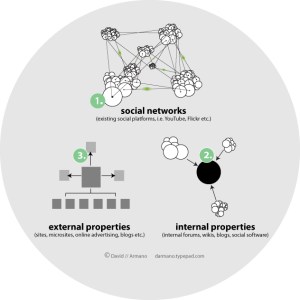
What happens next in each aspect is covered as well by David Armano  with another one of his wonderful graphic representations in which David essentially asks… We’ve identified all the different mechanisms and networks and tools to bring forth the dialogue and raise the level of everyone’s voice beyond the tinge of a whisper so, “What next?”.

You see in each “property” in the above graphic, conversations are and have been taking place. But what comes of them? Here is a quick example. Do we blog because we want to hear and read what we speak and write about respectively? No, we do it because we essentially want to talk and we want to be heard, and we want to engage others in a dialogue. Problem is, and I’ve noticed that perhaps this one tiny aspect is often overlooked- in order to be heard and in order to converse on or in a blog platform, it does not happen immediately. It takes work, and it takes effort, and I think to a large degree, most people underestimate that. Thus they abandon the endeavor. Do we need to make it even easier to be heard and engage others? Is it still to intimidating and difficult to join in the conversation?

The outcomes of conversations in each of David’s properties all predicated on various barriers of entry. Some not as great as others, but each still requires some effort in order to be heard. Do people want to work at their conversations? I don’t think so, but in each example, conversations and the endeavor of enagaging in them is not a passive activity. never has been, unless you like to lurk.

Another aspect often overlooked in the online social world, is that there is still the aspect of engagement. Type “A”‘s might still have an easier time of engagement than type “B”s. We still have to look at easing the transitions for N00bs. Once they are engaged in the conversation, they may be ok. But then we all come back around to the beginning. And we ask ourselves, “Now what?” “What comes of this?”

Seth Godin started an invite only social network called triiibes that was tailored to his forthcoming book. There are roughly 3000 people in this network and conversations abound. The problem is, I have to think, and do, that all the people in the network are in the “take” mode. A network where everyone is looking for, according to Steve Bridger’s comments to David, “what’s in it for me” can’t be very productive, or maybe it is? Conversations have to be equally 2 way, if not, they’re not called conversations, they’re called monologues. They have to have something more to them in each web 2.0 scenario. That’s what Valeria and David are getting at. We have all these tools, so now what? What do we do with all the various ways that we now have to communicate with each other. Perhaps a Conversation Manifesto is in order?

Social media marketing’s 7 deadly sins

With apologies to all of the spiritualists out there, this post is not to make fun of the “real” 7 deadly sins. This is simply a way to magnify the importance of getting it right versus screwing it up seven times over. Over the last few days Peter Kim and I have exchanged emails over topics that swirl in and around social media marketing, and somehow this blog post evolved. I am not sure how it came up exactly, but then again, thats how a lot of these posts start. But the subject of this post seems to dovetail nicely into what is being discussed lately, especially on SMT.

So there’s a lot being discussed every day about social media marketing, what works, what doesn’t, why, how, when, etc etc. In the past I’ve written lengthy pieces on what social media isn’t, but how about 7 things that you better not do in social media marketing? That in and of itself would be something to throw up on the fridge with a  fridge magnet right?

1) In your push to increase customer loyalty and retention, you’ve driven your customers away with poor messaging, poor communication and complete disdain and compassion for them and the product they love. You’re Insincere and it shows. You nod your head and pretend to listen, but you decide that you know what’s best. That’s a bad choice.

2) In your zeal to hit the ground running with your product, you have failed to realize that the product has serious deficiencies and you choose to launch anyway. It could be that your product is either being hurt by the initial buzz of bad publicity, has been hurt or bashed by 3rd parties,  or the word on the street is, it just doesn’t work. Your product awareness campaign has only increased the awareness of how bad the product might actually be. Why? You were not listening and your timing could not be worse.

3) Because of #2, in your quest to create brand advocates you have created the anti-brand champions who have made it their goal in life to do everything in their power to make sure that your brand does not succeed. You made enemies and you continue to not listen and you decide to push on without addressing it. Could it have been, that you might not be listening or refusing to even try?

4) In pushing to roll out your social media marketing plan, you miss the mark completely and are marketing to the wrong people. In fact these people may have had their fill of social media marketers, social networks, and are essentially hip to the overtures of marketers in general. So again, in your rush to create new revenue streams, you’ve decided to beat a dead horse. Not knowing your customer and assuming you did. Bad. Guess what? You again must not have been listening.

Are you sensing the recurring theme here yet?

5) You decide to do it your way. You think your one way style of contacting and talking at the customer using the latest social media tools should work just fine in its own intrusive way. You sir or madam are not respecting the rules of engagement. You have lost your protocal compass. You have decided that frequency is better than reach and breadth is better than depth. You have not heard a thing that has been said.

6) You’ve decided that you need to hide behind a few layers. You don’t want the customer to know anything about you, the company, the realness of the people behind the product. Nothing. You have decided that a fake persona is the best route to driving sales and stickiness. Wrong. If you’re not being transparent, then you’re not being you. You have something to hide. One of the most important aspects of social media marketing it being transparent, or had you not heard that yet?

7) You’re not honest, you’re not who you say you are. This speaks as much to #6 as it does all of the rest.  But one of the keys to any relationship be it personal, or business is honesty. Just look at the code of ethics on the WOMMA They get it, and so should you. It may sound trite but keeping it real has never meant more than in social media marketing.  Oh yea, you might want to shut up and listen too!

I’m sure that there are tons of social media marketing faux paus’s that we can all think of it. In fact Jim Tobin over at Ignite Social Media has a nice post about it. The aformentioned 7 are just some that have really been standing out for me lately. And to be honest, I have made some of these, but I have also learned from these mistakes as well too, and have tried like hell to not repeat them.  Who was it that once said, “Those who cannot remember the past are destined to repeat it?” Last question, with the 7 points mentioned above, can you figure out what collective quality might benefit you the most?

7 sites to visit today.


I’m going to make it easy on you. Here are 7 things that were interesting to me and maybe you should read them in your spare time today or tomorrow.

Chris Kieff says that Seth Godin screwed up, I know it’s shocking isn’t it?

Adam Cohen thinks that there is a danger of communities becoming too diluted I think what he means is that social networks are becoming too water downed, too many choices perhaps? You decide.

Kami Huyse espouses that a course in basic human etiquette might be better than one in blogger relations, which I think we could all use since manners and etiquette have gone away quicker than you can text BRB.

Discover the real you here at Signal Patterns

Rohit Bhargava, freshly back from China, posts on an Insiders guide to marketing on Flickr, in detail.

Brian Solis with the second part of his three part series the socialization of your personal brand

Here is a rockin post by Geoff Livingston that you have to read, titled The Naturals

Social Media Visualization Part III:10 Wordles of your peers, do they fit?

In deference to Hermann Rorschach, I give you 10 Wordles from some of the more popular or notable people in the social media, marketing, and internet space that we swim in.  Interestingly enough, what makes them unique, is what makes them different, yet similar. Lets check them out and come up with a few words that might describe each of their blogs.

For the uninitiated, Wordle is a toy for generating “word clouds” from text that you provide. The clouds give greater prominence to words that appear more frequently in the source text.

Our first Wordle belongs to Jeremiah Owyang, the notable Forrester analyst:

What sticks out? Content, brands, social, personal, chanel, community and Youtube. All of which, in one way or the other, speak to what he writes about on a day to day basis. The one that is the real head scratcher is Ronald. Jeremiah?


Next up is Toby Bloomberg’s wonderful blog, Diva marketing Blog

I’m going to go out on a limb here and say that Toby is all about blogging, blogger relations, business strategy, marketing and social media. Your thoughts?  How did I do?

Next up is Todd Defren’s  Why is the McCain reference so prominent?  Todd’s wordle appears to look like it’s been tagged by some of Boston’s best graffiti artists. But PR does jump out of the mix, thank goodness.

Well, lets bring in Chris Brogan, the very prolific, as of late, Chris Brogan

Actually Chris’s wordle is very much like him as of late, all over the place. Lots of words. I mean lots. but Speech and Post certainly reveal what Chris is all about-in a good way of course. But so does email?

With that being said, Lets look at the wordle of Brian Solis

As you can see, the word information was cut off, but was essentially alone at the bottom. I find that odd for someone  with this type of blogsite. As if there is some sort of disconnect between PR and the conversation and information? The wordle does reveal the things that Brian blogs about, are dead on with his passion. PR and social media.

Did someone mention Hugh Macleod?

Given the nature and style of Hugh’s blog, its interesting and appropriate to see the word prominence falling on…of all things, people!  But companies and organizations fall in behind the term along with thought and know.

The next few people are certainly people we all know about, so lets see how their wordles compare. The first being David Armano’s Check out how prominent Twitter is, and like people, as well as media, talking, social and brand.


Next is Shel Israel’s  Whic speaks to everything that Shel is about. Very representative.

Speaking of representative, check out Scoble’s.

And lastly here is mine: Social, media, conversation, value and people all figure prominently.

Are we all too predictable? Or do we all just stick to what we know?

Social Networks: The path you take is equal to the effort you make!

So for shits and giggles the other day, I decided to do a search in LinkedIn for people with my name Marc Meyer. I think I found 13. I thought,  in their infinite wisdom, that maybe they would appreciate linking to me. There was a teacher, a sales rep, another techy person, someone in real estate, and a fireman to name a few. I only got 2 people who agreed to do it, probabaly because they either a) got a little freaked out and thought it was a glitch in the LI system or b) don’t use LI that much or c) were worried about ID theft? d) did not appreciate the irony of linking to themselves…

Marc Meyer is now linked to Marc Meyer.

Odd to think that there are lots of “us” running around out there. But this thought led me to Google where I subsequently “Googled” my name and did a couple of searches on Reunion.com and PeopleFinders and came to find out that there are about 46 of my likenamed brethren running around.  Before you say anything else, I guarantee that YOU have “Googled” yourself at least once. In fact, I am willing to bet that some of you have RSS feeds set up to notify you when your name is mentioned somewhere. Relax, it’s no big deal. I’ve done the former but not the latter.

 Back to my point on why this is relevant?

I’ll tell you why. I have spoken on numerous occasions and in numerous blog posts and to numerous clients about what will happen in the social media space in the future. I have said that what you will see is the “nichefication” of the space. Where large social networks will splinter off into smaller distinct groups. It’s already happening, in fact if you look at the current number of networking groups within the social networking site of LinkedIn, you will see that there are currently roughly 24,000  distinct groups and counting! Thats smaller social networking groups within the environs of the larger ones.

What does this have to do with me and my 46 counterparts?

Well in theory, we all have something in common, in this case, my name. So in theory, it might be worth it to network with people who have my exact name. Maybe not, since I haven’t really thought through the whole identity theft thing. But what could a social networking group consisting of 46 people with the same exact name do? Maybe not much, but they do have something very in common and that is essentially how people are now coming together today, as we speak, in these groups. They find a common thread or link and they build upon it. Through these connections, things happen. Conversations are started and relationships occur. As I have said in the past, we all want to run with our pack, our brood, our peeps. There is a comfort level that is there with people of like minds and backgrounds, so what is more common a starting point than your name?

So do I contact the 46 Marc Meyer’s? Maybe not, since the undertaking, the leadership and the roll out of something like that would fall on my shoulders. Perhaps I could start something on NIng and see where it might end up. But the bottom line is this, and this is what you need to be thinking about going forward: You need or rather you should try and find the group that best fits you and what defines you rather than settling for the stadiums or oceans that are the current state of social networks.

So do you want to run with your own/ or be a part of this large melange of different kingdoms, phylums, classes, genus’s and species?

Or this?


And in the end
The love you take
Is equal to the love you make.

I had to rework the quote “In the end the love you take is equal to the love you make”  which is essentially the Beatles closing statement. It is the last lyric on the last album they recorded. Let It Be.  Though it is certainly not the last line or epitaph for social networks and all that they have to offer, it can certainly define the future for Social Networks. So yes, “and in the end, the path you take, is equal to the effort you make.” Now more than ever, you determine you.

Listening and social media: 5 videos that drive the point home

Humility is the defining characteristic of an unpretentious and modest person, someone who does not think that he or she is better or more important than others.

We talk so much about the art of the conversation and how this new age has spurred countless conversations where we are able to share with each other and grow and nourish ideas that could one day create endless possibilities for everyone. But what happens if the conversations are one sided? How many of the conversations out there are taking place between one willing participant and someone who is in it, to win it, so to speak, no pun intended? Are you listening? Or is conversation a dying art?

Here’s an example: Forrester Research Vice President Josh Bernoff highlights one of the five primary objectives companies successfully pursue in the Groundswell: Listening. In this example, a group of twenty-one dedicated cancer centers formed the National Comprehensive Cancer Network (NCCN) to better listen to patient needs. October 11, 2007 in Chicago.


WHY DO WE TWEET

How many conversations take place today or are originated for the purpose of self-aggrandizement? I think more than we will ever know?  Do you think some of our finest web 2.0 thinkers are twittering for the sake of engaging in worthwhile conversations? Are they tweeting for branding purposes? How many of you comment on people’s blog or tweet, but yet bring nothing of intrinsic value to the actual conversation? How many of you don’t care if someone responds or not? Don’t all stand up at once either. Here is twitter explained for all you common folk out there, thanks Common Craft


I think we have an inate desire to be heard as well as to be seen and this truly does speak to this generation that I’m calling Generation U for “Generation User” as in generated content. But see, we want to be seen and heard, but rarely do we want to listen, when in actuality, that’s truly where the conversation begins and possibilities are created. Do you spend most of your time listening and reading, or do you create lots of content and vomit the information of whoever and whomever? Do you listen with the intent to understand?


So if that truly is the case, do we, or some of our more active purveyours of user generated content, even care about what others might think? Do they even ask what we think? If they did, I would expect the conversations to consist of them choosing to hear what they wanted to hear. God forbid it’s constructive criticism.

Ironically, Chris Brogan has written a post called 100 Personal Branding Tactics Using Social Media in which the first thing he leads off with is… Listening That’s right listening. And not a year prior he wrote solely on the subject of…Listening

I’m sure if you were to ask some of the top social media experts, and I know of about 30 or so, I would imagine that they would collectively say it is more important to listen than it is to talk. How many would understand the importance of listening with humility though? To listen, to truly listen? The disconnect happens when two parties get together and both have these agendas, which they seem to be paying more attention to then the actual conversation itself.

I want the age of conversation to be about what we can do collectively instead of what’s in it for me. The hyper link that preceded that statement, those guys get it. And most do, but I want you, all of you, to start listening, instead of hearing, what someone has to say.

THE MORE YOU KNOW, THE MORE YOU REALIZE WHAT YOU DON’T KNOW

So if you think about, look around and look at what everyone is talking about, it’s the conversation, it’s the word of mouth marketing buzz. We talk about it from the one side but not the other, the listening aspect. The art of listening.

We have more tools than we have ever had that help us with the conversation but we need to really start listening with humility, with a deep understanding of what the person or person’s across from us, is saying. All of these social media tools allow us more access than we have ever had in our lives, to conversations. A way for us to listen and to understand. Lastly, Look what Todd Defren has to say, it’s a quick blurb, so make sure you listen!. By the way, I told Todd I would add him to my new updated list of social media experts coming out soon.


So what sayeth you? I’m listening. Do people hear what you are talking about? Are you talking over their heads? Or vice versa? How can you improve the dialogue?