The Ubiquity of Social Media


Through the course of  11,000 plus tweets, 2  years of using Twitter, as well as creating, hosting, and participating in some very high level Twitter chats around the business of social media, I have oftentimes been struck with moments of absolute, 140 character clarity when it comes to all things social media.

Luckily I have been able to document those moments with the help of Twitter archives and compile them into a manifesto of sorts that hopefully helps the reader think more about the “why it sucks”, the “how” and the “wtf for”, of this maddening space.

The clarity, the thoughts and opinions are mine. You may not agree with them and that’s OK. They are meant to be talked about and discussed as much as they are to be challenged and disagreed with. They are talking points.


Share this Post

November 10th #Socialmedia topic-Social Media’s Impact on Business and ROI

Social Media’s Impact on Business (and ROI)

gas_powered_blender

Feeling like stirring the pot a bit this week so we thought a discussion on ROI should do it.

ROI certainly can stir the pot.  But, saying that most of everyone’s conversations on this topic are not actually ROI, rather Impact on Business (IOB), takes the act of stirring and turns it into a blender.  Ahh, much better!

So let’s start by saying that just because it’s “social” does not mean it should be held up to standards typically defined by financial returns whether in business, government or non-profits.  Someone can start a blog or join twitter simply to better understand the tools or to connect with associates they just met at a conference.  This becomes truly social and may at some point have an impact on your business whether financially or some other measure but does not need to be tied into sales goals just because an employee wants to post office pictures so other offices can see how they decorated for the holiday party.  That’s a beginners first step into social computing but not what we are interested for this discussion.

What we are looking for here is to better define and understand what we sometimes mean when we refer to ROI as a verb instead of referring to ROI as a financial metric.  The real definition of Return on Investment (ROI) is: gain from investment minus cost of investment, then divided by cost of investment.  Business books are written, classes are taught, and undergrad studies are derived from this very straightforward metric.  When I talk about ROI, I try to dumb it down a bit into either: 1) increase revenues, 2) decrease costs, or 3) increase in shareholder value and that assumes a financial investment of course.  So why then, does the term ROI get thrown around so much in the context of social media when no financial gain or costs saved are referenced?

Impact on Business (IOB) is the actual term that should be used when discussing things like: # of followers, brand awareness, mentions, impact, conversations and what ever else you can think of that is not related to a financial calculation.  The impact of an employee being nice on twitter is great.  The fact that the customer decides to continue service (Retention) as an indirect effect does not make the time that employee spent on Twitter an actual case for ROI.  It is however, IOB. Olivier Blanchard actually was the first that I know of to begin this discussion a few months ago here.  Companies all over are using social media to have an impact on their business like Kodak measuring Smiles or any company promoting their Facebook fan page.

Many industries discuss IOB like fast food, IT, or big box retailing and it affects every company’s business in some way or another.   You can even consider different departments of a company and the impact of HR, Payroll, PR, Sustainability, Operations play in a company.  Although often not connected directly to revenue, a company would have a difficult time without those departments.  Impact is easier to measure if you don’t have to tie it back somehow to ROI and ROI is much easier to measure if you don’t try to include calculations of impact.  To lead our discussion this week is Jacob Morgan, a principal at Chess Media Group, who focuses on Social Media ROI.  Jacob is well versed in this type of discussion and brings a lot of expertise to the table.  The questions will attempt to progress the discussion from ROI as a catch all phrase to the differences between Impact and ROI for businesses and how to align them.  They are:

1.  Whether Impact or ROI, what “Investments” could be measured to prove out value in Social Media?

2.   How can you prove value from Impact or ROI to executives to continue or try Social Media?

3.  What are some examples of businesses attaining true ROI from Social Media?

Plan on joining in this discussion Tuesday 11/10 at noon EST.  To join either follow #sm33 on Twitter or follow our LIVE site.


Posted via web from marcmeyer’s posterous

Talent is Everywhere On the Social Web

I met Sue Spaight through Twitter. She’s one of the smart one’s but she won’t tell you that. But what she will do is call bullshit on you if she has to. She’ll force the one’s who are smart, to think about another box and not just the one they’re currently thinking outside of.

I had the pleasure to meet Sue a few months ago and even though our conversations were too quick, I was glad to see that she was just as genuine in person as was her written word.

For that reason, another really smart and genuine mutual friend of ours,  Tom Martin of  Zehnder out of my home town of New Orleans, turned me onto Sues’  “Realist Guide to Successful Social Strategy”.  After viewing it I asked if I might embed it. Sue gave me permission to share it and I think it’s worth sharing.

Is the social web the answer to our ailing economy?

I’m going to guess that for a majority of the people out there, the answers that they seek are not in social media. Nor is social media the answer for a lot of businesses that have fallen on hard times. But damned if they are not looking.

They lift up the hood and they see this

social-media-logos

Yet the number of searches going on for the term “social media” per month hover close to half a million. So for most, when they get those search results, and try to make heads or tails of them, it looks like this:

wires

Yet people are wanting to know what it is and how they can make it work for their business. They’re searching for the answer. And the answers they find come from people who have never done it.

They are social media virgins

What social media has done for a lot of small businesses and large ones as well, is it has provided hope at a time when there is not a whole lot of good news to hang your hat on these days.

Hope is not a bad thing because it’s closely aligned with dreams, and right now for a lot of people, that’s all they can bank on. It’s why they wake up every day. Except hoping social media is going to change your business, it’s culture, and the people using it, and ultimately save it, is crazy. You’re looking for a quick fix and sadly, social media is not a quick fix. That doesn’t mean however, that it doesn’t work, because it does.

But there are people out there claiming that they can make social media work for your company and save your company quickly. Be wary. be very wary.

Social media is not the solution to what is ailing you. In fact, there is a strong likelihood that what is ailing you, is completely out of your control. But you are looking for ways to break out, to try something, anything that will turn the tide in your favor. So you’re looking at social media, looking at it hard.

The ripple effect of a bad economy if you will, causes you to look at everything in a different light. Including social media.

Yes, Social media is transformational, it just doesn’t happen over night. I wish it did, but it doesn’t. Chances are, the more you can wrap your arms around what social media can’t do and what it’s not, the better off you will be.


The Depth of Your Social Media Growth

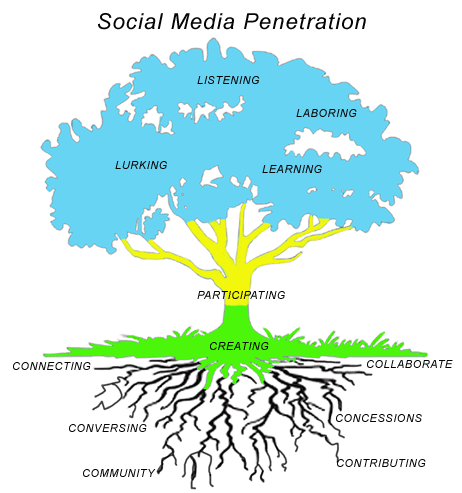
If you were to look at the following image, what would you say the expanse of your social media exposure, involvement or engagement would be?

smpresence

Let’s assume that  we all start off as seedlings in social media, and as we learn more, we grow. As the tree grows, so does our comfort level. Eventually we branch out and we all go in different directions, yet we all come from the same seed. We all have the same background and the same foundation.

It should all start with listening, learning, lurking and laboring. Lurking? Yes, lurking. Call it passive participation, but we all have done it. We watch the conversations, wondering where we can insert ourselves into them. If we don’t we lurk, we hover if you will.

Laboring? Even passive participation takes work. It takes effort and you have to put forth effort.

As we progress and grow, we become more comfortable in our need and desire and ability to contribute to the conversations around us. It’s a natural progression. But to make the leap to creating content is a bit more longer and takes a little bit more growth.

On the surface and by the looks of the tree, it almost seems that we all should or could be part of the yellow on this tree. However even those that are most comfortable with social media right now are not part of the yellow.Yet the desired or expected outcome from participation and creation lies in the blue areas of the tree.

Yett if we look at Forrester’s Social Technographics results, surveys show that when it comes to social content 21% of online US consumers are Creators, 37% are Critics (those who react to content created by others), and 69% are Spectators, meaning that the majority of people in Forrester’s survey would find themselves more at the root level of the social media tree.

Look at Jake Mckee’s model. The 90-9-1 Principle where 90% of users are the “audience”, or lurkers. These people tend to read or observe, but don’t actively contribute.

9% of users are “editors”, sometimes modifying content or adding to an existing thread, but rarely create content from scratch. and 1% of users are “creators”, driving large amounts of the social group’s activity and  driving a vast percentage of the site’s new content, threads, and activity.

If we look at it from that standpoint then the tree will be inverted, where it’s all about how “rooted” you are and how deep your social media penetration is. The deeper, more involved you are, the more rich the experience is.

smpresence2

So which version of the tree are you? Where do you see yourself? Should the tree be a 100 year oak or a common weed?

He Said/She Said on the Social Web

argue

You know how movie pitches go? Boy meets girl, girl falls for boy, girl meets another boy, boy leaves, they fight, etc. etc…These movies usually have someone like Jennifer Aniston and Tom Hanks in them or someone like that right?

Well I have another similar story for you. It happened last week. It’s a little better, a little different, it’s quick, and has a good moral in it to boot!

It goes like this.

Mom and infant son go to airport, Mom and son go through security, Mom freaks and claims TSA agents separate her and son, Mom blogs about it in excruciating detail, story goes viral, community up in arms.

Except that… the plot thickens

Apparently, that same day, that’s right- the same day, that the Mom writes her post, the TSA fires back…On their own blog no less, and refutes EVERYTHING that is said. Essentially saying that none of what she had written was true. Not only do they refute it, they have 9 cameras to prove it. Not good for Mom, no matter what might have happened. Video has a way of revealing stuff.

So what are to you to learn from this?

From the woman’s perspective:

1) Don’t ever underestimate the power of what you produce, what you write, where you write it, who it’s about, and its viral capability. Be prepared to get hit from all sides once you hit publish.

2) When it involves social media, don’t ever sell something as the truth when it’s not. Especially when there are others who can call bullshit on it. That is blood in the water. Again, be prepared to get hit from all sides.

3) Your credibility and your reputation and your name are all you have online, make better decisions. The erase button hasn’t really been perfected yet for content that shows up in search.

4) If you make a mistake on the social web, don’t run away from it. Take it head on and then move on. It’s all you can really do. Time to repair the damage, don’t make it worse. Remember, we are the county of second and third chances!

5) Don’t ever, and I mean EVER assume that the stuff/content that you create is not being seen, read or consumed by someone, somewhere. That would be your biggest mistake and the one mistake that could ultimately take you down when you decide to push out something wrong, inflammatory or defamatory.

From the TSA’s standpoint, this was a great exercise in crisis management, customer service and PR. Why?

1) They immediately investigated the claim, they didn’t wait 24 or 48 hours.

2) They didn’t wait to respond. They tried to reach out to the woman with the complaint, that same day. And not only that, it wasn’t just an admin calling her, it was the TSA’s Atlanta Federal Security Director and the TSA blog team. They took it very very seriously.

3) They started to do their homework immediately. After doing so and finding some major discrepancies, they realized that if they did not respond in a timely fashion, their reputation, already tenuous at best, would be worse. They moved swiftly. As well, they should have. Why wait?

4) Their swift response comprised following up with THEIR OWN blog post (fire with fire),  and also posting video elements from 9 cameras backing up their claim that they DID NOT do what the woman claimed that they had done.

Conclusions and the moral of the story

Now I’m not going to get into a pissing match here of what actually happened between the woman and the TSA. And I’m not going to declare a winner either since the reality is that there are no winners here. My point is simply that we have 2 instances of where 2 parties used social media to bolster their case. Both sides had detractors and supporters. Both took their cases to the social web and let public opinion and sentiment decide who was right or who won. Not the best usage, but what would have you done differently?

However, the bigger picture here and the moral of the story is the valuable lesson(s) that bubbled up from this on both sides. These include:

  • How to properly deal with crisis using the social web
  • Reputation management using the social web
  • PR using the social web
  • Customer service
  • Full on transparency in a very public setting using social media as a primary means of communication.

Lessons abound people. Let’s learn from this stuff. Here’s the link to the original blog post TSA agents took my son

Here’s the TSA’s response

On thought leadership

Yesterday Peter Kim tweeted the following:

140 characters are for passing thoughts, not thought leadership.

On Monday, Beth Harte and I spent a solid 15 to 20 minutes on Google chat talking about leadership in social media and the best way to push the thinking further. The reasons why were myriad, but the gist was the seemingly attractive proposition of repurposing other people’s stuff as your own and then passing one’s self off as a thought leader.

Which leads me to this. I love when people in this space are like the following image:

sponge

But when they pass themselves off as social media thought leaders based on the accomplishments of others and their content and ideas, then we have a problem. You see the term thought leader in and of itself is innocuous.  It implies so much and yet defines so little. And that just may be the problem. Too many self appointed or even anointed social media thought  leaders and not enough social media leaders.

This space needs leaders

Beth and I have had many discussions on this topic and interestingly enough those discussions have occurred on the phone, via twitter, on Google chat, on the comments section of some of her blog posts, and in the comments section of other people’s blog posts. It obviously is something we both are thinking about and passionate about. I’m not saying there are no social media leaders or thinkers for that matter. But it’s just time to move things forward and let the trolls fight over the scraps that fall on the floor.

So what’s your point Marc?

My point is, I’d like to see more of a focus put on people and ideas that are reshaping the social media landscape rather than a focus on people repeating what they hear or see on the social media landscape. Those are not thought leaders. They’re thought repeaters.

In closing, think about this quote by Deborah Schultz via Twitter:

When authority is defined by influence – popularity beats knowledge…

We need to change this…

Share this Post

Marginalizing your social media relationships

margin

What happens when you marginalize your social media relationships? You discount the impact that it will have on you and your personal brand. You dismiss its outcome. Your needs become the priority, though it has been categorized as a relationship. The loose definition of marginalize is to  relegate or confine to a lower or outer limit or edge, as of social standing.  In other words, you push it to the edge. Whether it’s a social media relationship, engagement or a commitment.You push it away, because its importance is not readily evident to you.

A loose definition of relationship is, a particular type of connection existing between people related to or having dealings with each other. Dealings with each other.

Here’s the kicker…

The problem with marginalizing relationships or business connections in the age of social media, is that it can come back to bite you in the ass. Some might claim that marginalizing things for them is merely their way of assigning priorities to things. But because of the broad association of people within the social media bubble and for that matter, outside the bubble, connections are magnified. Six degrees of separation is really about two or three. Every connection counts. The context of what is said, what is written, and what is implied, matters. Always. Everywhere.

Morgan Brown recently wrote about a connection that he had with Chris Brogan and how he came away so impressed with the way Chris conducted himself and handled a very brief meeting of sorts. Why am I struck by this? Because it speaks volumes about relationships on the edge. It magnifies the importance of connections that were made prior to the physical meeting. They might not have seemed evident before, and the meaning not readily apparent months ago, yet they now have come full circle for Morgan and Chris. No burned bridges, bad experiences, bad tastes, nothing.

What am I trying to say? In social media, sometimes I wonder how often we get or give second chances at first impressions. Yet, I do know that any social media relationship or any engagement should never be marginalized or discounted because YOU don’t think it’s important enough.

Share this Post

Practical Social Applicability

Cotton-Candy

If you wanted to look at what or why or how social media works, you have to look at its Tangible Relevance…It’s essentially the melding of being precisely identified with practical social applicability. Look no further than in an article last week in Adage by Simon Dumenco titled, “Balloon Boy, Kanye West and Lady Gaga Walk Into a Bar …”

In that piece Dumenco refers to an earlier article in which he says:

The rapid dissemination of misinformation through Twitter and other real-time social media is increasingly causing a “general derangement of reality” that’s “becoming more and more endemic to the way we consume information and communicate…

He then goes on to marvel at how the public Twitter time line reflects our fascination with Kanye, Lady Gaga and Balloon Boy. Sadly, he’s right! Now back to my opening statement. Yes social media works because of “Tangible Relevance”, but what I see slowly starting to appear, and maybe not so slowly, is a phenomenon called “irrelevant social media with zero social applicability”. Just look at what was trending; Kanye, Lady Gaga and Balloon Boy?

Simply put, the average, social media using public does not need to, nor do they desire to think while consuming social media. A) we make it easy for them not to and B) they just want to be in the moment. Watching, semi-participating but not getting dirty. Let’s call it social media rubber necking. Slowing down long enough to check out what’s going on, make a comment, say something derogatory, view some video, share some misinformation, push out your 2 cent content with zero value and move on.

The problem with all of that? It has zero social depth. There is no practical application to the content, to the story, or to the overall value. It’s like eating cotton candy. It tastes good, looks pretty, but you’re going to be hungry in an hour. Do I have a solution? Nope. Even worse? This is not going to go away or diminish in any shape, way or form. All you can do is watch and comment. Or better yet, bring value to your social engagements. Indeed a general derangement of reality is dominating common social media usage.

Share this Post