
Just watch the video…and then jump on over to Invisible Children
The Problem with Blending Organic Results with Social Information

Hey Google, you know me, but do you really know me? I know, I know, you have all that customer data and you’ve just changed, refined your privacy policy so I know you really know me but… we’ve known each other for at least 10 years and we’ve grown on each other but…I have a beef.
Just because I have people in my Google Plus Circles doesn’t mean that what they “might know” or talk about is necessarily the search result information that I was looking for or need. That’s great that you now make it come up above the fold, but that doesn’t always mean it’s going to benefit me. What it really means to me is that I now have to scroll through a bunch of stuff that may not matter in order to to get to a hopefully organic result.
Part of the attraction of Google has always been its simplistic interface tied into an algorithm that really understood that what we were looking for was the best, most relevant search result. Now what we get is a search result tied into a) Google’s latest foray into social and b) someone’s Google + social affiliation to me. This means that if I’m looking for information about violins. I may have to sift through a search result that incorporate’s my Circle’s random observations, musings, photos and videos of violins, when what I was looking for was where I could buy one in my city that was inexpensive and durable.
Google isn’t enhancing the search process with tying it into Google Plus, it’s assuming that it knows me and my circles and what is best for me when I search. You don’t want that, what you really want is this…
What we may have to start doing is redefining what a Google organic search result is. Sometimes, actually more times than not, I need and you do too, a search result that isn’t or hasn’t been influenced by nothing more than pure relevance to the topic at hand. It may not happen today or even next year or the year after that, but at some point, someone will build a better, cleaner search engine that will be what Google was when Google first launched.
Business Myopia-The Need To Realign Hope And Reality With Your Social Business

A lot of companies are going to transition to becoming a social business and fail horribly at it. It’s not entirely their fault. You might be sitting there and asking why not. Look no further than their website. It starts there. Here’s a real world example. 3 days ago I was on the phone with a prospective client, before I got on the phone I did a little research. First I wanted to look at their source code. I wanted to see what they thought of themselves. Regardless of who built the site, the meta tags that lie underneath can tell you a lot about what a company thinks they are, of how they view themselves.
I know, in the grand scheme of things meta tags don’t matter, but ahhhh, they do. It let’s people like me get a quick understanding of whether a client or company gets the rudimentary element of knowing who they are and how they want to be perceived online. you know why? Metas matter but not in the sense that we were all told or taught years ago. Metas matter because they drive the creation of content, the creation of bios, and the creation of hyperlinks from Tumblr and Twitter to YouTube and Pinterest. Metas are your descriptors of you and your company.
If you can’t tell me who you are with hyperlinks, geo specific hyperlinks,160 characters in a Twitter bio,25 characters for an adwords title, and or 70 characters for ad text, then how are you going to do it for your customers? The point being that search will continue to love social but before you even get to the point of cranking valuable content about you and your business. You have to have your act together structurally, internally and digitally.
Go look at all of your digital touch points and see if they pass the smell test. Are you painting the right picture of how search views all of your current content. Understand that part of being a social business is that, regardless of whatever social channel your choose-the digital content that you will create, has to align perfectly with what you do offline and what you currently have online.
When customers or prospects do a search, the results that they get back tell more of a story about you and your business then you may be aware of, and sadly the results may contain content that you had no control of. By the time you see it, or become aware of it-it’s too late, it’s been indexed and it’s virtually impervious to reputation management fixes.
Don’t wait for that to happen, go check your digital house and see if it’s in order. Align reality with perception and make sure that as a social business you understand that you are now searchable and accountable for content everywhere, starting with something as simple as your source code. Metas might not matter in search, but in reality, they can tell us what you think your business is.
The Dawn of Social Mediocrity

Let’s do a hypothetical. You like western saddles. You search for them every day on Google. Google gives you relevant results from a) your Google Plus peeps and then b) the most relevant, most SEO’d results. Let’s assume that your peeps straddle the lines of friends, family and business contacts, so the results or likelihood that there will be content from these people about western saddles may be 50/50.
You continue to search for info about saddles. I am a marketer that sells cowboy hats or western hats. I know that if I use the term “western saddles” as a key word, page title, hyper link, hashtag, splog site or blog post in some social networks or platforms, the likelihood of you finding or landing on my pages might be pretty high. Why? Every link that you will find will ultimately take you to my western hat pages. I may or may not have much on saddles, but the bottm line is that I sell hats not saddles. Will you buy from my site? Maybe not. Of course I will or may affiliate links on my pages that will get you to a site that sells saddles but…the “quick” search has now turned into an hour’s worth of chasing the long tail of a bullshit game of bait and switch.
Is that a good user experience? No, but it’s the reality of search and social.
The more content that is created, the more that you have to choose from. The more that you have to choose from, the more of a chance that the content is watered down and possibly gamed. The more that search and social become intertwined, the more that you may become the victim of a bait and switch. Clicking on a link in the hopes that it is the right link-has become more precarious these days than it ever has.
The more that search and social lines become further blurred by the notion that content drives the machine, the more the user will get played. Pretty soon it won’t be social media any longer, it will be social mediocrity.
The Evolution of Our Data Fixation in Social Media
Six years ago, we were talking about the growth of blogging and MySpace. In 2006, Radian6 was founded by Chris Newton (@cdnewt) and Chris Ramsey (@chrisramsey) Back then monitoring and listening were a novel concept, but they knew that social wasn’t a fluke.

Five years ago, hundreds of millions of people around the world were starting to visit social networking sites each month and many were doing so out of curiosity on a daily basis. Clearly,social networking is not a fad but rather an activity that is being woven into the very fabric of the global Internet.
However, we could have cared less about measuring our engagements…yet. We were all about doing first and thinking second. Case in point Wal-Marting Across America uses a real journalist and real photographer, and sets them up as your average Wal-Mart fans, who travel across America, park their RV at Wal-Mart parking lots and hang and blog.

4 years ago, we were still fixated by the numbers, and the bulk of measurement questions still consisted of “how many”, but “who and why” are starting to become more of a focus in social.

3 years ago, the numbers bordered on the ridiculous but some trends were starting to take shape.

But underneath that astounding growth trend, was a disturbing stat. One that will do 2 things. First, it freaks people out and then, it spurs people into action.

2 years ago, We stopped blowing on the reflection of our social media selves in the mirror and wanted to get serious about measuring social. Consider this blurb from 10 Ways Social Media Will Change In 2010
“Return on investment on social media activities has been challenging to most companies in 2009. Surveys show only 18% of companies say they saw meaningful return on investment from their social media activities while the other 72% report modest, no return or inability to measure the return on their investment in social media. While the definition of ROI is evolving to better fit the world of relationships and networks, the ability to demonstrate ROI in hard numbers — not in followers or fans — will become a baseline business requirement in 2010. Already, both traditional firms and startups are working feverishly to demonstrate they can turn hype into science. But, only those companies who will be able to analyze and predict hard returns on investments will last”
The funny thing is, if you bother to try and search on the number of articles or blog posts about data, data measurement, monitoring, listening and engagement in the last 6 years, you can see that as social has evolved, so has the need to become less fixated on quantity and more concerned with what one does with the numbers. The number of blog posts and articles in the past 6 years reflect this sea change in doing something with the numbers, yet we still aren’t there yet. Consider this post in Gigaom, 3 accurate metrics for ROI on social media campaigns. Here is the opening sentence:
Businesses are struggling with how to evaluate the effectiveness of their social media campaigns.
Yes, we’re becoming enamored with the data and analytics of social, and we’re becoming really good at collecting it, but we still need a primer in what to do with it and how to turn it into Action. Look at how long it has taken us to get over big numbers! So when does this change? How long will it take us to get there?
The Empowered Consumer Needs An Empowered CPG
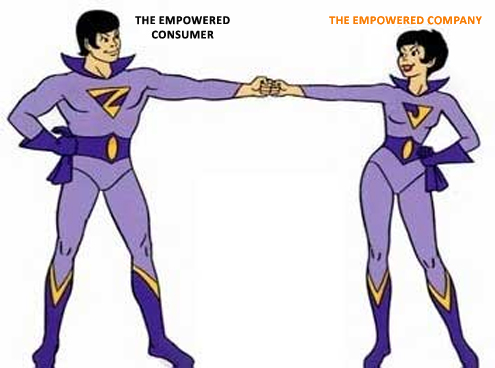
Brian Solis from Altimeter Group used the term empathetic business models in a recent blog post titled, A Critical Path for Customer Relevance, Part 1, and though it sounds good and I would like for all businesses to “be” that in the end. I prefer not to use it to describe an ideal business model, as much as I think it’s more of an idealistic business model, and I think he knows this. Here’s the exact quote:
A key objective for senior executives over the next several years is to use disruptive technology to get closer to customers, to improve relationships, and enhance experiences. It is a considerable move and the result will usher in a new era of adaptive and empathetic business models. However, this is a move that is easier said than done.,
What makes more sense today, and Brian actually touches on it in the next paragraph, is how do we deal with the empowered consumer? I’m not so sure an empathetic business can deal with the an empowered consumer. I’m not saying they can’t, merely that it might be somewhat one sided. What we need to look at is the empowered business and the empowered consumer together, as one. Put the two together and it’s lightening in a bottle. I think of the two as having the potential of the Wonder Twins. The Wonder Twins, are comic book superheroes. Their powers are activated when they touch each other and speak the phrase, “Wonder Twin powers activate!” This phrase is unnecessary and just a habit of theirs, but it’s catchy. Physical contact, however, is required. If the two are out of reach of each other, they are unable to activate their powers. As they are about to transform, they would each announce their intended form. “Shape of…”, “Form of…”
So think about this. An empowered business without the customer means nothing. An empowered customer who wants to buy from a business that doesn’t get “it” means nothing to that business-it’s just a lost opportunity to that business. Today’s empowered consumer has too many tools at their disposal to make an informed and educated buying decision. For a business to say, It’s a fad and it’s business as usual and the digitally empowered consumer will buy from us because of our history and are heritage-that just won’t cut it any longer. Today, every CPG company has to have as much ammo as their customers. Has to.
So what good is the empowered customer without the empowered business? No one wins. No Magic. But…If we put the two together then we get, The Wonder Twins. The empowered consumer needs the empowered business.
Relationships In A Socially Connected World

In the New York Times recently there was an article titled, My Dinner With Clay Shirky, and What I Learned About Friendship which I highly recommend. The piece was essentially about an authors dinner experience with noted writer, speaker, and internet ethnographer Clay Shirky. If you don’t know who Clay Shirky is, go to Amazon and read some excerpts from his two books Here Comes Everybody: The Power of Organizing Without Organization and Cognitive Surplus: Creativity and Generosity in a Connected Age.
The gist of the NY Times piece was that if we’re not careful we could spend so much time interacting with people on the Web that we could become a little socially deficient. Ironically, this week we held a social media tweetchat hosted by Jamie Sandford on how one cultivates relationships in a social world. The parallels were neat and not lost on me. On the one hand we had Shirky wanting us to take it offline and on the other, we had a group of people in a tweetchat talking about how to make online connections stronger with the eventuality that we do take them offline.
Complete and utter online social immersion can make us feel like we are so busy with our connections that don’t have time for the offline world. Just as quickly however, if we don’t take the time to balance the two or at least make the attempt to deepen our online relationships we can easily feel the false euphoric high of quantity give us the semblance of relationships. Yet the reality is the payoff rests in face to face interactions. We spend so much time cultivating our numbers on various social platforms that we begin to think we have “a lot” of “friends”.
Our manufactured social world allows to think we’re popular until we step out from behind the machine. The point? Even in a connected world, we have to make the effort to cultivate a virtual relationship into something greater than the sum total of the networks that we are part of.
Some Handy Social Networking Statistics and Trends

Infographic by Invesp
Where Are the Jobs and What Can You Make In Social Media?
As I’ve said many times, I love a good infograph, thus, let’s introduce the Onward Search Social Media Jobs Salary Guide. Some interesting things to note here. One, there are a lot of good paying jobs out there in the social media space. Two, I’m surprised that some of the positions and locations are not paying more. Given what is on the line for some companies, I would have expected more from some of the locations for the strategist and marketing manager positions. What do you think?

© 2012 Onward Search
The 3 Levels Of Change Needed To Integrate Social Media
If You have not visited the blog site for the agency, We are Social, make sure you do. It’s a great resource of information. In particular, I was struck by an infograph that was up recently titled, Social Business-Social Media Integration. Within that infograph, I found this:

Which one do you think is the hardest? Which is the easiest? Which takes the least amount of time?
 Direct Marketing Observations