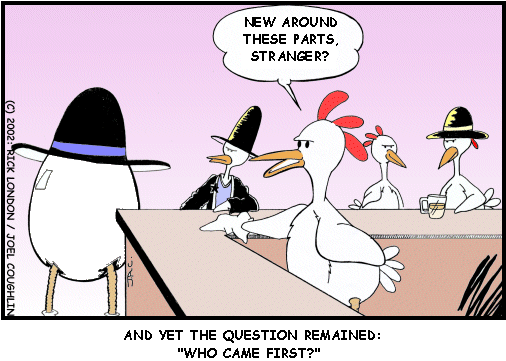
The social media food chain and A-listers

A-listers, movie stars, superstars and rockstars, every industry has them. Including ours. Social media, PR and Marketing. We love to worship them don’t we? We watch their every move. We’re fascinated by them. The only thing they might lack are the paparazzi and a posse. There’s just something about what they say and do and write that mesmerizes us. (Cue the chorus of angels) We have decided by our adoration that they hold the keys to the kingdom and thus we need and have decided to quote them and listen to them and follow them whenever we can. Is it wise? Seriously. Is it?

Admit it, you’d take some of that “rockstar” love if it was thrown your way. By that, I mean if you became an A-lister yourself, you wouldn’t turn down the title. Additionally, If they showed interest in you, or talked to you-you’d take that “bounce effect” as well, in a heartbeat. Hell, it might be why we all blog. We want what they got. It’s just that some of you might not admit it. It’s Ok. It’s not why I blog but the residual effect of the blog has certainly brought some notoriety with it that I was not prepared for, and thus I’m not going to reject it.

When you get right down to it, and where I might be in the social media food chain, I think I might be a J or K lister. And while we’re on the subject, lets ask ourselves why we are blogging.  That’s right you- “Mr. or Ms. Stranger that I don’t know yet I trust more than an advertiser”. You, The New influencer, What is your endgame goal here? Is it to be a new influencer?  To be a difference maker? A game changer?

Lets back up though.  That’s not the sole purpose of this post. The duel purpose is to figure where we should place the A-listers in the social media food chain.  Lets ask ourselves who’s eating who here? For example: I recently asked at one conference whether advertisers realized the influence that A-listers have just in the Twitter-sphere. I didn’t really get an answer to that. My point: Twitter followers look for A-listers, follow them immediately, and then jump all over those A-lister quality tweets. And why?

So let’s ask ourselves. What, if any, value or credence should we place with an A-lister when they utter anything? Be it in a micro-blogging platform, a conference, a blog post, a book, an e-book or a podcast. I know some have a body of work that certainly can belie their status. Others, are a tad bit more fuzzy. But even then, we have to be careful and we have to be selective of what we choose to listen to.

I say we read the menu, sample what you want, chew on what tastes good, and digest what will stay down.. Their’s is not the only restaurant serving something hot.

A couple of days ago,  Mack Collier wrote about why he enjoyed the SMBU more than SXSW because it was more of a teaching gig than it was a big “look at me” Rockstar, fest. and frankly, I’m down with that. In fact, if I think back on the last 6 speakers I’ve listened to at various engagements, 4 of them had the same M O.

You see, we’re all guilty of our own MO or modus operandi, as well. Ours might look something like this: We show up at a conference, and wait for “the name” or the “A” lister to talk. When they take the stage, we sit on the edge of our chair, try to tweet something sharp and clever and original and game changing that he or she might say in their slotted time. Then we watch them hustle through their slides and then.. . they answer 4 questions, and poof, they’re done. I know thats not always the case but bear with me.

We then sit there with a few thoughts: They are: “Have I just seen the second coming? Or, WTF was that?” Or, “Did I get anything out of that just now?” Or maybe, “I can’t believe he or she really looks and sounds like that”. All the while the A-lister has stepped off the side of the stage into a throng of social media, marketing or PR groupies. At which point, the exalted one” answers maybe 1 or 2 more questions while 15-20 others hope that he or she looks their way. It’s at this point that I might shake my head, mumble something to the effect, “when is a speaker going to learn how to at least  properly close their talk with something other than, “well it looks like my time is up, thanks.” Perhaps they should read Rohit’s blog post about how to avoid being a bozo when presenting?

In closing, I see that my time is up. But here’s your takeaway. There are a lot of people to listen to in this space. Some of them are not even close to being A-listers, and you know what? They still know their stuff. Maybe even more than the A-listers. Chances are, the A-listers might even be pulling their thoughts and content from them. It’s up to you to decide who you engage. Step back and decide why you are listening to them. Is it because “everyone” else is? Or because they make sense to you. If that’s the case, then stay the course. One last thought: If you’re blogging and you have a dedicated following, you might just realize that you are a thought leader yourself and not a follower of a social media A-lister with clay feet.  And there ain’t nuthin wrong with that.

Seize this moment to make a difference.

I wrote something down 2 weeks ago. Gary Vaynerchuck gave a keynote at web 2.0 expo in NYC and mentioned it and it’s still resonating with me. Ari Herzog, whos blog posts I’m enjoying more and more, blogged about it last week. And today, on September 29th 2008 it makes as much sense to me now than anything I’ve heard over the last few days let alone weeks and months. What is it? it’s this:

Legacy is greater than currency.”

I wish I could have thought of that. I know some of you are saying this right now-“Dude, do you have any idea of the financial straits I’m in?” Trust me, there are very few people right now who are not hurting, I get that. But the point of me letting you in on Gary’s point is this.

Times like these, lend themselves to people who can help others. Times like these allow people to really share their knowledge with those who can benefit the most from it.  For example, If you’re on the tech, or marketing side of the house, do you have any idea how much or how valuable the things you do or can do, are needed right now? The things, the actions, that you leave behind in your life will be greater than the money you made and the money you’ve accumulated. Your legacy, your footprint is more important.

Your legacy right now can be defined by what you do in the next 12-24 months. If you start today to define it. You can either complain or bemoan the current state of affairs or you can try and do something that can make a difference in your life which can inherently make a difference in others. It’s up to you. Are you going to take? Or are you going to give? It doesn’t have to be a lot. But reach out to someone and help them out. They really need it right now.

Maybe we need a national, “Reach out and affect someone’s life day?”

Are you a thought leader or a follower?

When I was a kid most coaches and teachers used to tell me to be a leader and not a follower. Amazing how we manage to find ourselves saying the same thing to each successive generation. Why? because it makes sense. But does it? I immediately think of the old saying, “too many chiefs and not enough indians”. Ok so now we should all be confused. Which should we be?  Do we need more indians or more chiefs? Rachel Happe brings up a great point in her post about The Wisdom of The Crowd in which she writes:

Crowds without leadership and inspiration are not necessarily better or worse than individuals.  But a crowd can become both more than the sum of its parts and less than its lowest common denominator depending on how it is inspired.

What this means to me is that although I might want you to be a leader, you might be better suited to be a follower. Some people are born leaders and some are born followers and some can become…. etc etc. However, in social media and Web 2.0, if we’re to look at the whole thing holistically,  the space reeks of the “follower mentality”. Too many people as I said in an earlier post are inclined to be of the “echo mindset”. They possess zero original thought. I’m not sure they are even actually participating in the conversation to be honest. To this end, they are not leaders, and they are shitty followers. So they bring nothing to the table. Period.

Rachel’s original post stemmed from one that Guy Kawasaki wrote on Dadomatic titled, The top 10 lessons his dad taught him in which #3 was:

Don’t follow the crowd. Initially, I thought that he was saying that most people were stupid–and I agreed with him. But I now realize that he was telling me not to follow the crowd because the crowd “mentality” can make smart people do dumb things. This is why I don’t believe in the “wisdom of the crowd” to this day.

Given the current state of all things political and economic, perhaps what we really need is original thought and not noise that has a new tread on it. I know it’s easy to just put some lipstick on the pig, forgive me for using the analogy, but try to step out from under the umbrella and look at things in the social media and web 2.0 world differently. I don’t need you to be a though leader or a follower, I just need you to think.


ROI vs. Engagment: The social media conundrum continues

I can’t tell how many times I’ve written about this, but for me, this topic is the key driving metric in whether a social media campaign is successfull or not.  I had planned on writing about something else this morning and literally had only been reading a few blogs when I came across an interview by Amber Naslund for Marketing Profs in which she interviews Kodak’s Corporate Media Relations Manager Krista Gleason and Chief Blogger Jenny Cisney to find out why their social media program is so valuable to their business, and how they’ve defined success.

It’s an interesting interview but check out this question on ROI. I have to give mad props to Amber for asking the question in the first place, because I think it gets to the heart and soul of social media marketing.

Q: How do you define your “ROI” from involvement with social media? Krista:


  • Feedback from readers and customers via the blogs and email
  • Invitations to speak at top-tier conferences, including BlogWorld and BlogHer
  • Links to our blogs from other blogs and online articles
  • Recognition from social media experts, like Mario Sundar and Debbie Weil, and traditional media, like Business Week
  • Awards: Earlier this year Kodak won three awards for our blogs—the PRSA Bronze Anvil, American Business Award (Stevie Award), and an Interactive Media Award

Her answer entails everything that would involve branding and exposure and face time and has nothing to do with making actual money. She is not selling anything. Her ROI is measured, but it’s measured by the interaction. The money aspect takes care of itself in it’s own way, but for Krista, ROI in her world is measured by the quality and depth and reach of her social media engagements.

Some would say that if she’s not making money then there is no ROI. Would you agree with that or disagree? What do you think her efforts have done for the Kodak brand?

*Then, lets end on Ambers post of 6 things she learned from Kodak and look at #6

6. ROI isn’t always about direct revenue.
No, I’m not saying social media shouldn’t HAVE an ROI. But I took notice that, on Kodak’s list of social media ROI, not one of them cited any dollar figures. It’s about building relationships, building your brand, and making people want to learn more about you. These are the things that drive revenue for your company over the long term, even if it’s a meandering path.

The social media echo is viral

David Parmet recently wrote a post that should be required reading for all of us in the social media space, for all of us on the outside looking in and for those of us who want to pretend that we are playing in the space. You see, David wants us to set our sights a bit higher.

He cites Shel Israel’s post about social media becoming a vast wasteland which I won’t go as far to say as being the case, but I can see why he said it. David also mentions Tim O’Reilly’s key note at Web 2.0 expo NYC which I attended, in which O’Reilly muses “And what are the best and the brightest working on?” displaying a slide of the Facebook app SuperPoke, which invites you to, “throw sheep” at your friends. Essentially asking, is this what we have been reduced to?

The point being it’s time for more, we need to stretch our collective muscles amongst the group. I have to agree with David that seeing another “How to with Twitter or another “6 steps to conquer your fear of Friendfeed”, or whatever, is not going to do us any good. Especially when we are essentially talking amongst ourselves. I mean that in the sense that the readers of our blogs, are in general, industry types.

Which essentially means that the social media echo comes right back at us. But then it is spread by other N00bs who want in on the game and thus spread the same thing that we already have heard and already have come to learn. And it comes back to us. We’re seeing a push of info that is the “same-ole, same-ole”. Nothing new, just a push, that is spread virally.


So let me ask you.

  • Do you want to repeat what someone else says?
  • Do you have any original thoughts?
  • If you hear someone else talking about the same thing, do you feel the urge to repeat it verbatim?
  • Isn’t it sometimes better to look at something in a completely different way?
  • Are you so boring that you don’t care about formulating your own opinions and thoughts?

Don’t be a me too person. There is way too much under the social media hood here. We need leaders not followers.

On your radar: 6 People from Web 2.0 expo NYC.

I’ve now had a few days since I left New York and the Web 2.0 expo, to think. My last post was a quick shot at the highlites, and this post will focus on the specifics of what I thought were memorable moments and people. Keep in mind that I was focused more on the media and marketing tracks of the expo.

Jonah Peretti

One of the funnier and more informative sessions belonged to Jonah Peretti. Peretti co-founded  The HuffingtonPost. During Peretti’s session he cited some of his viral media experiments including the Nike sweatshop email, which was hilarious, as well as BlackPeopleLoveUs and the New York City Rejection Line. According to Peretti, all of these projects started small but spread through word-of-mouth to millions, illustrating the practical application of 6-degrees of separation and tipping points, though the tipping point was not the end game. To sum it up, you should add, test, tweak and optimize.

Words to live by in more than just this setting I think. Don’t you?

Brian Solis

One of the sessions that I thought would deliver more just based on the quality of his blog and other writings was from Brian Solis. For some reason, and there can always be some that can prevent someone from knocking the ball out of the ballpark all the time, this one did not deliver. Though it did provide some nuggets, it mostly was Brian reading slides. I’m going to give Brian a free pass this time though, because his blog “over-delivers”. With that being said, I still suggest that everyone take the time to read and then add Brian’s blog to their reader list.

Avanish Kaushik

If you are into web analytics, as I am, and you don’t know who Avanish Kaushik is, then I would suggest you check out his blog, Occam’s Razor. His session was informative, funny, entertaining and passionate, and it was about fricken web analytics.  With that being said, he topped off his session by giving away his book, Web Analytics-An hour a day. He even autographed it too, if you wanted to wait! Thanks Avanish!


Michael Lazerow

Michael Lazerow is the CEO of company called Buddy Media and he delivered probably one of the more intriguing and informative sessions on Why Brand Advertisers Will Be the Biggest Beneficiaries of Social Media and How You Can Participate. He started slow and I was thinking, “uh-oh” here comes more of the same.  I had sat in on a few other sessions in which it was pointless to take notes since the speakers were re-hashing what we read and write every day. But Lazerow didn’t disappoint. He provided case studies and metrics to validate how brands can essentially use a company such as his (which he did not pimp) to promote and leverage a brand or product using social media.

While search dominated the last 5 years of advertising,  Lazerow is dead on when he says that social will emerge as the leading way for major brands to reach and engage consumers. As such, the social media application is both the new ad unit and the new media property all in one. I was very impressed.

Stephan Spencer

Stephan Spencer had a session titled, Best-kept Secrets to Search Engine Optimization Success: the Art and the Science, and to a certain degree it was. Throughout his talk he peppered the audience with the question, “How many of you knew this”? To which there were very few hands being raised, which in essence validated the whole theme of this session. He provided not only real world examples and strategies, but also a follow up email of content and links that certainly speak to the space of SEO. If you would like the email forwarded to you, let me know. I’m sure he would not mind.

David Armano

David Armano’s session was titled Micro-Interactions: How Brands Can Influence Consumer Behavior in a 2.0 World. I was fairly familiar with this since I am a big reader of David’s blog and his thoughts on micro-interactions. David focuses on new thinking in the web 2.0 world and his session did just that. Unlike some of the other echo sessions that prevailed at Web 2.0, David focuses on the little things that matter. To quote David:

We live in a world where the little things really do matter. Each encounter no matter how brief is a micro-interaction that makes a deposit or withdrawal from our rational and emotional subconscious. The sum of these interactions and encounters adds up to how we feel about a particular product, brand, or service. Little things. Feelings. They influence our everyday behaviors more than we realize.

You can access a lot of these presentation Decks at the  Web 2.0 expo site, but it won’t be the same without the audio. Overall, I’d like to see a little less echo going forward with these conferences, but I don’t think that can be avoidable. With the above people I have mentioned, they have stuck to what they know, and what they know works and they have run with it. For that, I’m thankfull. It was, in the end, a good gig that some should plan on attending.

Semantics in social media

So today isn’t starting off like I want it to be. I had to enagage in defending the childish difference of how someone responded to me. Email or blog comment..wtf? Does it matter? Which made me think about semantics in social media?

Semantics is the meaning, or an interpretation of the meaning, of a word, sign, sentence, etc.: i.e. Let’s not argue about semantics.

Isn’t social media at it’s core, about conversations and communicating?  Does it matter how we communicate? or the vehicle used to converse? I’m sure we could  all rattle off about a  half dozen different ways of communicating online.  The bottom line is, “there was communication”. But does the message change, gain, lose meaning, or become altered based on the delivery method? For example:

I called you on the phone to say hi.

I texted you via cell phone to say hi.

I emailed you to say hi.

I tweeted you to say hi.

I did a blog post in which I said hi.

I friended you on Facebook so I could say hi.

I posted on your Myspace page to say hi.

I sent you a pic that says hi.

I created a video on Youtube that says hi.

I commented on your blog to say hi.

Does the medium matter? Sure it does, in regards to delivery. Is the message the same?  Sure is. In every case. Can the message be construed any differently based on the medium? Depends on how many different ways someone can construe what “hi” might mean. I use this simplistic example for obvious reasons. And yes I understand that you cannot hear tonality or inflection when someone is writing something but my point is the same.

I can see it now…

“What did he mean when he texted me to say hi?” Was he pissed? Was he happy? Did he really mean it?  I mean it was a text. Now if he would have emailed me, thats totally different. Isn’t it? or Is it?

When it comes to social media, lets not argue about semantics.

*For the next few days I’ll be at the Web 2.0 expo in New York, hit me up while I’m there and we can chat about this.


The dark side of communities

Much has been written about the positive aspect of communities and what they can do to enrich and enliven customer experiences. Jeremiah Owyang has written extensively about the good and the bad in communities. Specifically, using “the bozo feature” in trying to limit bad apples in communities.  Elsewhere,  Jake Mckee blogs about and knows a little about communites and what it takes for them to run smoothly.

But what happens sometimes is that the inmates can run the asylum. I actually read a comment on Jeremiah’s post that said that communities can be self policing. Branded communites or corporate communites CAN NOT police themselves. They have to have moderators and managers. Why you ask? Well let me share with you an open letter I had received a while back from one of my more popular members who I had to ban because of amongst other things, he was scarring people.

To Marc:

I never threatened anyone on the site, I merely told that person that I would hand deliver ALL of their posts to their home!  THIS IS MY PAGE!  You DO NOT come here and malign me…..you had better wake up and look around.  I am not a person you want to make mad. Maybe your bosses need to see some of the posts you have written to me??? You don’t own this site. We do. I do.

Maybe they need to know just how you ban people from a site for specific reasons, but continue to let two people CONTINUE to break the rules?? Maybe you should look at (Name Withheld) ADVERTISING on the site—clearly against the rules!!  Maybe you should see someone about “PULLING YOUR HEAD OUT OF YOUR ASS!!!!!!!

And for anyone else who reads this, Marc  works for (supplies company name, adrdess, and phone number) They make a good product, they just have lousy employees!!!!!!!

Also, if you would like to contact Marc with suggestions on just HOW to recover his head from his ass, then, by all means, try these…………..(supplies ALL of my contact information, including home address)         

I am sure that he would LOVE to hear from you———ALL OF YOU!!!!!!!  Delete that, Marc and kiss my ass! You don’t want to mess with me. You have been warned.

So this letter, which he posted on his blog and in the forum came after I had essentially told him that he could no longer be a member of the community.  He was able to post under another name and thus everyone would have read this had I allowed for it, or had I not been moderating the site. As it was, it stayed up on his blog for quite awhile.


So what would you have done? Would you have been scarred or felt threatened? The good in communities certainly outweighs the bad, but I feel for all the community managers out there who have to deal with this type of personality a lot more than you might think. People need to understand that  online communities, just like in real life, have good people and bad people. The more that users realize that it’s not the wild wild west in these settings, the better off we will all be.

Is the Forrester Groundswell biased?

I’ve been looking at the finalists submissions for the Forrester Groundswell Awards and I’m wondering if choosing the winning entries based on proof of business value might be looking at the value proposition the wrong way. I’ve blogged about and complained about how social media sites and networks need to have a better way to monetize what they’re doing, and lets face it we all want to make money.

But, what if I’m completely seeing this the wrong way? What if the value of a social network isn’t in the amount of money it’s generating, but it’s instead about the quality of the community and the value it brings to each and every member of that community? And THAT is the true essence?

I know this completely smacks in the face of why we go to work everyday. And it also reeks of the “if you build it they will come” mindset or is that blindset? but…. Should Forrester be focusing on a bigger “world view” of social media and social networks instead of proof of business value?

I also see that Forrester has segmented out the finalists  entries into a few distinct categories. Are these too broad? Or too narrow? Or too generalized?

Listening

Talking

Energizing

Supporting

Embracing

Managing

Social Impact

What would you add to this list that might make it more complete? Forrester says that they got over 150 submissions, 151 to be exact, and they have whittled it down to 128What made the other 22 unworthy? I know, I know, lack of proof of business value. I just need to look at what justifies a win in social media and social networks. It may go back to my what’s more important question: ROI or Engagement. So what is it?

*Note Forrester has since called me to clarify that no one has been eliminated or whittled down, and that ALL entries will be judged on their proof of business value. Apparently there was an issue with one of the pages. I stand corrected.

TechCrunch50, Forrester and 8 other sites that require your attention

You know, it’s amazing how life just throws you softballs, curveballs, fastballs, whiffleballs and screwballs. It’s all in how you take the pitch. Do you hit it? Or wait for your pitch?  With that being said, lets look at some sites and posts that might require your attention over the weekend.

The TechCrunch50 just concluded and there were a couple of entries that really stood out to me. I thought that Steve Spalding brought up some good points in his Techcrunch50 recap in regards to why some of the entries may or may not make it and I have to agree with him on icharts Icharts has a crappy tagline but a great premise. Make better charts, make them seo friendly and searchable and interactive. Things that I would love to do for some of the lame charts I create. Maybe they’d kick me a free trial so I can review it?

I’d highly recommend fitbit too. since we’re all obsessed with losing weight, gaining muscle etc etc. Fitbit is a device and website that makes you aware of how active you are and what you eat. Go figure, a site and product with a way to make actual money!

My other favorite was Goodguide, it has a great idea and is so dead on right now. I think it’s only hurdle might be widespread adoption.  Goodguide provides free and easy access to the world’s largest and most reliable source of information on the health, environmental and social impacts of products and companies.

Of course be sure to check out this years winner Yammer, which is essentially enterprise level Twitter. Yammer had a ton of action as soon as it was released publicly. They too have a business model as well, but it can be used freely.

Be sure to read Carter Lusher’s post When hype can go overboard and hurt credibility  he mentions some Analyst ‘hype-alert’ verbiage  to be on the look out for.

Joseph Jaffe adds more than just his 2 cents on his blog post about Why the term “Agency of the Future” is an oxymoron (you can choose if you’re the ox or moron) Its a definite keeper.

When you get a chance, test drive this site SpinVox and tell me what you think.

I’ve been participating remotely to events all week and have to say that the access to all them has been awsome they are: IzeafestThe Techcrunch50,  and the T3PR confeerence to a certain degree. I think it’s important that though you may not be able to be there physically, you can still interact via, Twitter, Summize and the live web casts. I’d highly suggest you check your calendars.

Lastly,  Forrester, has pushed out it’s submissions for Groundswell awards, check out some of the companies up for awards, it might help you hone in on your OWN social media strategy. Imitation is the best form of flattery!