In social media, cluttering the space, confuses the topic

I’m the biggest proponent of social media that you could possibly find but I am also the one that told my daughter that she doesn’t need Facebook. She’s 14. I also told a group of 400 parents and educators that anyone under the age of 16 doesn’t need to be on a social network. I got a standing ovation for that one. I didn’t get a standing O from my daughter however.

On the one hand I will tell a company that they are missing the boat because they are neither a social brand nor a social business, so they better get with it. On the other, I will flat out tell some people and some companies that they have no business playing in the social space. Why the flip-flop?

You’re going to roll your eyes when you read this next line, but hear me out. When social media first came on the scene-it was about the conversation. But what happened next was that companies and developers smelled blood in the water. They saw that we liked conversations and connections. Soon we were offered multiple sites, multiple touchpoints and multiple opportunities to have conversations. However, a lot of us, no, the majority of us, don’t need to be having conversations 24/7/365. But what happened? Start-ups and new companies have flooded and have inundated us with so many social applications and sites, that they have confused the basic premise of what made social great in the very beginning.

It’s not just about building and maintaining connections. It may have been initially, but not any more. And thus…we don’t need another social network. We need to develop the one’s we’re in. At this point, it’s no longer about growth and it’s all about engagement. Sometimes when I see another “new” social app or site that is claiming that it will simplify or aggregate my confusing and complex social life, I roll my eyes. Why? They’re not making things easier, they’re forcing me to a) Look at and evaluate ( which I invariably do) another vendor/application b) Decide whether the current sites and apps I use now are still effective c) reconsider my loyalty d) disrupt the flow of my social engagements.

Perhaps that’s why the social landscape changes so rapidly. Developers are constantly rolling out bright new shiny things that they think we’ll need or that they think will make our lives easier, more productive, more connected. Or does it? I’m sure there’s over a 1000  social apps or more that I currently do not have on my phone or desktop that could make my social engagements better. But really? Better? Or just more cluttered and confusing?

Southwest Airlines: When Offline Meets Online

There was a time when Southwest Airlines were the darlings of social media. The numbers and the feel good stories were numerous and plentiful. However, Southwest Airlines notwithstanding,  employees far and wide, seemed  to have never received the memo about the impact of social and digital within the organization. Alas, some never seem to or ever will get that memo. The memo is simple. In this new digital age, everyone is always under a microscope, a microphone, and a magnifying glass. Southwest seems to be the poster child for this transgression.

When social becomes the conduit for airline passengers who feel they have been wronged, social media becomes the vessel to take that message to the masses.  It’s funny and somewhat ironic, but if it were not for social media, the perception of Southwest Airlines as the gold standard for airline travel would probably be pretty intact.

3 recent cases come to mind.

1) Kevin Smith, writer/director, get’s thrown off a Southwest flight for being too fat. He immediately starts tweeting about it and the issue goes from smoldering to flammable to toxic and media outlets immediately pick up on it. The airlines tries to make it right and apologizes.

2) Billie Joe Armstrong, singer from Green Day, gets kicked off of a Southwest flight for baggy pants and tweets about it. The media pick up on it and the issue goes from bad to worse and then the airlines apologizes.

3) Leisha Hailey actress, gets kicked off a Southwest flight for kissing her companion and she tweets about it. The media picks up on it, the issue goes viral, and the airlines apologizes.

What are the lessons?

1. You may be the gold standard of social media engagement but that doesn’t mean you can escape criticism.

2. Every employee needs to understand the implications of a customer situation spiraling out of control when that customer uses social media to feed the flames.

2.(a) Every employee needs to understand that every customer is now capable of voicing their displeasure and their bad experiences online. Even if it was a misunderstanding. Thus the ramification of every action needs to be measured.

3. Corporate social media policies need to include triage components for customer situations that go awry. $100 gift vouchers might not cut it.

4. Sometimes the resolution will not be pretty no matter what you do and sometimes the positive resolution never gets told via social.

5. We need to learn from previous situations where customers have taken to using social media to voice their displeasure.

6. The left hand needs to know what the right hand is doing. Offline and online need to coexist harmoniously.

At some point, screwing up and then apologizing for it, can get old. We know about the experiences of stars who tweeted their displeasure, but are there more that we don’t know about? Should Southwest be the fashion police? Should they be the judge of what is considered obese? Should they be imparting their morals on their passengers?

Who is right? Who has the power?  Those that have access to social networks versus those that can’t defend themselves?

Blog posts about social media

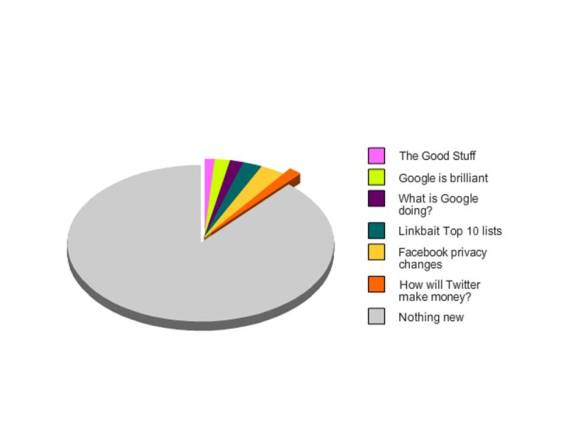
A tongue in cheek observation of the social media blogosphere. I’m sure I could add a few more slices, what would you add?

The secret sauce of social is selfishness-and that’s not a bad thing

Excuse me while I say the following: If  it wasn’t for social media, you wouldn’t be anywhere near where you are right now in your career. To put it more succinctly, social media has made a lot of you. Yes I know that’s like saying if it wasn’t for the internet Bill Gates wouldn’t be anything but another coder, but let me back up. You see, for a lot of us, and notice I said us, social media added that missing layer. That missing dimension, that lens  into our personal, private and public lives.

Social is the accelerant.

In a way, using social is very much like wining and dining to get what we need.  For some, utilizing social media to “court” others and market ourselves, is the same as drug reps taking doctors on ski trips to “earn” their business.  Or going out on a date where we both talk about ourselves. It’s an interview. It’s the handshake and the introduction. Social is the empty seat next to you on an airplane that soon will be occupied by someone you can talk to for 3 hours. Or not. The potential is there should you choose to engage. The seat is the tool or the platform for discussion..

People have been using each other for centuries. In social media, the same holds true. People are using each other because they’re seeing that our social selves  can be so easily intertwined into our ability to create, and curate; and yet it’s also dependent on consumption, its dependent on sharing, dependent on broadcasting the message, the message that is you and me. Some of you may or may not know this but we are feeding off of each other. We’re sitting across from each other on that plane and we both have the same opportunity to talk to each other and take it to another level.

Without those elements, you are nothing but a product of what we were prior to the boom of the internet- a product of the 80’s and early 90’s. You are static. Social has added flash to your being. It’s added substance to who you are or… who you want to be, should you so choose.

It starts with Linkedin

Think about this.  Linkedin is and became one of the initial gateways into people’s lives; and for a lot of people, who were never into that “social thing”, and who are still not that social, Linkedin is their gateway into social media.  In fact, if we go by the 90-9-1 model, Linkedin might be as social as some people will ever get! But at the end of the day, is Linkedin a social network? Perhaps. It has elements of social. But what Linkedin really is, is it’s our vetting tool. It’s  our way to learn more about others, and have others learn more about us. But really it may have evolved with Linkedin, but it started with blogging.

Bloggers were considered outlaws

Social has a quid pro quo nature to it. In fact, today’s social elements were born out of the early days of blogging which were veiled in a sensibility of  “us versus them”  camaraderie. Essentially it boiled down to a  “if you show me yours I’ll show you mine” mentality of reading, commenting, and sharing each others blogs. It was almost the manual defacto way that you grew your readership. But it also allowed us to show each other and others our many layers in ways in which we never were able to before.

Blogs allowed us and allow us to say whatever we wanted when we wanted, and we used each other, and then we used someone else, and they used us too-and we let them, if it grew our readers. It’s how blogging works.  Funny but in the non-blogging world, we indirectly and directly use each other every day by associating ourselves with new people and entities that we think can help us get where we want to go. It’s not sacrilege to say this but people use each other all the time; but it might be sacrilege to say this though…Using each other is the nature of social media.

We call it social media but it could easily be called useful media.

Social has added that dimension of vetting the who, search added the dimension of vetting the what. Yet we still have to work, we still have to pay our bills, and eat, drive, sleep and do that daily mundane life stuff; because the  human element still weaves its way through all of that offline stuff. The new difference is, social media is adding that dynamic layer of personal utility. It’s adding the layer of creating who we are, so that someone might see who we are. Social is selfish. It helps us. It connects us. And that’s not a bad thing, it’s more just the reality of where we are going.

10 Social Posts to Save and Share

I haven’t done a post like this in a while.  But I bookmark and favorite posts just like you. Here are 10 of my most recent favorites.

1) This post The hidden cost of social though a bit long by Mark Schaefer really deconstructs the conversation, give it a read.

2) It’s funny, but I was talking to someone the other day about the difference between communities and social media, and lo and behold I came across this article,  Is social networking community building? See what you think.

3) When you see a whole bunch of rabbits together, what do you call them? Well, refer to your animal nouns website!

4) MixRank shows you exactly what’s working for your competitors right now. See their most successful ad copy and landing pages.

5) Wanna see a cool video about the power of Google analytics?  Check it out.

6) Olivier Blanchard, has carved out a niche in and around social media ROI, but read his 5 basic rules of calculating the value of a Facebook ‘fan’.

7) Here is the gold. Here are the 50 best websites of 2011 according to Time Magazine.

8. Want to know what social media can tell us about American Society?

9) Who loves a good infograph? I do! Content-an illustrated history.

10) Last but not least, Why are some users dissatisfied with Facebook and walking away?

Social Media Specialists Are No Longer Needed

If you’ve been in this business for any length of time, then its time to take your collective aggregate knowledge of social media and add it to the overall mix of what you know and do. We’re at least five years in and I want you to quit being a social media specialist, because you aren’t one any longer. Simply put, and I’ve written about this at various points in the past, we’re all becoming social media generalists.

I used to be  an SEO specialist until  what I did just became a small  part of the daily mix of things that I did for our clients. There was also a time where I used to do nothing but manage PPC campaigns until it just became part of each clients overall web marketing strategy.

We all did something before social media

We all could mildly claim that we are or were bloggers at one point in time, except that it’s now merely part of what we do for our clients and respective companies. Same with video/vlogging, same with social media optimization, same with email marketing, same with creating websites, designing logos, writing copy, and creating tag lines; at one point in time it was unique and special but now-it’s just a sum total part of the collective us. We’re pulling from our collective experiences now. It’s natural and expected.

By now social should be a small part of what you do, but not all of what you do- At least for some of you. In fact, and I know a lot of you who fall into this category, there was a time where you owned social media and no one else could touch you. You were oracles of the social media soundbite.  Not anymore, social media knowledge bearers and practitioners are multiplying like rabbits and they know the game just as well as you do except…

You still have an advantage...

When I first got started in social it was for reputation management purposes and even then it wasn’t as much about the conversation as it was about understanding social media and its relationship to search… or I should say a blogs relationship to search (Facebook and Twitter weren’t even part of the conversation yet) Back then, a lot of you SEO’ers were merely concerned or wondering how to hyperlink signatures with keywords-I know that’s what I did, but then I evolved and so did you. Case in point.  I can bet all of you who have had a blog longer than a year can now spot a noob to the blog scene. How? When you get comment spam from people who insist on hyperlinking their generic, lame, weak, comment to a no-follow keyword based signature, you know… and you ask “Did they really just do that”? You’ve evolved.

Let’s digress

Things are changing. skill sets are changing- for example, if you are a PR practitioner, when did it become imperative that you understood how to not only write for your client, but also how to write for search? Or where the title of the promo piece was as important as the content contained within? Or better yet, when was it asked of PR practitioners that they had to understand the value of making connections with people in social networks? or starting blogger outreach campaigns? The PR person of today has many skills across multiple disciplines. They have to have them to survive.

Things change, people learn and skills evolve.

For Marcom people adding social to the mix is just another in the long list of things that are now just part of the job description. Yes we all still have to deal with the pretenders in the space, the snake oil salesman if you will, but for a lot of us, social is just part of the mix now. There was a time where I hated hearing the comment, “Yea but there is no ROI in social”; Now? I love to hear that comment so that I can fire both barrels of justification back at them. I’ve evolved and so have you. Marcom people need to know social, marketing, writing, PR, email marketing, advertising and design. Do they have to have deep knowledge? No, but give me breadth if I can’t have depth.

The next act

You see for a lot of you, your baseline level of knowledge in social now sets you up for what’s next. For those of you with an agency background, social is now just a part of what one does when creating a campaign. In some cases it’s the cornerstone, in others, it augments. Same with design. It’s a given that sites will have social components now-The hard part used to be finding people who could carry out the idealistic social initiatives aligned with the campaign, not any more. The troops are waiting for their marching orders.

Now social media failure isn’t so much based on the unknown or the person with a lack of knowledge, as much as it is based on a weak strategy, poor management, the wrong KPI’s or bad tactics. For a lot of you, you are the ones that will lead the charge into the new era of well rounded, seasoned generalists with skill sets that cover, tech, social, marketing, pr, and web. That’s the person I want and that’s the person that brands need.

Social Media’s effect on the UK riots should surprise no one.

According to HitWise, Twitter accounted for 1 in every 170 UK Internet visits yesterday; by their estimates, there were over 3.4 million visits to the Twitter homepage from the UK population alone. This is the world that we live in now. WE are the media. We create the content, we share the content and we consume the content-CONSTANTLY.

I can’t pinpoint the exact date where we started to leverage the medium of social media for world wide causes, but I can cite some recent events such as the terrorist attacks in India and the uprisings and revolutions in Iran and Egypt respectively as moments where cultures took social media platforms to such scales as a way to augment, support, discuss, share and or fuel what was happening IRL.

It is the nature of the world that we live in today. we are one digital culture.  But look at what organizations and institutes now have to deal with…

Yes there are other digital platforms that are in play during all of this but it is Twitter which seems to be the primary conduit for real time conversations, and updates during the riots in London. The real-time aspect of sharing information through Twitter has made the platform ideal for updates on what has been happening. In fact because of the riots, it has been Twitter’s biggest ever spike in UK traffic online.  Beyond the role that social media has been playing in the UK riots, there’s a larger question that needs to be asked…Has the disruptive nature of social media now become the fuel for anarchy?
Eventually we’ll all be good at social media and then what?

I was talking to a really smart person yesterday, way smarter than me, and I told her in no uncertain terms that eventually, this whole social media thing will eventually flatten out. Pretty soon,  a lot of us, if not all of us, will have a pretty solid grasp of what social media is, and and how we are supposed to use it. So instead of just a few of us knowing what’s going on along with the requisite snake oil guys, they’ll be a whole slew of us running around who actually might know what they’re doing. It’s inevitable. For some of you snake oil dudes-the clock is ticking

Just like the early days of the internet and AOL, of email and using Hotmail and Outlook for some good ole’ email blasts, of SEO, of pay per click, of content marketing and so on and so forth. In each case there was always that big learning curve and once everyone overcame that, then all of a sudden you had people and companies left and right who decided to wrap whole business solutions around disciplines such as internet marketing, email marketing, search engine marketing and content marketing.

What happens is, as more and more people learn social media, they then turn right around and flip that new found knowledge into a business that is either directly or indirectly related to it. That’s technology.

So then what happens is that some people are no longer deemed a  social media specialist as much as they become a generalist. Face it, we all to a certain degree become generalists. Is that a bad thing? Not necessarily. It means that surface level discussions now have the potential to take deeper dives because we all have a general understanding.

Right now, we’re still stuck in a semi-education mode with social.

My point though is that the days of the lone ranger, of the actual social media knight in shining armor riding in to save the day, will start to wane. Eventually when a mar-comm person or an IT person, or a PR person is hired, the skillsets will include a healthy understanding of how to use social networks, how to build communities, how to engage users in social nets, how to drive engagement in social nets and how to measure social engagements. Those will be “must have’s” and not “would be nice” reqs-and that won’t be asking a  lot either.

The day is coming. We’re not there yet but eventually finding a director of social media won’t be too difficult and having director of social media in your title will be the same as being a director or email marketing or SEO, they’ll be everywhere; which will still be cool, but as I said, eventually, you’ll see that everyone will have experience “with” social media on their resume right alongside all the other must have skill sets . We’re close but not yet. But when we are there, then the real fun will begin.

Who’s making the rules in social media?

I know it sounds like I’m bucking the system right? Or I’m challenging authority. Or I’m that guy who says, why are we doing it this way on his first day on the job…  But here is where my head is at.  Back in the Oh so heady dot com bubble days I became part of a very large team working on a startup. I remember thinking I had died and gone to heaven-I mean it was a dot com, I was going to be able to retire by the time I was 35. I came into the project mid-stream and yet the product had essentially been built. And I remember that very first day that I got a look at the site that it wasn’t right.

The reason?  Simply put, a bunch of software engineers and developers built a system in which they assumed they knew what the user wanted without really asking. There was zero intuitiveness to it and I remember asking anyone willing to listen-How do they know the users will want this? Blink…Blink…

Let’s fast forward 11 years. I’m in a meeting in which I was talking to a bunch of department heads about the major social platforms, I alluded to Twitter in particular and how it has changed. The interface has not really changed and the “way” you’re supposed to use it functionally speaking has not changed-but the way in which we actually use it has-Dramatically. You see, when Twitter was first created it was meant to be a way to update people on what you were doing quickly right? Remember this comment from the naysayers? “Why do I care what someone had for lunch?” For the most part, the way it was built and the way it was intended to be used held fast. But…

What has changed is that we the users have redefined how we use Twitter. We have decided that Twitter is a great way to share links, to share content and to consume content. Sure you can have those short staccato like conversations, but we have chosen to use it in another way that suits are needs and desires. It is now purely a content consumption and content push platform. That’s not to say that Twitter is not good for conversations any longer, but obviously what Twitter has done for us, for them and for the Google+’s and the Facebook’s of the world, is that it has defined a new action that has been woven into the fabric of our social lives. The action of sharing a piece of digital content in the form of a link. Pure and simple.

In the evolution of social, we might say that first it was blogs in which the written word was used in long form, then Twitter in short form, followed quickly by Facebook who then realized that Twitter was onto something so they borrowed the Twitter stream idea… The underlying theme in all of this is that we, the users have determined what we want from our social networks and how we will use them-and not the engineers. Although I still have a problem with the narrowness of defining what the social actions must look like or be called, i.e. “likes”, “friending”, and “follows”-We still have the power to really define them in the ways that we want to treat them.

The biggest mystery however lies with marketers trying to get inside the heads of the users to determine how they can turn them into loyal brand advocates. Stay tuned.

The Rub of Social Ubiquity

Sometimes we just want to “lay low”. Sometimes we just want to pull back and do nothing. Sometimes we just don’t want to post, share, update, comment, tweet, or chat. We just want to be.  However, as each day goes by, we’re starting to see that social doesn’t sleep. The digital footprint isn’t necessarily in sand.  

Social ubiquity, unfortunately doesn’t know what laying low means. With the advent of Google+ and Facebook’s landgrab of all things social, we’re edging towards an age where we all can be found at any time. Our digital footprint is becoming one which isn’t etched in sand but more like one cast in clay and concrete. What we all need to understand though, is that Google, Facebook and Microsoft want to keep us in network, 24 seven 365.  This starts with a social network and then extends to email, to docs, to phone calls, to commerce, to video and beyond. Every one of these “actions”  has or will have a social component attached to it. If it hasn’t already.

So where do we go once we’re reached that saturation? We “retreat” and we “treat” social as a utility. It becomes part of the fabric of our lives that we use in moderation knowing that we CAN use it 24 seven 365, but we don’t. We will eventually become more identified by the social networks that we use all the time but right now we’re still deciding what camp we want to be in, while the big 3 try to figure out what we want.