The Dark Side of Viral Content

Black to beat Bieber for YouTube’s most hated…

via Know Your Meme

This is your brain on Rebecca Black.

Tween sensation Rebecca Black will see her parent-financed video “Friday” beat Justin Bieber’s “Baby” for most disliked YouTube video within the next few days, if not hours, reports ReadWriteWeb. It’s an exciting, yet unsurprising development for the 13-year-old sensation whose Auto-Tuned masterpiece of mediocrity became the cool thing to hate on the Internet barely two weeks earlier.

While mainstream media critics, including this one, contend that “Friday” rates about as high on the Lame-O-Meter as pretty much everything else in current popular culture (with the exception of insanely overlooked NBC sitcom “Community” which is GENIUS), the Internet begs to differ.


Content is under scrutiny? It’s about time.


Creation, curation and aggregation. We all probably fall into one of those categories. We do one of those. I do. I don’t dispute blog posts like this Why Content Curation Is Here to Stay. I get that. What I have a problem with is the type of content creation we run across when doing brand monitoring work for clients. It’s falling into two camps.

Here’s the first.

Recently we were doing some work for a very prominent client where in the analysis of brand mentions we had to sort through thousands, yes thousands, of useless pages of content on websites that were set up  as splogs to drive better search results around pages geared towards Google Adwords. This is troll like stuff.  This is not new. Useless web pages have been appearing high up on search result pages for awhile now.  So Let me ask you a question. I assume that most of you who read this post are fairly savvy web users, but when you do a search-what part of the search result do you look like?  Me? I look at the URL under each search result. and that in and of itself can be revealing-sometimes content that you think is going to be worthwhile turns out to be crap.

 I’m using Google search results as the prime example here.

I thought we were getting the best search results possible? Maybe not.  For a lot of us Google is part of our everyday lives. We are slaves to the rhythm of search as much as we are to what Google returns to us.  Google and search dominate the web. The conundrum? To get traffic to your webpage, you have to appear high in Google’s search results. Which in turn means that you must create some type of content that works for Google. Thus the incentive to learn or understand SEO and Google’s Algorithm i.e. game the system, is huge.

Google will admit that the quality of it’s SERPS is higher than it has ever been; in terms  of comprehensiveness maybe so, relevance  may be debatable. They might be the first to tell you that there is a proliferation of sites that rip off other people’s content because they’re too lazy to build their own audiences based on fresh content and fresh thoughts and ideas; and that is a problem. Yep, the rise of the “content farm” which is heavy on volume and light on fresh, original content is upon us.

Google has been making changes to its algorithm to keep low-quality sites from appearing high in searches, according to Matt Cutts in a blog post last month. But he also wrote that, despite Google’s efforts,

The fact is that we’re not perfect, and combined with users’ skyrocketing expectations of Google, these imperfections get magnified in perception.”

I cannot tell you how frustrating it is to have to sort through garbage search results both personally and on behalf of a client; to be bogged down with the process of weeding through content farms.

“As pure web spam has decreased over time, attention has shifted instead to ‘content farms’, which are sites with shallow or low-quality content,” Cutts added.

I got into SEO years ago and understand the game.  High rankings in search have always been driven by the number of pages/sites that linked to it and how prominent they were ranked and what pages and sites were linked to them. There were always “other” little things involved, but to me it was always about the hub and spoke model. What sites were at the end of the spoke and so on and so forth. Oh yea, and one other thing-Content.

Marketing departments and SEO companies understand this. Thus,  they’ve been creating “landing pages” buried inside corporate sites to hit all of the different possible combinations of keywords of a search query relating to their company/ industry. Bloggers do it by linking to each other. It works, content farms work, and that’s part of the problem.

The bigger part of the problem? Large companies are catching on. They know this and are willing to play in this grey area space that Google doesn’t police very well, and we, the people that do searches, suffer for it. As it turns out, they are getting away with it. Or are they? The latest to be identified according to the New York Times is JC Penney.  Large and small companies will continue to game the system like this until a) they are caught and penalized or b) Google in particular-fixes the algorithm. Until then, content farms will continue to rule and the research that you  and I do on behalf of clients, will still take three hours instead of one.

If only there were a way for monitoring companies to weight and kick out splogs and obvious content farms…hmmmm.

On Influence and Bad Blog Posts

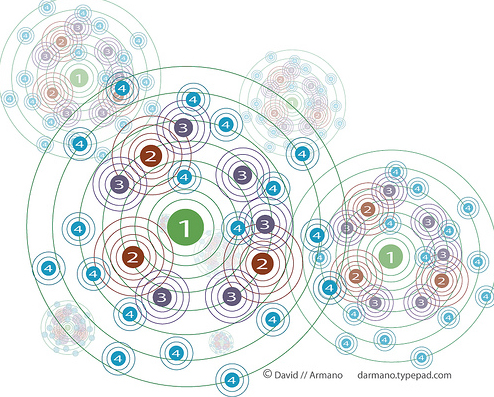
I like differing opinions, thoughts and comments. I think it’s good to have a variety of thought. No one likes a yes man right? Except maybe in the social media world. Then sometimes it resembles a quid pro quo type of environment. I’ll promote your stuff you promote mine. The thinking is well illustrated by David Armano with his depiction of influencer ripples. If your content can be promoted by the right people than it can reach more people. It’s why companies are so hot on the influencer thingright now-find the influencer and get eyeballs and sell product. Look, I’m down with helping my friends out but…

Today’s online influence is overblown, overrated and diluted and can be gamed.

Here’s why. What if the content sucks? Yet because you and I are friends and we read and promote each others stuff we’ll retweet and share content sometimes sight unseen.  That’s kind of jive isn’t it? Yet it’s effective.  That’s not really fair to the reader is it? But it works. What if the reader is someone on the outside and is trying to “get in” to the world of social media? They might share and promote your crappy content too. Add the element of two people with very large networks of followers and subscribers sharing content and you can see how this can all be affected. Crappy content always has a fighting chance with a killer post title and a supposed influencer sharing it.

How about these 2 scenarios? The first one I’ve been sucked into a bunch of times. You see a compelling blog title tweeted, you click on it and it’s end up being something that you might wrap your dead fish in. The second, I will refer to this definition from Wikipedia.

A spam blog, sometimes referred to by the neologism splog,[1] is a blog which the author uses to promote affiliated websites, to increase the search engine rankings of associated sites or to simply sell links/ads.

We’re all suckers for a great blog post title. Why? Because we’re hoping for fresh, we’re hoping for a different POV. We’re tired of repetitive thoughts, posts and comments without any backbone.  A lot of people have ceased writing for their audiences and are writing purely for search, link juice and hollow authority. Unfortunately there’s no end in sight and we’ll continue to be influenced into clicking on and reading. Hoping.

Fear of Social Media

I worry about the expectations that some people have for social media success versus the actual results. In some cases, we the consultants and champions of social media are just as bad and as guilty as the snake oil salesmen in pumping up and promising instant, magical results from social media. It’s not fair but for some of us, we believe and we know.

Sadly though, the reality is that even in the five plus years I have been consulting and the three plus years that I have been writing this blog, disaster still lurks in parallel with success for all that utter the words, “I do social media”…

And that’s OK…

There are a lot of intangibles that can equally push the needle in either direction, but the fact is, that the number (of intangibles) that can affect success and failure, has exponentially grown in the past 2 years. Meaning it is easier to succeed in social media now than it was in 2008.  Yes but…

  • It’s also easy to think you know what results you want from social media
  • It’s easy to set up a Twitter and Facebook account and think that you’re doing social media
  • It’s easy to compare your brand to another unrealistically
  • It’s easy to measure the wrong thing
  • It’s easier to be sucked in to the mystique and the aura of numbers
  • It’s easier to be duped by numbers
  • It’s easier to trust the wrong person
  • It’s easier to fail and
  • It’s easier to think that social media just doesn’t work because you fail

After reading that bullet list, I’d be scared to do anything too! Take solace though in this- Some of the best companies fail and will fail at social media, and even more-so, some of the biggest and best brands as well will do nothing with social media out of that fear of failing or notion that  social media doesn’t work.

So which company would you like to be?

Temper your expectations, temper your fear, do your homework, align yourself and your company with the right people and the right vendors and push on with your social media initiatives. It’s worth it. Does this mean that you won’t fail? No, but from every failure, you learn-Here’s a quick analogy: Baseball players fail 7 out of 10 times when batting and get paid millions to do it…and they practice hitting every day. Every day.

Remember being scared about learning to ride your bike without any training wheels? What did you do?  What will you do now?

How to Alienate an Influencer with Horrible Customer Service.

First, I am not making this up and second, I very rarely complain openly on a social platform about another company underperforming in the customer service area. But I am so angry, that I have to get this out before it subsides, because I think it’s important for management to know when they can do better.

Today my wife and I decided to try some place new for lunch. So it was, that we chose Salad Creations in Naples, Florida.

Now this story has nothing to do with crossed signals. misleading signage, or poor service on the front end-this is all about what happened at the middle and the end of eating. I ordered a Chinese chicken salad-It looked good in the picture and I was starving and anxious to see how it might taste, given that this was my first time. First impression? The salad could have been a little crispier but trust me, I understand, they’re a restaurant focusing on salads.

About mid-way through my salad, I ate a piece of chicken that did not taste right. An alarm of sorts went off in my head but given that there was an ample amount of dressing on it, I forged on.

A few bites later, I had another bad piece of chicken. It just did not taste right. You know what I’m talking about. After I swallowed it, I sat there for a bit and immediately got up and went to the bathroom because I thought I was going to be sick.

So I come back from the bathroom, sit down, and  tell my wife, and am now waiting for the right moment to talk to “the manager”.  I wanted to be discreet and just wanted to let him know that I thought the chicken did not taste “right”. I wasn’t looking for a handout or a new meal and frankly, I wasn’t even sure I could even eat another thing at that point anyway!

So I finally get a chance to tell the manager, at which point he and another employee grab a toothpick each, stick it into some of the chicken*, eat it and look up and say, “No, the chicken tates fine” and go back to what they were previously doing. Really? Did you just blow me off? (*Note: Initially I thought they had stuck a thermometer into the chicken, but my wife told me they stuck toothpicks in the chicken and tasted it themselves…)

So they were essentially saying, “No, you’re wrong, we’re right and that’s that!” Thank you very much Buh-bye? Next!

Which caught me and my wife completely off guard. But then he compounds things. He starts muttering how he eats chicken every day and it’s fine, and some other various, under-his-breath, inaudible things directed at me- He’s obviously perturbed at my complaint. It was almost as if he was calling me out and saying I was full of it.

I’m thinking he can’t possibly be doing this.  I interrupt his rant and say, “Wait a minute, I eat chicken all the time too, and it just did not taste right.”  I’m thinking it was supposed to be and meant to be a constructive comment- but don’t mutter under your breath how I’m wrong and crazy and you’re right. You can’t be serious.

At which point I asked him out loud.

Who is the customer?

He says, “You are, and then says, “All of you people are the same, wanting something for free…”

Did he just say that? Are you kidding me? Did he honestly just say that? I didn’t want a thing. I’m trying to turn this into a teaching lesson.

I asked him again. Who is the customer? I think I was hoping that somehow I could convey telepathically to him about how I write and talk about customer service all the time, and that somewhere, maybe, just maybe,  a light would come on and he would come to his senses and say…

“OMG, You’re right! You are the customer, I’m so sorry, what can we do to make it right?”

Sadly things deteriorated quickly and all he kept saying was that you people are all the same. Was I just stereotyped? I was wearing baggy jeans…Ironically, I thought that Salad Creations had potential, but what my man, the completely irrational manager failed to realize was this:

I am now the latter and not the former…Maybe he just had a bad day, maybe not, but either way, don’t take it out on me.

So what are the lessons here?

  1. The customer will always be right.
  2. The customer can be your brand champion or your arch enemy, it’s your choice.
  3. The customer has a voice it never had before, and it’s getting more powerful.
  4. The customer has the tools to make or break a company
  5. A bad customer experience can go viral

3 questions:

1) I wonder what the response will be?

2) Will they respond at all? and

3) If you were them, how would you handle the situation now?

Should You Outsource Social Media?

This might be the dirty little secret that no one wants to admit. That if they had their druthers, they would outsource their social media activities. Why? Because what they won’t admit is that social media is a big time suck and furthermore, they might not even admit that they are tired of “engaging” every day. Why? because they didn’t know it was going to be like this.

It’s hard to be “On” every day isn’t it?

There is the pretty side of social media, the stuff that you read about every day about how cool it is and glamorous and sexy and blah,blah,blah, but the dark side is that social media is hard ass work.  In fact Amber Naslund just the other day, wrote a”be careful what you wish for” post about the down n dirty aspect of social media.

Those of us who have been around know this. I can’t tell you how many times I have bouts of writers block; and then other times, its a magical stream of consciousness that propagates itself in 3 posts in one day. But you see, there’s more than just the blog, that’s the easy part; there are status updates, there are content updates, consuming content, creating content, sharing info, driving traffic, analyzing data, connecting with your peers, finding your customers, making sure your clients are happy, and looking for prospects. All via social or electronic means. Every day and night. Which leads to this- and I know you’re thinking it or thought about it…

“If I could, I would love to outsource some of this stuff in a New York minute.

But is that really wise? To outsource your social media activities. Except for those times when I’m feeling a bit toasty around the edges, I like doing it. I like connecting and consuming and creating.

Have you ever wondered though if there are others doing it? Well I got news for ya. Hell yea and you betcha. Most wont admit it unless your name is Guy Kawasaki. Todd Defren points out in his wonderful social media ethics series that they have been faced with that exact dilemma, and still others are doing it and you don’t even know about it.

The sexy term might be aggregating activities

The fact is, there are a lot of people who are automating a lot of their social media activities and still another group that are completely ceding control of their social media day to day operations to someone else.

Either in an automated fashion, or by merely having agencies do the work for them in the form of ghost writing or status updates or flat out being someone they are not– people and companies are choosing to wash their hands of real life engagement. Some admit it like Guy Kawasaki and still others… You’d never know the difference.

Do you care about who you “think” you are talking to? Brand or otherwise,  I do. I don’t like talking to logos and when you say you are Mary, I trust that it is Mary that I’m talking to.  Some don’t care and some do- some seem to only care when they find out they are being duped. Some companies seem to think it’s OK to create fictional characters inhabited by multiple people within an organization, I’m not one of them, but I’m not going to lose sleep over it.

Here’s the point.If you’re going to outsource your social media activities, I don’t care, and I won’t care until I find out that who you are is not who you’re supposed to be. I’m taking the don’t ask don’t tell stance. Why? Because I trust you. Funny thing that trust eh?

But I’m also not dumb.

I think that more and more people or companies are doing it (outsourcing their social activities) than you think. Or they are seriously looking at solutions that can streamline, enhance and speed up the reward of their social activities Why? Because I encounter companies and agencies every day that say they dont have time to do it nor do they care to, they just want to reap the benefits. I know it’s selfish and disingenuous but…

I’m ok with that. Why? because isn’t social media from that standpoint, just an extension of what a PR or ad agency already does? In their eyes it is. It’s marketing and PR. They will say, “What’s the difference”? Just do it for me and we’ll pay you. I’ll do it and get you started, but I’ll train you to do it for your selves and your company. You need to take ownership.

As social continues to grow and grow, some people just don’t want to do “it”, the social stuff, they would prefer that someone else do it for them- and you know what? There are plenty of people that will do it and… Do it well and.. You’ll never know the difference.

Social Media Consultants & Companies-The truth can be found in their numbers

I read an article in Wired’s Epicenter from a couple of days ago titled- Gaming the System: How Marketers Rig the Social Media Machine and the article caught my eye for a number of reasons.

The first reason is that when I first “dabbled” in social media 5 years ago-I was that marketer. I was the one gaming the system. Back then, comment spam and server farms did wonders for text based links and I was all over it. But a funny thing happened. I started seeing the conversations. I started paying attention to what was really happening around me. And it was cool. All of a sudden I got it. I had an epiphany. I now understood the real reason why social media was so dynamic and so transformational. I never looked back.

Here’s the second reason the article caught my eye-it was in the opening paragraph.

Regular users of social networks generally collect friends and followers on a one-by-one basis, then use those connections to share their opinions and links to the latest “Double Rainbow” remix or whatever is making the rounds that day.

A One to One basis…
Let that sink in for a bit. OK, so here’s my bigger point.  Let’s say I’m in a need of a social media company or consultant, and that business claims to be all things social. What do you do? What would you do? You check them out right? But how do you vet them?

Before I get to that, let me first offer up that I know that there are lots of good, solid  social media consultants and companies who do great work. My problem is I keep bumping into people or companies claiming that they are social media companies or consultants, and yet I have no clue who they are or what they have done; and worse, upon deeper discovery-they don’t even eat their own dog food or drink their own koolaid.

Here’s what I would do to quickly vet someone or some company that claims to “be” social.

Let’s take an actual Twitter account for example with 2500 followers. OK 2500 followers, that seems cool on the surface and would probably satisfy those who glance quickly at numbers.
But wait…
They only have 130 tweets. If you were acquiring and vetting followers and following people with just a modicum of organic effort and due diligence-by the time you got to 2500 followers, your tweets would be in some type of proportion to those numbers- i.e. 2500 followers- following 2500 and < > =4100 tweets
Let’s keep going. Upon further examination, there are zero conversations.The screenshot below is what you see when you click on the @yourtwittername on the Twitter main page of the example account.
There’s nothing there. Nothing. The tweets that are on the page, consist of lots of repetitive links to their blog pages, and or benign tweets/announcements about benign topics. No “ats” to anyone. Which leads to some really obvious questions:
  • Why on earth would you want a company like this consulting on, creating, and or managing your Twitter program?
  • If they can’t do it themselves internally, why would they treat you or your company any differently?
  • Is that really the way to use Twitter?
  • Is that effective?
All of this information is right there for you to see.
  • Look at who follows them,
  • Look at who they follow.
  • Are they on any lists? What types of lists are they on?
  • Are they sharing and or promoting others?
  • What are the nature of the tweets?
One of the lists this particular company is on is called, “Spammers that follow me”…Nice, That’s the kind of promo I want others to see! If they can’t get Twitter right, does this mean that their Facebook strategy and or their blog, or Linkedin strategy will be any different?
Social Media is equal parts strategy,  tactics and tools as it is about labor. Shortcuts don’t cut it and they can be, readily apparent. If these companies and people are not investing the effort, attention to detail, and labor in themselves-How social can they really be? How are they going to get you right?

In Social Media, Value Is Perspective

Yesterday I was listening to ESPN Radio and Three-time World Series champion Curt Schilling was explaining some of the finer points of baseball, when he came up with the following nuggets of wisdom. They were so insightful for the world of baseball, but when I got to thinking of them more, they started to resonate into other areas. Check them out and tell me what you think.

  • Bad managers lose games by getting in the way.
  • Good managers manage people.
  • Evaluating talent is a crapshoot
  • Value is always perspective.

That last one stopped me in my tracks. Value. Value is perspective. He was talking about how GM’s have to look at talent from the perspective of what it means to the organization and how it can help them, regardless of a person’s age, salary or diminishing skills.

I naturally equated value to what we do in social media and thought that…

Not only is value perspective, it’s subjective as well.

In other words, The way you use social media might not be the way the others do “it”, or the way I might use it, but if it’s working for you and your organization, then who am I to tell you to stop? I can suggest some other things to compliment it, or tell you why it might not be a good idea to do this or that, but in the end if it ain’t broke-don’t fix it.

Value to your organization will be perspective.

Think about that.

The takeaway? You can define engagement through social media anyway you like- just as long as it’s working for you.

For you baseball peeps, here is the interview with Schilling