It’s the little things

Why do we work? Why do we smile? Why do we cry? Why do we wake up every day? I found this “card” in a pile of papers on my desk…

Apparently, the things that matter are the dog getting walked and winning a baseball game.  Actually the things that matter is the little critter that made this card.

14 Guiding Principles of Social Media

I live in Florida and hard times are visible everywhere. I’ve seen businesses open with promise and flair only to close within a year with nary a sound and barely an announcement. This extends to the houses in my neighborhood, the families that occupied them, and the jobs that the people who lived in them once had. All Gone. Empty. It sucks.

I know some of these families. We were almost one of those families. And because of that, because I know where I once was and because I know where I could be, I have a respect, an  empathy and an acknowledgment of people’s situations, of their plights.  These are still sucky, hard times for a lot of families and thus when I see some of the Dad’s at various functions around town-usually our kid’s games of some sort, I try to help in as many ways that I can but also being respectful of their situation. Oddly, I try to tell them what social media can do for them and what it did for me.

It sounds corny but it’s true.

Social media altered the course of my career. It was somewhere between 2005 and 2006 but that’s when I really started to “understand” the power of the possibility with social. I know things are much different now and the space may appear to be crowded and overrun but the principles still exist.  It is by no means a silver bullet but social can help someone create that picture of who and what they are. It also can help define where you want to go. I could fill up pages with stories and instances of where I personally benefited from the impact of social media-and I want to pay that forward. It starts with these principles that are derived from the positive impact of social media. Now I know they may seem high level but they are absolutely concrete.

The 14 guiding principles of social media.

1) Everything that you do online has some relationship to search either directly or indirectly. Always know this.

2) Understand that you can leverage search in your favor-but so can your detractors

3) Social Media loves search-your footprint is permanent

4) People have an innate curiosity about you-including those you went to kindergarten with and your current employer

5) You can create and control your online  presence instantly, but it takes longer to remove it, if at all

6) You can socialize that online presence instantly

7) You can manage and curate that online presence in real time and any time

8. You can find your tribe easier than ever before-what happens after that, is up to you, and sometimes up to them

9) Social is free. The investment is in your time, understanding and commitment.

10) You can connect with virtually anyone, anywhere and at anytime-but respect that power

11) Social requires  that you are upfront, honest and genuine-If you find that hard to do, reexamine your motives.

12) You can’t wait for it to happen, you have to make it happen-sounds a lot like life doesn’t it?

13) It can be life altering in both good ways and in bad

14) Realtionships matter-take time to develop them and make them Real

I’m sure if I went back over my past 800 plus posts, I may have written similar posts about principles, tenets, beliefs or rules of social, but right now at this moment, these 14 principles are holding fast from my perspective of what social is and what you can make of it if you understand what is at it’s core.. Care to add to it?

Social Media Specialists Are No Longer Needed

If you’ve been in this business for any length of time, then its time to take your collective aggregate knowledge of social media and add it to the overall mix of what you know and do. We’re at least five years in and I want you to quit being a social media specialist, because you aren’t one any longer. Simply put, and I’ve written about this at various points in the past, we’re all becoming social media generalists.

I used to be  an SEO specialist until  what I did just became a small  part of the daily mix of things that I did for our clients. There was also a time where I used to do nothing but manage PPC campaigns until it just became part of each clients overall web marketing strategy.

We all did something before social media

We all could mildly claim that we are or were bloggers at one point in time, except that it’s now merely part of what we do for our clients and respective companies. Same with video/vlogging, same with social media optimization, same with email marketing, same with creating websites, designing logos, writing copy, and creating tag lines; at one point in time it was unique and special but now-it’s just a sum total part of the collective us. We’re pulling from our collective experiences now. It’s natural and expected.

By now social should be a small part of what you do, but not all of what you do- At least for some of you. In fact, and I know a lot of you who fall into this category, there was a time where you owned social media and no one else could touch you. You were oracles of the social media soundbite.  Not anymore, social media knowledge bearers and practitioners are multiplying like rabbits and they know the game just as well as you do except…

You still have an advantage...

When I first got started in social it was for reputation management purposes and even then it wasn’t as much about the conversation as it was about understanding social media and its relationship to search… or I should say a blogs relationship to search (Facebook and Twitter weren’t even part of the conversation yet) Back then, a lot of you SEO’ers were merely concerned or wondering how to hyperlink signatures with keywords-I know that’s what I did, but then I evolved and so did you. Case in point.  I can bet all of you who have had a blog longer than a year can now spot a noob to the blog scene. How? When you get comment spam from people who insist on hyperlinking their generic, lame, weak, comment to a no-follow keyword based signature, you know… and you ask “Did they really just do that”? You’ve evolved.

Let’s digress

Things are changing. skill sets are changing- for example, if you are a PR practitioner, when did it become imperative that you understood how to not only write for your client, but also how to write for search? Or where the title of the promo piece was as important as the content contained within? Or better yet, when was it asked of PR practitioners that they had to understand the value of making connections with people in social networks? or starting blogger outreach campaigns? The PR person of today has many skills across multiple disciplines. They have to have them to survive.

Things change, people learn and skills evolve.

For Marcom people adding social to the mix is just another in the long list of things that are now just part of the job description. Yes we all still have to deal with the pretenders in the space, the snake oil salesman if you will, but for a lot of us, social is just part of the mix now. There was a time where I hated hearing the comment, “Yea but there is no ROI in social”; Now? I love to hear that comment so that I can fire both barrels of justification back at them. I’ve evolved and so have you. Marcom people need to know social, marketing, writing, PR, email marketing, advertising and design. Do they have to have deep knowledge? No, but give me breadth if I can’t have depth.

The next act

You see for a lot of you, your baseline level of knowledge in social now sets you up for what’s next. For those of you with an agency background, social is now just a part of what one does when creating a campaign. In some cases it’s the cornerstone, in others, it augments. Same with design. It’s a given that sites will have social components now-The hard part used to be finding people who could carry out the idealistic social initiatives aligned with the campaign, not any more. The troops are waiting for their marching orders.

Now social media failure isn’t so much based on the unknown or the person with a lack of knowledge, as much as it is based on a weak strategy, poor management, the wrong KPI’s or bad tactics. For a lot of you, you are the ones that will lead the charge into the new era of well rounded, seasoned generalists with skill sets that cover, tech, social, marketing, pr, and web. That’s the person I want and that’s the person that brands need.

Search Results and Quality Content is an Oxymoron

Like it or not we are a search driven society. Thus this post could have easily been titled, “Content for content’s sake” or “Crappy content for search engines”, or “The difference between worthless content and worthy content”. The point being that in today’s hyper mobile, hyper-consumption, media driven society-we search for the information that we need right now without thinking that maybe what we’re looking at is not nearly the “best” information.

The reason? We see the information that we see first and has ranked well and assume it is the best. Unbeknownst to most of us is the fact that we’re getting played because someone knows how to play the game of driving eyeballs to a site that isn’t about quality content as much as it is about trying to get you to click on Google adsense boxes.

And that my friends is the problem-at least for the majority of us. Unfortunately we have quite a few lazy, dubious, web marketers who understand that if they have a choice of either writing for search or writing for the public, they are going to opt for search, and the public be damned. The reason? The game is all about getting ranked quickly on page one and that means inbound links, page rank, lots of keywords, and a site’s relationship with other sites… and maybe not so much about content quality.

Good content takes time. Good content that we may value, may take even longer to produce and in some cases may take longer to find. Why? If the person who has authored it has not written equally for search engines as well as for their audience, and if it doesn’t possess the “right” linkage and properties that meet Google’s search algoritham-it may fall quietly by the wayside.

Thus we have more noise than signal and more of a glut of worthless, search friendly content. So instead of it being like this:

We get something like this:

So for a lot of people, they have to really sift through a lot of non-relevant stuff to find what they’re looking for. Luckily and sadly for some, they generally can look at a search result URL and know that what they’re getting ready to look at, and they know that it’s  going to be bad and worthless-but what about everyone else?

Will search ever be about  contextual efficiency?

Social Media’s effect on the UK riots should surprise no one.

According to HitWise, Twitter accounted for 1 in every 170 UK Internet visits yesterday; by their estimates, there were over 3.4 million visits to the Twitter homepage from the UK population alone. This is the world that we live in now. WE are the media. We create the content, we share the content and we consume the content-CONSTANTLY.

I can’t pinpoint the exact date where we started to leverage the medium of social media for world wide causes, but I can cite some recent events such as the terrorist attacks in India and the uprisings and revolutions in Iran and Egypt respectively as moments where cultures took social media platforms to such scales as a way to augment, support, discuss, share and or fuel what was happening IRL.

It is the nature of the world that we live in today. we are one digital culture.  But look at what organizations and institutes now have to deal with…

Yes there are other digital platforms that are in play during all of this but it is Twitter which seems to be the primary conduit for real time conversations, and updates during the riots in London. The real-time aspect of sharing information through Twitter has made the platform ideal for updates on what has been happening. In fact because of the riots, it has been Twitter’s biggest ever spike in UK traffic online.  Beyond the role that social media has been playing in the UK riots, there’s a larger question that needs to be asked…Has the disruptive nature of social media now become the fuel for anarchy?
The Secret Sauce of Social Networks

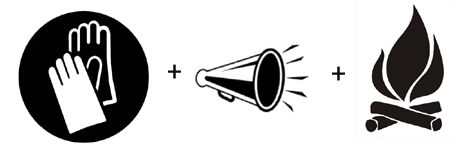
What is the secret sauce of a social network? What do you think it is? What motivates people in your networks? What motivates you? Right now, companies are obsessed with or have deduced that the only way to grab market share in social  is to incent their customers into doing something-give them something. Reward them. But at some point a social loss leader strategy will waver because of the weight of constant escalating consumer expectations.

Over the weekend, I was asked the following question on Formspring

“How can media organization encourage more readers to post and more thoughtful comments? Alternatively, what determines when you will take a few minutes to post a comment to a story online?”

Great questions, don’t you think? It’s the burning question that every marketer wants to know.They are constantly asking themselves how can we get people in and keep them in?

It’s all about participation. It has to fit for YOU. It has to be the right platform for YOU and your voice and YOU have to have a desire to be heard. We’re all looking for our tribes every day online. And it starts with the fit, it starts with finding your voice and it starts with wanting to be heard.

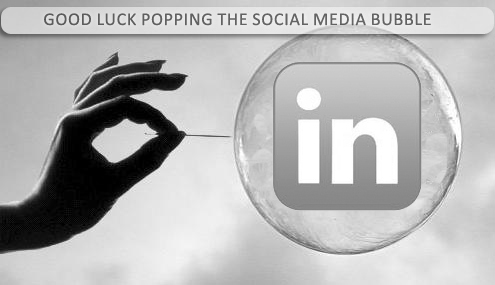
There is No Social Media Bubble

It’s sexy to say that the recent valuations of social networking companies and platforms is very similar to the dot com bubble valuations. Except, it was easy to see back then ( or is that now?) that commerce driven sites whose success was going to be reliant on transactions is a lot different than social sites and platforms with hundreds of millions of people with millions upon millions of daily visits that are reliant on nothing more than activity, conversations, shares, likes and content creation.

The implicit difference between the 2 bubbles, if we’re indeed going to call this period in tech history as a social media bubble, is that one was propped up on just bad business models and just plain dumb valuations, where the traffic had to buy product or the traffic had to go to a physical location whereas with all the social sites, the action and the CTR’s, its still predicated on traffic, but the traffic doesn’t necessarily have to buy something in order for the network to thrive.

It’s community based and people based and not sales based.  Though the model to make money in social networks is still based on traffic pouring through the site- the need to separate someone from their cash isn’t as large a priority as it was in the dot com bubble days. Big diff

Search Drives the Purchase, Social Influences it… A Little

The impact that search and social media have on a consumer’s purchase has never been disputed. I have always maintained that they were always joined at the hip. In a recent GroupM Search and comScore study this has pretty much been verified. Search drives the intent or consideration to buy, and social locks up or seals the intent and turns it into a conversion.

Interestingly, the research show that search alone is still a powerful tool in online buying intent, behavior and research. Always will be IMO, but what really caught my eye though was how little online buyers relied on social alone as the primary driver to a purchase. The internet is too broad and delivers too much information in regards to research on a buying decision to just rely on a social recommendation. Why? Because we still want the best deal possible. Relying on one piece of info, i.e. a recommendation from Twitter or Facebook isn’t enough for today’s savvy online customer. We start with search, we add social in there and then we finish with search.

The results from the survey/study revealed the following.

What does this really mean? Ignore the power of search at your own peril and relying solely on social to drive consideration and conversions is a risky proposition.

What Twitter could learn from Facebook Deals

I know that the comparisons between Facebook and Twitter are not justified. Facebook is really about developing deeper relationships with friends and family whereas Twitter is more about sharing and consuming information with people in a quick and easy fashion. There are other similarities but the fact is they are different. Their UI’s are pretty different.

But in 2012 you cannot mention social media without a reference to 1) Facebook and 2) Twitter. But if we’re to compare the adaptive growth of the two over the last few years, Twitter came out of the blocks fast and Facebook has been consistently building major momentum as of late.

Here’s the rub though…

Twitter has appeared to have stalled with it’s growth, it’s user adoption and new features, while Facebook continues to enhance it’s feature set at a rapid rate.

The latest case in point: Facebook Deals Facebook Deals has been designed to let the site’s 600 million plus users easily share their shopping experiences with one another. The deals may show up on a users’ news feed, or in ads on the dashboard on the left. Users can buy the deal with a credit card, or share it or like it.

The new service is Facebook’s latest  attempt to tap into the multibillion-dollar market for daily deals online and additionally adds the element of commerce  as well as further keeping their users “in network” on Facebook. 

This latest addition to Facebook further amplifies Facebook’s  proactive moves in regards to what it sees in the social media space. When Facebook sees what users “like and do” in social networks, they quickly incorporate those features into it’s own network. Remember when Facebook changed it’s wall into a virtual Twitter feed of your Friend’s activities?  Why did Facebook create Places? To adress and fold in what Foursquare, Gowalla, Loopt and others had accomplished. And now Facebook has created Deals

What has Twitter done? Dialed down the API from third party developers, changed their UI and have added features that Facebook has. I realize that Twitter and Facebook are different but Twitter had had just as much of an opportunity to change the lanscape of social platforms and communications as Facebook has.

HeyTwitter, don’t you know the first tenet of social media is to listen and monitor your customers and competition and then turn that into actionable outcomes?

Should Companies Play it Safe in Social Media?


What does that mean exactly, to play it safe? Is that creating a Facebook page just to satisfy the critics and the bashers? Is it creating a Twitter profile “in case” someone maybe be talking about you so that you can claim that you and your company are proactively listening to the conversation?  Or is it a blog that has 3-4 posts over the span of 6 months?  Maybe, possibly, and perhaps?

One of the easiest ways to opt out of the social media revolution is to do just enough to satisfy the hacks that may be looking at your social efforts who then may be writing, speaking or commenting about your stuff and trying to poke holes at it. To be honest, if I was a company who didn’t have money, resources, or time (weak excuse) to dip a toe into the waters of social, I might do the same thing. Of course doing the barest of minimums also sets you up for the hacks who love to point out the companies who…do the barest of minimums. Or…doing the barest of minimums sets you up for nothing.

So what’s happening here?  Call it paralysis by analysis. Fear of talking, orRO-myopia. But the fact of the matter is that some organizations are so fixated on social but so unsure of what to do, or so obsessed with a wait and see mode, that they end up doing nothing or prefer to just sit back and do very little. Ironically they then claim that they are social, or that they’re doing nothing, because they’re waiting for things to sort themselves out.

Does either strategy ( I use the term lightly) work? Not really. Does it buy you time compared to your comptetitors? Maybe. You see, the easiset way that you could  measure your efforts in social would be to first measure how you’re doing compared to the competition. When I coach basketball and baseball- I want to know who is the best and why. Amazing players aside, preparation can go a long way. Once my teams are suitably prepared, we measure where we are by competing. Then I know exactly where to focus my practices and future game plans.

You’re in business to make money and you’re in business to compete against others that do what you do and sell what you sell. Do you scout them? How do you compare to them? What are you doing to improve what you do, as it compares to what they do? What makes you better than them? What are they doing with social media that you are not?

Playing it safe in sports means playing for ties or not caring whether you win or lose. If that was what mattered, then we wouldn’t have to keep score or root for any teams. In business we keep score by making money and surviving.  Social used the right way, could determine both.