Social networks tied to every product, service and brand…Don’t laugh.

So the logical evolution of social networking is taking hold. In todays volatile marketplace, the success of manufacturers, advertisers, marketers, and media companies in creating long-term value and stickiness depends primarily on their ability to develop great stategies wrapped around great value propositions quickly. So what better way than to use the power of social networks?

I use the terms great strategies and value props. because todays consumers are as discerning as they have ever been. Why? Because they are armed to the teeth with more information than they know what to do with. And now with social networks, the ability for consumers to talk and share and recommend virally, is as big a challenge for marketers et al. as it has ever been.  But it can also be a major home run if done right.

That strategy appears to have taken flight with Viacom for instance. You may not know Viacom as well as you do their MTV properties. Having said that, MTV has recently announced that is jumping back into the social-networking game. In 2005, News Corp. outbid Viacom for social-networking giant MySpace.com. Since then, Viacom has largely been on the sidelines in the growing market. Now the company is focusing on creating a vast array of highly targeted Web sites that are loosely connected and focus mostly on programming such as VH1 Classic, Jackass, and Sucker Free on MTV.

When we mentioned product-centric strategies earlier, this is a case in point where Viacom/MTV has a solid brand they are looking to grow and expand  into new markets and new channels using all of the resources available to it. One of them being social networks.

MTV’s highly-targeted web sites will be at the core of the company’s digital efforts. MTV sees its content as its strength, and thus they have  decided to wrap that content with the power of social networking. In the past year, the company has constructed 32 new sites. The idea is to create a type of assembly line for Web sites. Those sites that find an audience will continue to be nurtured and those that don’t will be stripped down and “reskinned,” or refitted for the next experiment. Kind of like the 10 day “look-see” contracts athletes get in professional sports. They essentially have 10 days to impress. If they don’t, away they go. 

Interestingly enough, the company  doesn’t plan to spend a lot of cash in promoting the sites. The reason being that they have the utmost confidence in their content and the viral ability of the Web to spread the word. Given that lack of faith, I’m going to give Viacom/MTV a 10 day look-see to see if this particular strategy pays off. It almost gives you the sense that they are saying,”we love your idea, we just don’t want to sink much money into it, until it works”.

While killer business processes, off-the-hook customer service, and bleeding edge technology all play vital roles in todays web 2.0 world, companies that create and buy into solid product-centric strategies and processes with the customer in mind, will be those that build valuable loyal brands and profitable businesses beyond the 21st century. It remains to be seen though if this particular strategy will pay off for Viacom/MTV.

Buzzword Compliant

Can anyone add some scalable and yet granular social networking, web 2.0 buzzwords to this bingo card to essentially bootstrap this into a viral marketing message?

buzzword-compliant.jpg

What’s the deal with widgets?

Ok so I’m going to go out on a limb and here and say that chances are that most of the common masses do not know what a widget is. Even if you use your computer on a daily basis, there is still the slight chance that you might not know what a widget is. No big deal. Yet…

Simply put, a widget is a portable chunk of code that can be installed and executed within any separate web page by an end user( You or I) without requiring additional work or previous knowledge on the users part.  Other terms used to describe widgets include: gadget, badge, module, capsule, snippet, mini and flake.

Widgets often but not always use DHTML, JavaScript, or Adobe Flash.  A widget adds some content to that page that is not static. Generally widgets are third party originated, though they can be home made. They add a more rich, entertainment, multi-dimensional feel to a site that might be otherwise static.

Widgets are now becoming more commonplace and are used by bloggers, social network users, marketers, advertisers, and owners of personal web sites. They exist on home page sites such as iGoogle, Netvibes, Pageflakes, SpringWidgets and yourminis, and hundredes of other sites.

Widgets are used as a distribution method by ad networks such as Google’s AdSense, by media sites such as Flickr, by video sites such as YouTube and by hundreds of other organizations.

Applications can be integrated within a third party website by the placement of a small snippet of code. Which is now becoming a primary distribution or marketing channel for many companies. The code brings in ‘live’ content – advertisements, links, images, and video – from a third party site without the web site owner having to update.

Thus the end users can utilize widgets to enhance a number of web-based hosts, pages or drop targets. Categories of drop targets include social networks, blogs, wikis and personal homepages. Although end users primarily use widgets to enhance their personal web experiences, or the web experiences of visitors to their personal sites, corporations can potentially use widgets to improve their web sites using syndicated content and functionality from third party providers. They are also now using widgets as a carrier of their branding message or product.

So where can you find some widgets? The easiest source would be generally on the page you are currently reading, either on the left or right side of the pages. The widgets are dropped in via a widget managment system. Should you feel compelled, check out KickApps which states: The KickApps hosted, white-label platform puts social media and online video functionality directly into the hands of every web publisher who aspires to be a media mogul and turns every web designer and developer into a social media rockstar! With KickApps, it’s now easier than ever for web publishers to leverage the power of social and rich media experiences on their websites to drive audience growth and engagement.

If you are the casual reader, then hopefully this helps you. If you are a certified blogging fool, then this is nothing that you already don’t know. If you are somewhere in the middle, then now you have been enlightended.

Global search revenue will reach $60 billion by 2011

As if Google and company did not make enough money, by years end, global search revenue will reach $30.5 billion according to a recent JPMorgan report which hinted that investors still should view the web as a good  “buy” or investment.

Contrary to the dot com bust of the early 2000’s, 2007 was actually a very good year for internet companies. In fact, due to the rising world GDP, according to the report, internet companies with a global reach would continue to enjoy a healthy profit due to the broad and seamless appearance of a global marketplace. Conversely, the US GDP growth has slowed in recent years.

By 2011, look for search revenues to exceed $60 billion according to the report. A lot of this groth will be tied into paid search as a global marketing vehicle. The growth will also be attributed to keyword price inflation and increased web usage. Tied to this will be an increase in the user experience and increase in click-through rates for all sites.

The Top 20 search terms for the week

It’s a new year and thus the searches have a “turning over a new leaf” type of feel to them. But not for long, as our beloved searchers show their age when they give us WWE and Dragonball.  But fear not, we are still a nation/ world obsessed with absolutely anything that Britney does as well as Jessica Simpson and Lindsey Lohan. mnay thanks to the Lycos 50.

1 Poker
Full House, and you thought all that SPAM was worthless?
2 Golf
Fore! and it’s still winter people! 
3 Fashion
2008 trends.
4 Britney Spears
Dating and running from the paparazzo
5 Disney
“National Treasure 2” a must see.
6 Clay Aiken
“Spamalot”, Who said AI Stars have no traction?
7 Paris Hilton
Buddy Nicole gives birth. She’s slipping.
8 YouTube
Videos, we are a nation obsessed with videos
9 South Beach Diet
Low carb. Oh and we are obsessed with losing weight as well
10 Naruto
Manga
11 Pamela Anderson
Not pregnant and still looking, er uh.. like Pam Anderson
12 Kim Kardashian
Socialite taking advantage of her 20 minutes
13 Apple
Macworld, Check out the new Air Mac or mac Air
14 WWE
SmackDown. Who said anything about roids?
15 Lindsay Lohan
Dating Adrian Grenier? and still clean?
16 Pokemon
Battle Revolution
17 Jessica Simpson
Not at Cowboys game and they still lose.
18 Weight Watchers
Weight loss. In 2008, I will lose…
19 MySpace
Profiles
20 NFL
Playoffs? Did someone say playoffs?

The top 15 overall searches for the week

A few things to note here with this top 10 list:  First, we are a nation obsessed with all things Britney and her clan. Second, we still cannot get enough of Jessica Simpson even when she is at a Dallas Cowboy football game. and Third, your typical search must be done by a 15 year old male.  Thanks to the Yahoo Buzz Index, Behold the list:

  1. Jessica Simpson
  2. Casey Aldridge-The father of Jamie Lynns baby
  3. I love New York- See Tiffany
  4. Jessica Alba-A staple in top internet searches
  5. Tiffany Pollard- See I love New York
  6. Angelina Jolie- no news here
  7. Claire Forlani
  8. Britney Spears
  9. NFL
  10. Jamie Lynn Spears
  11. Tony Romo-Gee, I wonder why?
  12. WWE
  13. Hi-5
  14. Christmas-Finally, something searched by more than 15-17 year old males.
  15. Leah Remini- She is so 5 minutes ago isn’t she?

Google stats for November, no surprise here.

Google accounted for 65.1% of all US searches in the four weeks ending Dec. 1, while Yahoo Search, MSN Search and Ask.com received 21.2%, 7.1% and 4.6%, respectively, reported Hitwise. The remaining 46 search engines it tracks accounted for less than 2.0%. Thus if you’re an internet SEO/marketer and you’re strategy is to concentrate on the second tier SE’s, you might want to rethink that strategy. Furthermore, if you are tempted to pay money to be registered in “thousands” of search engines, our question to you would be, why?

Further enhancing marketers claims that niche based selling is the way to go, Google is also growing as a source of traffic to key industries, Hitwise said. Search engines remain the primary way internet users navigate to key industry categories, with Google leading the way.

Three categories – Travel, Entertainment, and Business and Finance – had double-digit increases (Nov. ‘06 to Nov. ‘07) in the share of traffic coming directly from search engines. These three categories revert back to a comment I made in an earlier post about the top 15 web searches: We as a society only care about being entertained and making money.

Lemonade.com deserves to succeed

I’ll tell you why. Last week I checked out their site and was impressed by their product, their site and their plan of action. What I didn’t like was the business model. It wasn’t solely based on affiliate marketing but enough of it was to throw it in that direction. I wasn’t so much railing on their business model as I was the whole notion of affiliate marketing in general as a business model. I just have never been wild about having to rely on other peoples traffic for the success of my product or business.

Well after saying as much, about an hour later or so I received the following email from Thomas Zawacki the Co-founder and CEO of Lemonade.com:

I read your blog and appreciate your opinion. Like you, I have been in the internet marketing industry for a long time. I agree with you that relying on an affiliate program as your sole source of income is a very difficult business to be in. That is exactly why we have built the Lemonade Social Commerce Server to be able to receive data feeds from a variety of revenue generating opportunities. Currently, we have integrated revenue from commissions from sales (affiliate deals), cost per acquisition offers (CPA deals), cost per click ads (CPC) and cost per thousand online advertising offers (CPM deals). The Lemonade Social Commerce Server also has the flexibility to add auction based revenue streams (e.g., Ebay) and revenue a user might get from selling their own products. All coming soon. In addition to aggregating revenue streams in our flexible back-end, the user experience must allow for three things to happen: 1) easy to join and set up the application (e.g., widget or Lemonade Stand); 2) easy for the consumer find what they want and interact with; and 3) the Lemonade Stand owner must make a significant amount of money per month to make it worth while – this is a combination of impression levels, click-through rates, conversion rates, etc.It takes under 3 minutes to set up a Lemonade Stand. Lemonade Stands live at http://www.lemonade.com and/or as a widget/application on Facebook, Blogger, and other key distribution points. This means that there is a built in amount of traffic to the stands that our users can monetize. Lemonade Stand owners can then make money via four different revenue streams, commissions from sales, CPA deals, CPC or CPM ads. This aggregated revenue is what makes it worth it to the user, not solely the returns from affiliate deals.Thank you for validating our model. We hope millions of people have fun setting up their Lemonade Stands, enjoy the social community aspects of http://www.lemonade.com, and make a bit of money along the way to pay their cell phone bills, donate to a good cause, or buy that gift for the holidays that their loved one really wants.

TRZ

So riddle me this. Here is the CEO of a company, taking time out from his busy daily schedule to actually reply with thought, meaning and honesty on a) why I was partially right and b) why I might be wrong. And yet, he feels that it is worth his while to respond.

This tells me a few things. First, here is someone that knows what the viral effect of blogs can have on a company. Second, rather than getting defensive, he decides to point out why he thinks their product will bet better. So now, instead of me saying, “boy what a jerk”, he gets, “Boy, what a class act”!

I don’t know if his widget will set Web 2.0 on it’s ear, but if I were to teach how to be the CEO of a company, what he did would certainly be a lesson.  he took the time to address a blog that mentioned his company, spun it in his favor and didn’t burn a bridge in the process. He made an ally.  So what if he only responds to one a day, or whatever. The fact is, he took time out, to handle a little guerilla marketing on his own. A little hand to hand, if you will. Good Job TZ.

A Word to Mobile Marketers: Dumb it Down.

 By 2010, over 300 million people  will be using mobile phones and PDA’s. The five big verticals of mobile marketing and search will be : Consumer Package Goods, Fast Food, Entertainment, Travel, and Financial. Two other  industries not to ignore however, are gaming and adult.  In all of these market segments though, there will always be a need to vomit the information to the consumer, if you will.

Graphic analogies aside, what marketers need to have, to steal a line from “Top Gun”. Is a “need for speed”. having said that, internet marketers and web designers have to build their mobile sites in a completely different way for mobile users. Below is a short list of things that will need to be done in order for the experience to be a positive one for mobile users.

1) Keep the layout simple and compliant to the device(more on this later)

2) Small URL’s. At some point, someone will have to type in your mobile URL into their device.

3) No Forms. Why you would want forms on a mobile site escapes me, but if you stay in the business long enough, you tend to see it all.

4) Make the naviagtion simplistic and linear. Keep the user going down  a logical path.

5) Be specific in the content, so that the user finds what they are looking for quickly. Bear in mind that mobile users have an immediate need and reason for surfing mobile content, give them a quick result.

6)  Limit the number of clicks and drill downs for the user to get their information.

7)  Refrain from using graphics and ads. They will only cloud the page and the result and slow the results to a crawl.

8)  No scripting, no plugines and no tables.

9) Try and develop a page that can be navigated using one hand. I know it’s virtually impossible but, put yourself in the users place.

10) Make the content accessible regardless of device and regardless of bandwidth needs.

11) Keep the following specs in mind as well:

  • 120 pixel screen width
  • Use XHTML
  • Use UTF-8 character encoding
  • Use JPEG’s and GIF’s
  • Page size should be 20Kb’s
  • Color: 256 min.
  • No scripting
  • Css1 style sheets
  • Http/1.0
  • No image maps
  • Limit Links

You’ll save yourself a lot of grief and headaches if you, wanting to cash in on mobile marketing, subscribe to certain design constraints when building your mobile ready websites. I know there are others that still need to be discussed, but the above should help in at least giving you a small checklist to utilize in your quest to be part of the next great marketing boom. Remember KISS! (Keep it simple, stupid.)

Click Fraud is on the rise.

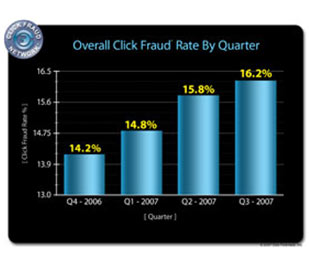
 Recently The Click Fraud Index run by Click Forensics  showed that click fraud rate was on the rise. What you will find interesting about these numbers are

Key findings from data reported for Q3 2007 include:

  • The overall industry average click fraud rate was 16.2 percent for Q3 2007. This is an increase from 13.8 percent for the same quarter in 2006 and from 15.8 percent for Q2 2007.

cfq.jpg

  • The average click fraud rate of PPC advertisements appearing on search engine content networks, including Google AdSense and the Yahoo Publisher Network, was 28.1 percent in Q3 2007. That’s up from 25.6 percent for Q2 2007, 21.9 percent for Q1 2007 and 19.2 percent for Q4 of 2006.
  • Over 60 percent of traffic from parked domains and made for ad sites was click fraud
  • In Q3 2007, the greatest percentage of click fraud originating from countries outside North America came from France (4.2 percent) China (4.1 percent) and Germany (3.7 percent

Publishers and advertisers have recently felt the impact click fraud is having in the content networks. Increasingly, publishers are seeing a performance drop in the content network traffic quality. Advertisers are seeing their conversion rates drop significantly on content networks because of bad traffic coming from parked domains and other low quality sources.

“Click fraud activity continues to grow especially on made for ad sites, parked domains and on the content networks,” said Tom Cuthbert, president and CEO of Click Forensics. “Advertisers, publishers and search engines need to take notice because content networks are becoming the fastest growing source of click fraud. Ensuring their quality is essential for the pay per click advertising market to continue its growth