
The top 10 hottest Social Networking Widgets

 Comscore released the November 2007 U.S. rankings of the top web widgets. For those of you who do not completely understand what a widget is, it’s essentially independent objects or an object that can be embedded or downloaded onto another site and can be used as a tool, have automatic content updates, or are or can be interactive. Though they go by the name of “widget”, Facebook calls them “applications” and Google calls them “gadgets.”

In November 2007, nearly 148 million U.S. Internet users viewed widgets, representing 81 percent of the total audience. MySpace.com widgets had the widest audience, reaching more than 57 million Internet users, while Slide.com ranked second with 39.2 million viewers. Google.com has the sixth widest widget-viewing audience with more than 19 million viewers.

What’s the “skinny” on what widget usage means to the lay person? Simply put, it means that widget usage can be computed as eyeballs on the site, which also means that if the widget is cool, you can bet others will go to get the widget. The widget is essentially another form of advertising. If they have your widget, that means they came to your site or heard of your widget from someone else. Word of mouth, Seth Godin, word of mouth!

Having said that, take a look at these November numbers.
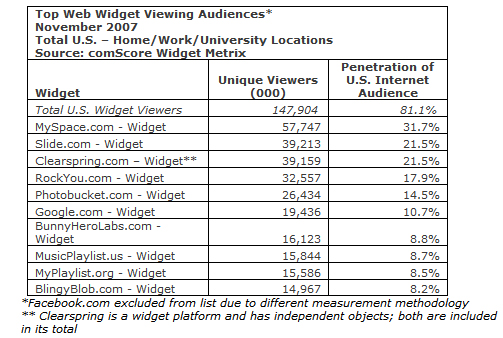
Comscore Widgets

Obviously MySpace is the dominant player here but look at the others on the list. Slide for example is the largest personal media network in the world, reaching 144 million unique global viewers each month and more than 30 percent of the U.S. Internet audience. They help people express themselves and tell stories through personalized photos and videos created on Slide.com and viewed anywhere on the web or desktop.

Slide’s products — including Slideshows, FunWall and SuperPoke! — are popular on top social networking and blog platforms, including MySpace, Facebook, Bebo, Hi5, Friendster, Tagged and Blogger. Slide is also the leading developer on Facebook with more than 84 million applications installed and the most active users than any other developer.

Clearspring though is NOT a social network. Clearspring is the leading provider of cross-platform widget services. Their goal is to make it easy to use content and services from across the Internet to weave personalized experiences. Clearspring is the leading enterprise-class widget syndication platform. With our out-of-the-box syndication solution you can quickly repackage your existing content and services as viral widgets and syndicate them across multiple platforms.

RockYou is a leading provider of applications and widgets on the web. RockYou widgets include photo slideshows, glitter text, customized Facebook applications and voicemail accessories that are simple to use and enable people to frequently refresh their online style. RockYou has over 35 million users, serving over 180 million widget views per day in more than 200 countries. RockYou applications are customized for easy integration across all social networks including Facebook, MySpace, Bebo, Friendster, Tagged and hi5. RockYou’s cost-effective, results-focused advertising platform is the largest Ad Network on Facebook and the most dynamic method for rapidly acquiring Facebook application users. New applications can reach over 100k users in 24 hours, spanning a suite of applications across multiple publishing partners

Photobucket Owned by News Corp is the most popular site on the Internet for uploading, sharing, linking and finding photos, videos, and graphics.  Photobucket, According to Comscore is: 

  • 24.1 Million unique site visitors/month in the US, and 34.6 Million unique site visitors/month worldwide.
  • #1 most popular Photos site in the US.
  • #3 most popular Entertainment/Multimedia site in the US.
  • #7 most popular Entertainment/Multimedia site in the world.
  • #24 in Top 50 Sites in the US and
  • #47 Top 100 Global Sites

The next one is BunnyHerolabs, bunnyhero pets bebo app the pets have been available on bebo for a while now as “widgets,” but now bunnyhero pets are available as an application on bebo’s new application platform.

What this means for bebo users is now when they adopt a pet on bebo, they can add the “bunnyhero pets” application. With the new application, they are able edit their pets after they’ve added them to their profile, like changing their pet’s name and color.

Next are the Musicplaylist.us and myplaylist.org widgets, which are a no brainer in the land of “can’t-miss” and “must-have”, widgets. And lastly if you ever wondered where all of the kitschy graphics on the MySpace pages was coming from, look no further than, and the name seems awfully apropos, BlingBlob.com. BlingyBlob.com, for us uninitiated, is the hottest source for FREE high quality graphics, animations, Flash and much more for your MySpace page, personal site, or blog. Makes you giddy, doesn’t it?

Look for music, video and image sharing widgets to continue to evolve to an extent that perhaps one day they become part of someone’s v-card or email signature, along with the location of their MySpace, FB or Linkedin pages.

M-commerce will work…for Gen Y…for now.

In the next 12 to 18 months analysts predict that m-commerce revenues will reach a half a billion dollars.  Pairing that with almost 300 million wireless customers, “someone” is going to be buying something through their wireless device. The question is who is that person? Is it the Baby boomer? No, they are just becoming comfortable with their computers and shopping online. Is it the Gen X’ers? No not yet, although they will follow pretty quickly as soon as the cool and the perceptive ease of use factors rises to a palatable level.

The answer my friend lies in your Gen Y users. The 15-29 users who just so happen to be your biggest social network users as well. This is, by no means coincidental. It makes complete sense on a lot of levels but here it is in its simplest terms. This generation is so technologically saavy that buying “things” using their mobile phones is nothing more than another viable option for spending money, communicating with their friends and being in the NOW.  It’s just another way to simplify their overly simplified “Me generation” entitled lives. It is a mere blip on the landscape that is their socialized technified world.

Not to sound bitter, and if I do it’s only because this generation can embrace a new technology so easily and so seamlessley that the projections for what kind of money might be generated might be underestimating the puchasing power of this group. The only way the numbers get pushed down is by overestimating the mobile purchasing power of a 15-19 year old who might not have a credit card to complete the transaction.

Gen Y users have 2 things working in their favor as well. 1) they account for almost a 100% ownership of cell phones and 2) have a purchasing power of almost $200 billion.  Add to this the fact that this group has no problem accessing the mobile web with relative ease, and couple it with their comfort level in regards to their expectation that mobile web sites meet their demands, and you have volatile mixture of a captive audience ready to buy with expendable cash.

In the next 12-24 months, marketers, consumers and advertisers will need to look to Gen Y to call the shots in regards to usage numbers, trends, and expectations. As soon as Gen X and the Boomers see how well it works for Gen Y. Look for M-commerce to explode. Look no further than Japan for a classic example, where in the last year e-tailers rang up almost $10 billion in revenue from M-commerce sales.

The growth of social networking

By 2011 about half of U.S. online adults and 84% of online teens will be using social networks. This according to eMarketer. What this points to is an evolution or a continuing evolution of children who currently are becoming aquainted with and more comfortable with, “How social networks work”. This also points to the greater value that adults will put in their social network. “Their” being the operative word.

Furthermore, this raises a very poignant question. Though Facebook and Myspace are the darlings of the moment, can they continue the momentum that they can surely take credit for? Will they be “The” players in 3 years?

As it is right now today the evolution for most users looks something like this:

Club Penguin/Webkinz—->Myspace—->Facebook—-Linkedin.

I use Linkedin as the last one for professional reasons but really after Facebook, the usage fractures into a 100 different niche based social networks. This usage in the next 3 years will continue to evolve into hundreds of other social network sites.

My educated guess, though they (MySpace and FB) will still be viable, there will be others that will come along, if they have not already, that provide more to their niche than the current duo do. Here is the reasoning. Myspace is for teens/bands and tire-kickers and fringe users. Facebook is for college aged and older users who have more of a familiarity with the social network and all that it can provide.

So in 3 years when your current crop of Facebook users for instance, graduate and possibly outgrow the Facebook newness/coolness factor what do they do then?  What do adults who are currently using Facebook do in 3 years? The same thing I suspect that AOL users did once they found out that AOL wasn’t the only game in town. Everything will evolve. Including the knowledge and expereince of the users. Thus the reason that by 2011, social networks will be so entertwined in our daily lives that it will be assumed that you are part of some SN.

The good news, and really none of this is bad news, but worldwide Ad spending will increase at a healthy 20-39% each year between now and 2011 according to eMarketer. In the U.S. alone social network ad spending is expected to rise to $2.7 billion in 2011. Currently the pie is being divided naturally towards Facebook and MySpace, but look for that to change significantly with the growth of niche and marketer oriented sites.

Global search revenue will reach $60 billion by 2011

As if Google and company did not make enough money, by years end, global search revenue will reach $30.5 billion according to a recent JPMorgan report which hinted that investors still should view the web as a good  “buy” or investment.

Contrary to the dot com bust of the early 2000’s, 2007 was actually a very good year for internet companies. In fact, due to the rising world GDP, according to the report, internet companies with a global reach would continue to enjoy a healthy profit due to the broad and seamless appearance of a global marketplace. Conversely, the US GDP growth has slowed in recent years.

By 2011, look for search revenues to exceed $60 billion according to the report. A lot of this groth will be tied into paid search as a global marketing vehicle. The growth will also be attributed to keyword price inflation and increased web usage. Tied to this will be an increase in the user experience and increase in click-through rates for all sites.

Death of The Library and rise of the Kindle.

Unless libraries can tailor everything that they do and stand for towards the digital universe, their days as a wellspring of knowledge and information are numbered. After reading an article titled, “The Impatience of the Google Generation” in wich the author and the responses essentially come to the conclusion that the current generation and younger generations for that matter, are essentially impatient when it comes to how quickly they can find and receive information, I can only assume that the last place that they would want to go is a place where their information was in a hard bound book!

OK, so yes libraries have computers that are tied not only to their volumes of hardbound books but also to search as it relates to the internet. But riddle me this: Why would I go to a library and search for a book when I could log onto a computer and find the same information? Says the 18-24 old student. I know it’s deeper than that, but lets put ourselves in the place of someone in college or younger. A) every college student, or a good portion of them now have their own laptop. So now they “walk” around with access to any and all information/research that they will ever need.  Bogus wikis notwithstanding. and B) They are so accustomed to getting information readily, that going to a library defeats the purpose of  library research per se.

 Of course, they can still go to the “quiet” library to get work done. And there are still certain things that a library provides or possesses that a student still might need or utilize, but…the thinking is,”It’s all here on the internet”!

Generation “C” (content) has no use for a library. In fact I would venture to guess that funding on local, state and federal levels for libraries is constantly slashed in favor of more digital type programs or programs that lawmakers feel have more importance.

Having said that, here is one more thing for you to chew on.  The Amazon  Kindle is an electronic book device launched in the US by Amazon.com  this past November.  It uses an electronic paper display, reads the proprietary Kindle (AZW) format, and downloads content over Amazon Whispernet, which uses the Sprint EVDO network. This means that the Kindle can be used without the need for a computer. Whispernet is accessible through Kindle without any fee. On the release day, the Kindle Store had more than 88,000 digital titles available for download. Amazon’s first offering of the Kindle sold out in five and a half hours. It retails for $399.

Think about it. People still want to read but they want it condensed and more than just portable. So does this mean that the Dust jacket will go the way of the Jewel Case and album art? If the latest advances in media, music and entertainment are any indication, it appears that that will be the case.

What’s not to like about Google?

You know there are always going to be people out there who will despise anything and everything that Google does and stands for. Of course we all know that they secretly use Google and if they were approached to work for Google, they would pause for about a split second before they accepted. 

Further enhancing it’s reputation as a company concerned with more than just search, Google recently announced that they were going to to use their incredible power as it relates to information and technology to help people better their lives. Google is rolling out five core initiatives that will be the focus of its philanthropic efforts over the next five to ten years. Google.org, the philanthropic arm of Google, will collaborate with experienced partners working in each of these fields, investing its resources and tapping the strengths of Google’s employees and global operations to advance its core initiatives.  

Today’s announcement includes more than $25 million in new grants and investments to initial partners. The resources come from a commitment by Google’s founders to devote approximately 1 percent of the company’s equity plus 1 percent of annual profits to philanthropy, as well as employee time.   Below is a listing of how the money is going to be disbursed:

$5 million to InSTEDD (Innovative Support to Emergencies, Diseases and Disasters) to improve early detection, preparedness, and response capabilities for global health threats and humanitarian crises. InSTEDD will work with the community of relief and response organizations, governments, academia and top scientists around the world to address gaps in information flow with software and other technology-based tools and services.

$2.5 million to the Global Health and Security Initiative (GHSI), established by the Nuclear Threat Initiative to prevent, detect, and respond to biological threats.

More than $600,000 to Clark University, with equal funding from the Gordon and Betty Moore Foundation, for Clark Labs to develop a system to improve monitoring, analysis and prediction of the impacts of climate variability and change on ecosystems, food and health in Africa and the Amazon.

$2 million to Pratham, a non-governmental organization in India, to create an independent institute that will conduct the Nationwide Annual Status of Education Report (ASER) as well as large scale assessments in the education sector.

$765,000 to the Centre for Budget and Policy Studies, a Bangalore-based analysis group, to create a Budget Information Service for local governments to facilitate better district- and municipal-level level planning in India

$660,000 to the Center for Policy Research, an action oriented think tank based in India, to increase the debate and discourse on issues of urban local governance and urban service delivery.

$4.7 million grant to TechnoServe to provide general support to expand Technoserve’s efforts to support enterprises, spur job creation, and strengthen poverty alleviation programs globally, and to develop and implement a business plan competition to support entrepreneurs in Ghana and Tanzania

$10 million to eSolar, a Pasadena, CA-based company specializing in solar thermal power which replaces the fuel in a traditional power plant with heat produced from solar energy

RechargeIT is a Google.org initiative that aims to reduce CO2 emissions, cut oil use and stabilize the electrical grid by accelerating the adoption of plug-in hybrid electric vehicles and vehicle-to-grid technology. Google.org launched a $10 million request for investment proposals this Fall, and will invest amounts ranging from $500,000 to $2 million in selected for-profit companies whose innovative approach, team and technologies will enable widespread commercialization of plug-in hybrid electric vehicles, electric vehicles and/or vehicle-to-grid solutions.

Granted that $25 million is not a lot of money initially when looking at what Google makes every day, but is certainly a step in the right direction and sets an examples for other like minded tech companies to either fall in step or raise the bar in regards to philanthropic endeavors.

The Top 20 search terms for the week

It’s a new year and thus the searches have a “turning over a new leaf” type of feel to them. But not for long, as our beloved searchers show their age when they give us WWE and Dragonball.  But fear not, we are still a nation/ world obsessed with absolutely anything that Britney does as well as Jessica Simpson and Lindsey Lohan. mnay thanks to the Lycos 50.

1 Poker
Full House, and you thought all that SPAM was worthless?
2 Golf
Fore! and it’s still winter people! 
3 Fashion
2008 trends.
4 Britney Spears
Dating and running from the paparazzo
5 Disney
“National Treasure 2” a must see.
6 Clay Aiken
“Spamalot”, Who said AI Stars have no traction?
7 Paris Hilton
Buddy Nicole gives birth. She’s slipping.
8 YouTube
Videos, we are a nation obsessed with videos
9 South Beach Diet
Low carb. Oh and we are obsessed with losing weight as well
10 Naruto
Manga
11 Pamela Anderson
Not pregnant and still looking, er uh.. like Pam Anderson
12 Kim Kardashian
Socialite taking advantage of her 20 minutes
13 Apple
Macworld, Check out the new Air Mac or mac Air
14 WWE
SmackDown. Who said anything about roids?
15 Lindsay Lohan
Dating Adrian Grenier? and still clean?
16 Pokemon
Battle Revolution
17 Jessica Simpson
Not at Cowboys game and they still lose.
18 Weight Watchers
Weight loss. In 2008, I will lose…
19 MySpace
Profiles
20 NFL
Playoffs? Did someone say playoffs?

7 Social Media/Tech Trends to look for in 2008

By now I’m sure everyone is accutely aware of the social networking/media phenomenon that has transformed everyone’s  old school web experience into a transparent user generated virtual world. Look for that to evolve even more in the coming months and year(s) The more that social media works its way into the fabric of our everyday lives, look for more far reaching and useful applications that hopefully have more significant value and meaning then posting pics of the drunkfest you went to over the weekend

 So having said that, the first term to wrap your arms around in the new year is:

User Generated Content– Look for this to be dumbed down(see simplified) even more, to the extent that eventually everyone will have a web bio/resume/personal page devoted to who they are, what they are about, and all the gritty little details of their life. Almost like a web based  drivers license. Our lives will be even more transparent than they already are, thanks to the tools that social networks will be providing.

Quest for Cool-The demographic of 12-24 year olds will push itself into more social relevence than it has at any other time in the history of pop culture. Because of the ease in which content can be pushed out to the masses, this demo, which otherwise would normally go through these years unnoticed, now can grab the status, the fame, recognition, and justification for social relevence that now accompany social networks. The quest for Me branding has never been more prevalent.

Individualistic Saturation– One of the offshoots of this “20 megs of stardom” instead of 15 minutes of fame, will be that we as a digital society will grow weary of tired content, quickly. In other words, as quickly as someone can rocket to digital stardom, they can, equally as fast, fall back to earth and fade into “Bolivian”-to quote Mike Tyson. This can be attributed to our homgenization of all things related to media. We need our content quick and to the point; and the minute we think it’s bogging us down, has grown tiresome, or has ceased to be entertaining, we are off to find the next great big thing.–>See William Hung.

The Age of Reinvention and Redefinition-With so many ways in which one can create alt-personas, we will hurdle faster towards an age in which there is the digital persona, the off-line persona and the “real-you”. What social media has done has given us a completely new set of “friends” that one can hang with and thus, this is the pack that people will be running with when they are online. Because of the intense focus of all things media driven, this will lead to people who will extend and break the boundaries and barriers of social acceptance. This will ultimately cause us as a society to redefine the terms,”social acceptance, social values, social morals,  and social ettiquite.

The EIAV Phenomenon– The Everyone is a Videographer phenomenon has changed the landscape of acceptable video content. What used to be taboo now has it’s own portal. What used to be objectionable is now made into a low budget high grossing movie released on 120 screens nationwide.  Everyone is capable of filming anything and uploading it to social sites worldwide in a matter of minutes. This cottage industry will continue to boom as it is  now easier for someone to film something and upload it versus writing about it. This has also led to the drive for fame through one doing something so mundane as filming oneself doing absolutely nothing.

MOSO- Mobile Social-Look for the boom of social networks tied to mobile networks. As it has slowly started to happen, watch for the big players to  rapidly start to crank out  more user friendly interfaces and applications on mobile devices that will  converge with high speed networks, resulting in keeping social media freaks engaged with their social networks at all times. An advertisers dream, this will further solidify the mobile device as the most important devleopment since..well the internet!

Search Explodes– As Google continues to swallow up all aspects of what drives the user expereince online, look for search to become more integrated into how one conducts or initiates any type of online endeavor. What has happened and will continue to happen is that the re-emergance of the portal will become relevant again.  As we get closer to the launch of the “G-phone”, be prepared for a massive push towards a mobile-social-search environment that will redefine portability and world wide exposure to all things global.

I said 7 but one more merits mentioning:

S-Commerce– As social networks continue to expand and grow at exponential rates, look for their to be more creative ways for users and advertisers to push products that are niche like in their importance and acceptance to the users. I have written about this before, so for reference, look to Lemonade.com

There is certainly more to discuss in the coming months but, for now  lets work off of these 7 and see what else is under the hood. Is there a glaring omission here? Please feel free to contribute your thoughts. Certainly, we should not igonore how we as a digital culture need to address the oil shortage, creating a more eco-friendly environment, homelessness, world hunger, genocide, corrupt politicians and Britney Spears, but for now we will continue to focus on the biggest sea change in the online world since the advent of… well the internet.

The top 15 overall searches for the week

A few things to note here with this top 10 list:  First, we are a nation obsessed with all things Britney and her clan. Second, we still cannot get enough of Jessica Simpson even when she is at a Dallas Cowboy football game. and Third, your typical search must be done by a 15 year old male.  Thanks to the Yahoo Buzz Index, Behold the list:

  1. Jessica Simpson
  2. Casey Aldridge-The father of Jamie Lynns baby
  3. I love New York- See Tiffany
  4. Jessica Alba-A staple in top internet searches
  5. Tiffany Pollard- See I love New York
  6. Angelina Jolie- no news here
  7. Claire Forlani
  8. Britney Spears
  9. NFL
  10. Jamie Lynn Spears
  11. Tony Romo-Gee, I wonder why?
  12. WWE
  13. Hi-5
  14. Christmas-Finally, something searched by more than 15-17 year old males.
  15. Leah Remini- She is so 5 minutes ago isn’t she?

Building a website? Don’t forget about the user!

In the golden age of SEO and SEM often websites are built with the search engines in mind. This is not necessarily a bad thing its just that sometimes one of the key elements is forgotten. The user. The person who brings revenue and eyeballs to your site in the first place.

We know that content is king, always has and always will be. We also know that content is one of the keys to a search engine friendly site. But when the content does not speak to the user and is geared more towards the SE’s. Then we have a problem. As a Search engine marketer, you have to be intrinsically aware of what you are trying to achieve.  Simply put, you want…web nirvana. That happy place where you have achieved the goal of creating a search engine friendly site with a user friendly design.

It can be done, but remember that it has to be built from the inside out. That means your pages have to have ample room for content. Sure Flash is cool but really, what does flash do for a site? It makes it sexy and it’s visually appealing but the SE’s are not too wild about it. But… “What about my user? They like it!” And there my friend is the Catch-22. What’s good for the user is not necessarily good for the search engines. Thus the thinking that has to go into any and all web deployments. You have to straddle the beam like an olympian. Balancing between the users needs and expectations and the SE’s criteria.

Keep the flash to a minimum if you must use it, and spare the flash/splash as some organizations are wont to do. I would say that most users skip the intro anyway. Once you get past the flash, crank copy that you as a user would want to read and that is relevent to the site. After a rough draft, you can then go back and possibly tweak with some of your key words.

After you have crafted the content, then you can work on the structure, site maps, alt tags, metas and linking, all which speak to the SE’s and really won’t affect the user too much. Lastly once you have the site done, go back and see if it flows; and if you the user think the content is relevent to you, the user! While you’re at it, I would highly recommend one of the few Naples based seo companies