Let’s quit talking to each other

This post is or was inspired by Liz Strauss.  Actually though, I was going to write this post a long time ago. It’s origins can be found within Twitter, and it’s flourishing within the blogosphere.  Part of my post is fueled by the innate ability of the late comers and the me-too’ers to echo what everyone else is saying via Twitter and their Insta-blogs. Some of them are merely trying to get in the game, while others are just trying to profit off of the efforts and sincerity of others. But the bottom line is they are bringing nothing to the table-zero. You know who you are.

The other part of my post is about the rest of us, me included, who tend to write about whats right, wrong, great, shitty, and awsome about social media, marketing, and all things related to what we do. There’s one big problem with this though. You see we get paid by companies who need what we do. We get paid by companies who have no clue. But our blogs and our Tweets are read by  most people who already know or pretend to know what to do. I know that’s not completely the case but for the majority it is.  Sure we share resources and blog sites with another “great post”,  but the people that we need to be reaching out to are companies that need what you do for a living. And they might not have access to your blog or access to your Tweets.

We need to quit validating each other so much and patting each other on the back. We need to start doing more with clients, and talking less to each other. You need to figure out a better way of getting clients to listen to your Tweets and how you’re going to get them to your blogsite and your website. If that means changing your tune on your tweets or your blog, then so be it.

Wouldn’t you agree?

What can social media do for reputation management?


Alot has been written about online reputation management of late, and recently I was asked by a company to explain to them what I had done in regards to reputation management. So I’ve decided to recount what I did and what were the results.


About 18 months ago Emerson Directs’ web presence was no more than a brochure-ware site with no more than 3 pages of cursory content with zero traffic and zero web presence. all of its business was by word of mouth and referral. The only web presence was of SERP’s of information on an FTC settlement and consumer affairs reports on some bad customer service that occurred over 6 years ago.


Realizing that this had to have and was having a negative impact on the company and its ability to go out and get new business, I decided to do a few things. In short order, 1) I decided to create a new website, 2) a Social Media Optimization strategy wrapped around creating a number of social media pages devoted to the company-specifically the company name, 3) a blog site devoted to pushing out a more positive and leader like image for the company, 4) a robust social networking campaign 5) a Twitter persona in which I knew and hoped that people would go from the tweet to the blog site or to the website based on the quality of the tweet and lastly 6) be more visible and authentic with current and potential clients.


By creating the blog, it was another way of creating more content as well as another web site devoted to the Emerson Direct brand. As of today, The blog averages more than 10,000 visits per month, connects with clients, potential clients, and the casual reader, and has received numerous accolades. All of which were not my goal going on. They include ranking in the Adage power 150 The Power 150 is a ranking of the top 900 English-language media and marketing blogs in the world. The site is also ranked #23 of the Junta 42 which ranks the top 42 content marketing blogs. It’s also ranked oddly enough in the UK for top marketing blogs. It’s also part of the Big List of SEO blogs compiled by Lee Odden of Top Rank Blog. The indirect result of all of this, is people go from the blog to the website. The indirect direct result has been the creation of my personal brand as well, which has been cool and also very humbling since that was never my goal.


The residual effect of this effort has been tremendous in 1) driving traffic to a new site we built as well as 2) creating more opportunity for the company as well as 3) driving down the negative websites and 4) managing our website and companies’ online reputation in a more positive and proactive fashion and 5) I’ve become the de facto spokesperson for the reputation management campaign that Emerson Direct  undertook, as well as a champion for all things social media related and 6) Their phone has been ringing and 7) I’ve made some great new friends and contacts and 8. I’ve learned a ton and  9) respect so many others in the space now.


In regards to other forms of social media, I’d also created company related personas at nearly all of the top social networking sites, and even some of the lesser ones. I would venture that the total number was close to or had been 50. Some of those sites included YouTube, Delicious, Stumbleupon, Disqus, Propeller, Friendfeed and Twitter. All good viable ways of sharing content and changing a bruised reputation. Delicious is a prime example of my social media book marking efforts, in which I have over 600 bookmarks. That might not seem like a lot, but in the grand scheme of things it is.


I’ve toned all of this down now, as I’ve been able to dial it back, tweak it, and develop a happy medium with a consistent social media presence in the places where it’s most effective. Plus the time suck was killing me.

One note:  I also created a number of filters in Google Alerts, Summize  and Backtype that keep and kept me abreast of anything that was said or written about me, the brand, the company, or any of the products that they were marketing, which I highly recommend.


The culmination of these social media and reputation management efforts has been, to put it mildly, extraordinary. Not a day goes by where they do not see some type of positive ripple effect both professionally and or for me personally from these efforts. 

The interesting thing about this whole exercise has been, and some people might not realize this, the tremendous amount of effort and work required to maintain and do all of this. The payoff though has been well worth it. I also think it’s important to note, that you cannot afford not to be doing some variation of the above. What do you think? What more could I have done? Did I miss anything?


My Twinfluence

Came across this post about Twinfluence from Beth Kanter via Social Media Today. What is your Twinfluence? Mine make sense to a certain degree, but check it out.


Twitter Patter

Ok I admit it. Twitter matters to me. My 300+ peeps that follow me and vice versa, are starting to take on  the characteristics of a community where you can depend on certain personalities to talk about the things that they are passionate about. . Yes, this community still has the people that will give you TMI on the little nuances of their lives, but somehow even that isn’t so bad. My community is a diverse group from all walks of life that I enjoy exchanging thoughts links rants and raves with.

Thanks to Tweetdeck which though I consider a bandwidth hog, I can manage and filter my community with simple ease. It takes a mili-second to see what people are talking about and because it’s a very targeted group of people talking about all things that are markting, PR and social media related, the content that we share amongst each other is usually pretty strong.

Peter Kim brought up some great points recently in which he explains the value of Twitter to him, as well as some of the splinter sites he likes, that are devoted to making his Twitter experience more powerful.  Last night I was thinking about this:

When and how could you have in the past, connected with so many great minds and thought leaders on such an immediate real time level?

Therein is the true value of Twitter. Connect and converse not only with your peers but people that make a difference in your professional life? Are you kidding me? How can you not realize the value in that? Even the biggest of skeptics has to see that, and not the baseline, entry level, tag line that is wrapped around Twitter-“What are you doing?”

There are some rules of engagement that one should follow though, and to that I have to give a shout out to Beth Harte and her “Why should i follow you post” I’d suggest checking it out. And then follow it up with Michael Brito’s Twitter Manifesto post which is a nice dovetail from Beth’s.

Twitter is a great tool as long as you understand the value and the context in which it can be used; and or abused.  However, as is the great self policing aspect of most online communities, the abusers or the poseurs usually don’t last very long. Consider them similar to the travelling carnies. They usually are in town for the weekend and then you won’t see them again. Missing teeth and all…

Just remember: Value begets value.  So If you are going to Tweet or you’re going to participate, then try and avoid the mundane and the banal. We can get that anywhere. But you should be using Twitter for the following reasons, which I am going to scrape from Todd Defrens blog post on why PR people need to be in Twitter:

  • Personal branding
  • Knowledge
  • Relationships

Wow, talk about value adds! And Twitter is freakin FREE! Are you kidding me? Listen, if you’re reading this, then chances are very high that you already know about Twitter. That’s cool. But maybe what you take away from this post is that there is a “way” to use Twitter right, and I hope you “get” that more than anything else. Oh and you can follow me here,   http://www.twitter.com/@marc_meyer

I know I might be beating a dead horse here, but I’m going to throw Common Crafts Twitter Video back up.

You can’t “do” blogs half fast!

I was reading Paul Chaney’s blog post on Social Media Today this morning in which he thinks that there is a serious reduction on the number of comments flowing into blogs and he’s right. the quality is going down as well as the quantity. Part of the reason is that we now have more ways to access the writers of blog posts. Namely through Twitter, Plurk, Pownce et al.  I basically told Paul “thats great that we can do that, but now our conversations are somewhat muted and shorter”.

Does that mean that blogging is dead or dying? That we need a lesson in blogger ethics? No.

But as I thought about this more and looked at some of my posts and my comments on other blogs. I make a concerted effort to engage others. I’m not sure what the requisite amount of replies or back and forths are required between writer and reader, but I personally think that there is an expected return on the comment expected. Maybe. A requisite expectation if you will. But what I’m starting to see is smuggness and a “I started it, contributed some, and thats sufficient, attitude” starting to permeate some really good blogs. I’m also seeing really nice blogs, with some decent content, and some history, tailing off with posts, and an otherwise obvious downtick in effort.

What this tells me is that, perhaps that blog strategy or the author, have gone in another direction. What this tells me is that you can’t finish what you started. It tells me you are not practicing what you preach. It tells me that if you are a PR or a marketing person, no way in hell am i going to work with you. You started the race and you can’t finish it. You built the frame but you can’t put up the walls, the roof and anything else. You’ve done a half fast job and it shows.

Or maybe just maybe, Twitter is now cutting into our desire to comment?

Or… You’ve written a good blog post but you can’t comment or respond to the people who have made the effort and done the same to your post. I know you can comment via email, or Twitter, and maybe you have, but if we’re to extend the conversations beyond a micro-blogging platform and bring them back to blogs, we need to see that you have a vested interest in your blog post and you’re not posting just for attention or link juice, or extending the conversation privately.

The bottom line is you started it, now finish it with transparency and efficacy. We’re still watching we’re still reading.

Twitter and Gustav-The value of micro-blogging just went up.

Where was Twitter during Katrina was all I could think over the weekend. And for good reason too. Being a former New Orleanian, it pained me to watch not only the network coverage of Katrina, but also the lack of information and the disinformation flowing in and out. Thanks to Twitter I felt I had a better handle on what was going on in the city and its surrounding areas during Hurricane Gustav instead of relying solely on Jim Cantore. Sorry Jim.

Over the course of the last 3 days, I found myself doing the following: Tapping into #Gustav on Summize while watching the Weather Channel, texting and tweeting to friends and family who still lived on the Gulf Coast and who had evacuated (some did not), what I was learning from others via Twitter, and then sharing and pushing that information back and forth with others through my tweets. I felt like I was participating in another of David Alson’s and Chris Brogan’s Twebinars, only this one had larger ramifications. In fact,  I knew of the Industrial Canal starting to spill over a full 20-30 minutes before it was broadcast on CNN and the Weather Channel, and that was scarry cool.

Even post Gustav, valuable and credible ( most of it) information is and was flowing through Twitter faster than you if were hoping to hear it on the radio, read it in the newspaper or hope to get it from your local television broadcasts. Twitter ID’s had been created specifically devoted to Gustav  such as @GustavReporter which were some Chicago Tribune reporters covering Hurricane Gustav, but they still were providing reliable and informative tweets. Another was local @MarkMayhew whose tweets from the Quarter were dead on during the height of the storms landfall, and @YatPundit whose tweets before, during and after the storm have been and had been invaluable!

The point is this, Twitter was providing very very informative and real time information without the hyperbole that often accompanies the national broadcasts.  The tweets were coming from people on the ground and in the city. With only 140 characters, one has a tendency to only tell you what is most important without the descriptives, if you know what I mean.

Twitter is also bridging the communications gaps between people that want to help and might not know how or who to contact. Since the storm has come ashore, countless tweets have come over of people and organizations who want to help and are essentially tweeting their availability. Sans the pitch and sans the B.S. Simply real time tweets from people who can help, who can share their experiences, who were there, who’ve been there, and who are there. It doesn’t get more real time than that! At the least, I think Twitter passes the test as a major form of communicating during extreme circumstances like a Cat 3 storm.

I know all of you at some point were paying attention to what was going on down here on the Gulf Coast, but did it dawn on any of you to follow the tweets? I’m curious.

4 reasons to be excited about the next 5 years

According to the Gartner Hype Cycle, they have identified 27 emerging technologies to keep an eye on. They have also predicted that 8 of them will have a major transformational business impact. For that reason,  those 8 should be strongly considered for adoption by technology planners in the next 10 years. Of these 8, there are 4 that have caught my eye and thus have a particular interest to me.

The first of the 4 is Web 2.0. Although if you look at the below diagram, Web 2.0 is currently in Gartners “Trough of Disillusionment”. Though it almost sounds like some type of business purgatory, it will emerge within two years to have a transformational impact, as companies steadily gain more experience and success with both the technologies and the cultural implications-according to Gartner. If you cannot get excited about how Web 2.0 is transforming the web and the way we utilize it, then you just might not be geeky enough. That’s ok though, there are enough of us out there that truly are “giddy” about the direction we’re heading.

The next area that Gartner feels is about to explode is Social computing platforms — you’d have to be living in a cave on the island of Fiji to not suspect that consumer-oriented social networking sites, such as MySpace and Facebook, are causing companies of all sizes to evaluate the role that these sites, or various components of these sites, including their enterprise sized brethren, might do to transform and elevate the way that they currently communicate and do business. What’s more, the individual components and their ilk are forcing people to re-think what it means to be social, to re-evaluate what communities are all about, and how all of this can change the way we might interact with each other in the future.

If it hasn’t been obvious to this point what would be on Gartner list, its Microblogging— Thanks to Twitter specifically, and Plurk and Friendfeed to a lesser degree, microblogging is the new kid on the block in the world of social networking. But if microblogging is the new kid, it’s the new kid who can hit the ball out of the ballpark the first time he picks up a bat. The potential has already been leveraged by some pockets of the online community such as social media marketers and PR people, but it is also slowly being adopted by some forward thinking leading-edge companies who are using it to communicate with its customers, and employees. It’s becoming and will become another viable tool in a companies quest to engage it’s customer, communicate with the customer and brand their products more effectively.

Lastly, I’m going to lump 2 together. Corporate Blogging and Social Network Analysis I think that corporations, because of the advent of Web 2.0 technologies and the emergence of social networks and their niches, are starting to realize the importance of communicating like they never have before. We throw around the word transparency and I think it has never been more self evident what the upside can be to these organizations. As soon as Corporations can get a handle on the how’s and the why’s of blogging, they will be well served to incorporate it into their marketing mix. My suggestion would be to start with the book Naked Conversations.

Social Network Analysis is a natural extension of Web 2.0,  social computing platforms and microblogging. Because we are in the realtive infancy of these aformentioned technologies, the measurement of these is still as well, in it’s early stages. Analyzing the impact, the ROI, the level of engagement, the depth, the reach, the frequency, the conversations, the numbers- of social networks is something we talk about every day. An example of a company that does monitors social media would be Radian 6. As social networks continue to mature, look for this aspect as well to become robust and very vertical and very in demand.

So take a look at the diagram below, which ones get you excited to be in this space?

Twitter bands of influence

When will Twitter reach the outer bands of where it could possibly have the greatest impact on brands and people? Currently the Twitter circles of influence are skewed towards the Twitterati-light blue. These were the early adopters and thusly have 5 figure amounts of followers. The next band-green or the elitists, are folks that in some cases, have as well, thousands of followers and mutually follow thousands of others.

This is not as large a group as you might think but their influence can be felt amongst the next layer of  heavy Twitter power users-red. These folks also have a lot of followers but generally its on a more 1:1 ratio i.e a thousand followers and following a thousand. Your next group-the blue band, are mostly listeners or followers and may tweet from time to time, but it’s not as heavy a group of active tweeters as the people above them. After this group is the yellow band- these are the people who know they have to be doing something on Twitter so they may get an account, but either barely use it or never activate it. This group also consists of brand squatters and hijackers

Your last 2 groups have the biggest potential for marketers and yet have little if any Twitter presence. The outside band is the largest and has the largest potential since this is essentially all of your brands. these brands are waiting for someone to show them how they can use Twitter to market and sell their products. What they don’t know is that there are only 6 degrees of separation that separate them from listening and participating in conversations with some of the top minds in marketing, PR and social media, on the many ways that Twitter can improve, enhance and market their brands.

My only questions are these? Who is at fault? The brands and their owners for not listening, or taking the time to listen or learning how to listen via Twitter? Or, now thnk about this carefully. Are we, as marketers and communicators, not taking the time to venture outside our industry specific cocoons of Twitter followers, to talk with people who may be listening but not talking? Look at the people you follow and the people that follow you (if you’re on Twitter) How many are clients or potential clients? Jeremiah Owyang from Forrester adds his 2 cents to why brands fail on Twitter which may lend some insight as to why we all are coming up short right now.

Maybe we all need to read up on how to listen. There are lots of lessons on the art of listening. the bottom line is there is a lot of black and white out there.

Twitter chokes…again

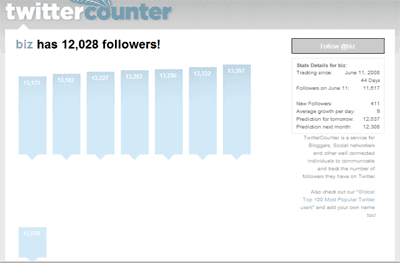
So I was just remarking on how well Twitter performed during the last Twebinar and was also telling someone how I received 25 new followers, and then the next thing you know, I start seeing tweets of people who lost hundreds, thats right hundreds of followers. I lost 40.  If you’re curious as to what your numbers WERE go here Twittercounter 

I would also suggest reading TwitterCounter, Inflation and Moby Dick The excuses as usual, are vague if not nonexistent from Twitter who has basically said, they’re cleaning out “spammers”. Can’t we take care of that? As it is, a quick scan can show you who’s a spammer, it’s not like they’re hiding, with names like amanda492 or tracy312 and what not, they’re easy as hell  to find.  They’re following 2,345 people and have 12 followers, I mean WTF?

We’ve been talking a lot lately about protecting the brand and I have to be honest, I know that there are certain market segments that utilize Twitter more than others but, and I’ve said this before, someone is going to come along and blow Twitter out of the water. They will build something faster, more reliable and failsafe. Find a need and fill it. Well guess what,  Can you say?

Opportunity

Want to see lots of pissed off Twitter people? Go to Summize and type in #suckit. Wonder if Twitter is following that? Can you say Brand Failure? Can you say No Brand Loyalty? Can you say revolt? How many times do we have to put up with this?


Social Media is not…Part II

As if having over 60 ideas, suggestions and observations of what “social media is not” was not enough, I now add an additional 25 responses from Linkedin and Twitter.

Social Media is Not

65. Your free answer generator if you run out of inspiration. After receiving this reply I responded that the person could do better than that and thus I received the following:

Social Media is not about individuals, it only is about its own gods and half gods. Since I am not a half god nor a god, it is quite obvious people would not know me. Social Media is also not definable since it is everything you want it to be and everything anyone else wants it to be. People who like to catch it in a few lines do not understand Social Media, since Social Media is more than some definitions and words alone it is a journey that never ends.

66. … A one way thing.

Be prepared for lots of criticism and people who have a lot of time and every motivation to make sure that what you are is accurate and true. If it is not… well we have all seen the examples.

Accept that any company/ product/ person that ventures into social media will be scrutinised and critisized.

While some shy away from social media for this reason exactly increasingly there is a realisation that abstaining is not a risk – free strategy. Getting out there and being honest might be scary but it certainly gains you a lot in terms of engagement and reputation.

67. … A substitute for a real social life.

68. …Doing much other than seriously turning everyone into a marketing expert to our global detriment.

When I mentioned that I would like to have him expound on this, and suggested perhaps he look at it differently, I received this heated response that diverts into a global political rant..

I’ll look at it as I please, thanks.

Anyone who tells me “you need to look at it like this” needs to look at, well, that kind of language and is a function of that culture.

The only reason I “need to look at it like this” is because your professional reputation depends upon the success of social networking. Otherwise what I said wouldn’t be such a threat to your well-being. None intended, but that’s what drives a statement like that.

True, social networking is not all bad, and they’re not all great either.

Where is all this communication getting us? It is a bourgeois pastime, a distraction from crippling debt, anti-intellectualism, fake dionesianism, and while on the surface, available to everyone for low-low rates, is yet another competition for time and energy towards things that really matter, like democracy and true personal freedom.

Our world is entering what appears to be an even greater period of vapid leadership than ever before. Why? Because MySpacers can’t see that Mr. Obama needs a team of 300 economic advisors. Bill Clinton could argumentatively engage that number in a blind-chess-tourney. All they see is a well-tailored marketing message.

Our present democratic contender is a direct result of the attitudes arising from social networking. He provides a message that is well tailored, yet inappropriate for our circumstance (he got prominence from unenlightened religious/political leader Oprah Winfrey, won the nomination on an anti-war platform, and having won it and being confronted with the economy, he’s got nothing. Nada. Zippo.)

We need a seriously deep, connected technocrat/intellectual to undo the ravages of this prior administration. This generation is going to continue to fail to see that all that glitters is not gold, and not all that’s being sold is worth buying. Unfortunately we’ll be worse off than with Hillary because they don’t know how to identify with what’s needed on a basis of principle over personality. And that’s the big, big problem.

At that point, I wished him well in his future endeavors!

69. The greatest thing since sliced bread, and it gets just as stale over the course of a few days. 🙂

70. The only internet marketing strategy.

71. An avenue to “push” your product.

72. A replacement for all marketing strategies and tools like ad, pr, print, tv, radio or other methods for a company.

73. Is not a replacement for good customer service or a good reliable product or product support.

74. Is not going to directly reflect $$ at the cash register in a short term– nor can it always be quantified in terms of dollars but actually name, brand, product recognition. Just as a tv ad might not reflect in significant sales, the social media should be dealt with in the same manner.

75. Is not static. It’s going to evolve so staying only on myspace.com isn’t the only place. There are other options that can employ social media within the context of the marketing strategy tools.

76. Is not just about the number of friends on whatever site you choose to be part of– you actually have to participate and you actually need to have a great product to deliver. It’s not just about the sizzle, you need to have the steak that goes with it. (as in show me the beef)

77. … Is _not_ a mass media

78.  … Something you can do in your spare time.

79. …Addictive

80. … Going to make you any money this year. Or next year. Or the year after that. Or the year after that, or the year after that, or even *gasp* the year after that — unless you’re kin to Rupert Murdoch.

81. …A goal in and of itself.

82. …new.

It’s something you and your organization are already doing, only without applying the “social media” tag to it. It’s using <insert platform here> to make it easier for people to reach each other.

The concept is ancient both from conceptual and technological aspects. What’s new is the shiny implementations popping up… and actual mainstream acceptance. It’s now officially cool to be connected.

83. …Owned by marketing, nor PR, nor advertising.

84. …A destination, it’s a tool.

85. … Accurate and qualitative enough to trust.

86. …Is not a solution to every communication or PR problem

87. …Is not just for kids

88. …Is not a replacement for developing a solid strategy and should not stand alone as a tactic

89. …Is not a new way of thinking, it’s a new way of doing.

As you can see, the perceptions sometimes do not mix with reality. I engaged in some really lively discussions on this topic and will cause me to create an interesting slide presentation on the subject. I’m amazed as well at how skewed and actually how misinformed some of the respondents were. You can also see, where some are completely fed up with even talking about social media anymore. Their loss I suppose. In the end, as I was telling someone earlier, in a few years, we might not even recognize the monolith that is social media as it evolves into iterations that we haven’t even thought of yet.