Your customers are not using Social Media-Case Study

I was talking to an SMB owner the other day who is doing everything that he is supposed to do in regards to social media usage for his company, and doing it seemingly correctly. By correctly I mean he has a Facebook fan page and a Twitter account which he updates semi-regularly. He is transparent, authentic, and he shares content and advice liberally when he can. He reads and comments on other blogs when he has time and he is thinking of starting  his own blog. He loves what social media can do and is a champion of it. There’s one problem tho.

His customers are not on Twitter and Facebook.

Or are they? The back story: It has not been a year of engagement for either platform that he’s on and thus the growth of fans and followers has not been consistent or completely measureable. He still loves it, but his perception that social media could be a game changer for his business is waning.

My thought? He may be echoing a larger sentiment of SMB’s far and wide. More and more businesses are walking away from social media because they are not seeing “the immediate results”.  Perhaps the first mistake is coupling the term “immediate results” with social media-Social is not a quick fix.

If we look under the hood of  the SMB owner, we would see that though he is on multiple platforms, there is minimal engagement. His usage of both is scattershot and not very consistent. The effort that he puts into both is casual at best and he measures nothing. If we add a dose of unrealistic expectations coupled with zero strategy, then he is ripe to walk away and say that social media did not work for his business.

So are his customers using social media or not? He doesn’t think so. What do you think?

Monitoring “G”

I was pulling some info about tomorrow’s #hashtag social media host Shel Holtz when I came across a video on his Posterous page about Gatorade’s  brand monitoring war room.

The video is well done and I love how they are investing time and effort in polishing and managing the brand via a social media war room. But it was the comment below the video that bothered me.

ooohhhhhh amazing !!
You check the stats of your websites ??? You gather tweets – with like, twitter search ?
Sooooo impressed !
LOL

I would volunteer that a bit more is required than that; but see what we, as marketers and managers of brands have to put up with? And you wonder why we  keep having to “sell” social media?

“Like” social media is “like”, soooo easy!

NOT!

Internal/External buy-in to social media is tougher than you think

Interesting how the intersection of what I’m thinking coincides with what others are too. Take for example the Forrester “social maturity” survey which wants to know which companies are ahead of the curve in implementing social technologies for both external use (i.e., for customers/consumers) and/or internal use (i.e., for employees/partners)?

I had been thinking pretty hard lately that the more that I talk to various companies of various sizes one thing is becoming quite clear. My passion and understanding of the power of social is not theirs. They may want to be part of the conversation but it’s not the same as mine, or the same for other similar organizations or competitors.

It’s all over the board.

Part of the reality is that companies want to be like their competition, or may just want to tap into the stream, but they want to do it on a 9-5 basis say maybe 3 times a week. The rub is, they want to enjoy all that socialness has to offer externally but are not as committed as they need to be internally. Which begs the question.

What level of buy-in and to what extent of buy-in internally do you need with social media in order to be successful externally?

Forrester is dead on in where they are going with this. It is clear that many companies have made some major strides in planning and organizing for the use of social technologies. But one of the primary questions we know they are asking is “where does my company stack up  compared to my peers and competitors in the use of social media-both externally and internally?” It’s natural to want to know how you stack up.

Is it a chicken vs. egg thing? Internal or external? Can you do one without the other? Are you doing one and not the other? Are you doing anything? Or do you still think it’s a fad? Take the Forrester Survey

The Social Media Press Box

When things are going good we don’t need to do anything. Maybe.  That’s what a lot of companies and people do. If it ain’t broke, don’t fix it. So somewhere along the line, the Cleveland Indians have decided to “fix” something. According to ESPN the Indians have established a 10-seat section in left field for bloggers and social media users in an effort to engage fans and further the Indians’ brand in the social media space. It’s called the Tribe Social Deck.

Hmmm…

I think I like the idea. Maybe it’s just the timing of it that I don’t like. So tweeters and bloggers get a press kit, media guide and press releases, and are free to update followers and readers throughout the game just as they normally would. But unlike the traditional press box, they don’t get any access to players or managers.

What will the tweets and live blog updates look like if the product on the field sucks? Isn’t that like fanning the flames? There is not a “stated” policy in place that requires them to say positive things, but I can see it now…

The Indians are down 6-0 in the 3rd but there seems to be a lively game of keeping the beach ball alive in left center#Indiansrock

This could be a problem. By hiring or inviting this social media deck to the game aren’t the Indians setting themselves up to go against the MLB social media policy? Check out this quote from Curveball: MLB’s tight control over social media

Multiple sources have confirmed to me that Major League Baseball is cracking down on Twitter usage, ordering MLB.com writers to cease tweeting about all non-baseball topics and scolding players for their Twitter usage in general.

I know, apples and oranges right? In the defense of the Indians they are allowing the fans to let it flow and are not going to try and control the message. It will be interesting to see however, how many games brutal honesty will get you in the social deck. The Indians are hoping that reaching out to influential Bloggers and Tweeters who happen to be passionate Indians fans will be the bridge to a warmer and fuzzier relationship with “other” fans. Transparency might only get you so far.

So while the Indians aren’t directly telling users what to send out to followers and the like, the whole process can have some influence on the type of coverage the team is getting.

OK, in theory I get this, and I would probably try it as well. I’m just not sure it’s going to work. It’s going to end up being subliminally manipulative of the message and the conversation. It’s like paying for blog posts. Look at this quote from Dominic Litten:

“They’re reaching out to people that are Cleveland sports enthusiasts or fans because they know these are the people that are going to spread that message: ‘Hey, it’s fun’ or ‘The Indians are doing cool things.'”

I agree but let’s see what happens. At the least, I applaud the Indians for trying. It’s just that the timing is not the best given the product on the field. But hey as we have always said, the conversations are happening with or without you-I just hope the Indians have thick skin.

The “other” types of social media users

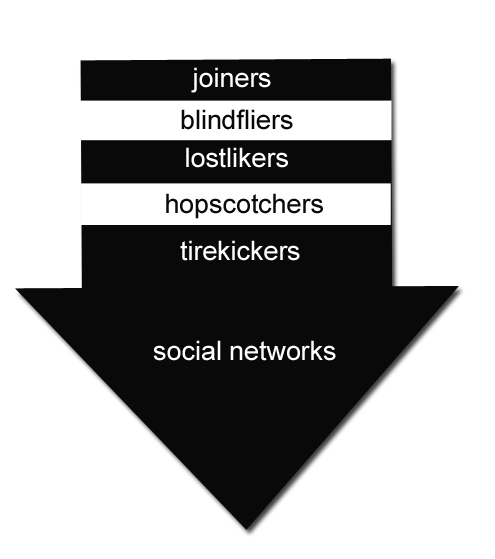
This is such a transcendent time isn’t it? I’ve been thinking a lot about how people use social networks and why. We have talked a lot about digital natives, immigrants, early adopters, lurkers and what not, but there is another group I’ve been tinkering with that I can easily add to the mix.

Joiners

The newbie in social media might think, and somewhat accurately I might add, that it’s easy to just dive right into social and worry about the big stuff later. True, you can, but I like to categorize those people as the one’s who leap before looking. They’ll join any and all social networks that they can. By the time they stop to worry about the little things, there will be bigger stuff on top of the big stuff and they’ll gravitate towards that.

Blindfliers

Then there are those that might look before leaping but don’t really know where they are landing. They are flying blind into social media. They’re excited. They’re not even taking the time to learn, but that’s not really a concern. They’re just happy to be here. They learned just enough to be dangerous. Like how to upload and share photos. They are a critical component to the success of social media-they will share the coolness of it all with others.

LostLikers

Some do manage to land after leaping but then they don’t know where they are. Those are the one’s who join a social network without really vetting the users of that group. It just seemed like a cool network to join; Or a cool tool to use, or a good idea at the time. They created a profile and started to interact before realizing that this group is not really for them. There are a lot of people that fall into this category. The good news? They liked their initial experience. Eventually there will be a tribe for all of them.

Hopscotchers

Still others leap and never land-To me those people are not really into it for the right reasons; they are the marketers, agencies, advertisers and companies that are trying to capitalize on all the buzz that they’re hearing. They will create a profile, add a link, and not much more; they’ll think that’s sufficient to get it done- -they’ll soon move on to the new shiny thing. Those people will shortly be touting how brilliant and cool Augmented Reality is.

Tirekickers

There is of course those that might land but they don’t really care if they do-they are the ones who will test drive, use the networks a bit and move on, declaring that social networks don’t work. They don’t give it a chance. They are not really engaging-or don’t understand the level of engagement needed to be successful. Those are the Tirekickers. They might be useful as beta testers and not much more. If they decided to stay around longer than a month.

What other types of users are there that I could add to this?

Leveraging Twitter: From Tools to Tweetchats

Below is a deck that I did for a Brighttalk Webinar this morning. There just may be some sites in here that you don’t know about.

Social networks are redefining what a friend or a relationship really is

This is a post where I am right but so is Brian…

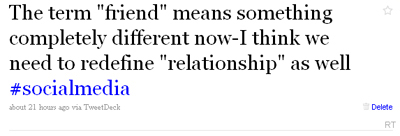
So yesterday I was talking via Twitter with Brian Dresher, the manager of  social media at USA Today. The discussion brought on by this tweet/thought:

Brian followed that thought up with mentioning that “following” someone pre-Twitter meant something more akin to stalking than it did to something more related to complimentary. You got that right.

There was a bit more to the conversation but here’s the point that I want to get across- and I’m fairly certain that you would agree with me. If you don’t, that’s OK, these thoughts are my own.

Like it or not, Social networking is redefining terms of “social endearment.”

It’s forever changing the etymology of commonly used words; and I would say easily within a few years it will completely alter their understanding and perception as younger generations continue to evolve as digitals’  new natives.

Here are the prime and most glaring examples.

  • Friend-Means absolutely nothing anymore. All it means is that we have allowed the other into our networks, or vice-versa. Soon we will have to qualify what kind of friend you or they actually are.
  • Follow-At its core, to follow would mean to come or go after; proceed behind; go in a straight or obvious course. There is nothing in the social networking world that resembles that definition. But as it stands now, if I were to tell you that I follow him or her-there still might be a pregnant pause. That too will soon change.
  • Like-I don’t even know where to begin.
  • Relationship-the definition of the relation connecting or binding participants in a relationship would seem to closely align itself with today’s social networks. However, some now think that relationships can be built on the thinnest of determinants. Which lead to this next tweet from me:

It took Brian’s next tweet to add the proper context to all of this.

He’s right. I didn’t know Brian before all this social networking “stuff” started and now we have a casual business relationship because of it. It has become enhanced because of it. We have met and talked at a conference, and later this summer he is going to host a Social Media Tweetchat for us. Thanks to the power of social networks.

Is there a fallout to all of this? No not really. We’re just adding layers to the complexity that is online communication.  In order to get to or take a relationship to the next level, They’ll still have to be consummated at some point offline. Right? Maybe not? Maybe these new layers allow for less physical/face to face interactions?

Maybe not.

*I know there were a ton of other “social” words that don’t mean the same thing as they used to that I did not mention. I’ll leave that up to you guys. Anyone want to start a wiki?

The Value Myth of Social Media

I was reading the post 7 social media truths you can ignore this morning when I was struck by one of the last things mentioned in the post which said, Provide Value.

As soon as I saw that, I had to get this thought out.

Scene 1.

You’ve been dating your significant other for a few months now and have decided to end it. Why?

They’re not bringing enough value to the relationship. Of course that translates better into things like:

  • They were slobs
  • The snored
  • They couldn’t hold a job
  • They cheated

What does that look like in the online world of social media? I unfollow you on Twitter because all you do is tweet out links and you’re not giving me enough value in the relationship.

What did I expect? I’m not sure. A business relationship? Maybe.

I followed you based on what your bio said. Oh wait, I followed you because you followed me. Similar to picking someone up in a bar isn’t it? You looked hot, we didn’t really talk much, mainly because it was so loud and dark; but on the surface you looked promising. So I had no expectations in the first place.

Value or perceived value is so subjective and so hopeful isn’t it? It always is in the beginning.

Shouldn’t the value that we want or expect out of others be commensurate to what we are putting out there? I’m trying, shouldn’t you? Or is it one way, or one sided?

Scene 2.

If I’m on a basketball team and I bust my ass in practice and during games, I should expect that of my teammates right? What if they don’t? Should it bother me? Should I complain? Should I say something to someone? What if we still win? What if each component functioning on its own and in its own way contributes to the sum total of the parts?

Should I demand value from my teammates? If I don’t get it, do I quit? or do I focus on my own game and do what makes me who I am and let it go? Is that selfish? Is it up to me to tell them that they are not bringing enough value? What if that’s the best that they can do?

If I expect value from every relationship or scenario that involves other people and I don’t get it, what am I going to do? I can abide by that mantra in social media, or try to abide by it, but to honestly and genuinely expect it from every relationship that I engage in in social media, is going to render us all sorely disappointed. no two relationships are going to render the same results. That doesn’t mean that it has to suck. Or that you end it.  You can cultivate the good relationships. Just treat the rest of the relationships for what they are. Just people being people.

I am wont to say from time to time that the value you take in social media should be equal to the value that you make. I still believe that and I still tell others that. It’s a good cornerstone. But sometimes I think we focus too much on the Utopian way things need to be in social media instead of the way things just are or will be.

10 social media sites, blogs and links you might have missed

I haven’t done a post on stuff I’ve saved lately, and I love when others share links, articles and sites with me, so here’s a few that I’ve accumulated.

I’ve been writing and talking a lot about Facebook and children and parents lately, and the site Togetherville is at least a step in some direction. I don’t know if it’s the answer but at least someone is doing something.

I came across Tlists when I showed up on one of it’s lists of “The most listed Tweeters on 921 lists about Social Media”. Find the best tweeters on any topic.

When I participated in this innovative Twitter project by Toby Bloomberg is an incredibly smart marketer out of Atlanta, I had no idea she would make it into an ebook, but it’s a great read and was a great idea! – Social Media Marketing GPS: A New Media Roadmap For Creating A Social Media Strategy

What are the top brands on Facebook? What might be a better question is, Are you surprised at who you see on this list? Fan Page List has all the data.

From one of our weekly Tweetchats hosted by JD Lasica on Facebook and Privacy, this link was shared: Facebook Backlash Sparks Transparency Tools which has a couple of really good tools in the article.

While we’re at, have a look at Openbook

I can’t say it any better than this: Where DIY meets WTF..

Turn an email address into a social profile with Flowtown

This has some potential now that Ning has constructed pay walls; Add a forum or social network to your blog with BlogFrog

This last post was so dead on and had me laughing and nodding my head all in the same breath. 8 websites you need to stop building

Got any I might have missed?