
Think you can make money on social media sites?

Can advertisers/marketers make money in a social networking environment? That is the real question.

Forrester reports about 30 percent of social networking site users embrace a brand so that they could become eligible for  freebies,exclusive offers, events or sales or because another friend recommended it. Forrester gave this type of social consumer reaction as “friendonomics.” Granted it greatly helped the brand if they(the users) had some clue about what the brand was all about prior to befriending it, but it wasn’t a complete deal killer.

With that being said in regards to having a clue about the brand, Forrester states, Gen Y users “show the greatest interest, with 37% saying they would be interested in seeing marketer profiles on social networking sites. Gen X isn’t far behind, with 31% showing interest.”

What appears to work though and is gaining some traction, is the creation of widgets or apps on Facebook.  If you use Facebook, you no doubt have noticed the plethora of new apps that have appeared over the past few months. These apps, created by marketers for instance, give some legs and visibility to brands, new products and sites that are looking for traffic and eyeballs.

Back in August of 2007, Google filed another  patent for “user-distributed advertisements” (UDA) whereby the UDA system “facilitates insertion of manually selected ads into a document that is to be distributed (e.g., transmitted, published, and/or posted) such that the document is to be made available to other users.”

The document explains why it’s a good idea: “Although advertising systems such as AdWords and AdSense have proven to be very effective tools for advertisers to reach a receptive audience, even automated systems that use sophisticated targeting techniques often can’t match the effectiveness of manual targeting. However, manual targeting techniques don’t scale well. Therefore, it would be useful to provide a scaleable advertising system that achieves at least some of the benefits of manual targeting. It would also be useful to provide a system of charges and/or rewards to encourage useful manual targeting of ads. Further, it would also be useful to track and use performance metrics of such ads if doing so would help an advertising system serve ads that are more useful. Finally, it would be useful to provide data structures and interfaces for enabling advertisers to participate in a system for manual insertion of ads into a document for distribution.”

Long story short is that Google wants to figure out a way for its users to be worker Bees that essentially spread or carry advertising. What better way then to incentivize every possible action that someone does while online. So I send you an email and I go ahead and drop a couple of Adsense bombs in the body of the email and off you go to make us both money. All of a sudden it does pay to advetise via email again and the more viral the better!

The problem with trying to tie together advertising for instance, and social media is that to most and we’ll use direct response, is that DR advertisers, are going to look at specific measurable results which essentially will tell them if it’s a) worth it and b) should they test again. the problem with social networking sites and advertising, at least right now is that the results of advertisers are not yet quantifiable or measurable to a degree of their liking. There is too much grey area.

It’s grey because Social media is about engaging the prospect, befriending the prospect and winning the prospects trust instead of vomiting the information(makes for a great visual doesn’t it?) and the pitch, all over them. And if you don’t think is true, go ahead and try it and let us know what type of experience you have.

Essentially the whole social media experience as it pertains to direct response is more about marketing than it is about advertising. And to that end traditional  online or offline advertising will not work in this environment anyways. So don’t bother.
 

The Public Perception of Social Networks

Unless you have been living under a rock….

I’ve been using that statement a lot lately and it seems to be very appropriate these days given the state of all things technology related. between the iphone, MySpace, Facebook, Android, Open Social, and all things in between, it is a great time to be a digital consumer. Or is it?

You know when AOL first came on the scene, Everyone had the same thought. What is this going to do to the way we communicate? What will AOL do to the social fabric of our lives. That is the exact thing happening in the social networking world. If you would like to stand and admit that you too had an AOL account at one time, it’s ok. We’ll pause.

Ironically AOL was the beginning of true social networking, through AIM. And if you really want to know the truth, AOL’s phenomenal growth wasn’t based around internet access. It was the ability to chat with others. To communicate with others. THAT is social networking. Finding people with similar interests that you could connect with. The real difference now, are the tools that are available to the common user to create and enhance their social networking experience or communicating experience. Social networks have become social media sites as well.  There is now a distinction between the 2. There is a social media type site and  social networking type sites. The tools now available allow users to share more than just words. Its now photos, music and video. Those are social media sites. Like Youtube or Flikr. Nothing new there right?

Because of this, social networking sites are the most frequented websites on the web. In fact according to Hitwise, the demo of 18-24 users hit Facebook more than they visit porn sites! So now instead of what is construed as a one way relationship with a porn site for instance, is passed up because now this demographic can go to Facebook and have a better overall user experience. Amazing when you think about it. Content isnt’t king, porn isn’t king. Social networking is king!

But what is the overall public perception of social networks?  That seems to be changing as well. The perception for some is, “I’ve heard about them, but I just don’t know enough.”. While others have jumped in with both feet. and some have dipped toes in the water. This is perception can be blamed on the media, marketers, and word of mouth.

Depending on the demographic, and this is no surprise as your 15-24 age group are always going to be the early adopters, the social networking experience is going to be different in regards to perception and usage, for each and every group. However this is changing as well as users realize that there is more out there besides Facebook and Myspace. Check this blog for older posts about the top rated social sites in business, video, and music. To read an interesting and no to surprising article about class distinction in social networks,  read this article by dannah boyd.

 the bottom line about social networks is that people are finding their people, their packs, their groups. Just like they did on the playground as children, it is now taking place with social networks. And you know what? There is nothing wrong with that. You see, the public perception of social networks right now is skewed, because THEY DON”T ENOUGH to make an educational, much less personal decision on whether to use them yet. So they base their opinion on their perception. It is changing though and rather quickly as statistics show that one of the fastest rising demographic of users on Facebook are the 35+ group. And of course as a side note, you know this is going to piss off the 18-24’s who will now have to latch onto something that is cooler.

But public perception of social networks is still skewed across the following words and statements:  Uncertainty, a time drain, a resource drain, zero value proposition, spam extenders, virus friendly, a place for stalkers to thrive etc etc. In fact, The blog Switched reports that according to a new study by an employment law firm, approximately $264 million U.S. dollars are lost in man hours because of Facebook.

The thing to understand here is that like any relationship, you get out of it what you put into it. Whether that is online or offline. The only way you are going to see whether a social network is for you is to take one for a test drive. It doesnt neccessarily have to be MySpace or Facebook, though those two are not bad starting points, but the only way to find out is to jump in.

It may enhance your computing experience or it may be a detriment. It totally depends on what you want to to achieve. Is it for business? Then there are a lot of purely social networks geared toward business and building relationships that will fit your needs. Start with Linkedin.

Just remember, in the end, you’ll get out of it, what you put into it. Just don’t base your opinion on what you have read or heard from someone else. What DO YOU think their perception is? What was your perception before you tried them out? What were your expectations? What are your expectations now?

The top 10 hottest Social Networking Widgets

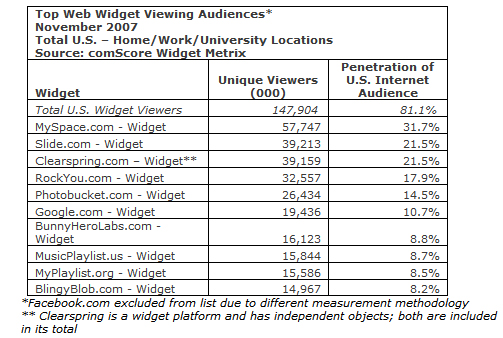
 Comscore released the November 2007 U.S. rankings of the top web widgets. For those of you who do not completely understand what a widget is, it’s essentially independent objects or an object that can be embedded or downloaded onto another site and can be used as a tool, have automatic content updates, or are or can be interactive. Though they go by the name of “widget”, Facebook calls them “applications” and Google calls them “gadgets.”

In November 2007, nearly 148 million U.S. Internet users viewed widgets, representing 81 percent of the total audience. MySpace.com widgets had the widest audience, reaching more than 57 million Internet users, while Slide.com ranked second with 39.2 million viewers. Google.com has the sixth widest widget-viewing audience with more than 19 million viewers.

What’s the “skinny” on what widget usage means to the lay person? Simply put, it means that widget usage can be computed as eyeballs on the site, which also means that if the widget is cool, you can bet others will go to get the widget. The widget is essentially another form of advertising. If they have your widget, that means they came to your site or heard of your widget from someone else. Word of mouth, Seth Godin, word of mouth!

Having said that, take a look at these November numbers.

Comscore Widgets

Obviously MySpace is the dominant player here but look at the others on the list. Slide for example is the largest personal media network in the world, reaching 144 million unique global viewers each month and more than 30 percent of the U.S. Internet audience. They help people express themselves and tell stories through personalized photos and videos created on Slide.com and viewed anywhere on the web or desktop.

Slide’s products — including Slideshows, FunWall and SuperPoke! — are popular on top social networking and blog platforms, including MySpace, Facebook, Bebo, Hi5, Friendster, Tagged and Blogger. Slide is also the leading developer on Facebook with more than 84 million applications installed and the most active users than any other developer.

Clearspring though is NOT a social network. Clearspring is the leading provider of cross-platform widget services. Their goal is to make it easy to use content and services from across the Internet to weave personalized experiences. Clearspring is the leading enterprise-class widget syndication platform. With our out-of-the-box syndication solution you can quickly repackage your existing content and services as viral widgets and syndicate them across multiple platforms.

RockYou is a leading provider of applications and widgets on the web. RockYou widgets include photo slideshows, glitter text, customized Facebook applications and voicemail accessories that are simple to use and enable people to frequently refresh their online style. RockYou has over 35 million users, serving over 180 million widget views per day in more than 200 countries. RockYou applications are customized for easy integration across all social networks including Facebook, MySpace, Bebo, Friendster, Tagged and hi5. RockYou’s cost-effective, results-focused advertising platform is the largest Ad Network on Facebook and the most dynamic method for rapidly acquiring Facebook application users. New applications can reach over 100k users in 24 hours, spanning a suite of applications across multiple publishing partners

Photobucket Owned by News Corp is the most popular site on the Internet for uploading, sharing, linking and finding photos, videos, and graphics.  Photobucket, According to Comscore is: 

  • 24.1 Million unique site visitors/month in the US, and 34.6 Million unique site visitors/month worldwide.
  • #1 most popular Photos site in the US.
  • #3 most popular Entertainment/Multimedia site in the US.
  • #7 most popular Entertainment/Multimedia site in the world.
  • #24 in Top 50 Sites in the US and
  • #47 Top 100 Global Sites

The next one is BunnyHerolabs, bunnyhero pets bebo app the pets have been available on bebo for a while now as “widgets,” but now bunnyhero pets are available as an application on bebo’s new application platform.

What this means for bebo users is now when they adopt a pet on bebo, they can add the “bunnyhero pets” application. With the new application, they are able edit their pets after they’ve added them to their profile, like changing their pet’s name and color.

Next are the Musicplaylist.us and myplaylist.org widgets, which are a no brainer in the land of “can’t-miss” and “must-have”, widgets. And lastly if you ever wondered where all of the kitschy graphics on the MySpace pages was coming from, look no further than, and the name seems awfully apropos, BlingBlob.com. BlingyBlob.com, for us uninitiated, is the hottest source for FREE high quality graphics, animations, Flash and much more for your MySpace page, personal site, or blog. Makes you giddy, doesn’t it?

Look for music, video and image sharing widgets to continue to evolve to an extent that perhaps one day they become part of someone’s v-card or email signature, along with the location of their MySpace, FB or Linkedin pages.

The growth of social networking

By 2011 about half of U.S. online adults and 84% of online teens will be using social networks. This according to eMarketer. What this points to is an evolution or a continuing evolution of children who currently are becoming aquainted with and more comfortable with, “How social networks work”. This also points to the greater value that adults will put in their social network. “Their” being the operative word.

Furthermore, this raises a very poignant question. Though Facebook and Myspace are the darlings of the moment, can they continue the momentum that they can surely take credit for? Will they be “The” players in 3 years?

As it is right now today the evolution for most users looks something like this:

Club Penguin/Webkinz—->Myspace—->Facebook—-Linkedin.

I use Linkedin as the last one for professional reasons but really after Facebook, the usage fractures into a 100 different niche based social networks. This usage in the next 3 years will continue to evolve into hundreds of other social network sites.

My educated guess, though they (MySpace and FB) will still be viable, there will be others that will come along, if they have not already, that provide more to their niche than the current duo do. Here is the reasoning. Myspace is for teens/bands and tire-kickers and fringe users. Facebook is for college aged and older users who have more of a familiarity with the social network and all that it can provide.

So in 3 years when your current crop of Facebook users for instance, graduate and possibly outgrow the Facebook newness/coolness factor what do they do then?  What do adults who are currently using Facebook do in 3 years? The same thing I suspect that AOL users did once they found out that AOL wasn’t the only game in town. Everything will evolve. Including the knowledge and expereince of the users. Thus the reason that by 2011, social networks will be so entertwined in our daily lives that it will be assumed that you are part of some SN.

The good news, and really none of this is bad news, but worldwide Ad spending will increase at a healthy 20-39% each year between now and 2011 according to eMarketer. In the U.S. alone social network ad spending is expected to rise to $2.7 billion in 2011. Currently the pie is being divided naturally towards Facebook and MySpace, but look for that to change significantly with the growth of niche and marketer oriented sites.

Social Networks by the numbers

For December 2007, MySpace.com received 72 percent of U.S. visits among the social networking category. Facebook.com received 12.57 percent of visits and Bebo.com received 1.09 percent of visits. (according to Hitwise)

U.S. traffic to all the social networking websites increased four percent year-over-year. MyYearbook experienced the largest gain in market share in December 2007, increasing 407 percent compared to December of the previous year. Facebook and Club Penguin followed, increasing 51 and 48 percent, respectively. For those who are unaware of Club Penguin, it is the entry point for children into their first brush with social networks.

In December 2007, MySpace received 95 percent of its share of traffic from returning visitors. Among the top five social networking websites by market share, Facebook and BlackPlanet.com followed with 93 and 89 percent, respectively, of traffic returning from the previous month.

Market Share of U.S. Internet Visits to Top 10 Social Networking Websites

Rank

Name Domain

Dec-07

Dec-06

YoY % Change

1

MySpace http://www.myspace.com

72.32%

78.89%

-8%

2

Facebook http://www.facebook.com

16.03%

10.59%

51%

3

Bebo http://www.bebo.com

1.09%

0.99%

10%

4

BlackPlanet.com http://www.blackplanet.com

1.04%

0.96%

8%

5

Club Penguin http://www.clubpenguin.com

0.80%

0.54%

48%

6

Gaiaonline.com http://www.gaiaonline.com

0.76%

0.58%

31%

7

myYearbook http://www.myyearbook.com

0.73%

0.14%

407%

8

hi5 http://www.hi5.com

0.63%

0.64%

-1%

9

Classmates http://www.classmates.com

0.55%

0.58%

-7%

10

Yahoo! 360 360.yahoo.com

0.54%

0.91%

-40%

What is a social network? Really.

A new report by Strategy Analytics claims that roughly one out of every 6 people on the face of the earth will be using social media in 5 years. To what extent and for what purpose reamins to be seen but the report also adds that there are currently approximately 373 million people using social media. “It is clear that user generated media will increasingly compete with professional media when it comes to the attention and free time of users,” comments Martin Olausson, Director of Digital Media Research at Strategy Analytics. “However, if professional media companies choose to embrace social media applications it will enable a more direct and positive relationship with consumers, which will in turn drive increased engagement and loyalty.”

The rise of social media sites and applications can be attributed to the desire of web users to create and manage their own content. This desire has fueled a cottage industry of niche based sites that are geared towards like minded individuals cut from the same cloth. What was unexpected though was the evolution and sea change effect that this has had on computing as we know it in the 21st century.

If the report’s estimates are proven to be accurate, one can only assume that there will  be more social networks available, all with their own hook, niche and community. One can also expect that blogs will continue to grow at an exponential level as the ease in which someone can create “their” blog will continue to evolve into an even more intuitive interface.  What all this means is that the rules as we know it in regards to how content is produced and how it is deduced will no doubt change. Just as everyone is now an amateur videographer, now too will there will millions of social commentators who will develop loyal readership bases. This will change the way the public perceives what they read.

One of the more interesting aspects of all this of course, is how marketers and advertisers are salivating over the prospect of selling to these targeted customers. The only problem is that the last thing that these social netizens or users are interested in, is your product. They will and can smell a marketer a mile away and thus if they are “found” out, they can forget it.

Social network users don’t want to be sold to. That is, in part why they are here in the first place. They want a nirvana like environment in which they can do their own thing without having to deal with a marketer or an advertiser or a pitch.  They want to play and share their widgets and tools with others without having some ad streaming across the top of the page. They want to  post, comment, create and “maybe” make money as well but as discrete as discrete can get.

Because of the value of user generated content and the lack of desire to be approached by advertisers while those users are in their “world” something has to give. Either users accept it or..advertisers get smarter or more respectful. consider the former being the road of choice. but really what we’re talking about is a sea change in how individuals go about computing. The sea change being a) that we accept that search is an integral part of of how are day begins or rather our computing day is wrapped around search and is integrated with search and b) What do we do with the rest of our time online? Social computing is your answer.

Ok so now what do the rest of us who are not into blogging or social networks do? Ahhhh…  but wait, before we are too quick denounce this “social networking” thing that is too hard to learn, perhaps we might want to reconsider a social network. Think back to when you or all of us were in High School. How were you labeled? What defined you?  The answer was, we were all in a clique a group or on a team. If you think about it, it’s how we were identified when we were growing up. What “group” were you part of? It was what gave us our identity.  The band, the chess team, the football team, the student council, the yearbook staff. Those were all social networks. The only difference between then and now, is that we can now share and communicate with those people 24/7/365.

Still there are inherent problems. The biggest one being a barrier of entry. Computing though accessible by all, is not affordable by all. Computers though accepted by all, are not understood by all and lastly computers, though they can close the gap between countries and people who wish to communicate, they cannot solve the issues of war, famine, and natural disasters. So yes social networks are a wonderous thing but truly, the only way they work is if people are willing to communicate, exchange ideas,  respect one another, and share in common goals and beliefs. Hmmm. there’s a novel idea. Is there a place for social networks? Absolutely. It’s just up to us to redefine them, because right now they are all cut from the same virtual cloth.

Social Networks cutting deals left and right with mobile carriers

As was previously stated in earlier entries, something had to give in the wonderfully bloated world of social networks. It actually has been in play for awhile but, lo and behold, mobile carriers are realizing that the next big thing for their continued world dominance will be the melding of social networks with mobile carriers. Thus the following news doesn’t really surprise me:

 MySpace Mobile to be Packaged with Sprint

Fox Interactive Media and Sprint have hooked up to offer MySpace and other FIM properties to mobile customers. Under the deal, MySpace will come as a default option on Sprint’s mobile portal, meaning that the site can be accessed directly as opposed to typing in a URL (in this case, mobile.myspace.com).

sprintCurrently in beta, MySpace Mobile will launch officially early next year. Other FIM properties included in the deal are IGN, FOXSports, Photobucket, Rotten Tomattoes, and AskMen.

Why is this important? Because the users of social networks use something even more frequently than their respective social network. Namely, their cell phone.  So the thinking is; If you can pair the 2 digital beasts, then you have a match made in marketing heaven. A captive audience 24/7/365. Now this comes on the heels of the announcement in October that:

O2 Partners with MySpace and Facebook for Mobile access in the UK

o2_logo.gif

O2, the UK mobile operator,  announced partnerships with MySpace and Facebook, giving its users access to these social networks from their mobile devices.

This partnership provides  MySpace and Facebook users, access to their profiles pages for viewing and editing via their cell phone or hand held device. Granting mobile access to the major social networks is another way in which consumers, especially in the teen and college demographic can stay engaged with not only their social groups but also with advertisers and marketers. Virgin, Nokia and Sprint have all gone this route as well.  O2 already has a deal with Apple for exclusive sales of the iPhone in the UK.

And this comes in from the vapor trail of a July announcement in which:

Sprint Nextel had announced two new services  which enabled users to access social networking sites, and let customers locate each other using GPS technology.

Providing better browsing options for access to social networking sites such as Xanga, Rabble and LiveJournal meant that users would now have more reason to use mobile browsing and stay better connected with friends.  Partnering with Loopt, Sprint Nextel is also allowing users to geo-locate one another via GPS, within another private network of friends.

The only sticking point with all of these announcements is that there is still the speed issue that all of the carriers and the respective social networks seem to be ignoring. Granted the iphone seems to have all the speed you need with their Safari browser, but not everyone can go out and afford an iphone. Having said that, what is the 15-18 year old supposed to do with the free phone their parents got them that can only text 50 times a month, supposed to do?

It’s too soon to tell, but don’t think that we’re the only ones who have mentioned it, or have thought about it. The bottom line is this: That the social networks know that a key to their survival will be extending the social network beyond the confines of the home/bedroom. Until they do that, like I said, They’ll all eventually end up standing around staring at each other saying, “Now what?”

Do Boomers know the power of a social network?

I just had read where uboomerutv.com was reinventing itself and making the leap, or so they say, from a second tier social network to a premier social network. My first thought was that a used car company could start selling caddies and a Lexus here and there, but at the end of the day, they are still a used car company.

Thats not to say uboomerutv.com is not goint to make the leap but it does beg 2 questions: 1) what is up with that name? and 2) If Boomers comprise the largest demographic in the world then theoretically your numbers for u-b-o-o-m-e-r-u-t-v.com should rival that right? So 20 million users should not be out of the question.

Ok so there is something wrong here. The first thing is and I’m not underestimating the tech knowledge of the Boomer but all I keep thinking is Homer Simpson reading aloud, “press any key to begin” and then stating, “where is the any key”?.

Boomers do adapt quickly I will give them that, but will they adapt to the previously named website above that I refuse to type any longer? I’m not so sure. They will however go to Facebook and even MySpace, to check out what they have read and heard from just about every major news source on the planet as of late. The problem is and maybe this is where the previously named website that I refuse to type any more comes into play. If they really like 10-30% for instance, of what they saw on Myspace and Facebook, but felt the demo was not just right for them, maybe they will embrace the other boomer sites.

The other question is, what are they doing on these networks. Are they exchanging their favorite music? Looking for “cool widgets”? Looking for Love? Are they into creating their “pages”? There’s where the disconnect is. Facebook and Myspace thrive because of the content managed aspect of their sites and the ownership and freedom that teens and college students take in “their pages”. That aspect does not have the same sex appeal to Boomers.

Boomers want info and want to share info that is relavant to their lives at that moment and beyond. But they also want to be able to share and learn without a huge learning curve. Hey it’s great to have all sorts of cool tools and widgets, but if you’re building it because it worked on MySpace and Facebook, then you have totally missed the boat. So do Boomers know the power of a social network? Yes and No. They know the power of Myspace and Facebook because they heard it so. They don’t know the power of a social network thats geared towards them because of a perceived learning curve and a lack of knowledge and understanding of what it can do for them.

S-Commerce, where the E meets the social network.

A funny thing is happening to all of those builders of cool social networks. It’s the same thing that happened in the pre-dot com bust days. After their cool sites were built and they were all sittin’ around drinkin’ a microbrew, they all got the “South Park” look in their eyes and in unison said, “How do we make money”?

Again, in unison they said 2 things. “Well first we’ll make money off of advertisers and then, when we get so much traffic we can barely function, someone will buy us’.  I got news for you, a 1000 visitors a day, let alone a week, ain’t gonna gitter done.

So lets flash back to the South Park image again as they all look around after seeing that their traffic aint hittin the millions. “Now what”?

Well here’s an idea. Since consumer visits to social sites are growing at an exponential rate,  and since they’re becoming more comfortable with the model and more comfortable with the tools, controls and widgets of these sites, wouldn’t it make sense as a marketer to take advantage of this niche community? The answer is yes. But what about the owner/operator of the site what do they do?

So’s here how it goes down. Lets say I have this  social network for the lovers of all things llama. Why can’t I blend the transactional and social aspects of this group  by involving consumers in promoting and selling their offerings as they pertain to…”All things Llama”?

As these social sites become more and more “social”, and people find themselves spending more time on these sites, they become impervious to traditional media; That media being Tv, Radio, Newspapers and magazines. And what happens is that now all of a sudden your social network of peers and “friends” can now influence a buying decision. Because you trust them and they, you. Statistics show people join a social networking site to receive four benefits, 1) to meet people (78%); 2) to find entertainment (47%); 3) to learn something new (38%); and  4) influence others (23%) I tend to disagree with the 4th, but that just maybe a residual effect of a marketers desire to influence the social perception of their product.

Whats interesting to note though is that members of social networks have a higher disposable income than the general population – 20% more – and spend more of it online. So if they do and going back to our llama group analogy, we now present Joe, who is selling the most healthy llama snack ever made.  You trust him because Joe is a llama lover like you. Wouldn’t you buy your llama snacks from Joe? Of course you would!

You now have seen the benefit of selling to your peeps. S-Commerce.

But the question will  and does arise, how does a marketer get to Joe? How is Joe influenced to buy the best llama snacks?  For starters maybe Joe went to a branded micro-site devoted to llamas and their snacks, saw that they were offereing a free trial, and jumps on it. Or maybe Joe read a review online somewhere about the latest in llama feed and someone mentioned Killer llama Snacks. Joe could have been in a llama forum where he saw a skyscraper? Perhaps he could have been on a competeing site and saw an add for the latest llama snack? See how many ways you can get to him?

Of course Joe might be a heavy blog reader and reads a couple of killer llama blogs everyday where he reads some posts by the author or readers about an amazing new llama snack. Better yet, Joe loves Youtube, so combining his love for llamas and video, Joe does a search and finds a cool 30 second spot on the llamas at the san diego zoo that are big and strong thanks to the killer llama snack.

So by combining all elements of branding, and marketing, and advertising along with the power of a social network. And the trust that only a niche group could have for someone within the group, S-Commerce can thrive. The best part about it is that if your product makes it into the group. No selling is required.

Furthermore, you’re probabally asking, how does the owner/operator make money? Well since he owns the niche site, wouldn’t it behoove the maker of the killer llama snack to come to the owners and see if they can cut some type of marketing deal to push their product? You betcha. So now the only advertisers on the social site are relavant to the niche aspect of the site. Everyone wins…

Lastly, taking this to the next level then would be a company like lemonade.com Where they literally provide you with the stand and all you have to do is supply the products. Just make sure they(the products) are relevant to your group and you are good to go! It would also help if you were actually part of the group. Trying to win over the group as a  passing member of this group is a hard sell and could result in an instant loss of street cred. So tread lightly, stay long, grow some roots and sell some product. Can you name another seamless example of e-commerce in play in a social networking setting?

The top 10 social networking sites for October 2007

I’d like to revisit this after the FB/Beacon fall out because I think the reality of it is that I don’t think Facebook is going to lose millions of users because of it. Having said that. here they are:

  1. MySpace -58.8 million unique visitors
  2. Facebook -19.5 milllion
  3. Classmates Online -13.2 million
  4. Wiindows Live Spaces -10.3 million
  5. AOL Hometown -7.9 million
  6. LinkedIn -4.9 million
  7. AOL People Connection -4 million
  8. Reunion.com -4 million
  9. Club Penguin -3.8 million
  10. Buzznet -2.3 million

Looking at the list from a growth standpoint and taking the same month from the previous year shows that Linkedin had the biggest percentage growth at 189%. The site experiencing the biggest loss from the previous year was AOL people connection. Other big gainers were #2 Club Penguin at 157% and #3 Facebook at 125%. MySpace only grew 19% and looks to be finally leveling off.

LinkedIn would appear to have the biggest value add as a “true” social network in which people actually “network” for busiiness reasons; whereas Facebook has the appeal to the college demo for example, for the sole purpose of “hooking up” or connecting with like-minded individuals. There are some other sites that are fast on the rise, and  we would like to know from our readers if there is a site in particular that needs to be on everyone’s radar.