Social Media Visualization Part III:10 Wordles of your peers, do they fit?

In deference to Hermann Rorschach, I give you 10 Wordles from some of the more popular or notable people in the social media, marketing, and internet space that we swim in.  Interestingly enough, what makes them unique, is what makes them different, yet similar. Lets check them out and come up with a few words that might describe each of their blogs.

For the uninitiated, Wordle is a toy for generating “word clouds” from text that you provide. The clouds give greater prominence to words that appear more frequently in the source text.

Our first Wordle belongs to Jeremiah Owyang, the notable Forrester analyst:

What sticks out? Content, brands, social, personal, chanel, community and Youtube. All of which, in one way or the other, speak to what he writes about on a day to day basis. The one that is the real head scratcher is Ronald. Jeremiah?


Next up is Toby Bloomberg’s wonderful blog, Diva marketing Blog

I’m going to go out on a limb here and say that Toby is all about blogging, blogger relations, business strategy, marketing and social media. Your thoughts?  How did I do?

Next up is Todd Defren’s  Why is the McCain reference so prominent?  Todd’s wordle appears to look like it’s been tagged by some of Boston’s best graffiti artists. But PR does jump out of the mix, thank goodness.

Well, lets bring in Chris Brogan, the very prolific, as of late, Chris Brogan

Actually Chris’s wordle is very much like him as of late, all over the place. Lots of words. I mean lots. but Speech and Post certainly reveal what Chris is all about-in a good way of course. But so does email?

With that being said, Lets look at the wordle of Brian Solis

As you can see, the word information was cut off, but was essentially alone at the bottom. I find that odd for someone  with this type of blogsite. As if there is some sort of disconnect between PR and the conversation and information? The wordle does reveal the things that Brian blogs about, are dead on with his passion. PR and social media.

Did someone mention Hugh Macleod?

Given the nature and style of Hugh’s blog, its interesting and appropriate to see the word prominence falling on…of all things, people!  But companies and organizations fall in behind the term along with thought and know.

The next few people are certainly people we all know about, so lets see how their wordles compare. The first being David Armano’s Check out how prominent Twitter is, and like people, as well as media, talking, social and brand.


Next is Shel Israel’s  Whic speaks to everything that Shel is about. Very representative.

Speaking of representative, check out Scoble’s.

And lastly here is mine: Social, media, conversation, value and people all figure prominently.

Are we all too predictable? Or do we all just stick to what we know?
7 Social Media Visual Representations

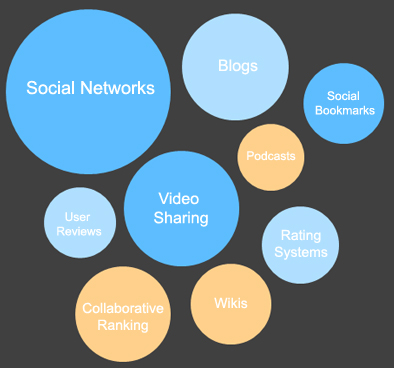
I’m a visual person, so I want you to be too. With that being said, I think it’s interesting to look at the many different types of graphical examples of the social media space. The first graphic I want you to see comes from Lorna Li’s post on 6 Steps for Creating a Social Media Marketing Roadmap & Plan It’s interesting to note that her bubbles do not connect. They merely float around each other. Does that work for you?

The next is from Susan Scrupski’s post Circles of Expertise in 2.0 for Biz I like hers since they are interconnected, but I think that in some instances, that perhaps they should bleed over more.


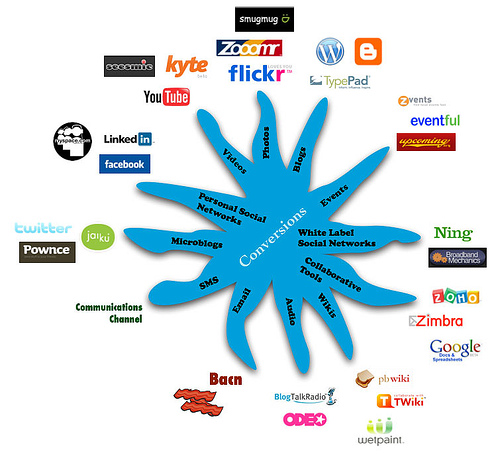
Then we have Brian Soli’s Conversation Prism which is pretty cool since it doesn’t appear to have left out much. It reminds me of the NBC peacock though.

Next is Scoble’s Starfish Very accurate except for the sickly starfish. It looks more like a mutant glove.

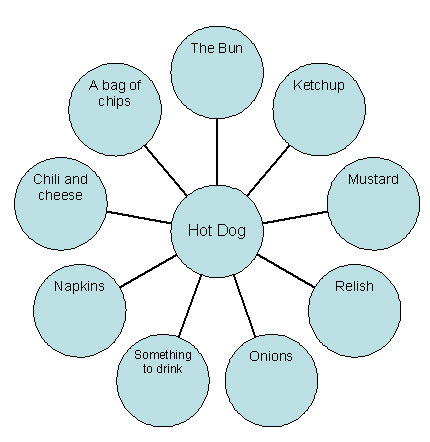
Then there is my simple explanation of how the hot dog could be the center of the universe from a social networking standpoint. Chew on that, if you will. No comment on the  public bathroom shade of blue I used.

And lastly, this one is pretty cool from Touchgraph Go there and type in “social media” to see a larger view.

Of course we could really dumb it down to a scrawled spiral and draw it on a napkin as well

Here’s one more submitted by one of my Twitter frinds, this one titled the new marketing ecosystem from Mullen Though it does look a bit like a Christmas ornament or some type of dangerous coral.

Which one works for you? or maybe there’s a better one? Flippant sarcasm aside, the point is that social media’s influence is far more reaching than anyone could have ever expected and the exciting news is that it’s only going to grow in depth and breadth.

The definitive working list of what social media is not

I had, awhile back, compiled a list of what i thought social media was not. This morning while exchanging tweets, Beth Harte mentioned that Amber Naslund had just dropped a post on what social media isn’t, which led me to thinking: “why don’t we create a list of what social media is not”! There are so many lists and blog posts out there that are touting what it is, that maybe we should clarify and quantify what it is not. I would like this to be a continuous work in progress and need everyone to contribute as little or as much as possible. So here goes:

From Search Marketing Gurus we have the following:

  1. Social Media Isn’t:  Easy
  2. Social Media Isn’t:  Fast
  3. Social Media Isn’t:  A Substitute for Sound SEO Practices
  4. Social Media Isn’t:  A Substitute for Sound PPC Practices
  5. Social Media Isn’t:  A Practice to be Done by Interns
  6. Social Media Isn’t:  Another Place to Distribute Your Press Release
  7. Social Media Isn’t:  Something That Will Work if Your Site is “Broken”
  8. Social Media Isn’t:  Something To Send Out Mass Emails For
  9. Social Media Isn’t:  Something You Can Do Without Participation
  10. Social Media Isn’t:  Something You Can Do in Disguise

Courtesy of Rachel Happe we have: 11. Social media is not community

B.L. Ochman says that:

12. Social media isn’t a one-shot deal 

13. Social media isn’t a technique

14.  It’s not a short-term project

15.  It’s not an experiment, 

16.  It’s not an event, 

17. It’s not a quick fix.  and 

18. It’s not something you throw money at.

Brian Solis tells us that Social media is not:

19. The final frontier

Robert Young from GigaOm, mentioned 2 years ago that 

20. Social Media is not Mass Media.

Is that still true? I think it’s not true any longer, nor might have never been. Its perhaps a function or channel of mass media though, or slowly becoming that.

John Gray writing for imediaconnection wrote that: 

21. Social media is not just for kids, and I’m down with that!

Don Schindler from Media Sauce Blog tells us that:

 22. Social media is not advertising or

23. It’s not marketing, it’s about connections.

Ike Piggot over at the Now is Gone blog mentions that, 

24. Social media is not a commodity.

According to the Deal,

25. Social media is not the next bubble. But that was 3 years ago.

26. Social media is not a direct response marketing channel according to the 10e20 blog

27. Social Media may not be all that it’s cracked up to be, this from Jennifer Laycock over at searchengineguide. What the hell does “all that it’s cracked up to be” actually mean? I never really understood that statement.

28. Social media is not about Links, this from Li Evans

29. For teens, social media is not technology, it’s life!

30.  Social media is not a free for all, thanks Luke Armour

Brian Magierski mentions that:

31. Social media is not just another marketing channel. 

Laura Porto Stockwell  believes that

32. Social media is not new

Thanks in part to Scoble we know that Social Media is not:

33. Newspapers

34. Magazines

35. Television

36. Radio

37. Books

38. CDs

39. DVDs

40. A box of photos

50. Physical, paper mail and catalogs and

51. Yellow Pages

And here are mine:

52. Social media is not up to them, it is up to you and your voice

53. Social media is not predicated on many to many

54. Social media is not one to one, but it can be.

55. Social media is not closed to anyone

56. Social media is not calm, sedate, unresponsive.

57. Social media is not passive

58. Social media is not laryngitis

59. Social media is not mainstream, yet

60.  Social media is not static

And here are Amber Naslund’s:

61. Social media is not Show and Tell

62. Social media is not a Popularity and Numbers Contest

63. Social media is not a Silver Bulllet

64. Social media is not just for “Experts”
 

Ok so I think 64 is a pretty good start. What am I missing here? Feel free to add yours or, feel free to tell me where some of these might actually be wrong. Let’s talk about it!

Searching for social media experts

I just read an article in Adweek about Ford hiring Scott Monty in its quest to grapple with and implement the monolith that is… trumpets please… social media. While reading the piece I couldn’t help but wonder outloud just how social media experts became social media experts in  a space so relatively fresh in our collective marketing, media and PR consciousness. Not that Scott is not one, but this thought came to me after reading that Ford ran 50 candidates through the gauntlet before choosing Scott. 

Which begs my first of many questions: Though they chose a good person, who made the final decision, and what was it based upon? Who were the other 50 and why were they not chosen? I know that there is always a bit of subjectiveness to this process but I think, given the “newness” of the space, that it had to be absolutely fascinating to see how the whole thing went down. I do have to give some credit to Ford for stepping up, now more than ever, and especially given the state of the economy and the auto industry in particular. Somebody, somewhere, within that organization had the foresight to get to a decision maker and say, “we need to grab onto the beanstalk that is social media.

Some other questions I had and I’m sure other likeminded organizations are probabaly grappling with are:

Do we, they become expert like from writing it so much that we begin to understand how it works? Do experts, or are experts people who have implemented  a or some social media campaigns of any scale, successfully or unsuccessfully? What is the criteria? Are they IT people? marketing experts?  PR experts? What determines the experts title as the “expert”. Who determines it? Their peers? The  nascent industry itself?

I do think that longevity in the space that is and has been marketing, PR and even IT/internet/marketing, certainly is a determining factor. Why? Well think about it, when we all got into the business of what we do, what we did then is certainly not what we do now. Our jobs, titles and positions have all evolved. They have morphed into what the public and our bosses have demanded, expected and required us to learn, on the fly. And currently for some of us, that is all things social media related.

With that being said, when I write about the top 30 social media evangelists, I write from a position of referring to these people time and time again about social media topics that are hot. I mention them because they have their fingers on the collective pulse of their clients, their usage of bleeding edge technology to leverage brands, and their willingness to share their experiences. I call them experts, because their names and their blogs come up in conversations, they are constantly pushing out valuable information, and they are essentially practicing what they are preaching. And I find myself going back to “them” because clients and what I do and we do on a day to day basis, requires that I learn fast and implement faster.

Funny thing though, even the experts are wondering who the real experts are!

And if you really want to know the truth. Social media has to be a “practice what you preach model”. Why? You can’t be successfull in the space by being quiet and stealthy. it’s all about the sharing and exchanging of information without pretense. That’s right, the conversation. 

But to be successfull in the space, it is eventually going to boil down to those who do and those who did and not those who have heard and those who say.

All I do know is that the expert does not or should not call himself the expert. I can’t place the quote but:

Anyone who has to tell you that they are “the man”, ain’t “the man…”

Social media and customer service; a no brainer

I’ve been thinking about this for quite some time. I’ve read iterations from other notable bloggers and marketers but my questions are these. Where does social media make the best sense in say, a B2B setting? Or. for that matter, a B2C setting? Could it be customer service?  It’s funny to think that in 2008 that a novel concept could be communicating with the customer! Reaching out to the customer. Talking with the customer, listening to the customer  before, during and after the purchase.

Now don’t get me wrong there are plenty of companies out there that do a good job in maintaining a relationship with the customer but… But the problem is, the model that they are operating from is cut from the “old school” of marketing and customer service. It consists of 2-3 major direct mail campaigns per year, a decent if not underperforming customer service call center in which most customer issues are resolved amicably, and a website that takes orders and ships them on time etc. etc. You get the point. I’m sure you can think of at least a half a dozen companies like that. You see them everyday. You interact with them EVERY day. They do just enough to satisfy your expectation of customer service.

However, when a company reaches out to you or goes above and beyond your expectations, you raise an eyebrow. You’re surprised. Why? Because your expectations are so low that you expect NOTHING! and when you do get a friendly note, someone that speaks with you instead of at you, or the least bit of CSR love, you a) are surprised and b) become a customer for life and c) you tell your friends.

Lets do  a quick test. Think of 5 companies that suck. And perhaps they suck because you have heard that they do, which in an of itself is not good. Why? Because maybe they don’t, though chances are they do, but the viral reputation dictates that they must suck because so many have said so. Ok so quick, think of 5.

Most of the ones that come to mind for me are airlines. How about you? If you talk to Joseph Jaffe, he’ll go off on Delta But I would guess that most of you, if you fly with an frequency, will volunteer an airline. Ironically, I’m thinking that because our expectations are so lowered when we fly now, that when we do have a good experience, we think of that as a WIN.

But here’s what happened. If you’re fed bread and water for so long, you expect it. When they add an apple, you consider it a treat. But the reality is that you SHOULD be getting a balanced meal, but your expectations have been lowered so much, an APPLE is considered a score by the customer. How pathetic is that?  What’s worse is that customer service representatives throw us bones and we snap them up and thank them up and down and then we tell everyone about the great customer service we just received. Again, I say to you, how pathetic is that? I mean look at Seth Godin, he’s amazed at this small act of customer service.

Becky Carroll, who has a blog called Customers Rock wrote a post called Social Media Empowering Customer Service: Guest Blogger Brian Solis in which Brian Solis and Becky blog about social media empowering customerservice. That’s my point, it makes perfect sense for social media to be an extension of what customer service does FOR the customer. As new media marketers and observers, it’s up to us to explain to large companies and even small ones, that, here is a way to find out more about your customers instead of the usual demographic info.

Social media does empower customer service, if it’s used for that. But how many get that? How many examples can you, me and everyone else out there, think of? I think what’s more of a viable statment is: “Social media will eventually empower customer service and social media should empower customer service”.