The Consistency of Being Inconsistent in Digital

The only constant in life is change-François de la Rochefoucauld

Sometimes I think the toughest part of my job is trying to stay current.  And I’m supposed to be a thought leader? Ha! So if I’m thinking that, what does that mean for you or the CMO, the CTO or the Director of social, or digital marketing or marketing? It means we’re all in the same boat. It means we don’t have a lot of time to learn something, prove something, sell something, justify something and then run it up the food chain to the C-suite and back then back down. What’s more, let’s add the pressure of 3 concrete tenets in the digital space:

  1. Is what you’re doing making the company money?
  2. Is what you’re doing saving the company money?
  3. Is what you’re doing driving or building equity for the company?

If what you’re doing, does not concretely answer in the positive one of the above 3 questions, the clock is ticking. Digital is moving so fast, that it is really hard for a lot of digital leaders, or social media managers to show the results that are required from their C-suite counterparts.

Therefore, the one way to break through the light speed pace of digital is to know these five thnigs.

  1. Anticipate that things will change
  2. Be agile enough to change
  3. Be open to change
  4. Be inclusive
  5. You can’t manage digital if you don’t measure digital-but know what metrics matter.

Some things do remain constant besides change in digital though. It’s up to you to figure out what works for your organization and to build out from there, but always keeping an eye on what’s next. Be agile.

What are You Supposed to Measure in Social Media?

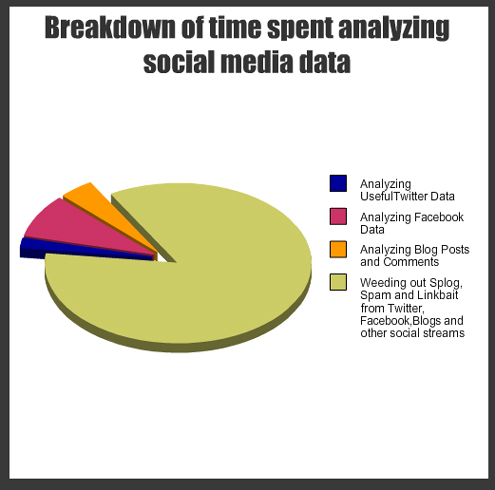
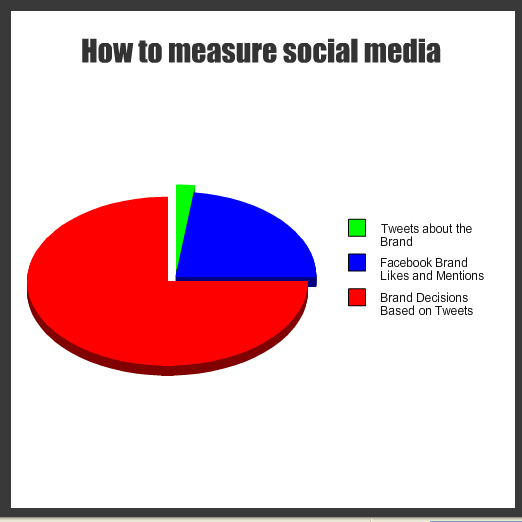
My graph is not totally untrue for those of you that play in the space, but I was reading a post by Tom Webster today titled, The Uneasy Relationship between Twitter and Social Media Measurement and I knew exactly where he was going with it. My above graphic doesn’t really completely delve into what the point of his post was, but it does help me highlight two things about social media measurement-one of which he does highlight in his post.

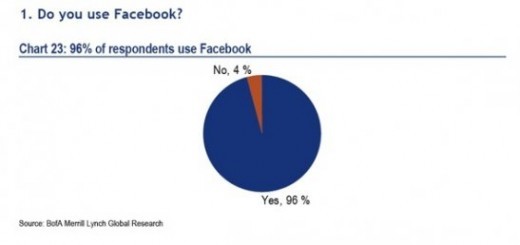
One, there is a lot of useless “social” content to sift through and Two, if the majority of people are not using Twitter and everyone is using Facebook, then why do we make brand assumptions based on a Twitter stream? Here is your answer from Tom’s post:

Most of Facebook’s user data (and, even worse, an indeterminate amount of Facebook’s user data) is not exposed to sites and services that measure sentiment, buzz and influence. So all of the new crop of sites and services that measure these things, from Klout to Crimson Hexagon to Radian6, rely heavily on Twitter, the Internet’s great easy button, as their most easily accessible source of unstructured social media data.

Ok, so again I was having a bit of fun here but I’m curious to hear what some of the social media data aficionados think. Yes there is a lot of unstructured social data out there, and yes a lot of it is bad, and thus I’m wondering; Because we cannot get behind the firewall of Facebook, are we relying on Twitter for a lot of our brand assumptions because it’s giving us the largest unfiltered swath of the social media landscape? If the answer is yes, this troubles me.

Is Being Too Social Ruining Social Media?


I was reading an article on MSNBC recently about Groupon and the tag line to the piece was the following:

“When everything’s social, nothing is.”

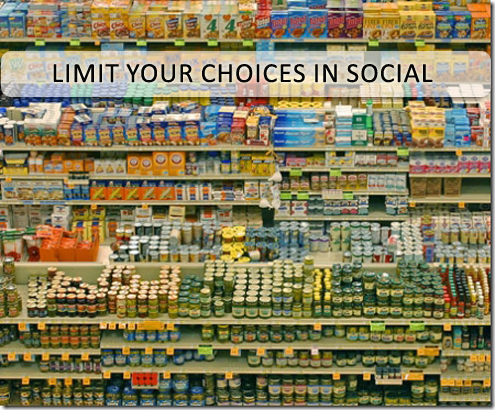
Which gave me pause to think.  What happens when you have so many options to do something or buy something or say something or share something in social? Is there a tipping point looming here where eventually everyone tires of being so social?

I actually think so.

It’s not going to happen yet, but as I was made aware in a comment on a post I wrote about social media bubbles-“there is a bubble, it’s just different”. So with that assumptive comment in hand, which in hindsight I now agree with. I think it is safe to say that eventually we as a social world will tire of being so social with each other. There’s just too many choices and it’s not decreasing anytime soon.

There will come a time where we just won’t want to share, chat, upload, download, friend, follow, or like from a social standpoint, a mobile standpoint, and a mobile social standpoint. It’s inevitable.  If we produce too much of something (i.e. social networks) then demand goes down right? We’re going to burn ourselves out. Let’s look at this another way.

Being social on the web is not a utility, but a lot of us use the social web from a utilitarian standpoint.  They are two distinct things. But when they start to bleed into each other, that requires more time, and for most of us, time is still a commodity.

When social first came on the scene, the amount of networks were few and far between. Eventually more and more copycat type of networks emerged as the boom spread far and wide. The Big boys i.e. the Facebooks, the Youtubes, The Twitters and even the Myspace’s of the world enjoyed the rush. But as we head toward 800 million users on Facebook and we see stuff like this graph from Ken Burbary, we realize that we truly are in an age of “digital enamorment”.

Eventually there will be a correction where we pare down our networks and we start to refine who our connections are with, and what they stand for. Right now we’re too enamored with social to see that. As things progress we’ll soon realize that there is indeed a bit of truth to Dunbar’s number about limits to the number of people with whom one can maintain stable social relationships with. These are relationships in which an individual knows who each person is, and how each person relates to every other person. The number sits at 150 and ironically Dunbar did not figure online social networks into the mix.

Your goal? Develop and refine the networks you’re in and remember Facebook isn’t your network, it’s your platform. Who you are connected to within Facebook is your network.

The Secret Sauce of Social Networks

What is the secret sauce of a social network? What do you think it is? What motivates people in your networks? What motivates you? Right now, companies are obsessed with or have deduced that the only way to grab market share in social  is to incent their customers into doing something-give them something. Reward them. But at some point a social loss leader strategy will waver because of the weight of constant escalating consumer expectations.

Over the weekend, I was asked the following question on Formspring

“How can media organization encourage more readers to post and more thoughtful comments? Alternatively, what determines when you will take a few minutes to post a comment to a story online?”

Great questions, don’t you think? It’s the burning question that every marketer wants to know.They are constantly asking themselves how can we get people in and keep them in?

It’s all about participation. It has to fit for YOU. It has to be the right platform for YOU and your voice and YOU have to have a desire to be heard. We’re all looking for our tribes every day online. And it starts with the fit, it starts with finding your voice and it starts with wanting to be heard.

Recommendations have nothing to do with loyalty!

Just saying that out loud sounds crazy but check this out.

So let’s get this straight. If a brand hooks it’s customers up with coupons, and a customer takes them, because that’s what they are demanding, does that mean they are telling you or us that you can have their business? I think so.  It means so long as you keep rewarding the customer- they will be your customer for life. Or at least until a better offer comes along. What does that have to do with loyalty and recommendations? It means as a consumer I will recommend your product as long as you reward me. It means I will be loyal to you as long as you give me free stuff, or coupons, or a deal. It means that I may recommend you solely on the basis of how much you give me and not necessarily on how good the brand experience was. I may recommend you because of customer service, but loyalty has nothing to do with it. It means and it has meant for quite some time, that loyalty can be bought and our “likes’, our follows and “friendships” can go to the highest bidder.

Social will give you the opportunity to nurture and marinate the customer experience but if you don’t give today’s consumer something, then they will walk. And you thought people on Facebook just “liked” your brand because they liked your brand? Please.

There is No Social Media Bubble

It’s sexy to say that the recent valuations of social networking companies and platforms is very similar to the dot com bubble valuations. Except, it was easy to see back then ( or is that now?) that commerce driven sites whose success was going to be reliant on transactions is a lot different than social sites and platforms with hundreds of millions of people with millions upon millions of daily visits that are reliant on nothing more than activity, conversations, shares, likes and content creation.

The implicit difference between the 2 bubbles, if we’re indeed going to call this period in tech history as a social media bubble, is that one was propped up on just bad business models and just plain dumb valuations, where the traffic had to buy product or the traffic had to go to a physical location whereas with all the social sites, the action and the CTR’s, its still predicated on traffic, but the traffic doesn’t necessarily have to buy something in order for the network to thrive.

It’s community based and people based and not sales based.  Though the model to make money in social networks is still based on traffic pouring through the site- the need to separate someone from their cash isn’t as large a priority as it was in the dot com bubble days. Big diff

The Assumptive Close of Facebook App Registrations

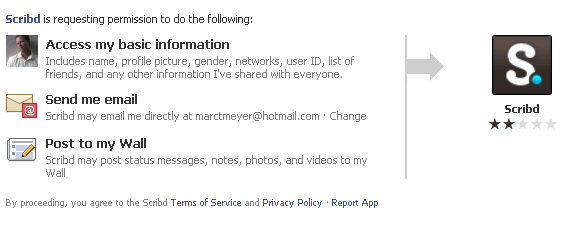
There needs to be a better way. I wanted to download a report that was on Scribd but I needed to Login/Signup. My options? Use Facebook or standard email addy. But upon further investigation of signing up via Facebook, I see that Scribd will access the following data below.

What if I don’t want Scribd to send me emails, post to my wall, access my networks, my user ID and a list of all my friends? It seems a little bit excessive don’t you think? There has got to be a better way for Scribd and it’s users to derive mutual value from each other through Facebook registrations. This just isn’t it. Am I wrong? And yes I know they are not the only one’s doing this…People need to understand the value of their data. Their social currency is gold to others and they need to leverage it as such.

Social Media Conundrum #34-You Hired Them but Don’t Trust Them

Why is it that social has created a whole new set of problems in the workplace? You know what I’m talking about. I’m talking about the employee with the  new found voice, the social employee. I think it’s an interesting dichotomy nowadays in which we have interviewed, poked and prodded this person before we have hired them, and yet we do not trust them to use social tools and platforms- Essentially, we have scared ourselves into thinking that every trusted employee that has been hire to be a part of the family and the culture is a social media risk.  Which begs a few questions:

How is it you hired someone you might not trust? Where is the disconnect? or better yet, why is there a disconnect? How can we ease the tension of the employer when it comes to the social employee?

Two words.

Manage Expectations.

The long form answer is that it starts with guidelines that include internal and external social policies, rules and guidelines that everyone can live by like what Cisco has done and it extends to adult like socially acceptable behavior. Social Media gives you the privledge of having conversations with anyone about anything but it does not give you the right to use it to run roughshod over the people that trust you and pay you to do a good job. At the end of the day it’s a two way street in which you both have to meet at the intersection of expectations and understand what is expected of each other.

Need more examples of social media policies and guidelines? Here’s a database with 174 examples.

Search Drives the Purchase, Social Influences it… A Little

The impact that search and social media have on a consumer’s purchase has never been disputed. I have always maintained that they were always joined at the hip. In a recent GroupM Search and comScore study this has pretty much been verified. Search drives the intent or consideration to buy, and social locks up or seals the intent and turns it into a conversion.

Interestingly, the research show that search alone is still a powerful tool in online buying intent, behavior and research. Always will be IMO, but what really caught my eye though was how little online buyers relied on social alone as the primary driver to a purchase. The internet is too broad and delivers too much information in regards to research on a buying decision to just rely on a social recommendation. Why? Because we still want the best deal possible. Relying on one piece of info, i.e. a recommendation from Twitter or Facebook isn’t enough for today’s savvy online customer. We start with search, we add social in there and then we finish with search.

The results from the survey/study revealed the following.

What does this really mean? Ignore the power of search at your own peril and relying solely on social to drive consideration and conversions is a risky proposition.