Does social media force us to be interesting?

First off, I have to tell you about a very funny post about The 10 commandments of Facebook that you should read.

Next I was reading another great post on Social Media Today by John Bell about whether Twitter was breeding a lack of authenticity and it pushed me to think about how authentic people are now, or rather how social media has allowed us to be more visible and “out there” and god forbid but I’m going to use a very tired word…”authentic”.

But has the explosion of social networking tools, resources, and outlets, forced some people to try and be interesting? Or forced them to think they have to be more interesting? When they otherwise might not be? Or has it, or does it force us to inflate an average persona into something entirely not us? I think so. I think some people think they have to “be” in order to “be”.

Or… how often is someone forced to be the voice of a corporate brand and asked to be more interesting for the sake of their corporate or personal brand? When in fact…. They otherwise might not be? Or otherwise would choose not to be?

Hey I applaud you for jumping in, but don’t blog or talk, or brag, or bash, or be snarky for the sake of trying to be interesting. We like the real you. We appreciate real people.  It’s why the social net has evolved the way it has. It’s allowed us to learn and share with more people than ever.

 Which begs the next blog post.

Is social media raising the bar of expectation?

Are you ready to become a social media “doer”?

I was reading Joseph Jaffe’s latest post on the Agency of the future in which one of his points was that brand marketers are wanting someone or a company with more experience and knowledge in regards to the digital space.

It struck me that the majority of brand marketers are currently searching for someone who gets it. Or at least for someone who get’s it, until they get it.  Which makes me wonder how many of us out there right now, could take a company where they want to go? Sure we all have an idea, or maybe a clue, at least I hope you do, but how many of you could map out a plan, that works? I’m guessing not as many, which leads me to my main question of how many of you are willing to take the lead instead of languishing in the echo chamber?

 With that being said, here are 5 questions you need to ask yourself:

  • Are you a social media “me too” person?
  • Could you sit down today and map out a social media plan that could garner results either for yourself or a company?
  • What are you doing to become a social media doer or leader?
  • How long are you going to sit on the sidelines?
  • Have you really tried?

Once you answer these questions, see where you’re coming up short and do something about it. You can only read and write about it so much. A great resource for “how to’s” if you need it, is Chris Brogan   But most of all, practice what you preach! Get out of the fishbowl and go do it dammit!

Are we slaves to the rhythm of social media?

I’ve been thinking alot lately how all of us are starting to meld social media into the daily fabric of our lives. For some of us, our daily routine consists of checking in or logging on to various social nets to see if we have anyone who has posted, commented, uploaded, friended or mailed anything directly to us. 

We check our email, and that’s a given. We use our cell phone to surf the net and check mail and that’s a given too. But then in short succession we could log onto Facebook, MySpace, LinkedIn, Friendfeed, WordPress, Ning, Bebo, Orkut, Hi5, Twitter, Plurk, Typepad, Google Reader, Feedburner, and dozens of others to check for new friends, uploads, downloads, new pics, new scoop, new mail, new comments and new widgets.  We then could log onto and read more than our share of random or relevant blogs,  and we even might comment on a couple as well.

Not only might we do this once, but we might do this more than a few times a day depending on the nature of our work. And even more when we get home at night. Which leads to a few questions:

  • Are we slaves to social media?
  • Does social media own us?
  • Are our lives more or less complicated by using social media?
  • Do we get more done thanks to social media?
  • Are we more or less social?

What do you think? What is acceptable? Frankly I try to limit my time into blocks built around the work day and even at home. But I can see where one could spend endless amounts of time building and maintaining social media personas from here to BFE and back. The question is. What is your ultimate plan or goal with social media? As a layperson and as a professional, do you have an end game result in mind? Do you have a plan?

You can’t “do” blogs half fast!

I was reading Paul Chaney’s blog post on Social Media Today this morning in which he thinks that there is a serious reduction on the number of comments flowing into blogs and he’s right. the quality is going down as well as the quantity. Part of the reason is that we now have more ways to access the writers of blog posts. Namely through Twitter, Plurk, Pownce et al.  I basically told Paul “thats great that we can do that, but now our conversations are somewhat muted and shorter”.

Does that mean that blogging is dead or dying? That we need a lesson in blogger ethics? No.

But as I thought about this more and looked at some of my posts and my comments on other blogs. I make a concerted effort to engage others. I’m not sure what the requisite amount of replies or back and forths are required between writer and reader, but I personally think that there is an expected return on the comment expected. Maybe. A requisite expectation if you will. But what I’m starting to see is smuggness and a “I started it, contributed some, and thats sufficient, attitude” starting to permeate some really good blogs. I’m also seeing really nice blogs, with some decent content, and some history, tailing off with posts, and an otherwise obvious downtick in effort.

What this tells me is that, perhaps that blog strategy or the author, have gone in another direction. What this tells me is that you can’t finish what you started. It tells me you are not practicing what you preach. It tells me that if you are a PR or a marketing person, no way in hell am i going to work with you. You started the race and you can’t finish it. You built the frame but you can’t put up the walls, the roof and anything else. You’ve done a half fast job and it shows.

Or maybe just maybe, Twitter is now cutting into our desire to comment?

Or… You’ve written a good blog post but you can’t comment or respond to the people who have made the effort and done the same to your post. I know you can comment via email, or Twitter, and maybe you have, but if we’re to extend the conversations beyond a micro-blogging platform and bring them back to blogs, we need to see that you have a vested interest in your blog post and you’re not posting just for attention or link juice, or extending the conversation privately.

The bottom line is you started it, now finish it with transparency and efficacy. We’re still watching we’re still reading.

10 quick hits of September levity

What can you do today that can empower your customer using social media?

“What can you do today that can empower your customer using social media”?

I was asked this by someone who works for an Amazon owned company. Their customers in this scenario are B to B but they also have B to C. The question essentially was. How can we get more ROI from our customers utilizing todays social media without going down the path of ” A blog”? What makes the best sense?

You see, their thinking is that everyone is doing the blog thing and in their industry, there is no way it will have legs, so what else is there that we can do? What will work in our space, knowing that we have to have some type of social media element? One of my points was that the B to B consumer might be slower right now to embracing the tools that social media might provide. Whereas, the B to C consumer might be more apt to utilize them. The thinking being that the B to B person is still in education mode and is going to stick to what’s tried and true in regards to traditional forms of marketing.

They seemed to think the same thing. And maybe I’m wrong, given the larger context that social media is being bandied about currently. But what does make sense for each group? Can you roll out a social media campaign for both groups that makes the best sense for both? And is it wrong to think that a blog just won’t work?

What should be the entry point? Krishna De wrote a post back in January on a similar topic, but the problem is, it was written in January. Does it still apply? Social media advances are moving at such a rapid rate that sometimes what made sense 6 months ago, might not be the case now. Jared Goralnick has some thoughts on this too but it’s more of a jumping off point for the person, not the organization who is trying to leverage social media to increase ROI.

Here’s a guest post on the My Creative Team blog site that makes a little bit more sense titled the roi of social media but the whole point is this. As a marketer you can sit across from me and educate me, but then at the end of the day, what are you going to do?  With that being said Mashable has a nice post on 5 things you can do to develop a social media plan for your business.  The list includes

  1. Listen
  2. Prepare
  3. Engage
  4. Go Offline
  5. Measure Success


In conclusion: To all the social media marketers out there, this is essentially what you are going to hear from your clients and customers to be when going down the path of social media:

TELL ME WHAT YOU ARE GOING TO DO! and then tell me how it will impact me and how long will it take. See the below chart from Marketing Charts

My Social Media Morning

Here’s the drill and it varies, but I’m curious what you’re social media mornings are like. Let me preface that this particular morning I have a headache from 2 glasses of red wine coupled with my inability to go back to sleep at 4:30 this morning. Thus, you lay in bed and you “fake-sleep” until 6 which at that point you do fall asleep and wake up a half hour later and you’re ultimately tired beyond belief.

  1. Fire up the machine (this particular morning we’re trying  out Google Chrome) While this is occurring I try to read either DM news, electronic retailer or the latest book.
  2. While it’s booting up I’m usually also thinking about a blog post. This morning, I’m thinking of a post in which I can compare bars to social networks-not sure there is something there though. what do you think? We all love to go to our favorite bar but why? What keeps us coming back? The beers and the drinks are no different at another establishment right?
  3. Staring at a product that a potential client gave me yesterday wondering whether it has legs for a social media campaign let alone a marketing campaign. This happens a lot.
  4. I have to put together a marketing matrix for another client in which I Identify the decision makers and their buying habits and then try to tie it back into social media.  In this case, it’s a supply chain software company, wondering aloud if that’s possible?
  5. Knowing we have to do a site redesign for the corporate site, I pull up some photoshop files to stare at the latest iterations. Initial thoughts: It’s not Web 2.0 enough. I’ll talk to the designer later.
  6. Rereading an article by Aaron Kahlow in which he writes about the 5 deadly sins of social media and thinking “I’m reading this after I wrote about social media marketings 7 deadly sins” and after a quick search I realize that there is a lot of sinning going on in social media based on this 7 deadly sin post and half a dozen others. It’s at this point that I think I’m very predictable.
  7. While chewing on that, I pull up Social Media Today, which is an incredible resource and provides lots of talking points on what’s going on in social media and I gravitate to post titled  Social Media, what about the risks? by Amber Naslund. I’d suggest reading it, it brought back some not so fond memories of a rogue social networker who terrorized all of our networks and efforts and made the experience very enriching. NOT!
  8. Thinking that Chrome is ok. For now.
  9. I have to call a recruiter in Chicago about an SMO/SEO strategist position. Not sure what I’m going to tell him, but it’s nice to be wanted. Couple that with the fact I’m in Naples, Florida. Never hurts to listen. right?
  10. Logging into LinkedIn, I like checking it everyday. Periodically, I like to read  the answers section or ask questions. I usually have a request or two to respond to as well since I started a LinkedIn group called the “Digital Response Marketing Group”.  It has a great name and has a world of potential to be developed into something larger, but hey, I gotta eat and sleep. I’m willing to partner on this, so hit me up.
  11. Time to fire up Twitter. I’ve been digging Tweetdeck more than Twhirl of late, but sometimes Tweetdeck just freaks out. yesterday i wasn’t in a very Twitterlike mood.
  12. I have to do a proposal for a client with a business (product) they’re getting ready to launch. I tried to counsel the CEO on the merits of social media and it’s potential. She didn’t want to hear it. She wants a DRTV proposal and that’s it. Ouch.
  13. Starting to read some various tweets.
  14. Need to do some related SEO/SMO stuff for another product we are marketing. Not sexy but needs done. Some people do not realize that social media marketing is hard work.
  15. It’s only 9:36 in the morning and I’m thinking of about 3-4 different social media strategies for  a few of the products that we market. But the problem is, not every user or audience is a perfect fit for social media.
  16. Just decided to scan through Outlook mail. Also opening Hotmail as well. I dread both activities.
  17. Have to talk to a client about creating a blogsite for his skin care line and forthcoming book. I’ll call him later this morning.
  18. Just got an invite email from Signalpatterns.
  19. Going to now fire up Pandora, it helps me work, though I’m worried about them lately. Logging into Facebook too. Thinking I might as well open up Ning. During Gustav I joined a Ning group devoted to the 2008 hurricane season, it is very well done.
  20. Now firing up Google Reader, throughout the day I’ll read over a 150 blogs, or I should say scan, since some don’t update everyday. Though there are a few that are a must read, and I would suggest you create that short list as well. If you want my short list let me know.
  21. Sitting here wondering what the next big thing is going to be in social media. I have my ideas, and to that end my thoughts are that as the number of social sites continues to grow exponentially, our usage habits might become more diluted. We may have to pick a few and leave the rest behind. But if there is a better way to aggregate them, then maybe not. I’m just sayin…
  22. Ok, I’m done with Chrome. it’s dragging too much.

Twitter and Gustav-The value of micro-blogging just went up.

Where was Twitter during Katrina was all I could think over the weekend. And for good reason too. Being a former New Orleanian, it pained me to watch not only the network coverage of Katrina, but also the lack of information and the disinformation flowing in and out. Thanks to Twitter I felt I had a better handle on what was going on in the city and its surrounding areas during Hurricane Gustav instead of relying solely on Jim Cantore. Sorry Jim.

Over the course of the last 3 days, I found myself doing the following: Tapping into #Gustav on Summize while watching the Weather Channel, texting and tweeting to friends and family who still lived on the Gulf Coast and who had evacuated (some did not), what I was learning from others via Twitter, and then sharing and pushing that information back and forth with others through my tweets. I felt like I was participating in another of David Alson’s and Chris Brogan’s Twebinars, only this one had larger ramifications. In fact,  I knew of the Industrial Canal starting to spill over a full 20-30 minutes before it was broadcast on CNN and the Weather Channel, and that was scarry cool.

Even post Gustav, valuable and credible ( most of it) information is and was flowing through Twitter faster than you if were hoping to hear it on the radio, read it in the newspaper or hope to get it from your local television broadcasts. Twitter ID’s had been created specifically devoted to Gustav  such as @GustavReporter which were some Chicago Tribune reporters covering Hurricane Gustav, but they still were providing reliable and informative tweets. Another was local @MarkMayhew whose tweets from the Quarter were dead on during the height of the storms landfall, and @YatPundit whose tweets before, during and after the storm have been and had been invaluable!

The point is this, Twitter was providing very very informative and real time information without the hyperbole that often accompanies the national broadcasts.  The tweets were coming from people on the ground and in the city. With only 140 characters, one has a tendency to only tell you what is most important without the descriptives, if you know what I mean.

Twitter is also bridging the communications gaps between people that want to help and might not know how or who to contact. Since the storm has come ashore, countless tweets have come over of people and organizations who want to help and are essentially tweeting their availability. Sans the pitch and sans the B.S. Simply real time tweets from people who can help, who can share their experiences, who were there, who’ve been there, and who are there. It doesn’t get more real time than that! At the least, I think Twitter passes the test as a major form of communicating during extreme circumstances like a Cat 3 storm.

I know all of you at some point were paying attention to what was going on down here on the Gulf Coast, but did it dawn on any of you to follow the tweets? I’m curious.

How do you respond to social media technology?

You’re a large corporation, you’re a medium sized business, you’re an entrepreneur with a start up. How would you react to the following situations?

Someone has decided to blog about the poor customer service they have just experienced

Someone had posted a You Tube video portraying your company in a poor light

Someone has created a social network for people that like your company.

Don’t think the above scenarios are occurring or happening? Better think again. And you better have your ducks in a row on how you are going to deal with each of these situations. The last thing you can do is to ignore them. As each day goes by, every person now has the tag of “citizen journalist” and with that title, they can now post, share and spread good, bad, or indifferent news about you and your company. How you deal with it will determine alot about how hip you are to the power of social media and the power of your customers and customers to be.

Case in point #1 Jet Blue does not handle well the person who decides to video an altercation between 2 passengers and then it spirals out of control when the Wall Street Journal picks up on it.

Case in point #2  A blog with numerous examples of corporate failure and success A citizen journalist has documented corporate failure. How did they react?

And Case in point #3 One of social media’s most influential thinkers decides to devote a very large post to this subject.

The bottom line is this. What is your response? How do you respond? How do you act? How do you react? Does anyone know? Who calls the shots in your company on the best way to respond and what is said? How do you and your company respond to some of social media’s and the bloggosphere’s most prolific writers and thinkers when they say something about mistakes that you might have made?

You need to have a plan in place. And you need to be able to move on it quickly. To ignore it, will be your biggest mistake.

Post Conversation-What do we do now?

Once you get beyond the conversation, what’s there?  For each aspect or rather in each of it’s iterations, there will always be a result or an action. Conversations, regardless of the network they are swimming in, have to have some causal net result. If not, then it’s one big dinner party or bar, where the conversations have no substance, and we all go home and wake up in the morninh with a headache and ask what happened.

There is a great discussion about this exact subject going on in a few places that I would encourage you to visit. Over at Valeria Maltoni’s site the conversation agent, Valeria has always maintained that it was always about the outcomes of the conversation. And she cites numerous sources that in one way or another support this premise. I couldn’t agree more. You have to do something with the conversations that you have participated in. There has to be an outcome. Unless of course, you converse just to hear yourself speak.

But see, the difference is that in this Web 2.0 age, our conversations take on many different forms. We reach out to have these conversations in many forms and in each form, the effort on our part is the push and we want the pull from the other party. But the conversations may have a tinge of self aggrandizement unfortunately, and that’s where we might be missing the point. I think that these days people are realizing that some of the conversations may be disingenous. It’s the dirty little secret of the social-ness of what we are all participating in. Its the nature of the fluidness of social. It’s way too easy to start the conversation and it’s way too easy to manipulate the conversation in your favor. But most of us are hip to that and I think it eventually  sorts itself out. We’re able to police that part fortunately.

What happens next in each aspect is covered as well by David Armano  with another one of his wonderful graphic representations in which David essentially asks… We’ve identified all the different mechanisms and networks and tools to bring forth the dialogue and raise the level of everyone’s voice beyond the tinge of a whisper so, “What next?”.
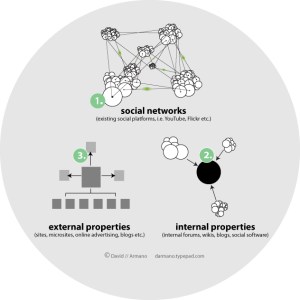
You see in each “property” in the above graphic, conversations are and have been taking place. But what comes of them? Here is a quick example. Do we blog because we want to hear and read what we speak and write about respectively? No, we do it because we essentially want to talk and we want to be heard, and we want to engage others in a dialogue. Problem is, and I’ve noticed that perhaps this one tiny aspect is often overlooked- in order to be heard and in order to converse on or in a blog platform, it does not happen immediately. It takes work, and it takes effort, and I think to a large degree, most people underestimate that. Thus they abandon the endeavor. Do we need to make it even easier to be heard and engage others? Is it still to intimidating and difficult to join in the conversation?

The outcomes of conversations in each of David’s properties all predicated on various barriers of entry. Some not as great as others, but each still requires some effort in order to be heard. Do people want to work at their conversations? I don’t think so, but in each example, conversations and the endeavor of enagaging in them is not a passive activity. never has been, unless you like to lurk.

Another aspect often overlooked in the online social world, is that there is still the aspect of engagement. Type “A”‘s might still have an easier time of engagement than type “B”s. We still have to look at easing the transitions for N00bs. Once they are engaged in the conversation, they may be ok. But then we all come back around to the beginning. And we ask ourselves, “Now what?” “What comes of this?”

Seth Godin started an invite only social network called triiibes that was tailored to his forthcoming book. There are roughly 3000 people in this network and conversations abound. The problem is, I have to think, and do, that all the people in the network are in the “take” mode. A network where everyone is looking for, according to Steve Bridger’s comments to David, “what’s in it for me” can’t be very productive, or maybe it is? Conversations have to be equally 2 way, if not, they’re not called conversations, they’re called monologues. They have to have something more to them in each web 2.0 scenario. That’s what Valeria and David are getting at. We have all these tools, so now what? What do we do with all the various ways that we now have to communicate with each other. Perhaps a Conversation Manifesto is in order?