The Dawn of Social Mediocrity

Let’s do a hypothetical. You like western saddles.  You search for them every day on Google. Google gives you relevant results from a) your Google Plus peeps and then b) the most relevant, most SEO’d results. Let’s assume that your peeps straddle the lines of friends, family and business contacts, so the results or likelihood that there will be content from these people about western saddles may be 50/50.

You continue to search for info about saddles. I am a marketer that sells cowboy hats or western hats. I know that if I use the term “western saddles” as a key word, page title, hyper link, hashtag, splog site or blog post in some social networks or platforms, the  likelihood of you finding or landing on my pages might be pretty high. Why? Every link that you will find will ultimately take you to my western hat pages. I may or may not have much on saddles, but the bottm line is that I sell hats not saddles. Will you buy from my site? Maybe not. Of course I will or may affiliate links on my pages that will get you to a site that sells saddles but…the “quick” search has now turned into an hour’s worth of chasing the long tail of a bullshit game of bait and switch.

Is that a good user experience? No, but it’s the reality of search and social.

The more content that is created, the more that you have to choose from. The more that you have to choose from, the more of a chance that the content is watered down and possibly gamed. The more that search and social become intertwined, the more that you may become the victim of a bait and switch. Clicking on a link in the hopes that it is the right link-has become more precarious these days than it ever has.

The more that search and social lines become further blurred by the notion that content drives the machine, the more the user will get played. Pretty soon it won’t be social media any longer, it will be social mediocrity.

The Top 5 Challenges for Digital Brands in 2012

Last week in a very thought provoking Tweetchat hosted by Lisa Petrilli, the discussion, though swirling around how an introvert uses social media, somehow segued into driving website traffic. So my first thought was a poll was in order. But then I started to think about 2012 and the challenges that most brands will face and thus the basis for this post was born: The challenges for a digital marketer or a digital brand in 2012. What are they specifically as it pertains to the web?

1) Driving traffic–  The challenge in 2011 is the same in 2012. In order for people to know that you are open for business you have to get them to your website, your blog, your Twitter account or your Facebook page, right? Whether you’re a click and mortar or a web based only company, either or requires  more than just a cursory amount of effort revolved around driving traffic. So you have to think about things like:

  • Site design that incorporates SEO
  • SEM to artificially drive traffic
  • Some type of lead generation
  • Social site design geared towards your target audience
  • Content creation

All with the premise of driving traffic. Eyeballs.

2) Engaging that traffic-You’ve got them to your site(s) now what are doing with them? In 2011, it was all about doing “something” with someone once they had visited your site, your blog or your Facebook page. Well that hasn’t changed. In 2012, it’s imperative that we determine what engagement looks like. What does it feel like, what does it smell like? Is it conversational? Interactive? Is it wrapped around gaming? You have to test, you have to experiment and you have to understand that you have about 20 seconds to get it right.

3) Keeping the traffic-The segue from the last sentence in #2 says it all. You have 20 seconds. For some of my friends, when they are telling me a long story and I start to lose interest, I tell them to quit circling the airport, land the plane and get to the point. Marketers and brands will need to land the plane in 2012. Remember when websites were stuffed with content because marketers and webmasters thought that’s what we wanted? Guess what? The challenge now is to do more with less and strike the balance of keeping your users happy, engaged and delivering exactly what it is that they are looking for. Keep your users focused in 2012. Be iconic, keep it simple.

4) Converting the traffic-This is the holy grail of web marketing and sales. Doing something with the people that have come to your site(s). From the dawn of the internet, the goal has always been to convert the people that come to your site into either a lead or a prospect or a sale-Either for your company or your partners. This has not changed. The challenge in 2012 will be to further understand how to utilize the social tools, sites and platforms that now exist in order to convert the passive visitor into something other than a mistaken click, a browser or a passerby. In 2012 social will continue to help deliver customers to websites, but it still falls back on you to deliver on the promise of a good  customer experience. The biggest issue? Brands and marketers doing everything to get to the prom but not getting the kiss at the end of the night. Why? It will always be about the customer experience. Don’t discount the importance of search in this equation.

5) Getting the traffic to return-Repeat business, Word of mouth and increased sales, this is what it’s all about. It’s why people go into business, it’s why companies sell stuff. What’s better? The one off or the repeat customer? Why will people keep coming back to a website? Because  of the initial experience. How many people give a crappy website a second chance? None. They come back to good sites that are  easy to navigate, easy to understand, simple to use, that are safe, secure and trusted and they can find and get exactly what they want without much more than 2 or 3 clicks.  Put yourself in the place of your customer. Search for your own product or company the way they do. Do you/they find what they are looking for? Can you be found through search and social? What is your perception of the branded web experience? What are your competitors doing? What are your favorite sites? What brands do you follow on Twitter and Facebook? There’s a reason you follow them. You need to take that mentality into 2012 when it comes to marketing and branding your web presence.

Meet your own expectations as a consumer and flip them into those of your customers.

A Reminder on Risk Mitigation in Social Media

Social is here to stay. Yea I know, understatement of the year right?  Businesses are starting to realize and understand that social provides or could provide another way to extend brand identity and establish a better connection to internal and external communities. Social is enhancing personalized interactions. But it’s also creating new found risks that old school solutions aren’t prepared to deal with.

Social media is altering the how, the when, the why and the who in companies large and small.  In a spin on former NBA player Allen Iverson’s famous diatribe on the value of practice, We’re not talking about practice we’re talking about a  game…

The new reality is that customers don’t shrug their shoulders and sigh when they are mistreated by a companies shoddy customer service. They load up and they fire back with both barrels. And in some cases they don’t let up, they mobilize others who have been treated the same way and then in a twist, others pile on.

What social has done is it has highlighted the significant risks and the serious damage to a companies reputation that can occur when brands either choose to ignore or are caught completely unaware of attacks to their reputation both internally and externally by both employees and customers.

Shape your company’s influence and don’t be influenced by your company’s ignorance or naivete.

Companies shouldn’t be forced into a proactive approach to anything. In the case of social media risk mitigation-ideally you want to be able to shape your influence and not be influenced by your ignorance …Organizations need to be able to control and counteract how their company is portrayed or might be perceived on the social web, if it’s damaging in any way, shape or form… This requires that companies are agile and able to create internal social reputation management plans and policies that address what detractors to a company’s site might say, what a company’s rogue employees might share with others on other sites, and most significantly, what things are said about your company on other sites that you are completely unaware of.

Does this sound like a plan?

Competing with Free

Every day we’re faced with free and I hate it… Marketers throw free around like it’s confetti. Consumers snap up free stuff because it’s free. But does free work? Does giving stuff away for free make you eventually buy stuff? No, generally not. I’ve often said that the majority of people that follow brands on Facebook do it not because they are supposed brand champions  but purely because they are hoping to get something out of the engagement. Something free.

Why would you follow Nike , Gatorade or American Eagle  on Facebook? Because of the cool videos? Because of the witty banter? Or maybe you’re all about new product launches? Engagement? No? Be honest. You just want to connect with your niche of people that wear Nike and American Eagle and drink Gatorade…

Ok, so pretend you’re the SMB or the competition. How do other companies compete when Nike, Gatorade and AE give stuff away for free? Do they just go ahead and break down and give  away free stuff too? Predictable right? I think part of the reason why case studies on organizations that do it differently are written is because the majority of marketers and companies do it the same way over and over with predictably average results. We embrace and applaud being different and yet conversely, we choose nine times out of ten, to do it just like our competition. Why is that?

I remember asking a small business owner once why they kept advertising in magazines and newspapers when the results were so poor. Their answer was that they had no other options. They didn’t know what else to do, so they just kept doing what didn’t work. Thus, fighting free with free may seem like a good idea, in the end it is not a business model.

The value of free

The problem is we’re asking local SMB’s to compete with big brands who give stuff away for free all the time, by forcing them to give stuff away for free too. This ultimately leads to 2 things: 1)  It’s costing them more than they can really afford or b) It’s not really having the same impact on the consumer as it would if it was coming from the big brand.

The over-reaching formula for big brands is to create awareness of new stuff by giving away free stuff and then use social networks to promote the promise of free while driving the notion of new. Does giving something away for free inflate the value of that new product or service? Uh no. It may create awareness of the brand, product or company but there is no value in free.

Unfortunately we’re chasing the long tail of free, we always have. The internet and the emergence of social networks have created an atmosphere of chasing free wherever it may be. Interesting thing though is that you get what you pay for, even when it’s free.

So how do you compete?

I had a friend of mine who recently asked me how is he supposed to make money blogging or creating good content- and this was after one of his friends mentioned that a monkey could write content… I asked him, why would someone pay for your content? What is the value proposition of your content? Is it so bad that you feel the only way to push it out is as free content? We have to eliminate the notion that our IP is not valuable and promote the aspect of content, products and services that are so valuable that people would indeed pay for them.

The internet and social have gone a long way to creating free platforms to access free content when in actuality most people would pay for it if the value of the content they wanted were implicit. The point- we have created free markets for free which is a flawed model right out of the blocks.  Don’t give something away to sell something-you can’t compete with those that use that as a business model. So what’s the work around?

Try this:

a) Value your content

b) Create valuable content

c) Focus on where that content can be valued

d) Create a market for your content that creates awareness of you, your brand and your company

Lastly, Pay attention to this interview  by Andrew Keen of WPP CEO Sir Martin Sorrell. Very telling.

Does Good Content Matter Anymore?

We’re content starved. The emergence of tablets and mobile devices has only enhanced our desire to consume digital content. There’s a problem though. When content producers cannot meet the demands of a ravenous public, things can get ugly and the public walks-digitally speaking.

Actually, things already are ugly. Specifically, the dearth of original compelling content in the digital space has caused us to consume subpar content wrapped around good SEO. Don’t you just hate when you click on a compelling search result only to be met with 100 words of link laden dreck? That’s been the case for quite some time now, and only recently has it become clearly evident that what seems to work for most producers of content when they don’t have anything to “share” with others, is to just steal, plagiarize or reproduce someone else’s stuff; and wrap that around good SEO.

Good content is getting lost in the firehose of bad content

But there is a simple reason why they (marketers in general) have this burning desire to push out as much digital content as they can-whether it’s theirs or not. There’s an ulterior motive happening here.  These folks are trying to appease the almighty search engines. Specifically Google, but Bing and Yahoo and all the other 2nd tier engines  figure in as well. Organic search in a nutshell.

Most producers of content are in the business of driving traffic. Traffic equates to advertising which equates to dollars.  You can buy traffic, but short of spending in the 6 figures to create artificial traffic, the only real way you’re going to get organic visits to your sites is to write content and share content that has all of the “right” SEO properties so as to come up high in search. Screw the readers. Forget good content, the goal now is “searchable”, SEO friendly content.

Content producers are unknowingly deferring to search engines instead of people

Does this mean that there are still sites out there pushing fresh, relevant, content that is meant for people to consume, view and share? Perhaps, but it’s a short list. You can look to CNN, USAToday, The New York Times, Techcrunch, Mashable, and MSNBC for examples of purveyors of quality content except that they can be just as guilty of the keyword laden salacious topic and title that is sure to drive readers, shares, comments and traffic.

As the tablet and smart phone markets continue to expand, so will the amount of water downed re-used content. Thus, we need to get back to a time when content mattered, when good content mattered. I’m not so sure we can as long as we’re still trying to figure out who we’re supposed to be creating content for. Is it people or search engines?

In social media, cluttering the space, confuses the topic

I’m the biggest proponent of social media that you could possibly find but I am also the one that told my daughter that she doesn’t need Facebook. She’s 14. I also told a group of 400 parents and educators that anyone under the age of 16 doesn’t need to be on a social network. I got a standing ovation for that one. I didn’t get a standing O from my daughter however.

On the one hand I will tell a company that they are missing the boat because they are neither a social brand nor a social business, so they better get with it. On the other, I will flat out tell some people and some companies that they have no business playing in the social space. Why the flip-flop?

You’re going to roll your eyes when you read this next line, but hear me out. When social media first came on the scene-it was about the conversation. But what happened next was that companies and developers smelled blood in the water. They saw that we liked conversations and connections. Soon we were offered multiple sites, multiple touchpoints and multiple opportunities to have conversations. However, a lot of us, no, the majority of us, don’t need to be having conversations 24/7/365. But what happened? Start-ups and new companies have flooded and have inundated us with so many social applications and sites, that they have confused the basic premise of what made social great in the very beginning.

It’s not just about building and maintaining connections. It may have been initially, but not any more. And thus…we don’t need another social network. We need to develop the one’s we’re in. At this point, it’s no longer about growth and it’s all about engagement. Sometimes when I see another “new” social app or site that is claiming that it will simplify or aggregate my confusing and complex social life, I roll my eyes. Why? They’re not making things easier, they’re forcing me to a) Look at and evaluate ( which I invariably do) another vendor/application b) Decide whether the current sites and apps I use now are still effective c) reconsider my loyalty d) disrupt the flow of my social engagements.

Perhaps that’s why the social landscape changes so rapidly. Developers are constantly rolling out bright new shiny things that they think we’ll need or that they think will make our lives easier, more productive, more connected. Or does it? I’m sure there’s over a 1000  social apps or more that I currently do not have on my phone or desktop that could make my social engagements better. But really? Better? Or just more cluttered and confusing?

Moving without the ball: On Basketball and Digital Marketing

In the game of basketball there’s something that really can separate the good players from the average players. A lot of  players do not do it and yet they would be better served and more successful if they did do it. It’s fundamental to the game and yet a lot of coaches do not coach it or preach it. I’m not going to tell you what it is yet.

In digital marketing, social media marketing and any type of integrated marketing communications plan, we can create a strategy, design the tactics to use for that strategy and then we can implement. Then we wait. We measure. We tweak and we rework, redesign and we retrench if necessary. But if instead of waiting for things to happen. What if we made things happen? What if we created opportunities for ourselves?

Remember the movie Field of Dreams and the famous line, “If you build it, they will come”? In marketing, especially in the web world, there’s a sense that all we have to do is create a website, add that transactional back-end, create a Facebook page, a Twitter handle, and a blog site-and they will come. When what is really necessary is a lot of OFF page SEO work, a lot of content creation, content curation, and content consumption and commenting. You have to be proactive in this new digital paradigm. You can’t wait for it to happen or you’re done.

Back to the hoops analogy

In basketball, the more you stand around and watch, the less you are part of the action and the game. If you expect to get the ball passed to you on the wing just because you happen to be standing there, well it’s not going to happen. The defender is not fooled and you’re less of a threat because he doesn’t have to worry about you, he can see you. He can literally defend the basket and you at the same time because you’re not doing anything.

If you move without the ball, then you create more opportunities for you to get the ball, to score and to win. If no one moves-you don’t win. Simple as that. In digital, if you want to just build stuff and wait for people to find you-you won’t win. Simple as that.

Information versus Opinion and Search versus Social

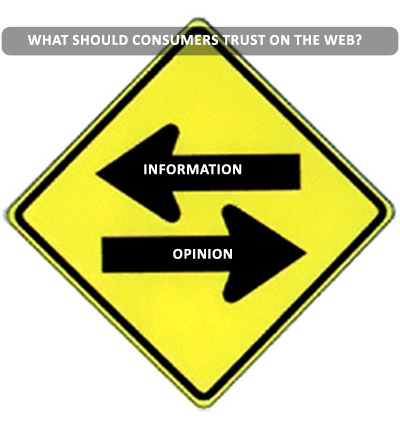
Information versus opinion. Whats the difference? Is there one? What matters to you when you are on the verge of buying something? What is your go to process for vetting a new product, service, or company? Does the process change depending on the type of purchase?  So here’s the scenario, I want to buy a new big screen TV. So I do research. My research consists of what?

A) Typing in “big screen TV’s in Google

B) Typing in a specific brand into Google

C) Going into a social network and letting 500 of my most intimate friends know that I’m thinking of buying a TV

D) Going to Yelp

E) Going to Google and typing in “product review sites” into the search box because Yelp didn’t work.

F) Going into a forum and looking up the product name to see what others have to say

G) Asking my neighbor, my co-worker, my college roommate, or the father of my son’s best friend.

H) All of the above

Some of you probably would do all of the above. I see a problem with every single option above with the exception of option G. Here’s why.

Option A)  is probably the most confusing. Why? Simply because a lot of consumers do not know what types of web results they are looking at. They don’t understand what can be bought, i.e. PPC versus a gamed organic result. Either way, the consumer may be in for a lot of hard work trying to find some information-thus this may be a case where they decide to forgo doing research and just go straight to Best Buy and get the deal.

B) Typing in a brand name lends itself to resellers bombarding you with “their” deal. At the least, when has doing research on a brand lent itself to a highly ranked result of a brand reporting that it’s product sucks? Not going to happen? So the results will always positively skew in their favor.

Option C)  has some potential just because more and more consumers are turning to social media for help with purchase decisions. According to Cone Inc.’s recent research,  consumers are seeking out product information and reviews; they’re interested in both the good and the bad since 80 percent of respondents look at negative comments and 87 percent of respondents look at positive comments with the biggest growth area for purchasing decision information being blogs. The only problem? Blogs can be gamed.

D) Let’s say I never went to Yelp before, my first thought is “Oh cool, this is handy”. Next thing I know, its been 2 hours and I have not been doing any research and I realize that Yelp is not the site for product research.

E) My first thought is, do I really want to go down this path?

F) This one has potential, provided the forum that I use has people in it that are genuine and are not cloaking themselves as regular people, but really are trying to promote their product. Don’t think that happens? Think again.

Option G) Probably my best bet, at least I get a real answer. Funny thing is, it’s not a web based derived result and decision, though the process of purchase may actually happen through the web. But then when I know what I want, finding it at the best price, is completely different than deciding what’s is the best performing brand . See the challenge foe the brand?

Look at how brands  have to compete and win against you, your friends and relatives, against gamed search, gamed social and everything else, in just trying to get a message out that says, “Hey our product is good trust us”-

Even better, the company that says “Hey our product is good, but don’t just trust us, trust the people thst bought from us-That’s the gold! But the larger question is how can a brand simplify the process of aligning it’s existing customers with potential new customers while still trying to maintain some type of objectivity thats not clouded by reward systems and incentives? Tough to do isn’t it? Are we now on the precipice of the Infopinion?

Avoid Managing the Minutiae of Social and Search

Remember all of the Rocky movies with Sylvester Stallone? How could you not? He only made 6 of them. In the very first movie, Mickey, Rocky’s crusty trainer played by Burgess Meredith, had a couple lines in the movie that I will never forget. Some of which seem to be appropos for two reasons. One, they apply to the worlds of search and social and two, they just makse sense from a business standpoint.  But beyond the lessons that we can learn from Mickey-the real lesson is in the title of this post. But first let’s look at one of those lines and see what “the Mick” has to say. 

#1 Mickey constantly is telling Rocky to “Stick and Move”

Mickey wanted Rocky to “stick and move”  because essentially Rocky was too slow to stand in front of someone and go toe to toe with them. Sticking and moving is a method involving landing  jabs, while backing away without giving his opponent, Apollo Creed, an opportunity to launch a barrage of shots to Rocky’s head. Apparently Rocky did not heed that advice as well as Mickey wanted him to. 

In search and in social, there are so many moving parts that it’s easy to become stuck in doing one thing and one thing well or badly for that matter. Call it Myopic or blinded by focus, while not necessarily a bad thing in search and social, there are just too many moving parts. It’s better, or I should say tantamount, that you understand how search can makes a good social strategy better and vice versa, but all the while not becoming bogged down in the 101 type of activities that alot of people tend to hover on. Stay high level and keep moving; and yes I know it is the little things, but in this case, it’s about moving and being effective and the bigger picture.

For instance in search, there’s the whole aspect of campaign planning, or the strategy itself before you even launch or relaunch. There is creating search programs just for branding purposes. There is SEO, both on-page and off page for main sites and micro-sites. There is PPC, there is mobile, local, and of course the whole analytics side of it all. The point being that all of these can be managed separately and or they can be managed as channels that contribute to or funnel into the bigger picture. It’s a huge task and yet one that is best managed by sticking and moving. 

The key here is to attack and address all of these and see where they fit or fall within your organization, but not get caught up in the minutiae of managing them. Now some companies, the smaller ones, can get away with just doing some of the above mentioned tasks and not doing others, and I might add, doing it well, but larger ones at the enterprise level cannot. If we’re to understand that all of these components contribute to greater profits for a company, think how social now is playing into all of them. Social has virtually the same amount of moving parts.

In social you have to have the ability to create and manage a strategy, understand and manage social analytics, create blogs, wikis, microblogs, manage profiles and activity feeds, create and manage communties, create tags, create and manage campaigns and then rinse and repeat. Very similar to search, and yet, both very complimentary as well. The scary part? All of this can be done at both the enterprise level and the SMB level.

The common themes? A couple of them. One is the digital consumer. Another is the digital vendor. and still another are the digital expectations of and aspirations of both. Another, is how extremely well search and social play together. And still the last 2 themes? One is how important it is to stick and move in managing both search and social concurrently-especially in todays rapidly changing digital world and the other? Don’t get caught up in the minutae of managing both search and social- they are large, fluid, everchanging monoliths. “Stick and move Rock, Stick and move”.

The secret sauce of social is selfishness-and that’s not a bad thing

Excuse me while I say the following: If  it wasn’t for social media, you wouldn’t be anywhere near where you are right now in your career. To put it more succinctly, social media has made a lot of you. Yes I know that’s like saying if it wasn’t for the internet Bill Gates wouldn’t be anything but another coder, but let me back up. You see, for a lot of us, and notice I said us, social media added that missing layer. That missing dimension, that lens  into our personal, private and public lives.

Social is the accelerant.

In a way, using social is very much like wining and dining to get what we need.  For some, utilizing social media to “court” others and market ourselves, is the same as drug reps taking doctors on ski trips to “earn” their business.  Or going out on a date where we both talk about ourselves. It’s an interview. It’s the handshake and the introduction. Social is the empty seat next to you on an airplane that soon will be occupied by someone you can talk to for 3 hours. Or not. The potential is there should you choose to engage. The seat is the tool or the platform for discussion..

People have been using each other for centuries. In social media, the same holds true. People are using each other because they’re seeing that our social selves  can be so easily intertwined into our ability to create, and curate; and yet it’s also dependent on consumption, its dependent on sharing, dependent on broadcasting the message, the message that is you and me. Some of you may or may not know this but we are feeding off of each other. We’re sitting across from each other on that plane and we both have the same opportunity to talk to each other and take it to another level.

Without those elements, you are nothing but a product of what we were prior to the boom of the internet- a product of the 80’s and early 90’s. You are static. Social has added flash to your being. It’s added substance to who you are or… who you want to be, should you so choose.

It starts with Linkedin

Think about this.  Linkedin is and became one of the initial gateways into people’s lives; and for a lot of people, who were never into that “social thing”, and who are still not that social, Linkedin is their gateway into social media.  In fact, if we go by the 90-9-1 model, Linkedin might be as social as some people will ever get! But at the end of the day, is Linkedin a social network? Perhaps. It has elements of social. But what Linkedin really is, is it’s our vetting tool. It’s  our way to learn more about others, and have others learn more about us. But really it may have evolved with Linkedin, but it started with blogging.

Bloggers were considered outlaws

Social has a quid pro quo nature to it. In fact, today’s social elements were born out of the early days of blogging which were veiled in a sensibility of  “us versus them”  camaraderie. Essentially it boiled down to a  “if you show me yours I’ll show you mine” mentality of reading, commenting, and sharing each others blogs. It was almost the manual defacto way that you grew your readership. But it also allowed us to show each other and others our many layers in ways in which we never were able to before.

Blogs allowed us and allow us to say whatever we wanted when we wanted, and we used each other, and then we used someone else, and they used us too-and we let them, if it grew our readers. It’s how blogging works.  Funny but in the non-blogging world, we indirectly and directly use each other every day by associating ourselves with new people and entities that we think can help us get where we want to go. It’s not sacrilege to say this but people use each other all the time; but it might be sacrilege to say this though…Using each other is the nature of social media.

We call it social media but it could easily be called useful media.

Social has added that dimension of vetting the who, search added the dimension of vetting the what. Yet we still have to work, we still have to pay our bills, and eat, drive, sleep and do that daily mundane life stuff; because the  human element still weaves its way through all of that offline stuff. The new difference is, social media is adding that dynamic layer of personal utility. It’s adding the layer of creating who we are, so that someone might see who we are. Social is selfish. It helps us. It connects us. And that’s not a bad thing, it’s more just the reality of where we are going.