From Hire to Fire: Mastering the Ups and Downs of the Modern Job Market

Featured

Recently, I was visiting with two of my oldest and dearest friends from college and as we are expected to do when standing in the backyard drinking beer and grilling, we talk about life’s deepest darkest mysteries such as what body part hurts, what we’re currently streaming, how scoring in pickleball works, and what exactly is bitcoin. On this day though we stumbled upon the subject of jobs and careers. The conversation meandered down this path:

Friend #1: I can’t believe I’ve only worked for one company since I graduated.

Friend #2: I think I’ve worked for seven different companies since then.

Me: I’ve had 17 different employers since graduating.

After the laughter had subsided, there were two questions that loomed large. Which is the lesser of two evils? Losing your job? Or the endless grind of trying to find your next job? Regardless of your answer, fear not. According to the U.S. Bureau of Labor Statistics, the average person in the U.S. will hold 12 jobs from ages 18 to 52. Thus, I wasn’t a complete outlier after all; and neither are you!

Over the last few years, I’ve tried to impart the wisdom I’ve gained from those 17 gigs onto those who are just starting out or are in the midst of a career crisis. So, consider this your inside scoop on getting a job, keeping that job and what to do when losing said job.

For most of us, the sudden sting of losing your job can only compare to the dull thud of not getting the gig you thought you were perfect for. However, hating your job is in its own category. In fact, it’s more common than you think. According to recent research from Microsoft and LinkedIn, nearly half of all workers were thinking of quitting their jobs in 2024.

If you’re one of the lucky few who does not dread going to work, be patient. Your time will come. The variables that can lend itself to this inevitability are plenty. The reality is that a lot of them are completely out of your control. A quick example? You love your boss, and he or she leaves unexpectedly. They are replaced by a fire breathing, micro-managing, maniac, who doesn’t like you simply because of who you worked for and thus decides to ride you and your performance like a rented mule. You did nothing wrong and yet, here you are. Congrats, you now dread going to work.

Though that is just one example, the playing field is littered with these types of stories that lead one to looking for a new job. The questions remain though. How can you lessen the psychological impact that losing a job can have on you? How can you deal with going from being perfect for the job you just interviewed for, to losing it because there were more qualified candidates? You don’t. You accept it and move on.

While I can’t cover everything that can happen in your career arc, here are ten nuggets of wisdom that can potentially provide you with some much-needed perspective on the employment game, as well as some Dos and Don’ts that will serve you well in the future.

1) No One is Irreplaceable

Everyone has a shelf-life no matter how successful they are or were. I hate to say it but yes, even the perpetual greatness of basketball player Lebron James will eventually subside, and someone will replace him. It happens to all of us. Football great Tom Brady didn’t retire in New England on his own terms as some thought he might. Decisions were made and his exit was messy. However, he did manage to have the last laugh as he subsequently won another Super Bowl title with the Tampa Bay Buccaneers.

This problem arises in the business world as well. Greatness can be fleeting. Technologies change and leadership teams come and go. User habits evolve. The digital obsolescence of apps happens continuously. The sooner you realize that you can be replaced at any given time, the sooner you will understand the importance of what you do, how you do it, and who you do it for. You must know your value at all times. Never assume you are untouchable.

2) Get Better

Particularly in the tech world, if you don’t learn new “stuff,” you are going to be eaten by it. It’s imperative that you stay ahead of a curve that keeps getting steeper for you and flatter to younger workforces. Change is constant and rapid, making it essential for you to stay at the top of your game. Keeping up with these unprecedented advancements is crucial for thriving in the modern workforce and maintaining a competitive edge.

Do employers want the specialist or the generalist? They want both. Know your stuff and the value it has. If you’re good, you’re good, but for how long? Keep learning and evolving and the doors will open for you. The sooner you know this and realize this, the more leverage it creates. If you are reluctant to learn new stuff, eventually you will have no leverage–plain and simple.

Let’s say you are getting better, and you are at the top of your game. If your current employer doesn’t realize how valuable you have become, you have every right to look around for new opportunities. How quick they respond to your rising star will say a lot about them. Don’t overlook it. More importantly, don’t stay in a bad fit job.

3) Relationships matter until they don’t

By all means, leverage your network of family and friends, and if it gets you your next gig, that’s great, but be sure to step back and try to understand the dynamics of what just happened. What are the expectations? Are you now expected to do something for this person in your new role? Did your contact go out on a limb for you? Is there more scrutiny on you because of how you got the job? Will there be jealousy or contempt from your co-workers or managers because they know how you got the job? All of these questions and scenarios are now in play from day one. You need to have your eyes and your ears open. You are now on display for the next 30-90 days. Tread lightly.

Is it a relative you’re working for or with? Watch out. It’s 100% true what they say about working with family. Expectations get a little fuzzy when you’re working for or with a family member. Maybe you roll in after 9 AM or knock off before five. How does that fly with your work colleagues or other family members? I once worked for an ex-brother-in-law. I created an ecommerce platform for his products that generated upwards of $9 million dollars in online sales in three years. My reward? My walking papers. I never saw it coming and to this day, it is still a bitter pill to swallow.

Is it a former co-worker, colleague or client that helped you get the job? Just because they know you doesn’t mean they can’t or won’t throw you under the bus. Know that the warmth and soft glow of the relationship that helped get you hired, could ultimately be a pot of boiling water you just got dropped in to.

4) Don’t always take it personally

Taking relationships out of the equation for a moment, know that there is a certain amount of timing, relevance, and algorithms that can all contribute to you not getting the job that you thought you were qualified for. It’s OK. I can’t count the number of interviews I had in which I thought I had crushed it, only to be let down by the rejection email stating that they we will not be moving forward with my candidacy.

Treat the job search like you’re in sales. Salespeople fill the funnel full of prospects and eventually a sale will drop out the bottom. Sometimes, it’s just a numbers game. If you’re only applying to two or three openings per month, well, it might be a while. According to Indeed, you should be applying to ten to fifteen different jobs each week, or two to three jobs per day. The more you apply, the more you increase your chances of receiving attention from hiring managers at the companies to which you applied to.

Conversely, take it personally, when you do lose your job. There’s always a reason and sometimes they are not good ones unfortunately. Sometimes, they make no sense. Sometimes it has nothing to do with you. You should be mad but don’t dwell on it too long. Use it as motivation. In the case of my ex-brother-in-law, my departure from his company, was and is my ongoing motivation, to this day.

In addition, take time to understand the why behind you no longer being there or no longer being wanted. Sometimes the wounds are self-inflicted, and you didn’t even realize it. That being said, if you didn’t get the job, figure out the why and fix it. If you lost the job, figure out the why and if it was your fault, live and learn and don’t do it again.

5) Check your humility at the door

Sometimes, one of the hardest things to reconcile with others is that you a) don’t have a job or b) are looking for a job. The sooner you can get over this notion the better. Don’t be embarrassed. It happens to all of us. If it helps, everyone goes through it. Yes, there are people in the C-suite that had to interview or look for a job at some point in their lives. You are not alone. Keep in mind, you can’t be hired by the really nice person you just met at your friend’s party if they don’t know that you’re looking for a job. Let people know you’re looking. Remember, it’s a job to get a job!

6) Don’t burn bridges

No matter how badly you just want to publicly rip a former boss or company to shreds, don’t. Keep the anger and vitriol in check. It will do you no good. Translation; No late night, drunken, social media rants. The easiest example of why you do not burn the bridge is that you’ll need former employers and employees for references. There will be a former co-worker or manager or department head that can make or break your next potential gig. You may even see a former co-worker again at another company, so keep it in check. As much as you want to say something about how much of a gulag your previous company was, don’t do it. It might feel good at the moment, but you’ll regret it. That said, do not just leave the company without notice. I know, it’s tempting. You’re fed up and ready to walk. But understand, that your new potential employer will be calling your ex-employer to verify that you indeed worked there and that you left on decent terms. Keep it together and play the game and leave the bridge intact.

7) Measure twice, cut once

As an extension to not burning bridges, if you’re going to be critical of someone, some thing, or some process, at your current or previous company, and your grand plan involves doing that in the form of an email or social media, be prepared for the consequences and repercussions when you press send or enter. Theres no turning back. Theres a digital record of what you just did, and the social media landscape is rife with examples. Don’t do it. Thinking of disparaging your company or your boss in an interview? Don’t. Thinking of blaming someone or something on your exit from your previous company? Nope, the answer is no. Keep it in check, think about it, think about it again, and then take the high road.

8) Manage expectations

When I first entered the management consulting world, I was overwhelmed. Looking back, there were plenty of things that I could have done better or differently. However, one of the best pieces of advice I ever got was from a colleague there who I now value as one of my oldest and dearest friends. He said to me early on, “the best thing you can do here is to make sure you manage expectations.” His point being, if you can’t do something, say “I can’t do that.” Don’t say maybe, or don’t say yes and then deliver something half-assed. If it’s a no, it’s a no. I’ve applied that piece of wisdom to everything that I do now, whether it’s in the business world or everyday life. It lets everyone know exactly where you are coming from and it eliminates doubt and ambiguity.

9) You must maintain an even keel

When things are going well at work how do you feel? You feel great. Let’s say you just closed a major deal, how do you feel? You feel awesome. You’ve just been promoted and have earned a nice little bump in pay, how do you feel? Your team has met its quota for the quarter, and you’ve been given a bonus and a trip, how do you feel? You feel freaking awesome. Who wouldn’t be? Now let’s flip the script. You haven’t popped a deal in weeks if not months. Are you feeling the pressure? Your new boss is hammering you about your work and is all up in your grill. Not too comfy is it? Your old boss has left, and he always had your back. The new boss/ Not so much. What do you do? How do you react?

Your job is going to have peaks and valleys. How you deal with those blips will determine your fate. There’s an old saying that I like to use from time to time for those that taste rapid and sweet success, and that is this, “act like you’ve been there before.” Simply put, try and avoid rubbing your success in others’ faces. Why? Because there will be a time when things are not so good. That I can guarantee. How you deal with the flip side and how you deal with adversity will also go a long way in determining your success and your relationship with your colleagues. Keep an even keel and understand that there will be highs and lows. Be prepared for both instances. My prompt is that I keep a typed sheet of paper with the initials “EK” taped near my desk to remind me just that. Maintain an even keel at all times.

10) Stay hungry

With the exception of Buddy #1 who has worked for one company his entire life, wanting more and doing more and exploring your options is a healthy obsession. Particularly when it comes to understanding your value, staying with your current company because it’s comfortable, will not necessarily quantify that value. Unless of course raises and promotions are coming at a rapid rate. However, there is no harm in keeping your head up and eyes open, even if you do like where you are.

I was once in this large conference room with all the principles of a company I once worked for. Everyone had a really serious look on their faces and the tension in the room was a tad bit thick. I was wondering why I was there. These people were the leadership team. The CEO slides a piece of paper face down across the table towards me and asks me what I think about this candidate they just found online. I turn it over and lo and behold, it’s me. It was my resume. I jokingly told him he better go get this guy before someone else does. For some reason he failed to see the humor.

At that time, I was in tech sales and was the #1 salesperson in the company out of about 40 salespeople. He wanted to know why I was floating my resume. Apart from the stress and pressure that I was constantly under, my value was at its peak, and I wanted to see what I was worth on the open market. His response? Name your price. I now knew my value.

Complacency and comfort are strange bedfellows so having both internal and external conversations about what your future looks like for you should always be in play. Just because you are full right now, doesn’t mean you won’t be hungry later. Stay hungry. Always.

In wrapping this up I am reminded of an old saying by Benjamin Franklin who once said, “In this world, nothing can be said to be certain, except death and taxes.”. The phrase reminds us that while much in life is unpredictable, there are some unchanging truths we must accept. Those truths are that at some point in your life, you will get a job, you will have a job, and you will lose a job. Knowing these eventualities and the ten lessons above will serve you well in acknowledging and understanding that indeed the most universally shared human experience, is work. How you navigate it, is up to you.


How are Those 2022 Predictions Working Out?

Featured

Why do prediction posts have to be written at the end of the year? There are no hard fast rules as to when they officially have to go out. I suppose it’s just sexier if it’s before the start of a new year. In my case, it’s just been delayed because I’ve been sitting on them, waiting for them to happen. Actually, that’s not true, it’s just been a severe case of procrastination and I apologize. Suffice it to say, the guilts have driven me to finish this piece. I could probably have shortened this post up dramatically though by just saying that Tik-Tok will be THE platform of 2022, but what’s the fun in that? Pardon my buzzword bingo but let’s get a bit more… granular.

As 2021 dry-heaved to a thankful close we had no choice but to be optimistic in 2022. For most of the inhabitants of this earth, the last two years have been fraught with challenges that we never could have imagined. During that time, the one binding thread that kept us all on the same page, so to speak, was information. Both real and imagined.

With that said, I’ll start by going out on a relatively sturdy limb and say that social media, as a source for information, disinformation, and entertainment, in all its various shapes and forms, has been the absolute center of our global universe for the last five years. 

What has 2022 brought to us all? Simply put, more of more. More trials and more tribulations. From the standpoint of a traditional predictions piece, it really was a no-brainer for me to say or write that social media was going to continue to be the heartbeat of chaos and reason and the pulse of saints and sinners. Absolutely. The volatility of it all, every platform buzzing, converging all at once, 24/7, the noise, it’s all still there. 

I know that’s not a prediction as much as it’s me being the observer of the obvious, but let’s continue.

If you’re wondering who receives thank-you cards for social media’s newfound prominence in our daily collective conversation, be sure to include Covid, politics, the war in Ukraine, and inflation; and while you’re at it, write out a few more for a lot more Covid and a lot more politics. 

For those that say they don’t pay attention to social. I’m going to have to call you out on that. I’m not saying it’s impossible, but let’s be real, it’s really hard to avoid avoiding it. It is virtually impossible to avoid rubbing bumpers with social media on a day-in and day-out basis. It’s not just Twitter and Facebook anymore either. It’s Snap, Reddit, Instagram, Twitch, Tik-Tok, We-Chat, and What’s App, in addition to a host of newcomers such as GETTR, Discord, Truth Social, and Clubhouse. 

In fact, chances are, on any given day, a headline that you see in your email, or online, or in ‘your feed”, was fueled by social and you may not even know it. As hard as it may seem to fathom, social media is the engine that drives the world’s collective opinion. Right or wrong, good or bad, social media sits there daily waiting for you and if you don’t see “it” that day, don’t worry, they’ll be more tomorrow. Social resets every day.

With that said, let’s focus on social media’s impact in a B2B world. It’s just as volatile and equally as uncertain for those in the B2C space, but for those trying to make a buck, it’s never been more unpredictable and yet still so promising.

Four+ months in, the stone-cold reality in 2022 is that the business world needs social media. It’s a necessary evil. You can’t not do it. Whether you and your teams know what you’re doing in social media will always be debatable, but business teams must embrace it from an overarching Comms POV. In 2022, NOT utilizing social media in any capacity is probably the reddest of flags and biggest of mistakes. Specifically, for B2B, social media is a complicated love/hate relationship. It always has been. With that in mind, what does the future hold for B2B’ers? What’s in store for the remaining 7 months? 

Let’s start with this. 2022 will be the year in which we all think we know what an algorithm is and does even though we don’t actually know what it is and what it does.

The user or consumer or whatever it is that we want to call ourselves, is getting smarter. We know we are the heart of the conversation, as it has always been and always should be; the only difference is we know “what’s up” now more than ever. In other words, we’re a little bit smarter and a little bit savvier on how this social media thing works.

The question though is, do the social platforms really care about us the user or us, the data source? They better care because 2022 could also be the year of the empowered user.

In no particular order here are a few other 2022 social media predictions I had written about prior to the new year in which I thought we’d see a lot of discussions about:

  1. 2022 will be the year that trust becomes the currency of choice in social. What does that mean? How is that defined? It’s simple. Users speak with their actions and their words. What does The Street care about when it comes to valuations for social platforms? It’s all about daily active users or DAUs and monthly active users or MAUs. Namely, it’s all about a platform’s ability to attract and retain users over time. However, what we need to see this year and beyond is an elevation of understanding and acknowledgment of what consumers expect. They can’t regain what they’ve never had. Have you ever wondered why these platforms bury their EULAs, their T’s and C’s and their privacy statements? Because if the user actually took the time to read and understand what they were agreeing to in order to “use” the platform, they would never check that yes box.
  2. Strategy and tactics will take a back seat to community and conversation in 2022. The former will still lead to the promised land, i.e. conversions and leads, but the value of the latter will never be higher. At the end of the day, social media is still a transactional, arrangement between strangers but to bolster and validate Seth Godin’s 2008 book, Tribes, everyone has a tribe and, thus the strength and growth of communities will continue to deliver on that notion.
  3. The proliferation of apps and tools for creative purposes skyrockets in 2022. Everyone is a creator even if they are not creative and thus teaching a man to fish has never been more attainable. Folding creative apps into social media is no different from peanut butter teaming up with jelly. It’s a natural fit.
  4. Brands finally get it in 2022 that the key to great social media engagement is telling real stories. Don’t talk at me, talk with me. You can look no further than the explosion of video. People love stories about real people and about real things. According to Statista, US residents spend an average of 323 minutes per week watching video content – on mobile phones alone! Rubber, meet the road.
  5. Social and search continue to be drivers of conversation and commerce in 2022. This isn’t as much a prediction as it is an acknowledgment that people search whether it’s via Google or via Facebook. They also use both for research, which can then drive consideration, which in turn can drive a commerce-type activity, eventually. My point? Social and search are inextricably joined at the hip. 
  6. The value of how “to do” social “right” for brands and businesses becomes non-negotiable in 2022. In addition to this, the business value of social media can never be underestimated and thus the emphasis on brands getting it right becomes an unavoidable focal point. There’s an old saying, “you never get a second chance at a first impression,” which could not be more accurate when it comes to social. Brands are under a microscope and social media, done right, can give them an opportunity to meet and exceed the expectations of their customers, stakeholders, and shareholders.

In conclusion, I’d venture that these “predictions” could be used next year to a certain extent and even the year after. The takeaway is that users or consumers are getting smarter in how they use and “see” social media. They’re getting savvier if not more comfortable. Unfiltered conversations are becoming a driving central force and a more accepted theme on social platforms, and brands have never been more vulnerable to fact and fiction, and yet, they’ve never had a more golden opportunity to get it right or fail miserably. The question is, do they want the user to decide? We’ll see in 2023.

It’s Time to Rethink Facebook

You’re thinking of leaving Facebook. I’m thinking of leaving Facebook. You want to leave because you feel like your data is not safe, the customer experience is not what it used to be and you’re creeped out by the contextual advertising and oh yea, the political vitriol. It may be time to evaluate the value of your relationship with Facebook.

You feel this way because in September of 2018 there was a data breach that affected 50 million users, and you might have been one of them. That’s a legit reason. Then there was the Cambridge Analytica scandal. You know, the one in which the political consulting firm connected to the Trump campaign, harvested the sensitive data of nearly 87 million Facebook users without their explicit permission, and then did something with it; but you’re not sure what “it” is. I’m not either, but that’s a pretty good reason to leave too.. And then there’s that whole contextual advertising thing taking place on the social network. You search for sunglasses and low and behold your Facebook pages are filled with Ray Ban ads. It IS creepy, especially when we start to fold AI into the mix (Are they listening to me?)

Regardless of your level of discontent, chances are you might be looking around and wondering out loud, is there something better? If you’re in the United States and you’re between the ages of 25 and 34, you’re wondering out loud the most, as this group has the most Facebook users at 50 million+.  In Europe, the feeling is no less different.  creating the global sense that Facebook users need more than what Facebook is giving. Or is it what they are taking? Depends on who you’re talking to.

The crux of the issue isn’t that you want to leave Facebook just because of the data breaches, the contextual advertising and the never-ending political finger pointing. The real raison d’être could be that you just don’t like the user experience anymore. I know I don’t. It has grown stale and repetitive. In fact, I’m willing to bet that you’ve grown weary of seeing the same people posting over and over about the same things, the same dialogue, over and over and over again. You like them as people for the most part but now they’re getting on your nerves. Just walk away you’re told, don’t log on. You try, but Facebook is everyone’s favorite dumpster fire, train wreck, car wreck, church choir, food-court, public drunk, on full display. You can’t turn away. It’s a voyeur’s delight.

Just for some perspective, do you know how many of the 2.2 billion users that Facebook has, have bailed due to the data breach? A lot. in some cases, upwards of 40% have decided to take “a break” from the social network. So my question is this. Has Facebook lost the trust of its core users or the fringe users? Forty percent is a lot.

Data breaches aside, and for some additional perspective, what do users like about the Facebook UX? For some, it’s graphic, it’s visual and it’s conversational. For others, it’s all about the connective aspect of the platform and the ability to “lurk” on what’s occurring in other peoples’ lives. Still some like the fact that the barrier of entry into the collective pulse of what is current, is low and seamless. The graphical layout is semi-easy on the eyes and the browsing experience is uber simple and it’s content rich. For many, it has replaced what AOL used to be to the masses-an internet portal into the world around us, except with more of a direct lifeline to our friends, their friends, our families, our likes and of course our dislikes. But Facebook is flawed.

As AOL eventually became overrun by “better” alternatives and we all became pretty weary of another AOL disc in the mail, this too shall pass with Facebook. Regardless of the fact that there are 2 billion active users on the social network, we will move on to something newer and shinier. It’s inevitable and the numbers are slowly starting to say the same thing.

At its peak, AOL had over 35 million active users, and though those numbers pale in comparison to Facebook, those were really big numbers back then. However, if you had told those 35 million users that eventually AOL would be deemed irrelevant in less than 10 years, they might have laughed. So what is currently out there that might replace Facebook? Here’s a list of contenders/pretenders “other” than Twitter, Instagram, LinkedIn and Snap, in no particular order. Peruse them in depth at your leisure. I don’t endorse them, I just found them.

  1. Diaspora
  2. Minds
  3.  Raftr 
  4. Mastodon
  5. Ello
  6. Family Wall
  7. Next Door
  8. 23 Snaps
  9. Edmodo
  10. MeWe
  11. Steemit
  12. Vero
  13. Sociall.io

So what will it take for these networks, or a future network to succeed? Will it be a data thing? A privacy thing? Will it be something in which we pay to play? In my opinion, it’s going to take something that is not Facebook in the least bit. Something that will be completely different and more experiential. Perhaps it’s VR or AR based. It will be equivalent of the Model T versus the horse. When Facebook came on the scene, there was nothing like it. There were things like it already such as MySpace and or Friendster, but we had seen nothing quite like it.

Clearly social networking and social networks fill a niche and a need to communicate, to share, to emote and to vent, but at what cost? When does Facebook jump the shark?

10 Things I Thought About in 2016 that Will Still Matter in 2017

police-gazette


Today I was thinking about a website that I go to, from time to time called Quotes on Design. What’s cool is that you can constantly refresh the page for a new quote on design. That thinking posed a question internally… ‘How about a site on things I said? I quickly shut that thought down. But…

Instead, here are things I’ve written in my Moleskine over the past 12 months. I just plucked the relevant stuff as it was written on the pages. It’s rather interesting in that you can track my thinking in the tech industry in 2016 and see how much we might be thinking about it in 2017. Hell, we might not be thinking these things at all. You decide.

January 2016

.

  • I noticed the term Smart Cities starting to show up a lot in what I was reading, sharing, tweeting and talking about.
  • Not a day went by where I did not talk about The Internet of Things.
  • Paid social, ugh…
  • Snackable Content-That’s all we want!

I wrote a lot about customer focus and for good reason, a lot of the data coming out, basically says, either focus on the customer NOW or you’re gonna lose them

  • Trust issues were a common thing on some of my pages when it came to privacy, the customer and brands.

I wrote this:

Being innovation led is as equally vexing a goal, as it is a deficiency.

I wrote a lot of words that started with “i:”

  • Insights
  • Intensity
  • Insensitivity
  • Interactions
  • Integrations
  • Indecisions
  • Innovations
  • Inertias

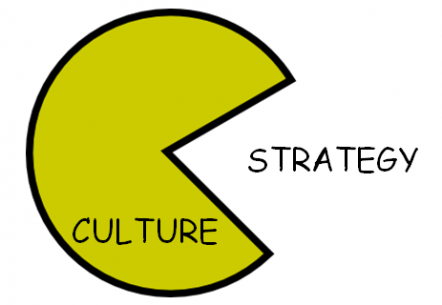
And one word that can blow it all up. Culture.

cultureeatsstrategy-442x3051

Customer Journey quotes and thoughts start to become the center of the universe of my notebook.Why?

February and March of 2016 Digital Transformation

Here’s an interesting page. On it are the names:

  • Dynamic Signal
  • Radian Six
  • Basecamp
  • Blab
  • Periscope
  • Lotus Notes and then at the bottom is the word/term…

Smart Cities,  Again

I wrote: “All anyone wants to talk and write about is…

“All anyone wants to talk and write about is digital strategy, except no-one really wants to share solutions.” If they do, it’s been done.”

#SXSW

Search Analytics

Keyword Frequency

Crowdsourcing

LiveStream

Boost/Program

Visibility plus Credibility =Profitability

April 2016

What is your strategy/vision?

What do you need to succeed? (I love this question)

My mantra? Make it right. Do it right. Make it cool. Do it cool. Happy People.

May/June 2016

Google analytics

Optimization

Inbound/Outbound

Linking Strategy

Killer copy

New Pages

“Performance issue with previous agency.”

Compliance

“Context and message can be 2 ships passing in the night or better yet, going on a cruise together on a really big boat and getting separated from the beginning.” -Me

Create amazing experiences

Designers need to think about people

#peoplefirst

“What are we solving for? Who are we solving for?”

July /August 2016

The true nature of design? #CX? or #UX

(iot) + (streaming) x (mobile)            figure out delivery

Humanize the strategy

Influencers? what gets shared?

When did influenceing the influencers become a thing?

There’s content, and then there’s our content

What are we using social media for?

What works? who is the competition?

September/October 2016

What’s more important a resource or a utility? app?

Whats the game plan?

Where does social fit in a brands mobile strategy?

Customer loyalty and disruption

Digital transformation, yea, yea, yea….

Disruption in mobile

Has the mobile imperative disrupted the design imperative?

How do you spell digital transformation?

Why are we valuable?

When you get marginalized.

IFTTT

November/December 2016

Word or term os the year? Digital transformation

  • Digital Transformation
  • Digital Disruption
  • IoT
  • VR
  • AI
  • AR
  • Design
  • Customer Experience
  • Mobile UI

Global Focus Local Thinking

What does digital ________actually mean anymore? Isn’t everything virtual?


CX is the new black

Mobile analytics is so crucial.

data

Which takes me to December 16th 2016.

These are the things I thought in 2016.


Sports and Social Media-What have We Learned?

hi-res-566d079c2f17c3b0a3d0dc3904fcdf2f_crop_north

Recently via ESPN,  a social media drama played out nationally as a Texas A&M  football recruit and one of their coaches sparred via Twitter, over the perception of each other’s veiled tweets. There will be no good that will come out of this. The fall out is bad mostly for the football coach and his respective university. The fall out is additionally bad because it also shows how recruiting athletes in a social media world can go terribly awry. In fact, it’s not even relegated to “just.” recruiting. Look no further than Laremy Tunsil and what happened to him on what was supposed to be the greatest night/ moment of his young life.

A few years ago I wrote about and presented on the need to measure twice and cut once on anything you might say via social media, but rather than heed that foresight, we’ve all, as a society have collectively run in the opposite direction. Into the light, if you will.

What’s happening is, we’re collectively realizing at the same moment, it seems, that we have become the media. This means that 1) we have realized the power and potential of the digitally written word/visual world and we realize its impact; and 2) all of us have become comfortable with the notion that we’re all publishers, editors and commentators of our lives, your lives and even the lives of people we know nothing about.

Which brings me to these quick thoughts:

  • Have we done a poor job of explaining the power of social to each other?
  • You may have no followers, but that doesn’t mean we don’t listen.
  • Everyone is a coach and will give you their 2 cents digitally
  • Digital has not lessened the consequences of our actions.
  • Athletes may have no fear but they always need to be accountable
  • The phrase, “Act like you been there before,” still resonates
  • Keep  it in the clubhouse still works
  • Team coaches need to have the social media talk with their teams

It really comes down to this. Organizations both large and small and teams of all sizes, have to have social media governance and policies that extend to their players and coaches, managers and staff. There’s too much on the line both personally and professionally as well as in the amateur ranks to not have the process and controls in place to deal with the coupling of social media and athletes. What you need to understand is that you may never have to worry about these types of issues but if and when it happens, you’re not in the dark as a coach or as an administrator.

The real question really comes down to this: What are you going to do when it happens?

What should you do?  What does an org do about the athlete who posts Instagram pics of their party life? What do you do about the athletes who dis another player or team via Twitter? How bout the YouTube video of athletes behaving badly? What do you do?  Who do you blame? Do you blame them? Because you know, we live in a transparent world now.

Going forward, athletes behaving badly via social media is not going away. The sooner you realize that as an org., the sooner you can prepare for what will happen. It’s not an if, it’s a when.

When content turns into an ad

It can’t be good…

😦

I was going to go off on a rant, but the fact of the matter is…it can’t be good. You feel duped and cheated and misled.

The Conundrum of Content-What is your Content Strategy?

I’ve been somewhat neglecting the blog over the last few months but I have a good excuse er… reason.  Others are getting my good content.  Or maybe I should just say they are getting my content, whether it’s good or not, well that’s in the eyes of the reader now isn’t it?

Being a content producer is brutal, it’s hard and it never ends.  And yea,  it sometimes it sucks.  Why?  Because content, in and of itself, is constantly being redefined and producing it is constantly a challenge.   Content for the consumer, is like Crack, the more one gets, the more one wants.  Good content keeps raising the bar for all content producers.  Why?  Because we all have to strive and push out something that will a) trump what was pushed out before, b) be consumed on a large scale and c) in a sense, hopefully will go viral.  Let’s use an Olympic analogy.  Once you score a 10, you’re expected to score another one.  When you don’t, we maybe wait and see if you can repeat and when you don’t, we maybe ask why and then, we look elsewhere.

The flip side? Like Crack, a users expectations are raised.  The tolerance levels rise. The need for more and better increase.  No longer is average content acceptable.  What make’s this further frustrating is that, as the producer of content, you no longer can control the quality.  It’s no longer up to you. You might think it’s good, but it’s really not up to you.  It’s up to them.

Thus,  just like the old adage or statement that “we’re going to create a viral video” is equal parts foolish and unattainable, thinking your next piece of content is going to rock them, well, it’s out of your control.

At the end of every business day on the web, the bottom line is that content churns the machine.  It’s what keeps companies and organizations in the public eye.  Sometimes though,  the content that keeps you in the public eye, isn’t produced by you, and isn’t necessarily how you wanted to be in the public eye.  That’s the dark side. Content is everyone’s friend and everyone’s enemy.  Why? Because  good content isn’t always about the positive.  Content, the good stuff, the reason why we fire up the computer every day, can be all about the bad stuff.

And…content is not abating, it’s not subsiding, and  it’s not morphing into something we can control, not even close and not any time soon. It’s not like there’s this rhythmic beat to the content that’s created and the content that is consumed.  Why? Pretty soon, (in  less than five years) everyone will have a smart phone AND a tablet device.  The desktop as we know it, will be dead soon.  Which means what?

Multiply the ability to consume what is created times two or maybe three.  As device proliferation increases, so does demand for sites, apps, content curators and content creators.  Like rabbits and mice, demand and creation will explode exponentially.

So I’m telling you right now, creating, collecting and curating content is damn hard. Additionally, just because you have resources and access to Google or Bing or Yahoo or whatever, it doesn’t mean that you know what will work for your company or a company when it comes to compelling content that will drive eyeballs and sales.  You can test, but at the end of the day, you have to ask yourself, if you sell soap for example-What content are you going to create that is going to increase the sales of soap?

Here are a few questions you need to ask:

  1. Can the intern help you with good content?  Initially, probably not.  But if you can nurture them into the position of “content beast,” that would be great but it takes time.  This of course would mean that you understand what works and what doesn’t.
  2. Can’t we just automate the process? So that means you’re just going to pull in everyone’s RSS feeds? Or does that mean you’re just going to scrape good content from others? Either choice is not a good one.  Though I’m a proponent of supplementing one’s own content with perhaps a national feed, it’s not a good idea to push the content of others.  Why? Well, where’s the value? Where’s the reason to come back every day?
  3. How well do you know what your customers want? Why? It takes knowledge and an understanding of your customers, what your customers search for and why exactly, are they your customers in the first place.  Once you conquer that, then you start to understand the difference between search and intent.
  4. Does it matter if your brick and mortar customers are online? It certainly helps.  Remember, that the first entry point for most people is not through the browser bar but generally through search and invariably through Google-which then heightens three things: one, is the quality of your content, two is the quality of your SEO and three is  your “socialness.”  Invariably though, your customers may start online before they walk in the door.
  5. Does it matter that your customers are social? It helps but what do you think?  If your customers are social that might mean they are digitally savvy and digitally demanding.  Don’t deliver and suffer the consequences.
  6. What will it take to create and curate compelling content? In a nutshell, you have to test what works and what doesn’t.  This is where a solid analytics package comes into play.  You have to know what drives traffic and what get’s clicked on and what doesn’t.
  7. Can we outsource it?  You can but you risk putting what you’ve known and what you’ve built into someone’s hands who doesn’t really know you, your product or your customers.  You may get lucky and find someone who plays in the same space but it takes some vetting to find that company or person.

So what’t the over-arching theme or point here?  As we hurdle towards 2013 and beyond, the proliferation of devices and platforms means that consumers are going to continue to demand content that “fits” them.  As well, that content not only needs to fit their niches and demands but it also needs to be accessed at anytime and anywhere. If it doesn’t, they are gone.  Which means, if you’re not delivering the optimum digital experience, then you lose.  It will start and end with the content you create and curate every day and every night.  If you don’t get it right, chances are that your competition will.

Social Business in 2012 Study

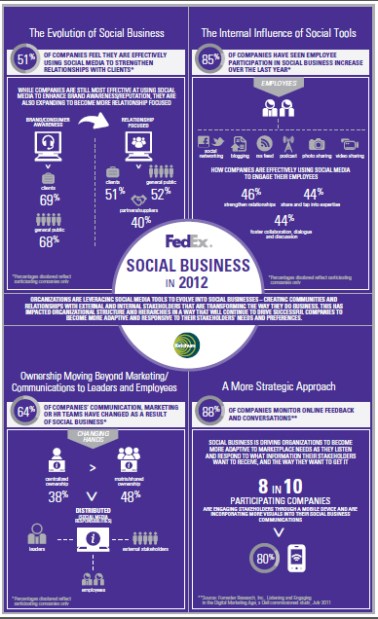
I just came across a great study co-produced by FedEx and Ketchum, titled The 2012 FedEx/Ketchum Social Business Study

This study, updates and expands upon research first undertaken in 2010 and analyzes the changing impact of social media on business today.  To quote, “Organizations are leveraging social media tools to evolve into social businesses – creating communities and relationships with external and internal stakeholders that are transforming the way they do business.”

Image

How Do We Get Duped By SEO [Infographic]

It all starts with a title. The better the title, the stickier the title, the more likely you’ll suck us in.