Social networks tied to every product, service and brand…Don’t laugh.

So the logical evolution of social networking is taking hold. In todays volatile marketplace, the success of manufacturers, advertisers, marketers, and media companies in creating long-term value and stickiness depends primarily on their ability to develop great stategies wrapped around great value propositions quickly. So what better way than to use the power of social networks?

I use the terms great strategies and value props. because todays consumers are as discerning as they have ever been. Why? Because they are armed to the teeth with more information than they know what to do with. And now with social networks, the ability for consumers to talk and share and recommend virally, is as big a challenge for marketers et al. as it has ever been.  But it can also be a major home run if done right.

That strategy appears to have taken flight with Viacom for instance. You may not know Viacom as well as you do their MTV properties. Having said that, MTV has recently announced that is jumping back into the social-networking game. In 2005, News Corp. outbid Viacom for social-networking giant MySpace.com. Since then, Viacom has largely been on the sidelines in the growing market. Now the company is focusing on creating a vast array of highly targeted Web sites that are loosely connected and focus mostly on programming such as VH1 Classic, Jackass, and Sucker Free on MTV.

When we mentioned product-centric strategies earlier, this is a case in point where Viacom/MTV has a solid brand they are looking to grow and expand  into new markets and new channels using all of the resources available to it. One of them being social networks.

MTV’s highly-targeted web sites will be at the core of the company’s digital efforts. MTV sees its content as its strength, and thus they have  decided to wrap that content with the power of social networking. In the past year, the company has constructed 32 new sites. The idea is to create a type of assembly line for Web sites. Those sites that find an audience will continue to be nurtured and those that don’t will be stripped down and “reskinned,” or refitted for the next experiment. Kind of like the 10 day “look-see” contracts athletes get in professional sports. They essentially have 10 days to impress. If they don’t, away they go. 

Interestingly enough, the company  doesn’t plan to spend a lot of cash in promoting the sites. The reason being that they have the utmost confidence in their content and the viral ability of the Web to spread the word. Given that lack of faith, I’m going to give Viacom/MTV a 10 day look-see to see if this particular strategy pays off. It almost gives you the sense that they are saying,”we love your idea, we just don’t want to sink much money into it, until it works”.

While killer business processes, off-the-hook customer service, and bleeding edge technology all play vital roles in todays web 2.0 world, companies that create and buy into solid product-centric strategies and processes with the customer in mind, will be those that build valuable loyal brands and profitable businesses beyond the 21st century. It remains to be seen though if this particular strategy will pay off for Viacom/MTV.

Buzzword Compliant

Can anyone add some scalable and yet granular social networking, web 2.0 buzzwords to this bingo card to essentially bootstrap this into a viral marketing message?

buzzword-compliant.jpg

The social networking experiment for business

Ok so much has been said about whether social networks are good for anything beyond poking someone and building a nice page that your six friends can check out, that I thought it would be interesting to see what the results would be if I had signed up for not 1 but 10 business oriented social networks.

Before I begin I need to set some specific goals though as to what I want to achieve. Do I want to meet potential business contacts? Sure I do. Do I want to help someone else get a project or a job or make a contact? Sounds like a good idea. Ok lets see what else? Drive traffic to the blog? Not a bad thing, but certainly not the end-all-be-all. Ok, so these are good starting points. However, I have no preconceived notions yet, but who does when someone signs up for one of these sights? What should be their expectations?

With that being said. I will have zero expectations but I will attack the 10 social networks with measurable goals so that we can see which has the biggest and quickest impact on me participating.  The first thing on the experiment list is how intuitive are the sites? How easy was it to login and register? and What are they promising? Below is the list:

Ecademy

Entremate

Friendly Favors

Konnects

Networking for professionals

Real Contacts

Ryze

Spoke

Teng

Facebook

Coming up in the next post will be what the intial impressions were, how was the account creations process and a more descriptive explanation of each sites service offereings. Am I missing any sites that should be on this list? Has anyone had any experiences that they want to share?

Think you can make money on social media sites?

Can advertisers/marketers make money in a social networking environment? That is the real question.

Forrester reports about 30 percent of social networking site users embrace a brand so that they could become eligible for  freebies,exclusive offers, events or sales or because another friend recommended it. Forrester gave this type of social consumer reaction as “friendonomics.” Granted it greatly helped the brand if they(the users) had some clue about what the brand was all about prior to befriending it, but it wasn’t a complete deal killer.

With that being said in regards to having a clue about the brand, Forrester states, Gen Y users “show the greatest interest, with 37% saying they would be interested in seeing marketer profiles on social networking sites. Gen X isn’t far behind, with 31% showing interest.”

What appears to work though and is gaining some traction, is the creation of widgets or apps on Facebook.  If you use Facebook, you no doubt have noticed the plethora of new apps that have appeared over the past few months. These apps, created by marketers for instance, give some legs and visibility to brands, new products and sites that are looking for traffic and eyeballs.

Back in August of 2007, Google filed another  patent for “user-distributed advertisements” (UDA) whereby the UDA system “facilitates insertion of manually selected ads into a document that is to be distributed (e.g., transmitted, published, and/or posted) such that the document is to be made available to other users.”

The document explains why it’s a good idea: “Although advertising systems such as AdWords and AdSense have proven to be very effective tools for advertisers to reach a receptive audience, even automated systems that use sophisticated targeting techniques often can’t match the effectiveness of manual targeting. However, manual targeting techniques don’t scale well. Therefore, it would be useful to provide a scaleable advertising system that achieves at least some of the benefits of manual targeting. It would also be useful to provide a system of charges and/or rewards to encourage useful manual targeting of ads. Further, it would also be useful to track and use performance metrics of such ads if doing so would help an advertising system serve ads that are more useful. Finally, it would be useful to provide data structures and interfaces for enabling advertisers to participate in a system for manual insertion of ads into a document for distribution.”

Long story short is that Google wants to figure out a way for its users to be worker Bees that essentially spread or carry advertising. What better way then to incentivize every possible action that someone does while online. So I send you an email and I go ahead and drop a couple of Adsense bombs in the body of the email and off you go to make us both money. All of a sudden it does pay to advetise via email again and the more viral the better!

The problem with trying to tie together advertising for instance, and social media is that to most and we’ll use direct response, is that DR advertisers, are going to look at specific measurable results which essentially will tell them if it’s a) worth it and b) should they test again. the problem with social networking sites and advertising, at least right now is that the results of advertisers are not yet quantifiable or measurable to a degree of their liking. There is too much grey area.

It’s grey because Social media is about engaging the prospect, befriending the prospect and winning the prospects trust instead of vomiting the information(makes for a great visual doesn’t it?) and the pitch, all over them. And if you don’t think is true, go ahead and try it and let us know what type of experience you have.

Essentially the whole social media experience as it pertains to direct response is more about marketing than it is about advertising. And to that end traditional  online or offline advertising will not work in this environment anyways. So don’t bother.
 

The Public Perception of Social Networks

Unless you have been living under a rock….

I’ve been using that statement a lot lately and it seems to be very appropriate these days given the state of all things technology related. between the iphone, MySpace, Facebook, Android, Open Social, and all things in between, it is a great time to be a digital consumer. Or is it?

You know when AOL first came on the scene, Everyone had the same thought. What is this going to do to the way we communicate? What will AOL do to the social fabric of our lives. That is the exact thing happening in the social networking world. If you would like to stand and admit that you too had an AOL account at one time, it’s ok. We’ll pause.

Ironically AOL was the beginning of true social networking, through AIM. And if you really want to know the truth, AOL’s phenomenal growth wasn’t based around internet access. It was the ability to chat with others. To communicate with others. THAT is social networking. Finding people with similar interests that you could connect with. The real difference now, are the tools that are available to the common user to create and enhance their social networking experience or communicating experience. Social networks have become social media sites as well.  There is now a distinction between the 2. There is a social media type site and  social networking type sites. The tools now available allow users to share more than just words. Its now photos, music and video. Those are social media sites. Like Youtube or Flikr. Nothing new there right?

Because of this, social networking sites are the most frequented websites on the web. In fact according to Hitwise, the demo of 18-24 users hit Facebook more than they visit porn sites! So now instead of what is construed as a one way relationship with a porn site for instance, is passed up because now this demographic can go to Facebook and have a better overall user experience. Amazing when you think about it. Content isnt’t king, porn isn’t king. Social networking is king!

But what is the overall public perception of social networks?  That seems to be changing as well. The perception for some is, “I’ve heard about them, but I just don’t know enough.”. While others have jumped in with both feet. and some have dipped toes in the water. This is perception can be blamed on the media, marketers, and word of mouth.

Depending on the demographic, and this is no surprise as your 15-24 age group are always going to be the early adopters, the social networking experience is going to be different in regards to perception and usage, for each and every group. However this is changing as well as users realize that there is more out there besides Facebook and Myspace. Check this blog for older posts about the top rated social sites in business, video, and music. To read an interesting and no to surprising article about class distinction in social networks,  read this article by dannah boyd.

 the bottom line about social networks is that people are finding their people, their packs, their groups. Just like they did on the playground as children, it is now taking place with social networks. And you know what? There is nothing wrong with that. You see, the public perception of social networks right now is skewed, because THEY DON”T ENOUGH to make an educational, much less personal decision on whether to use them yet. So they base their opinion on their perception. It is changing though and rather quickly as statistics show that one of the fastest rising demographic of users on Facebook are the 35+ group. And of course as a side note, you know this is going to piss off the 18-24’s who will now have to latch onto something that is cooler.

But public perception of social networks is still skewed across the following words and statements:  Uncertainty, a time drain, a resource drain, zero value proposition, spam extenders, virus friendly, a place for stalkers to thrive etc etc. In fact, The blog Switched reports that according to a new study by an employment law firm, approximately $264 million U.S. dollars are lost in man hours because of Facebook.

The thing to understand here is that like any relationship, you get out of it what you put into it. Whether that is online or offline. The only way you are going to see whether a social network is for you is to take one for a test drive. It doesnt neccessarily have to be MySpace or Facebook, though those two are not bad starting points, but the only way to find out is to jump in.

It may enhance your computing experience or it may be a detriment. It totally depends on what you want to to achieve. Is it for business? Then there are a lot of purely social networks geared toward business and building relationships that will fit your needs. Start with Linkedin.

Just remember, in the end, you’ll get out of it, what you put into it. Just don’t base your opinion on what you have read or heard from someone else. What DO YOU think their perception is? What was your perception before you tried them out? What were your expectations? What are your expectations now?

The top 10 hottest Social Networking Widgets

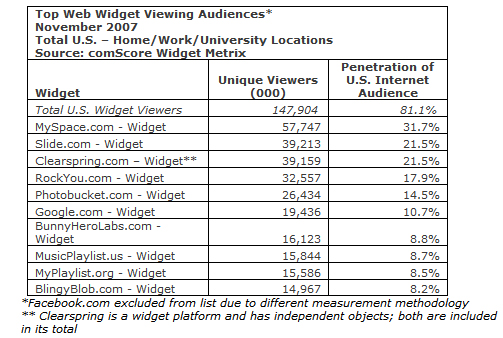
 Comscore released the November 2007 U.S. rankings of the top web widgets. For those of you who do not completely understand what a widget is, it’s essentially independent objects or an object that can be embedded or downloaded onto another site and can be used as a tool, have automatic content updates, or are or can be interactive. Though they go by the name of “widget”, Facebook calls them “applications” and Google calls them “gadgets.”

In November 2007, nearly 148 million U.S. Internet users viewed widgets, representing 81 percent of the total audience. MySpace.com widgets had the widest audience, reaching more than 57 million Internet users, while Slide.com ranked second with 39.2 million viewers. Google.com has the sixth widest widget-viewing audience with more than 19 million viewers.

What’s the “skinny” on what widget usage means to the lay person? Simply put, it means that widget usage can be computed as eyeballs on the site, which also means that if the widget is cool, you can bet others will go to get the widget. The widget is essentially another form of advertising. If they have your widget, that means they came to your site or heard of your widget from someone else. Word of mouth, Seth Godin, word of mouth!

Having said that, take a look at these November numbers.

Comscore Widgets

Obviously MySpace is the dominant player here but look at the others on the list. Slide for example is the largest personal media network in the world, reaching 144 million unique global viewers each month and more than 30 percent of the U.S. Internet audience. They help people express themselves and tell stories through personalized photos and videos created on Slide.com and viewed anywhere on the web or desktop.

Slide’s products — including Slideshows, FunWall and SuperPoke! — are popular on top social networking and blog platforms, including MySpace, Facebook, Bebo, Hi5, Friendster, Tagged and Blogger. Slide is also the leading developer on Facebook with more than 84 million applications installed and the most active users than any other developer.

Clearspring though is NOT a social network. Clearspring is the leading provider of cross-platform widget services. Their goal is to make it easy to use content and services from across the Internet to weave personalized experiences. Clearspring is the leading enterprise-class widget syndication platform. With our out-of-the-box syndication solution you can quickly repackage your existing content and services as viral widgets and syndicate them across multiple platforms.

RockYou is a leading provider of applications and widgets on the web. RockYou widgets include photo slideshows, glitter text, customized Facebook applications and voicemail accessories that are simple to use and enable people to frequently refresh their online style. RockYou has over 35 million users, serving over 180 million widget views per day in more than 200 countries. RockYou applications are customized for easy integration across all social networks including Facebook, MySpace, Bebo, Friendster, Tagged and hi5. RockYou’s cost-effective, results-focused advertising platform is the largest Ad Network on Facebook and the most dynamic method for rapidly acquiring Facebook application users. New applications can reach over 100k users in 24 hours, spanning a suite of applications across multiple publishing partners

Photobucket Owned by News Corp is the most popular site on the Internet for uploading, sharing, linking and finding photos, videos, and graphics.  Photobucket, According to Comscore is: 

  • 24.1 Million unique site visitors/month in the US, and 34.6 Million unique site visitors/month worldwide.
  • #1 most popular Photos site in the US.
  • #3 most popular Entertainment/Multimedia site in the US.
  • #7 most popular Entertainment/Multimedia site in the world.
  • #24 in Top 50 Sites in the US and
  • #47 Top 100 Global Sites

The next one is BunnyHerolabs, bunnyhero pets bebo app the pets have been available on bebo for a while now as “widgets,” but now bunnyhero pets are available as an application on bebo’s new application platform.

What this means for bebo users is now when they adopt a pet on bebo, they can add the “bunnyhero pets” application. With the new application, they are able edit their pets after they’ve added them to their profile, like changing their pet’s name and color.

Next are the Musicplaylist.us and myplaylist.org widgets, which are a no brainer in the land of “can’t-miss” and “must-have”, widgets. And lastly if you ever wondered where all of the kitschy graphics on the MySpace pages was coming from, look no further than, and the name seems awfully apropos, BlingBlob.com. BlingyBlob.com, for us uninitiated, is the hottest source for FREE high quality graphics, animations, Flash and much more for your MySpace page, personal site, or blog. Makes you giddy, doesn’t it?

Look for music, video and image sharing widgets to continue to evolve to an extent that perhaps one day they become part of someone’s v-card or email signature, along with the location of their MySpace, FB or Linkedin pages.

The growth of social networking

By 2011 about half of U.S. online adults and 84% of online teens will be using social networks. This according to eMarketer. What this points to is an evolution or a continuing evolution of children who currently are becoming aquainted with and more comfortable with, “How social networks work”. This also points to the greater value that adults will put in their social network. “Their” being the operative word.

Furthermore, this raises a very poignant question. Though Facebook and Myspace are the darlings of the moment, can they continue the momentum that they can surely take credit for? Will they be “The” players in 3 years?

As it is right now today the evolution for most users looks something like this:

Club Penguin/Webkinz—->Myspace—->Facebook—-Linkedin.

I use Linkedin as the last one for professional reasons but really after Facebook, the usage fractures into a 100 different niche based social networks. This usage in the next 3 years will continue to evolve into hundreds of other social network sites.

My educated guess, though they (MySpace and FB) will still be viable, there will be others that will come along, if they have not already, that provide more to their niche than the current duo do. Here is the reasoning. Myspace is for teens/bands and tire-kickers and fringe users. Facebook is for college aged and older users who have more of a familiarity with the social network and all that it can provide.

So in 3 years when your current crop of Facebook users for instance, graduate and possibly outgrow the Facebook newness/coolness factor what do they do then?  What do adults who are currently using Facebook do in 3 years? The same thing I suspect that AOL users did once they found out that AOL wasn’t the only game in town. Everything will evolve. Including the knowledge and expereince of the users. Thus the reason that by 2011, social networks will be so entertwined in our daily lives that it will be assumed that you are part of some SN.

The good news, and really none of this is bad news, but worldwide Ad spending will increase at a healthy 20-39% each year between now and 2011 according to eMarketer. In the U.S. alone social network ad spending is expected to rise to $2.7 billion in 2011. Currently the pie is being divided naturally towards Facebook and MySpace, but look for that to change significantly with the growth of niche and marketer oriented sites.

Social Networks by the numbers

For December 2007, MySpace.com received 72 percent of U.S. visits among the social networking category. Facebook.com received 12.57 percent of visits and Bebo.com received 1.09 percent of visits. (according to Hitwise)

U.S. traffic to all the social networking websites increased four percent year-over-year. MyYearbook experienced the largest gain in market share in December 2007, increasing 407 percent compared to December of the previous year. Facebook and Club Penguin followed, increasing 51 and 48 percent, respectively. For those who are unaware of Club Penguin, it is the entry point for children into their first brush with social networks.

In December 2007, MySpace received 95 percent of its share of traffic from returning visitors. Among the top five social networking websites by market share, Facebook and BlackPlanet.com followed with 93 and 89 percent, respectively, of traffic returning from the previous month.

Market Share of U.S. Internet Visits to Top 10 Social Networking Websites

Rank

Name Domain

Dec-07

Dec-06

YoY % Change

1

MySpace http://www.myspace.com

72.32%

78.89%

-8%

2

Facebook http://www.facebook.com

16.03%

10.59%

51%

3

Bebo http://www.bebo.com

1.09%

0.99%

10%

4

BlackPlanet.com http://www.blackplanet.com

1.04%

0.96%

8%

5

Club Penguin http://www.clubpenguin.com

0.80%

0.54%

48%

6

Gaiaonline.com http://www.gaiaonline.com

0.76%

0.58%

31%

7

myYearbook http://www.myyearbook.com

0.73%

0.14%

407%

8

hi5 http://www.hi5.com

0.63%

0.64%

-1%

9

Classmates http://www.classmates.com

0.55%

0.58%

-7%

10

Yahoo! 360 360.yahoo.com

0.54%

0.91%

-40%