The top 25 websites for February 2008

According to comScore here are the top 25 websites/properties that received the most traffic in February. Some of these should not surprise you. But it does give you a glimpse of what people’s surfing patterns consist of. The number next to it is uniques, as in millions. Yahoo! Sites continued to lead as the top property with 137 million visitors, followed by Google Sites with nearly 136 million visitors and Microsoft Sites with more than 118 million visitors. Wikipedia Sites and  The Ask Network each moved up one position in the top 10 to spots seven and nine, respectively. Glam Media jumped 10 spots to reach position 18 with more than 29 million visitors during the month. Since Tax season is upon us,  the IRS.gov site moved into the Top 50 ranking, capturing position 45.

Yahoo! Sites 136,767

Google Sites 135,970

Microsoft Sites 118,355

AOL LLC 108,911

Fox Interactive Media 83,638

eBay 77,864

Wikipedia Sites 55,906

Amazon Sites 55,172

Ask Network 54,120

Time Warner – Excluding AOL 52,661

New York Times Digital 47,632

Apple Inc 47,048

Viacom Digital 41,216

Weather Channel, The 41,057

CNET Networks 33,320

Facebook.com 32,436

Adobe Sites 30,620

Glam Media 29,136

Wal-Mart 27,651

Superpages.com Network 27,526

Verizon Communications Corporation 27,101

Disney Online 27,094

Craigslist, Inc 26,822

Gorilla Nation 26,710

Target Corporation 26,631

Mobile, Social, and Search. Quick hits.

In a quest to pare down my already slim posts, I’m going to fire off a couple of quick blurbs for everyone to chew on until the next post:

  • Aside from Microsoft not backing down in it’s quest to buy Yahoo, AT&T and Yahoo have entered in a multiyear deal to share revenue from advertising on Mobile phones. Yahoo will provide search and display advertising for AT&T customers. I’m shocked that Google did not get there first.
  • Speaking of Microsoft, the Wall Street Journal just cut a deal with them in which the WSJ’s paid search and contextual advertising services will be provided by Microsoft. Not to sound redundant but, I’m shocked that Google did not get there first…
  • Social media giants Facebook and Myspace will become application hubs and launch pads for niche based “smaller” social networks. Alot of this is the residual effect of Facebook opening its platform last fall.
  • Word of Mouth marketing is the new mode of marketing on the cheap. It’s also just as effective as traditional forms of marketing and has much more of a “buzz” factor.
  • Magazines drive more than 50% of online searches, followed by reading an article in a magazine and lastly by seeing something on TV.
  • According to Anderson Analytics, 32% of  the 1700 marketing executives polled cited “Green Marketing” as an important emerging concept along with it being considered the trendiest marketing buzzword.
  • The hottest demographic that you need to be marketing too, but are probably ignoring are the hispanic and baby boomers.
  • According to Informa’s latest report entitled “Mobile Social Networking: Communities and Content on the Move,” the number of mobile social networking users exceeded 50 million, approximately 2.3% of the global mobile user population on December 31st, 2007

Social networks tied to every product, service and brand…Don’t laugh.

So the logical evolution of social networking is taking hold. In todays volatile marketplace, the success of manufacturers, advertisers, marketers, and media companies in creating long-term value and stickiness depends primarily on their ability to develop great stategies wrapped around great value propositions quickly. So what better way than to use the power of social networks?

I use the terms great strategies and value props. because todays consumers are as discerning as they have ever been. Why? Because they are armed to the teeth with more information than they know what to do with. And now with social networks, the ability for consumers to talk and share and recommend virally, is as big a challenge for marketers et al. as it has ever been.  But it can also be a major home run if done right.

That strategy appears to have taken flight with Viacom for instance. You may not know Viacom as well as you do their MTV properties. Having said that, MTV has recently announced that is jumping back into the social-networking game. In 2005, News Corp. outbid Viacom for social-networking giant MySpace.com. Since then, Viacom has largely been on the sidelines in the growing market. Now the company is focusing on creating a vast array of highly targeted Web sites that are loosely connected and focus mostly on programming such as VH1 Classic, Jackass, and Sucker Free on MTV.

When we mentioned product-centric strategies earlier, this is a case in point where Viacom/MTV has a solid brand they are looking to grow and expand  into new markets and new channels using all of the resources available to it. One of them being social networks.

MTV’s highly-targeted web sites will be at the core of the company’s digital efforts. MTV sees its content as its strength, and thus they have  decided to wrap that content with the power of social networking. In the past year, the company has constructed 32 new sites. The idea is to create a type of assembly line for Web sites. Those sites that find an audience will continue to be nurtured and those that don’t will be stripped down and “reskinned,” or refitted for the next experiment. Kind of like the 10 day “look-see” contracts athletes get in professional sports. They essentially have 10 days to impress. If they don’t, away they go. 

Interestingly enough, the company  doesn’t plan to spend a lot of cash in promoting the sites. The reason being that they have the utmost confidence in their content and the viral ability of the Web to spread the word. Given that lack of faith, I’m going to give Viacom/MTV a 10 day look-see to see if this particular strategy pays off. It almost gives you the sense that they are saying,”we love your idea, we just don’t want to sink much money into it, until it works”.

While killer business processes, off-the-hook customer service, and bleeding edge technology all play vital roles in todays web 2.0 world, companies that create and buy into solid product-centric strategies and processes with the customer in mind, will be those that build valuable loyal brands and profitable businesses beyond the 21st century. It remains to be seen though if this particular strategy will pay off for Viacom/MTV.

10 Insights From 11 Months Of Working At Google

Here is a great piece on someone NOT bashing Google for being the great company that they are: http://www.kaushik.net/avinash/2008/02/10-insights-from-11-months-of-working-at-google.html

What’s the deal with widgets?

Ok so I’m going to go out on a limb and here and say that chances are that most of the common masses do not know what a widget is. Even if you use your computer on a daily basis, there is still the slight chance that you might not know what a widget is. No big deal. Yet…

Simply put, a widget is a portable chunk of code that can be installed and executed within any separate web page by an end user( You or I) without requiring additional work or previous knowledge on the users part.  Other terms used to describe widgets include: gadget, badge, module, capsule, snippet, mini and flake.

Widgets often but not always use DHTML, JavaScript, or Adobe Flash.  A widget adds some content to that page that is not static. Generally widgets are third party originated, though they can be home made. They add a more rich, entertainment, multi-dimensional feel to a site that might be otherwise static.

Widgets are now becoming more commonplace and are used by bloggers, social network users, marketers, advertisers, and owners of personal web sites. They exist on home page sites such as iGoogle, Netvibes, Pageflakes, SpringWidgets and yourminis, and hundredes of other sites.

Widgets are used as a distribution method by ad networks such as Google’s AdSense, by media sites such as Flickr, by video sites such as YouTube and by hundreds of other organizations.

Applications can be integrated within a third party website by the placement of a small snippet of code. Which is now becoming a primary distribution or marketing channel for many companies. The code brings in ‘live’ content – advertisements, links, images, and video – from a third party site without the web site owner having to update.

Thus the end users can utilize widgets to enhance a number of web-based hosts, pages or drop targets. Categories of drop targets include social networks, blogs, wikis and personal homepages. Although end users primarily use widgets to enhance their personal web experiences, or the web experiences of visitors to their personal sites, corporations can potentially use widgets to improve their web sites using syndicated content and functionality from third party providers. They are also now using widgets as a carrier of their branding message or product.

So where can you find some widgets? The easiest source would be generally on the page you are currently reading, either on the left or right side of the pages. The widgets are dropped in via a widget managment system. Should you feel compelled, check out KickApps which states: The KickApps hosted, white-label platform puts social media and online video functionality directly into the hands of every web publisher who aspires to be a media mogul and turns every web designer and developer into a social media rockstar! With KickApps, it’s now easier than ever for web publishers to leverage the power of social and rich media experiences on their websites to drive audience growth and engagement.

If you are the casual reader, then hopefully this helps you. If you are a certified blogging fool, then this is nothing that you already don’t know. If you are somewhere in the middle, then now you have been enlightended.

The top 10 hottest Social Networking Widgets

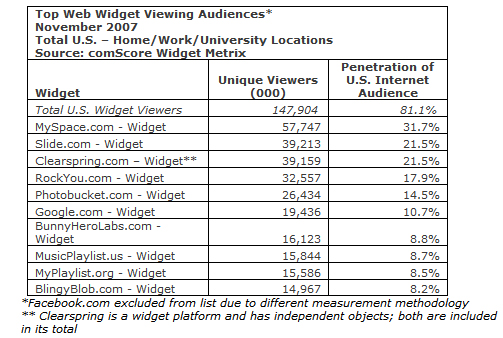
 Comscore released the November 2007 U.S. rankings of the top web widgets. For those of you who do not completely understand what a widget is, it’s essentially independent objects or an object that can be embedded or downloaded onto another site and can be used as a tool, have automatic content updates, or are or can be interactive. Though they go by the name of “widget”, Facebook calls them “applications” and Google calls them “gadgets.”

In November 2007, nearly 148 million U.S. Internet users viewed widgets, representing 81 percent of the total audience. MySpace.com widgets had the widest audience, reaching more than 57 million Internet users, while Slide.com ranked second with 39.2 million viewers. Google.com has the sixth widest widget-viewing audience with more than 19 million viewers.

What’s the “skinny” on what widget usage means to the lay person? Simply put, it means that widget usage can be computed as eyeballs on the site, which also means that if the widget is cool, you can bet others will go to get the widget. The widget is essentially another form of advertising. If they have your widget, that means they came to your site or heard of your widget from someone else. Word of mouth, Seth Godin, word of mouth!

Having said that, take a look at these November numbers.

Comscore Widgets

Obviously MySpace is the dominant player here but look at the others on the list. Slide for example is the largest personal media network in the world, reaching 144 million unique global viewers each month and more than 30 percent of the U.S. Internet audience. They help people express themselves and tell stories through personalized photos and videos created on Slide.com and viewed anywhere on the web or desktop.

Slide’s products — including Slideshows, FunWall and SuperPoke! — are popular on top social networking and blog platforms, including MySpace, Facebook, Bebo, Hi5, Friendster, Tagged and Blogger. Slide is also the leading developer on Facebook with more than 84 million applications installed and the most active users than any other developer.

Clearspring though is NOT a social network. Clearspring is the leading provider of cross-platform widget services. Their goal is to make it easy to use content and services from across the Internet to weave personalized experiences. Clearspring is the leading enterprise-class widget syndication platform. With our out-of-the-box syndication solution you can quickly repackage your existing content and services as viral widgets and syndicate them across multiple platforms.

RockYou is a leading provider of applications and widgets on the web. RockYou widgets include photo slideshows, glitter text, customized Facebook applications and voicemail accessories that are simple to use and enable people to frequently refresh their online style. RockYou has over 35 million users, serving over 180 million widget views per day in more than 200 countries. RockYou applications are customized for easy integration across all social networks including Facebook, MySpace, Bebo, Friendster, Tagged and hi5. RockYou’s cost-effective, results-focused advertising platform is the largest Ad Network on Facebook and the most dynamic method for rapidly acquiring Facebook application users. New applications can reach over 100k users in 24 hours, spanning a suite of applications across multiple publishing partners

Photobucket Owned by News Corp is the most popular site on the Internet for uploading, sharing, linking and finding photos, videos, and graphics.  Photobucket, According to Comscore is: 

  • 24.1 Million unique site visitors/month in the US, and 34.6 Million unique site visitors/month worldwide.
  • #1 most popular Photos site in the US.
  • #3 most popular Entertainment/Multimedia site in the US.
  • #7 most popular Entertainment/Multimedia site in the world.
  • #24 in Top 50 Sites in the US and
  • #47 Top 100 Global Sites

The next one is BunnyHerolabs, bunnyhero pets bebo app the pets have been available on bebo for a while now as “widgets,” but now bunnyhero pets are available as an application on bebo’s new application platform.

What this means for bebo users is now when they adopt a pet on bebo, they can add the “bunnyhero pets” application. With the new application, they are able edit their pets after they’ve added them to their profile, like changing their pet’s name and color.

Next are the Musicplaylist.us and myplaylist.org widgets, which are a no brainer in the land of “can’t-miss” and “must-have”, widgets. And lastly if you ever wondered where all of the kitschy graphics on the MySpace pages was coming from, look no further than, and the name seems awfully apropos, BlingBlob.com. BlingyBlob.com, for us uninitiated, is the hottest source for FREE high quality graphics, animations, Flash and much more for your MySpace page, personal site, or blog. Makes you giddy, doesn’t it?

Look for music, video and image sharing widgets to continue to evolve to an extent that perhaps one day they become part of someone’s v-card or email signature, along with the location of their MySpace, FB or Linkedin pages.

Global search revenue will reach $60 billion by 2011

As if Google and company did not make enough money, by years end, global search revenue will reach $30.5 billion according to a recent JPMorgan report which hinted that investors still should view the web as a good  “buy” or investment.

Contrary to the dot com bust of the early 2000’s, 2007 was actually a very good year for internet companies. In fact, due to the rising world GDP, according to the report, internet companies with a global reach would continue to enjoy a healthy profit due to the broad and seamless appearance of a global marketplace. Conversely, the US GDP growth has slowed in recent years.

By 2011, look for search revenues to exceed $60 billion according to the report. A lot of this groth will be tied into paid search as a global marketing vehicle. The growth will also be attributed to keyword price inflation and increased web usage. Tied to this will be an increase in the user experience and increase in click-through rates for all sites.

Class distinction is all over Facebook and Myspace, you just have to look

Here is an awsome (and long) article on Class and social networks

Death of The Library and rise of the Kindle.

Unless libraries can tailor everything that they do and stand for towards the digital universe, their days as a wellspring of knowledge and information are numbered. After reading an article titled, “The Impatience of the Google Generation” in wich the author and the responses essentially come to the conclusion that the current generation and younger generations for that matter, are essentially impatient when it comes to how quickly they can find and receive information, I can only assume that the last place that they would want to go is a place where their information was in a hard bound book!

OK, so yes libraries have computers that are tied not only to their volumes of hardbound books but also to search as it relates to the internet. But riddle me this: Why would I go to a library and search for a book when I could log onto a computer and find the same information? Says the 18-24 old student. I know it’s deeper than that, but lets put ourselves in the place of someone in college or younger. A) every college student, or a good portion of them now have their own laptop. So now they “walk” around with access to any and all information/research that they will ever need.  Bogus wikis notwithstanding. and B) They are so accustomed to getting information readily, that going to a library defeats the purpose of  library research per se.

 Of course, they can still go to the “quiet” library to get work done. And there are still certain things that a library provides or possesses that a student still might need or utilize, but…the thinking is,”It’s all here on the internet”!

Generation “C” (content) has no use for a library. In fact I would venture to guess that funding on local, state and federal levels for libraries is constantly slashed in favor of more digital type programs or programs that lawmakers feel have more importance.

Having said that, here is one more thing for you to chew on.  The Amazon  Kindle is an electronic book device launched in the US by Amazon.com  this past November.  It uses an electronic paper display, reads the proprietary Kindle (AZW) format, and downloads content over Amazon Whispernet, which uses the Sprint EVDO network. This means that the Kindle can be used without the need for a computer. Whispernet is accessible through Kindle without any fee. On the release day, the Kindle Store had more than 88,000 digital titles available for download. Amazon’s first offering of the Kindle sold out in five and a half hours. It retails for $399.

Think about it. People still want to read but they want it condensed and more than just portable. So does this mean that the Dust jacket will go the way of the Jewel Case and album art? If the latest advances in media, music and entertainment are any indication, it appears that that will be the case.