
Guerrilla marketing and social media marketing-an imperfect, perfect union.

This blog post comes from a tweet that I just had which was prompted by a tweet by Jeremiah Owyang in which he said:

Next, we need to think if media spending decreases, will marketers lean on low cost social media even though returns are generally unknown?

This statement made me think that right now marketers, advertisers, small business owners- actually everyone, is thinking about how to do “it” for less. In other words how can they drive traffic and sales and leads and eyeballs to their sites and products on the cheap. Bring in social media. One of the great things about social media and user generated content is that it can be done for no cost or a low cost. And the results can be pretty amazing if done right. Enter Guerrilla Marketing. If done right,  guerrilla marketing  can and has been very very successful in growing brands, creating viral buzz, and driving sales, eyeballs and traffic to products or companies.  Why mesh guerrilla marketing with social media marketing?  Well, lets look at the definition of guerrilla marketing:

The term guerrilla marketing was coined as an unconventional system of promotions on a very low budget, by relying on time, energy and imagination instead of big marketing budgets. The term has since entered the popular vocabulary to also describe aggressive, unconventional marketing methods generically.

So if we take the basic tenets of guerrilla marketing and meld them with social media marketing you create this marketing synergy that has all the elements of:

Cheap+Viral+ Unconventional+Social= Marketing Nirvana

Social media can be “done” on little or no budget. It is time intensive, it does require energy, it can be viral, and there is no limit on your imagination. Right?   It is definitely not constrained by conventional wisdom, and we still do not know about all the creative ways that it can be used from a marketing standpoint.

So why not?

From here on out I’m going to suggest to marketers and companies that are stuck by the challenges of marketing in a tough economy and social media marketing in general, adopt the “Flavor Flav/Brigitte Nielsen marketing concept”. Loosely defined as an imperfect, perfect union of styles, personalities and standards, that underneath the hood, are very very similar and actually work. For now. Until we figure the rest out.

Post Conversation-What do we do now?

Once you get beyond the conversation, what’s there?  For each aspect or rather in each of it’s iterations, there will always be a result or an action. Conversations, regardless of the network they are swimming in, have to have some causal net result. If not, then it’s one big dinner party or bar, where the conversations have no substance, and we all go home and wake up in the morninh with a headache and ask what happened.

There is a great discussion about this exact subject going on in a few places that I would encourage you to visit. Over at Valeria Maltoni’s site the conversation agent, Valeria has always maintained that it was always about the outcomes of the conversation. And she cites numerous sources that in one way or another support this premise. I couldn’t agree more. You have to do something with the conversations that you have participated in. There has to be an outcome. Unless of course, you converse just to hear yourself speak.

But see, the difference is that in this Web 2.0 age, our conversations take on many different forms. We reach out to have these conversations in many forms and in each form, the effort on our part is the push and we want the pull from the other party. But the conversations may have a tinge of self aggrandizement unfortunately, and that’s where we might be missing the point. I think that these days people are realizing that some of the conversations may be disingenous. It’s the dirty little secret of the social-ness of what we are all participating in. Its the nature of the fluidness of social. It’s way too easy to start the conversation and it’s way too easy to manipulate the conversation in your favor. But most of us are hip to that and I think it eventually  sorts itself out. We’re able to police that part fortunately.

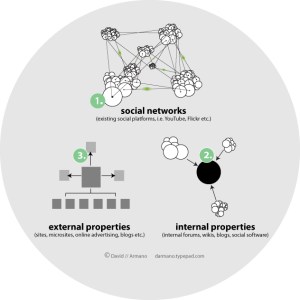
What happens next in each aspect is covered as well by David Armano  with another one of his wonderful graphic representations in which David essentially asks… We’ve identified all the different mechanisms and networks and tools to bring forth the dialogue and raise the level of everyone’s voice beyond the tinge of a whisper so, “What next?”.

You see in each “property” in the above graphic, conversations are and have been taking place. But what comes of them? Here is a quick example. Do we blog because we want to hear and read what we speak and write about respectively? No, we do it because we essentially want to talk and we want to be heard, and we want to engage others in a dialogue. Problem is, and I’ve noticed that perhaps this one tiny aspect is often overlooked- in order to be heard and in order to converse on or in a blog platform, it does not happen immediately. It takes work, and it takes effort, and I think to a large degree, most people underestimate that. Thus they abandon the endeavor. Do we need to make it even easier to be heard and engage others? Is it still to intimidating and difficult to join in the conversation?

The outcomes of conversations in each of David’s properties all predicated on various barriers of entry. Some not as great as others, but each still requires some effort in order to be heard. Do people want to work at their conversations? I don’t think so, but in each example, conversations and the endeavor of enagaging in them is not a passive activity. never has been, unless you like to lurk.

Another aspect often overlooked in the online social world, is that there is still the aspect of engagement. Type “A”‘s might still have an easier time of engagement than type “B”s. We still have to look at easing the transitions for N00bs. Once they are engaged in the conversation, they may be ok. But then we all come back around to the beginning. And we ask ourselves, “Now what?” “What comes of this?”

Seth Godin started an invite only social network called triiibes that was tailored to his forthcoming book. There are roughly 3000 people in this network and conversations abound. The problem is, I have to think, and do, that all the people in the network are in the “take” mode. A network where everyone is looking for, according to Steve Bridger’s comments to David, “what’s in it for me” can’t be very productive, or maybe it is? Conversations have to be equally 2 way, if not, they’re not called conversations, they’re called monologues. They have to have something more to them in each web 2.0 scenario. That’s what Valeria and David are getting at. We have all these tools, so now what? What do we do with all the various ways that we now have to communicate with each other. Perhaps a Conversation Manifesto is in order?

9 posts/sites that are required reading

I read so much that my eyes water sometimes. When I get home and walk in the door and set my laptop bag down, it’s nice to say-I’m home, time to take a break. Except, after about an hour or two and I’m finally settled in, what do I do? I fire up the laptop and read some more. I’m an information junkie and I suspect a lot of you are too. So since we have a 3 day weekend coming up. Here are some blog posts and websites for you to ponder over and check out.

Shel Israel has some interesting thoughts on the future fo social meda, don’t worry Shel is all about brevity but it’s still good.

Here’s a really interesting post from Veronica Giggey at Social Media Group, why? because she’s a project manager there and she’s looking for an internal collaboration tool. This struck me as odd, yet honest. Hit her up and see if you can help her!

I guess the big Yahoo Mash experiment is over. Actually I didn’t know it was just an “experiment”. Maybe that’s what you call something that doesn’t work.

This absolutely boggles my mind about Facebook and I’m still catching hell about this post I made on Social Media Today

Check out these numbers on how associations are using social technologies, over at Chris Carfi’s site, they’re actually higher than I would have thought!

Why do you exist?

How uber cool is this? meglobe

Valeria Maltoni asks what’s beyond the conversation, because she never thought it was just about the conversation itself. It’s a great piece.

And lastly, the socialization of your personal brand part III

There needs to be a little of Randy Pausch in all of us

Valeria Maltoni could not have said it any better in this post titled There’s a Randy Pausch in Each Person. I echo her sentiments by saying if there is not already some Randy Pausch in each and every one of us, then there needs to be.

Read her post. It made my week. Along with the ensuing conversation between her and myself and David Armano, it has really made me glad that I know both of them to the limited degree that I do. Be sure to read David’s post in which he says that we really need to make every interaction count. My question to you, are you making every interaction count? I bet you are online, but what about offline?