Click Fraud is on the rise.

 Recently The Click Fraud Index run by Click Forensics  showed that click fraud rate was on the rise. What you will find interesting about these numbers are

Key findings from data reported for Q3 2007 include:

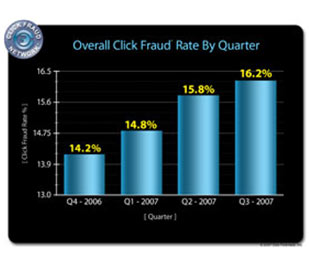
  • The overall industry average click fraud rate was 16.2 percent for Q3 2007. This is an increase from 13.8 percent for the same quarter in 2006 and from 15.8 percent for Q2 2007.

cfq.jpg

  • The average click fraud rate of PPC advertisements appearing on search engine content networks, including Google AdSense and the Yahoo Publisher Network, was 28.1 percent in Q3 2007. That’s up from 25.6 percent for Q2 2007, 21.9 percent for Q1 2007 and 19.2 percent for Q4 of 2006.
  • Over 60 percent of traffic from parked domains and made for ad sites was click fraud
  • In Q3 2007, the greatest percentage of click fraud originating from countries outside North America came from France (4.2 percent) China (4.1 percent) and Germany (3.7 percent

Publishers and advertisers have recently felt the impact click fraud is having in the content networks. Increasingly, publishers are seeing a performance drop in the content network traffic quality. Advertisers are seeing their conversion rates drop significantly on content networks because of bad traffic coming from parked domains and other low quality sources.

“Click fraud activity continues to grow especially on made for ad sites, parked domains and on the content networks,” said Tom Cuthbert, president and CEO of Click Forensics. “Advertisers, publishers and search engines need to take notice because content networks are becoming the fastest growing source of click fraud. Ensuring their quality is essential for the pay per click advertising market to continue its growth

Are your websites optimized for Google’s Universal Search?

Google is changing the way we all view search.  Back in May, it introduced a “Universal Search” system that  blends listings from its news, video, images, local and book search engines among those it gathers from crawling web pages.

The move potentially should be a huge boon for searchers, while search marketers who have paid attention to the importance of specialized or vertical search will see new opportunities.

But it has now become more imperative to include video, images, news articles and other content that search engines will want to crawl. Because of this search engine marketers are going to now add this to the mix of “things to do” in order to rank well in Google’s SERPS.

Where this is all going is towards a more vertical type of search result. By being more vertical, the result is more targeted.  The end result is a blend of everything in one column, hence better and more relevance.

Because of this change in a more targeted approach to search results, it means that you as a web afficionado, better have more quality content on your site. The better your content, the more of it that which will be pushed up. By better I mean variety as well.

Google’s ultimate vision for universal search is to search across all its content sources, then comapre and rank all the information in real time, and then deliver a single integrated set of precise and personalized search results.

So when designing a page, or a site, as your goal once was to be in the top 3 on the first page, it’s now important to be on the first page. Why? Because you are now competing with images, videos, blogs, and new results in the organic listings. So the more eye catching your graphics are that appear in the results on the first page, the better your chance of being clicked on, even if your not in the top 3. So the more diverse your site is in it’s approach to content, the better your chances.

So how prepared are you?

The Most Frequent Searches On The Web

The world’s most frequent searchers for Web sites using the keyword “sex” on Google search engines, according to statistics provided by Google are Egypt, India and Turkey.  And you thought all the pervs were here? The term “Jihad”–Morocco, Indonesia, Pakistan. That’s right people in those countries just “want” to learn what the word means. Nothing more…errr. right! Taking it to the next level are the party nations of Ireland, The US and The UK who all need information on the term”Hangover”.  I wonder if the term “remedy” was inadvertently omitted.

Worried about your sexual performance? People in Italy, The United Kingdom,  and Germany were the most prolific when it came to searching for the term “Viagra”. I’m not really sure why they just didn’t check their email.

And lastly, for those who of course don’t inhale, “Marijuana” was searched on the most in Canada, The United States,  and Australia.

7 great tips you need to know when marketing to Moms.

Did you know that there are more than 80 million mothers in the United States and 51 percent of all US Internet users are women? In addition, did you know that mothers of children under the age of 18 are “significantly more likely to go online than the rest of adult Americans?”  This, according to the Pew Internet Project.

The translation then is that ” Moms” will tend to disproportionately influence household purchase behavior. So how, as a marketer do you reach them?

1) They are savvy buyers/shoppers. More and More of them are using the internet to influence future and current buying decisions with the possible exception being electronics.

2) Working women ages of 24-54 — of whom the U.S. has some 55 million — have emerged as a potent force in the marketplace. If you’re product is not aimed at them, you are mssing the boat. These women are not only balancing work, but chances are, also a family.

3) Women  make more than 80% of the buying decisions in all homes. And women shop differently from the way men do: Females research more extensively and are less likely to be influenced by ads. Men buy, women shop. and Mom’s compare. They make buying “decisions”. Even in the online world, when selling a product,  it’s imperative that you have features and benefits as well as savings.

4) According to data compiled by AdAge, there are more than 30 million moms who read up to five blogs on a daily basis. Within these blogs can be the basis for buying decisions. More importantly, women talk, they are social, so if something is worthy in regards to a purchase, they will tell others. Viral marketing is an untapped resource in marketing to Moms.

5) The average household income of these moms is $70,000. They are computer savvy. They are educated.  If they cannot find their info through traditional search, they will find it in blogs, If not a blog, then chances are, a social network or a forum will provide the answers and or information they are seeking.

6) Early in 2006 a company called Lucid Marketing, which specializes in targeting moms, issued data that reflected just over 20 percent of stay-at-home moms and another 19 percent of moms who work part time visit “message boards” or “chat rooms” on a daily basis. A great place to market, but also an area where marketers need to be sensitive and not pushy sales peple.

7) Women’s decision-making authority has grown in part because more households are headed by women — 27% at last count, a fourfold increase since 1950-according to Businessweek. What does this mean? As online marketers, if you don’t realize that you need to segment your online marketing efforts into distinct niches, then you’ll be sure to see a reduction in overall conversion numbers.

So given the purchasing power of Women and or Moms. If you underestimate, ignore them,  and don’t bother to find out what they want. Then chances are they will ignore you and not bother to find out what you have to sell. It’s as simple as that.

What do you think women want online marketers to know about the way they buy and shop online? Do women use social networks for the purpose of making buying decisions?

5 Ways to Market to Baby Boomers.

With the crush of all things social these days. I want you to look at this Facebook stat.

– 3 million age 25-34
– 380,000 age 35-44
– 310,000 age 45-63
– 100,000 users age 64+

I know, it’s tough to ignore the 24-34 demo. but more importantly are the “other” almost 800,000 Facebook users. Even more so are the Boomers who use Fcaebook. these are technologically “hip” users who have adopted quite nicely to social networking.  But that’s not the point here. The point is that because of the fracturing of all things related to advertising, marketing and how it now translates to the internet, grabbing eyeballs has become more about marketing to niche’s.

Which leads us to a very wealthy niche. The Boomers. Anyone born from 1946 to 1964. This is a very materialistic group that spends a lot of money and thus  a group that you need to market to.  So below are 5 ways to market or sell your product to them:

1)  First off they have the cash and they are going online to find out how best to spend that money. More importantly, they are looking for ways to invest that money. Using the internet as a vehicle to educate, inform and advise the growing boomer nation is a great way to market to them Niche #1: The internet. Niche suggestion: Retirement and Real Estate web sites.

2) The Second way is to don’t assume that #1 is true. Boomers are cocky, they still think they can do the things that they did in their 20’s and 30’s. Because they have the money, they will do or try things like new hobbies, new toys, new families. new gadgets. Niche #2 is to advertise products that speak to the fountain of youth. using the internet, print and television and cell phones. Don’t forget the power of mobile marketing.

3) With nothing better to do, Boomers will want to start-up a new business, invest in a new business, start a new career or go back to school to learn a new trade or craft. Niche #3 Education. Investing in New Businesses, and Starting a new company.  Higher Ed schools have not tapped this to its fullest potential.

4) Social Networks. You have 800,000 people on social networks that are boomers, what are they doing? What are they talking about? Is it where the next party is? No that would be the 18-25 demo. The folks are talking about the first 3 niches. They are talking about new ideas, new ventures, and wondering where to turn. They are at their most viral. If they find a site or source or resource that gives them a warm and fuzzy, you’ve got them all.

5) Health Care and Insurance and Travel. These are some of the most talked about topics with boomers. Pick a niche and they will finid you. But make sure you tailor and cater to the fact that your audience is not the 25-33 demo. You cannot speak to them the same way. Do some homework.

If you can wrap your arms around this group, then the sales will start flying. the key is to understand that you have to drill down to the niche. Think long tail key word…It’s a term we use in internet marketing and SEO but it really applies here in that you don’t want to market just to baby boomers. You wan to pick a niche, and then a niche of the niche.

What do you think it will take to get them to part with about a trillion in spending power?

If Google was built with Google in mind…

Here is a great link to show you what Google would look like, if the pages were optimized so that the Google index page could rank high in, well Google!  Let’s  optimize Google

We can learn from Porn, Or If you build it, will they come?


Let’s look at the numbers first.  The monthly search volume for the word, “porn” last month was over 13 million. That’s the number coming from Google, Yahoo and MSN combined.  The term sex? Almost 22 million times last month. What does this tell you? Let’s put into perspective real quick. So you know that there is a major housing/mortgage crisis going on right now. It’s been in the news a lot lately. Well,  the term mortgage had been searched on a mere 7 million times as of last month. The Iraq war you ask? 189,000 times. I know, how about Britney? She has been in the news too much and the numbers don’t lie. Try 14 million times last month, now that’s more like it.

Ok so the point is this, in the porn industry, the ultra competitive  nature drives internet marketers to be on their game.  The reason why is for the simple fact that tastes and technology change quicker than the bath water. Think about it, leaving out the fact that porn marketers are shameless and unethical, with over 30 million searches combined for the terms sex and porn, there is money to be made. Lots of it. They know this. They also are accutely aware that they either can change quickly, either with the content or the technology, or be eaten alive. Good porn marketers are better than your average internet marketer because they push the technology as far as they can, and then find new ways after that. They take chances because they have to.

Because attracting eyeballs online is the name of the game internet marketers have to use every tactic and trick to get you there and keep you there. That’s why porn marketers are willing to try any and every new technology to achieve that. They are months ahead in some respects to what some traditional marketers might employ for user attraction and retention.

Starting with the user experience, porn marketers realize that content is king but too much “free” content will make them a pauper, thus the usage of creating crumb trails to the main paid content is the objective. In fact, porn price points for entry are almost nil, but, the usage of a recurring billing model and and the ability to accept any and all forms of payment in any and all currencies make it an ideal business model. Customer service doesn’t really exist in the porn game, except to the extent that they make it difficult to cancel an order, so to dwell on that aspect is a moot point.

Another reason  good porn marketers are better, is because they study the competetiton. They recreate what works best, and when that doesn’t work, they test something else, when that quits working they move on.  I can point to some normal sites that haven’t changed their GUI in 3 years and still pull a 9% conversion rate. But it always begs the question, what would a new look and feel pull? Guess they’ll never know. Good porn marketers will have days, weeks, months and years of data for you.

Another thing that traditional marketers could learn is that porn is as niche based as it has ever been. The more niche based, the better the audience retention is.  We will avoid naming for you specific niche examples, but I’m sure you can use your imagination.  The bottom line is that the recurring revenue model  in this situation is perfect as long as content is updated regularly but still retains the integrity of the niche. If you change the niche, they are gone.

At this point, you’re probably thinking, “Wow this person certainly knows the porn business well.” Actually, I will leave that comment as is. As someone who studies any and all online business models, I would be remiss if I did not look at why the porn business model is so successful. The majority of that success of course will always stem from peoples’ utter facination with sex and the search numbers that support that. But one caveat would be assuming the, “If you build it, they will come…” (no pun intended although it seems very appropo), model. That  business model would not last long in the hyper-speed nature of porn business models. At the advent of the internet, it probably worked very well. Now though, you need top programmers and savvy business people who understand the online marketplace backwards and forwards to be successful.

So if you think porn marketers operate in a vacuum and have no clue what they are doing. Rest assured, they are doing things from a technology standpoint, that the rest of the online marketing world would love to learn. Why? What do you think the PPC model might look like in the porn universe? If porn marketers relied on ppc, they would shoot their wad in one day(again excuse the pun) and be out of the business in a week. Instead they have to use not only traditional methods of internet marketing coupled with SEO best practices but they also have to test, test and test and then act at a moments notice.

Although I don’t expect you to rush out and go “study” porn sites, from an internet marketers standpoint. If you should uh.. stumble upon one, do take the time to study the structure and the messaging and the content… and then read the articles.

If Google went away, would you care?

How would Google impact your life if by happenstance, they just,”went away”? As a casual user of the web, I would think that you wouldn’t miss a beat, you’d just migrate over to Yahoo or MSN or one of the hundreds or thousands of other second tier search engines out there. Would your results suck? Would they be tainted by gross inacurracies? I’m sorry to say, and it probably pains Google to hear this (not really) but the answer is more than likely, no and no.

You see, the other search engines are not that bad, in fact Ask.com for instance, is really really good. But when you are trying to compete against this Goliath of a company, you’re little pebbles will have no noticeable effect or impact, no matter how cool and powerful.

I imagine that if Google went away, their 10,674 employees would have to find new jobs doing something that we have no clue about. Since they are so secretive anyways… Then there are the tens of thousands of people that make money on Adsense. What would they do? Arghhhh!!!! Get real jobs?  I suppose they might go back to that fine affiliate marketing model that was and is still so annoying. Here’s a thought. Maybe the CTR on banners would go north of 1% if Google went away?

SEO and SEM professionals would naturally just shift their attention in the forums and their blogs to bitching about Yahoo and MSN’s “Algo” and why it’s so unfair, and why they never get back to you, and why they never give you a straight answer, and why you need to do it “this way”.  They also would be lost without having a Google toolbar that gave them their PR’s; Oh and Matt Cutts, the Google Guru, would probably be an authority on something, but it just won’t be in search.

Would there be less web sites if Google wasn’t around? What would be the ideal business model for making money on the web? Yahoo would own PPC outright at this point so what would they do differently if Google wasn’t around?

Would MSN be even more formidable if Google wasn’t around? Since Google has come on the scene, casual water cooler talk has shifted from, “I wonder what Microsoft will release next”? to “Did you see where Google’s stock is at”?

Are we better off socially because Google is so entrenched into our daily lives? Do they make us better at what we do? Do they solve nagging problems that previously existed before they came on the scene? Do they have our best interests at heart? Does Google care about you and I?

What do you think life would be like without Google? Does Google impact your life?

Dumb People and Technology

According to Wikipedia:

Dumb may refer to:

  • Stupidity, the state of
  • Dumbing down, a term referring to over-simplification

I recently wrote about the fact that sometimes technology and the use thereof, may be too complicated for some “slower” people to grasp, therefore what they might use their computer for, might not neccessarily be what others use it for. Is that ok?

In creating web apps and websites, we always try to dumb down what we are creating, in the hopes that its simplicity will push it over the top in terms of the broadest possible audience grasping what we are trying to convey. In lieu of words sometimes we create icons. Yet other large manufacturers choose to assume that people will “get it” and if they have problems just call the help desk. Can you say focus group? Or lack thereof?

Maybe Dumb people shouldn’t operate computers? Maybe we underestimate the dumb person; Or perhaps they use it to go to YouTube? Do dumb people use email? Has anyone or any company actually looked at that sector of the public to see, just what they use the computer for? Is it a group that we should market to? Are we missing out on this demographic? Or do we just assume that they will get it? Isn’t it the goal of all technology innovations that they are accessible to all? If so, doesn’t that mean regardless of your mental capacity, that that person will be able to grasp it? That you, the slow one, will get it?

Is technology biased towards people who are educated? If it is, do they leave the dumb people in their wake? What are dumb people supposed to do? Rely on smarter people? Or the Geek Squad? Do dumb people want a  crack at technology and what it has to offer?  Does technology provide a fair shake to people who want to learn but just are really really challenged?

A dumb person might have the grandest of intentions when buying a computer, but what are they to do when they have to install software, get an internet connection, download updates, install security software, burn a disc, download some music from itunes, buy some porn, etc etc etc…?

You see the world is moving more and more towards a paperless virtual high speed electronic environment. But it moves at a speed that not a lot of people are comfortable with. And you know what? Technology could not care less! Social networking sites are great but I’m willing to bet the affluency of the users is solid middle class and up. Educationally, we provide our 1st graders with a solid foundation for technology, but we’ve forgotten about the boomers and some gen X’ers even, and those who may have slipped through the cracks and those that it just passed right over. For whatever reason, those people are missing out on what technology can do for them. But now that I think about it, maybe they don’t care. Maybe to them, playing FreeCell, Bejeweled and watching Videos on YouTube, is just fine…

Google Envy

 GE…  Google Envy. We all have it. Even if you don’t admit it because you are above that, deep down you know you have it.

In contemporary times, GE is the term used metaphorically to refer to the idea that we all wish  we worked for Google, had Google stock. or were bought by Google. In more subtler terms it refers to the anxieties we as marketers and site owners and SEO folks feel about our impact in Google’s search engine.

Think about our world and how Google has managed to work its  way into our lexicon.   Lik Pez, Google is a proper noun.  Pez is a candy and Google is…. Google. But where they differ is that I can’t “Pez you” but I can “Google you”.  You know this conversation happens a half million times a day… “Hey I Googled Thomas/Cynthia last night, and you won’t believe what I found!”

So alas, Pez is not a verb and Google has become one. How many companies can become a verb? Not Microsoft, Nike, Coke, McDonalds, Toyota, NBC, Rolling Stone, The Rolling Stones, Yahoo, The NFL, The NBA, Nintendo, Sony, The World Cup, The Olympics, Not even…. Microsoft-cue the reveal music.

I wonder if Microsoft has Google envy? I used to have Microsoft envy. In fact right after the bubble burst in my dot com world, I still had Microsoft envy. I wanted Microsoft to buy my company. Didn’t they buy anything that was cool and had a pulse back then? They were the big dog and I think we all worked for small start-ups with the hope that Microsoft would notice us and decide to buy us. It’s at this juncture that we should bring in Andy Rooney from 60 Minutes.

Andy: “Do you ever wonder if Microsoft has GE? or Google Envy? I bet they do. I know I do. I think we all have Google Envy. Even my dog has Google Envy.

As a world that now uses technology in every day life in every way possible, we now measure things by our ability to search for them on Google. It’s almost as if it’s the great judge of legitimacy. However, from the perspective of the marketer and the SEO’r, it’s also the gold standard by which one is measured. If you rank #1 in Google, then you must be good. Because Google said so. 

So it just goes without saying that Yahoo and MSN, the other 2 search engine’s, should have major GE. They fight over the scraps of what is left in Google’s vapor trail. And like it.  I envision Shaq going up against Herbie the wannabe dentist destined for Misfit Island, and The Keebler Elf. All fighting over the gold and girl, and it really not being much of a fight. It’s just not fair. But I like Shaq, he’s a likeable guy. I even think Herbie and the Keebler Elf are cool, but in the end, you know they wish they could trade places with the big man. Even if they don’t admit it.