15 questions the small business owner will ask about social media

I was reading Peter Kim’s wiki of social media marketing examples which I highly recommend, and thought that I’d follow that up with the following short post about the types of questions and comments you might be getting from business owners about social media. This differs somewhat from say Chris Brogan’s post about selling it internally to your boss-but the questions and comments might be very similar.

Are you having conversations like this? I’ve had these type of questions thrown at me over the course of the last few weeks and months. If you are not getting these type of questions, then maybe you should get out there more. But the flip side is this: You better be prepared to answer them.

  1. How much is it gonna cost?
  2. But first tell me what exactly it is?
  3. Is it like Facebook or Myspace? Because that’s all I really know.
  4. Twitter? I’ve heard about it, but I’m not really sure what that is.
  5. A blog? I don’t see what I blog is going to do for my business, besides, I don’t have time nor the desire to write one.
  6. So you’re going to “show me” how social media is going to drive business? Ok…(proceeds to wait)
  7. Who else is using it?
  8. Are there any companies like mine that are using it?
  9. So can you guarantee this?
  10. Who’s going to do this? You? or us?
  11. How long is this going to take?
  12. I still don’t understand but I’ll take your word for it.
  13. Can you get our website ranked higher in Google?
  14. Will I make money?
  15. Will I save money?

Interestingly enough, even the ones that do “get it” will still ask a lot of these questions.  You see, the issue is that social media and all it’s moving parts really involves putting a value on the engagement and then equating it to dollars earned or dollars saved. That’s what the business owner wants to see. We need to start putting what social media is and does into more equitable simplified terms that the public and small to medium sized business owners can understand, that they can wrap their arms around.  And if you are truly challenged, and you are “that person” that works for the small to medium sized business, then maybe you might want to check out this post by Mark Story, it may help. I know I get it, and maybe you do too, but can you articulate it?

Twitter is killing my blog

I just read a tweet, yep that’s right a tweet in which David Armano pondered whether Adam Kmiec’s blog post about the quality and frequency of some notable bloggers is diminshing because of Twitter… is true. 

Kmiec mentions that not only Armano, but Peter Kim and Joseph Jaffe are guilty as well of producing substandard  quality and quantity. I say he’s right. And though I’m not on the same level as those guys, I see it happening to me as well.

The proof:

David Armano yesterday penned, The world’s shortest blog entry

Joseph Jaffe recently wrote the post titled, “Who gives a shit about toilet paper?”

I’m not using David and Joseph as the poster children here, Adam already did, but I did think it was funny to look at their most recent blog posts. I liked both, but there was some delicious irony in it all. I know there are lots more of us twitter/bloggers out there whose craft might be suffering because of Twitter; and I can without a doubt tell you that I have tweeted wasted? some great blog post topics which have then transformed into some great twitter conversations. My posts are becoming shorter. Any coincidence? They’re becoming more rant-like. I feel like I’m mailing it in some time. Or maybe because there are so many good conversations going on, on Twitter, all the good stuff is being said in real time and doesn’t need to be elaborated on? I’m speculating, but you get the point.

 So what happens?

The digital footprint isn’t the same as if it were a blog post. It’s there, sort of, but for the most part it is gone.  I’m not sure how to strike the happy medium because I like both worlds. But my blog is suffering.

Thoughts?

You have no idea how much you know

I was on the phone yesterday with a student from Columbia U who is doing her Masters thesis on a certain aspect of social media. We were on the phone because we exchanged a bunch of emails and she felt that maybe a call was in order. After 45 minutes of talking about all aspects of social media we were done. I hung up and I thought to myself; “Wow, did all of that just come out of me?”

Let me sum up what I chatted about.

  • I told her people like Scoble and Chris Brogan had devotional followings yet were different in nature and focus.
  • I mentioned that people like Brian Solis offer an interesting take on the landscape that is the ever-evolving moving target of social media.
  • I mentioned that she should check out Naked Conversations as a primer on what the blogging scene is all about and where it came from and where it’s going.
  • We talked about how Twitter is a great way to connect with Rock Stars, A-listers and thought leaders, but can still pull people into your circle that you have no reason why they are there.
  • I told her she should check out Danah Boyd and some of her work on Social media, teens and class divisions
  • We talked about why people do not contribute right away in social networks, though they have joined a community; and that it could be they’re just not completely comfortable yet.
  • As well, different demographics have different comfort levels in embracing new media.
  • We talked about communities and how individuals and brands operate within those communities.
  • I abused the words authentic, transparent, and “real”.
  • I’m pretty sure I did not take a breath.
  • I stressed that Chris Brogan is walking the line that separates saturation and Scoble like status.
  • I told her that Seesmic would be a good way to connect with people in regards to some of her social network questions
  • I’m pretty sure I mentioned David Armano
  • We talked about the goal of brand participators in communites and the challenges they face in trying to connect with their users and customers
  • I forgot to tell her which of my favorite blogs would help her in her research, so here’s the shortlist.

———————–

  • Brian Solis– Brian is very giving with his thoughts and observations on social media and PR,
  • Valeria Maltoni– If you want deep, thought provoking takes on all things social and beyond, I highly suggest you add her blog to your list 
  • Adam Cohen-Adam is a new add to my list but I enjoy his take and the variety of his posts
  • Ari Herzog-good writer, good take and his posts are timely.
  • Peter Kim-I’ve been probably been giving Peter too many props lately but man his stuff is so insightful.

So after all that, I sat there and started thinking. My first thought was that earlier in the day, I was explaining social media to a bunch of people in a doctors office. The first question out of their mouth was to ask if it was like an online dating site. Ouch.

Having my little chuckle to myself, my next thought was about what I just verbally spewed out to the grad student from Columbia, who by the way, didn’t know as much as I expected. This gave me pause to ponder what do I know? Was it alot? A little? 

Well, maybe I do know a little about some things but… I do know this. The people that I deal with, and talk with, and share with, and laugh with, everyday in my communities, know a lot. ALOT.  And everyone else outside of these circles or spheres that I float in, just might not. And that’s pretty cool. So I wanna thank you for letting me be a part of that.

Twitter Patter

Ok I admit it. Twitter matters to me. My 300+ peeps that follow me and vice versa, are starting to take on  the characteristics of a community where you can depend on certain personalities to talk about the things that they are passionate about. . Yes, this community still has the people that will give you TMI on the little nuances of their lives, but somehow even that isn’t so bad. My community is a diverse group from all walks of life that I enjoy exchanging thoughts links rants and raves with.

Thanks to Tweetdeck which though I consider a bandwidth hog, I can manage and filter my community with simple ease. It takes a mili-second to see what people are talking about and because it’s a very targeted group of people talking about all things that are markting, PR and social media related, the content that we share amongst each other is usually pretty strong.

Peter Kim brought up some great points recently in which he explains the value of Twitter to him, as well as some of the splinter sites he likes, that are devoted to making his Twitter experience more powerful.  Last night I was thinking about this:

When and how could you have in the past, connected with so many great minds and thought leaders on such an immediate real time level?

Therein is the true value of Twitter. Connect and converse not only with your peers but people that make a difference in your professional life? Are you kidding me? How can you not realize the value in that? Even the biggest of skeptics has to see that, and not the baseline, entry level, tag line that is wrapped around Twitter-“What are you doing?”

There are some rules of engagement that one should follow though, and to that I have to give a shout out to Beth Harte and her “Why should i follow you post” I’d suggest checking it out. And then follow it up with Michael Brito’s Twitter Manifesto post which is a nice dovetail from Beth’s.

Twitter is a great tool as long as you understand the value and the context in which it can be used; and or abused.  However, as is the great self policing aspect of most online communities, the abusers or the poseurs usually don’t last very long. Consider them similar to the travelling carnies. They usually are in town for the weekend and then you won’t see them again. Missing teeth and all…

Just remember: Value begets value.  So If you are going to Tweet or you’re going to participate, then try and avoid the mundane and the banal. We can get that anywhere. But you should be using Twitter for the following reasons, which I am going to scrape from Todd Defrens blog post on why PR people need to be in Twitter:

  • Personal branding
  • Knowledge
  • Relationships

Wow, talk about value adds! And Twitter is freakin FREE! Are you kidding me? Listen, if you’re reading this, then chances are very high that you already know about Twitter. That’s cool. But maybe what you take away from this post is that there is a “way” to use Twitter right, and I hope you “get” that more than anything else. Oh and you can follow me here,   http://www.twitter.com/@marc_meyer

I know I might be beating a dead horse here, but I’m going to throw Common Crafts Twitter Video back up.

SEO and SMO are conversation starters.

Last year Jason Calacanis wrote a blog post how he thought that SEO and SMO were bullshit. Now I know in some parts Calacanis is approaching demi-god status and in other parts he’s villified to no end. Hell, he has 35,000 followers on Twitter, which is a fairly significant number of people who put a lot of stock in what he says. I’m one of those followers too. But that doesn’t mean that I agree with everything he says.

I had been thinking about the role of SEO and SMO in internet marketing lately and decided to do a cursory search and that’s when I found Jason’s article. It’s not the driving force behind this post but it does give it some legs since Jason and others have deemed some of what is done on the level within SEO and SMO circles as unacceptable.

Over the last year and half and even before that, I have engaged in some pretty healthy SEO as well as SMO for clients. And it has worked. I utilized what was available and knew what I was doing. According to Calacanis that would make me a snake oil salesman. Talking SMO then, Calacanis said the following:

Anyone who hires an SMO firm is an idiot. The whole point of social media is TO BE REAL NOT FAKE!!! Just be yourself and participate… that’s all it takes (and note, participation is not just putting in your own links, it’s voting/commenting on/submitting other people’s content too!).

To which I have to say that “SMO is the process of realizing that being authentic and strategic within a social media marketing context or environment can be beneficial.

Here’s a generic example. I have a demographic of women smokers in their mid 30’s for instance. They  happen to use Facebook. So I create a widget that provides them a way to maybe quit smoking and track the results and share them, which in turn drives them to a blogsite, a branded microsite and a branded community. To get this ball rolling, I’ve also seeded/posted articles related to all of these sites and the product and the campaign on Digg, Stumbleupon, Delicious, Technorati, Propeller and say Reddit. All of these linked together creates a tremendous opportunity and buzz for these users to not only meet, but also to share, and perhaps learn more about a product dedicated to them. Does this mean that what I have done is black-hat or disingenuous? No. Does it mean that I have taken certain elements, linked them together and have enjoyed the linky-goodness via SMO and SEO? Yes. Am I bad? Am I evil? Am I hiding? Am I not being “transparent enough”?  Why can’t I let these social bookmarking sites know about a product launch?

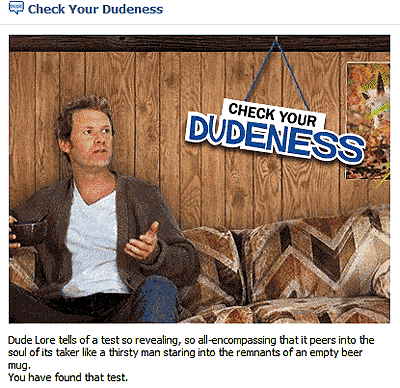
Want a good example?  Buddy Media created the Check your Dudeness app for Facebook-Couldn’t this be construed as some element of SMO? They’re taking a product, a branded one and using social media to promote it. Is that gaming the system? No.

We need to get away from the fact that what the system allows us to do, does not neccessarily mean that we are up to no good, or that we’re not being transparent enough. Ok I get it. I don’t need to be told over and over and over again to be transparent and authentic. Yes there is a difference between black hat seo and white hat seo as well as black hat smo, no doubt about it. Just check akismet for aspects of that. But.. most of your brand marketers are only using the tools that are available. I can show you at least 130 examples where companies used certain aspects of social media to promote or further their brand exposure using some of the above mentioned sites and tactics. This doesn’t mean that they are operating behind a cloak of deceit.

Listen, there is a big big difference between gaming the system and utilizing what is provided to promote your product, your brand, and your company. It truly boils down to how you use it. I’m all for engaging in conversations but someone has to start the conversation. The better you are at starting a conversation, the better your chances are of someone listening and responding back. Maybe we should be looking at not how to be transparent and authentic, but more on the proper way to enagage and start the conversation.

Happiness, Heroes and Relationships: 3 Lessons

Interesting day unfolding before me today. I’m going to provide you 3 lessons in relationship marketing. One of the first blog posts I read this morning was written over at Jason Falls’s social media explorerer. The post was about how social media can open the door for happiness marketing. I’m down with that, since scare tactics seem to be de rigueur these days. My take away points from this are as follows:

Social media offers a way to build your business by making people happier, rather than the other way ‘round.

People who feel like they’ve been heard are happier than people who don’t.

If you refer to yesterdays blog post, you will see that one of my deadly “sins” for a social media marketer are the pissing off of a customer. Any time we can make a customer happy, shouldn’t you take it? When you help someone or make them happy, are you not happy as well? Isn’t that, or can’t that have a viral effect? Come on people start thinking of the power that you posess to make people happy and use it.  The quality of a good relationship will make YOU happy. Lesson #1.

So after reading this article, I happen across Peter Kims’s blog post titled How to create successful hero marketing and my take away from this was to beware of gods with clay feet and to thine own self be true. Essentially Peter is saying that you either worship your heroes in social media, you want your heroes to notice you or you want to create your own hero persona.  Please read his whole post, it really raises some questions on just  what exactly is it that we want to achieve? Below is part of my response to his post.

The hero marketed to his followers and they did as they were told because their egos told them that perhaps it would open doors and allow them to get closer to the marketing guru…But once they got in, I think some might have realized that it was just another NING network.

But it serves up two good points that you have mentioned. Seth leveraged his hero worship status to drive sales via WOMM and the viral aspect of invite only status: and his followers/readers and their egos fell for the ego trap and bit.


The relationships that you cultivate all have a motivation. The ones that have the most impact on you and your life will be the ones that make you happy. They also will be the ones that to a certain degree are mutually satisfying. That isn’t saying that they might not involve some ego, but relationships are as much the driving force social media as any other component. i.e. the conversation  and the realtionship that springs from it,is not a monologue. Lesson #2.

Relationships. it’s what drives everything we do. Relationships are our universe. You might not agree but I will tell you that in the immortal words of John Donne, “no man is an island” especially in social media. Our relationships define us as much as any metric in social media. For example: Number of visits, Number of subscribers, number of readers, number of followers, number I’m following, blogs I’m reading, people I recommend- ALL Relationship driven.

But in some cases the relationship is not perfect. It has it’s “warts and all”. And we’re taught that we should tuff it out and eventually things will get better. Well you know what? In some cases that just isn’t true. And people end up bitter and angry and saying things they don’t mean because they stayed in the relationship entirely too long. Which leads me to Maggie fox and Geoff Livingston. They decided to not go through with their planned “merger”. They called it off a little over a month after they had announced they were teaming up. Rather than fight through it, they both had the foresight to realize that maybe it wasn’t going to work out. So the end result? A relationship intact. Some disappointment but in the end, no damage done.

In the end,  it’s all about the quality of ALL of the relationships you cultivate, and what you do with them in all of there various forms and stages. Lesson #3, Can you say Micro Interactions anyone?


Social media marketing’s 7 deadly sins

With apologies to all of the spiritualists out there, this post is not to make fun of the “real” 7 deadly sins. This is simply a way to magnify the importance of getting it right versus screwing it up seven times over. Over the last few days Peter Kim and I have exchanged emails over topics that swirl in and around social media marketing, and somehow this blog post evolved. I am not sure how it came up exactly, but then again, thats how a lot of these posts start. But the subject of this post seems to dovetail nicely into what is being discussed lately, especially on SMT.

So there’s a lot being discussed every day about social media marketing, what works, what doesn’t, why, how, when, etc etc. In the past I’ve written lengthy pieces on what social media isn’t, but how about 7 things that you better not do in social media marketing? That in and of itself would be something to throw up on the fridge with a  fridge magnet right?

1) In your push to increase customer loyalty and retention, you’ve driven your customers away with poor messaging, poor communication and complete disdain and compassion for them and the product they love. You’re Insincere and it shows. You nod your head and pretend to listen, but you decide that you know what’s best. That’s a bad choice.

2) In your zeal to hit the ground running with your product, you have failed to realize that the product has serious deficiencies and you choose to launch anyway. It could be that your product is either being hurt by the initial buzz of bad publicity, has been hurt or bashed by 3rd parties,  or the word on the street is, it just doesn’t work. Your product awareness campaign has only increased the awareness of how bad the product might actually be. Why? You were not listening and your timing could not be worse.

3) Because of #2, in your quest to create brand advocates you have created the anti-brand champions who have made it their goal in life to do everything in their power to make sure that your brand does not succeed. You made enemies and you continue to not listen and you decide to push on without addressing it. Could it have been, that you might not be listening or refusing to even try?

4) In pushing to roll out your social media marketing plan, you miss the mark completely and are marketing to the wrong people. In fact these people may have had their fill of social media marketers, social networks, and are essentially hip to the overtures of marketers in general. So again, in your rush to create new revenue streams, you’ve decided to beat a dead horse. Not knowing your customer and assuming you did. Bad. Guess what? You again must not have been listening.

Are you sensing the recurring theme here yet?

5) You decide to do it your way. You think your one way style of contacting and talking at the customer using the latest social media tools should work just fine in its own intrusive way. You sir or madam are not respecting the rules of engagement. You have lost your protocal compass. You have decided that frequency is better than reach and breadth is better than depth. You have not heard a thing that has been said.

6) You’ve decided that you need to hide behind a few layers. You don’t want the customer to know anything about you, the company, the realness of the people behind the product. Nothing. You have decided that a fake persona is the best route to driving sales and stickiness. Wrong. If you’re not being transparent, then you’re not being you. You have something to hide. One of the most important aspects of social media marketing it being transparent, or had you not heard that yet?

7) You’re not honest, you’re not who you say you are. This speaks as much to #6 as it does all of the rest.  But one of the keys to any relationship be it personal, or business is honesty. Just look at the code of ethics on the WOMMA They get it, and so should you. It may sound trite but keeping it real has never meant more than in social media marketing.  Oh yea, you might want to shut up and listen too!

I’m sure that there are tons of social media marketing faux paus’s that we can all think of it. In fact Jim Tobin over at Ignite Social Media has a nice post about it. The aformentioned 7 are just some that have really been standing out for me lately. And to be honest, I have made some of these, but I have also learned from these mistakes as well too, and have tried like hell to not repeat them.  Who was it that once said, “Those who cannot remember the past are destined to repeat it?” Last question, with the 7 points mentioned above, can you figure out what collective quality might benefit you the most?