Since it was a short week, we’re going to go with an infogrpahic from Patricia Redsicker.
![2012 Social Media Report How Marketers Are Using Social Media for Business in 2012 [Infographic]](https://i0.wp.com/www.wordviewediting.com/wp-content/uploads/2012/04/2012-Social-Media-Report.jpg "Social Media for Business")

Since it was a short week, we’re going to go with an infogrpahic from Patricia Redsicker.
The beauty of social media isn’t in the online connections. It’s not about the numbers, never has been. OK, maybe it is to marketers, but that’s because they operate from a different perspective. No the beauty of social media is in it’s potential. It’s potential to connect people from divergent backgrounds or in the same city or that have the same common interests. It can really connect people in infinite ways. That may seem somewhat preachy or full of green meadows, unicorns and rainbows but it’s true.
Recently in the Wall Street Journal, there was an article titled , Why Successful Branding Still Happens Offline. The article was good but it was really similar to a thousand other articles that I have read over the years about how brands need to do this or that in social in order to be successful. As I neared the end of the piece, I read the following:
The great social wave is an opportunity that no business can afford to ignore or look at myopically. It’s happening all around us – and to the continuing surprise of many, it’s mostly happening face-to-face
I’ve said the first part of that sentence, again, a thousand times about ignoring social at your own peril, blah, blah,blah. But the back half of the sentence struck a nerve. It’s mostly happening face to face. Basically where social takes off and takes on magical tones is when we get to associate a name with a physical face and voice and not an avatar. Going to a conference and meeting that person that you have had tens of twenty or hundreds of conversations with on Twitter or Facebook or blog comments. That’s the money shot.
Whether you do business with someone online or whatever it is you or your company might do with social, it’s always going to be or should be based on some type of interaction and then some type of result. Taking social offline should be the goal of every online social media encounter worth its weight.
It all starts with a title. The better the title, the stickier the title, the more likely you’ll suck us in.
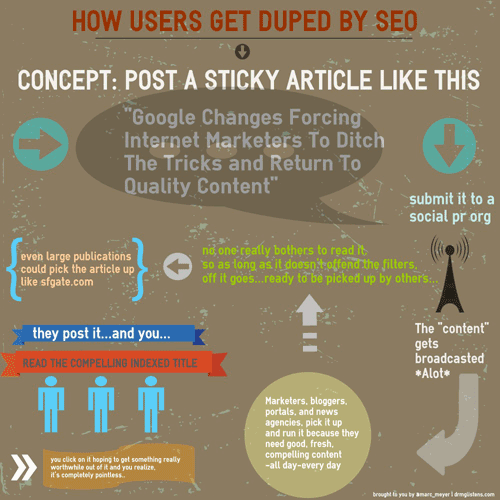

Let me give you a few real world examples that happen every day. You’re at a stop light for all of 30 seconds and you start to get antsy because the light hasn’t changed. You are going to make a right on red and there is someone in front of you who does not turn right away, and you lay on the horn. You’re in line at the store waiting to check out and it’s taking forever. Forever being about 3-4 minutes.
Why are we so impatient?
Maybe these examples will help. You’re surfing the web and a page doesn’t load quick enough so you try another website. You want to buy a product online so you do a search and you click on the first result and it doesn’t load quick enough, so you go to the second result. You load an app and it takes forever (10 minutes) and you immediately start thinking of your next computer purchase with more memory and more processor speed (whatever that means).
What’s happening here?
The web has conditioned us to want everything quicker and faster. We are become a bi-product of always on. Meaning that when we are on the web, we expect the delivery of the experience to match the level of our expectation. The result? That expectation starts to bleed into our offline universe. Our consumer experience is on hyper please
The result?
Everyone suffers. Think about it like this. The more it takes to satisfy us, the more we need- and the less it satisfies. In a sense we’re becoming junkies for a good web experience which again as I said earlier is starting to bleed into our personal offline lives. Is that a good thing? In a sense it is but it’s also unrealistic to think that waiting at a light for a whole 1-2 minutes is unacceptable. Just as it is unreasonable to think that just because it took 15 seconds for a page to load-is a bad user experience. The web experience, and I’ll include mobile in this, is now as much about the pulleys and levers as it is about the finished product. So how do people respond to a bad online customer experience? They click and go somewhere else.
Too bad for the visually appealing site that is hampered by it not possessing what the user wants- Be it access to the proper social channels, free stuff, or the right check out page, or access to a contact page that provides a direct link to customer service. If you don’t have that, you’ve crashed and burned before you’ve even taken off! Consumers indeed.
Two things for you to check out. First check out the infographic below and second, check out this link: http://hub.olympic.org/


According to a recent survey published by eMarketer, four in five North American brand marketers considered brand lift to be the most important metric for evaluating the success of their online branding efforts. But is brand lift the right metric at all? Vizu which partnered with DIGIDAY on the survey defines brand lift as the following:
Brand Lift is defined as the percentage increase in the primary marketing objective of a brand advertising campaign
But does that definition correlate to digital correctly? Should it? Marketers consider it to be the one worthy metric. Given its pure definition however, brand lift would or could always be loosely defined in the digital age as a percentage increase in followers on Twitter or Likes on Facebook, if it’s part of the marketing objective. In digital we can’t construe brand lift as the number of eyeballs, the number of likes or the numbers followers without any type of sales or action or in fact, a long term measurable return on those efforts.
The problem though is that marketers might be still associating a hollow metric (one of many in digital) to brand lift.
Consider this quote from eMarketer analyst Lauren Fisher:
“Digital’s legacy of direct-response metrics has caused many to fall back on measures that drove the first wave of online advertising—clickthrough rate and pageview.”
She’s right. A pageview and a clickthrough, though they can be construed as a positive, or as “effective” digital branding, can sometimes mean absolutely nothing. Same with Twitter, Facebook, Youtube and traditional blogs. Brand lift metrics in the digital age are, in my estimation,”one off’s. ” Indeed, marketers must break old habits of using single measures of success.

I was driving through the Florida Everglades last week when I thought, “How in the hell does someone survive and get around out here in this vast expanse of nothingness?” Which made me immediately draw a relation to the water that surrounds the glades being the internet so to speak, and the wispy reeds of sea grass or whatever the hell it is, being your customers or users of the internet. I then thought, “There’s a lot of noise out there now, was it, or is it now because of social media? Did social media create the noise?” Is social responsible for this?
The short answer is yes.
Remember Dr. Seuss’s, “Horton Hears a Who?” There’s a scene in the movie and in the book, where everyone in Whoville starts to shout in unison, “We are here, we are here”. They are trying to get Horton to hear them. Social media is like that. The plethora of platforms and devices has allowed everyone to have that voice, but the challenge for those with voices wanting to be heard, is the choices and platforms are multiplying like rabbits. For those businesses who want to bridge the gap and find those people with voices-it’s getting harder and harder to sift through the weeds and grass.
In the Everglades, you get around by airboat, which amazes me honestly. Why? Everything looks the same. If you look to your left or to your right, or forwards or backwards, it all looks exactly the same. So how does one get around? You have to have an experienced navigator. Someone who knows the lay of the land.
Here’s the correlation. I can use the best listening tools and platforms there are, but if I don’t know how to use them or I use them the wrong way, they are totally worthless to me. I’m going to airboat around the glades and find lots of nothing. If someone thinks they know how or knows what I want and they still get it wrong-Shame on me. Does that mean there’s too much noise and one cannot navigate through it? Does that mean there are no pockets of goodness in that vast landscape? Not at all. You just have to know someone who knows how to look and where to look.
A friend of mine, Mack Collier, earlier this month wrote a blog post on whether marketers should use social media personally before they use it professionally? I think we know the short answer again to that is yes. But I will end on this.
Just because you can get the boat in the water, start the engine and take off, doesn’t mean you know where you’re going or how to get there.
Infographic presented by 2D barcode service Microsoft Tag.
“Social” claims or has been claimed to do everything and it really has become quite the game changer. In fact, did you know that it can actually boil the ocean? OK, so I’m kidding, but the point is this-One thing that social media does and has done, is that it has spurred or enhanced or magnified relevance in everything that online and offline touch now.
Even if you were not relevant before, now you have a chance to be, thanks to digital and social.
But step back from every situation and I mean every situation, and it’s really less about social and more about an age of relevance. Social is just the lipstick. Chew on that a bit. Yes, we definitely live in a digital age now and yes, we definitely live in the age of social media and yes it’s definitely all about the conversation. But, what digital, social and the conversation have definitely done is that they have snapped a piece of relevance onto everything that we now come in to contact with. It’s actually a two way street. Relevance shapes our social and digital engagements and our digital and social engagements become more relevant the more hyper focused they are to what we are all about and what we want and demand.
It surprises me that others have not really focused on this. Until Now.
Accenture Interactive has just come out with a couple of pieces of thought leadership on the “Era of Relevance.” (Full disclosure-Accenture is a client of mine) Though Accenture Interactive is talking about relevance at scale for the enterprise, the underlying theme remains unchanged-when you or I are marketing, conversing, buying, shopping, or selling-relevance is the tipping point in the transaction or transformation.
I would highly recommend reading the pieces from AI because they really do focus on one of the larger straws that stirs the drink.

Should we be amazed anymore at how fast digital is moving? Honestly no. But what should we be thinking about as we watch it go by? When I was a kid and I would see a train go by, I always wanted to be on that train. I didn’t really care where it was going, I just wanted to be on it. With a little foresight and hindsight you can be on that train that we’re calling digital right now-and know where it came from and where it’s going. We sort of know where it came from, but here’s 4 stops on that journey.
We could have added more, but the point here is not to inundate you with all the things that occur every day in the tech world, it’s too much and can be overwhelming. The point is to help you focus on the areas that continue to mature and evolve-For marketers large and small, we need to learn how can we adapt and adopt to things that will be around in 6 months to a year. We have to get away from our fixation on the new and shiny and focus on the smart and profitable.
 Direct Marketing Observations